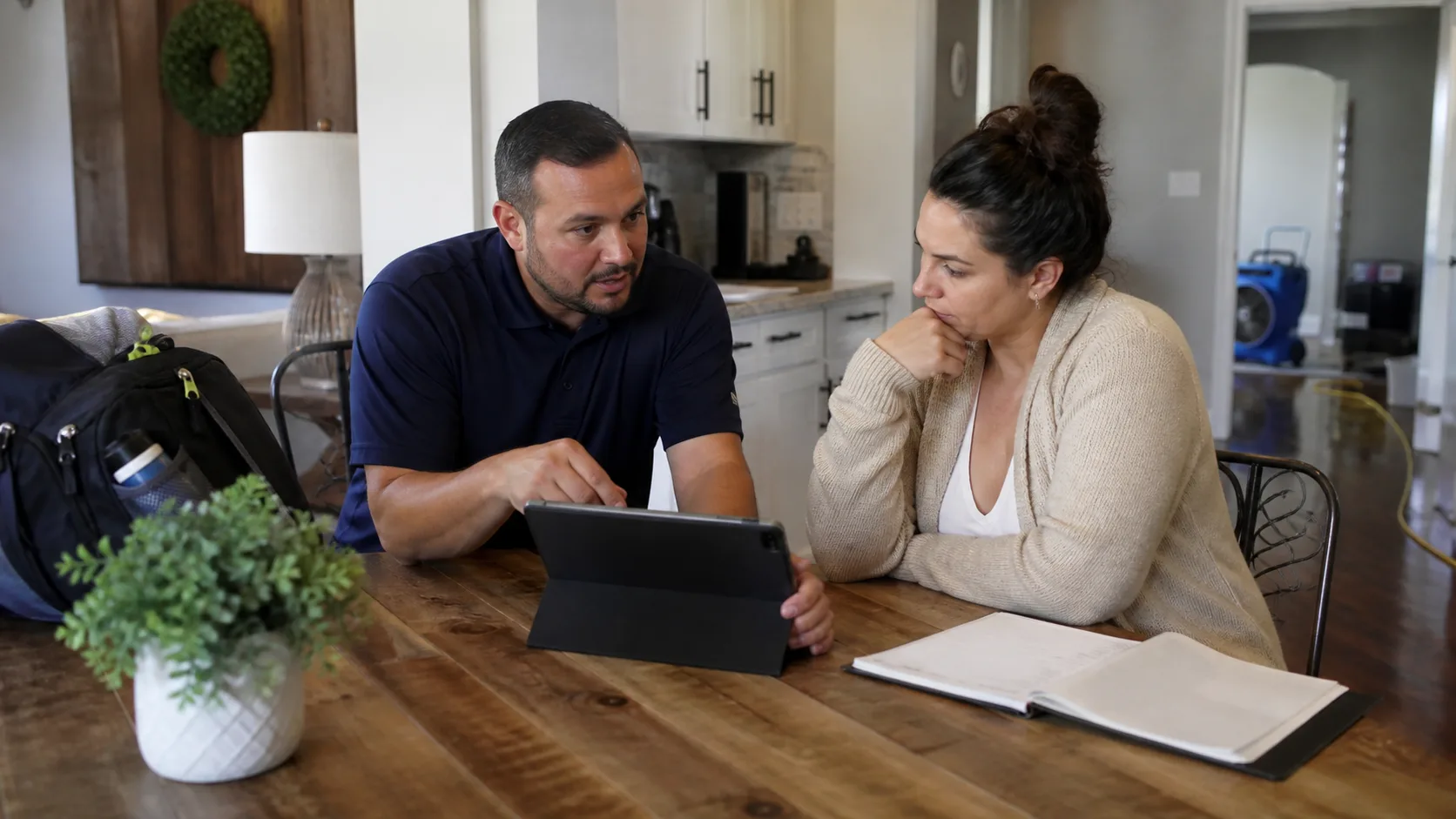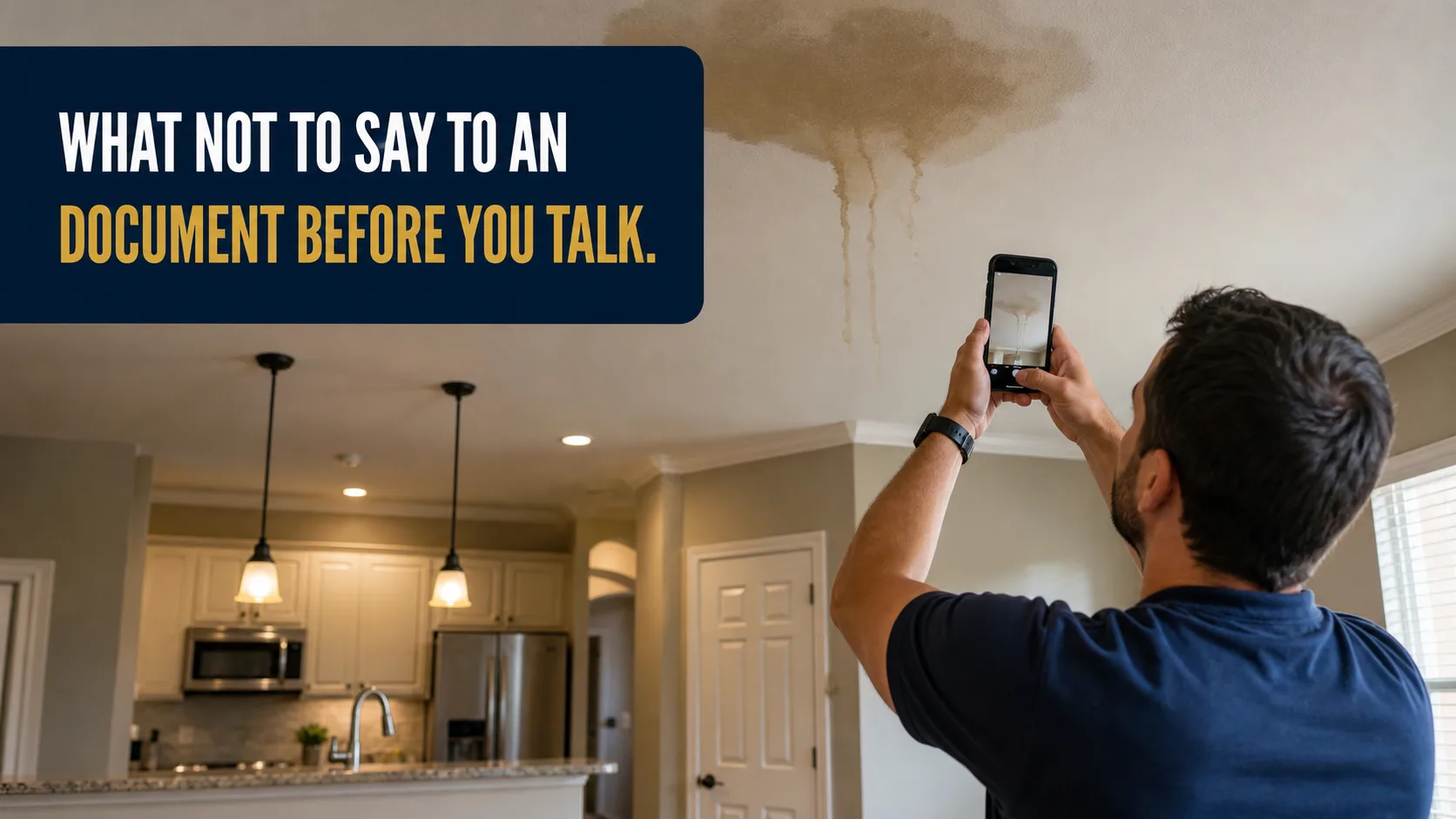
Don't guess about cause, don't accept blame, and don't volunteer words that imply *long-term* damage — especially the word **"mold."** Because mold signals gradual damage that policies exclude, leading with it can get your claim flagged for denial before anyone looks at the facts. Instead, report the **sudden event** (the burst pipe, the overflow), when you discovered it, and what you did to stop it. Stick to what you actually know. call **(346) 271-7004** and we'll help you document it right.
Why this page exists
Most water-damage advice online skips the part that actually decides claims. Here is what homeowners usually learn the hard way: how you describe your loss to the insurer can matter as much as the loss itself. Not because you should ever lie — you shouldn’t — but because volunteering the wrong framing hands the adjuster reasons to narrow or deny a claim that was genuinely covered.
The word that flags a claim: “mold”
Here’s the one that costs people. The moment you say “mold,” many carriers mentally reclassify your claim. Why? Because mold is associated with long-term, gradual moisture — and no standard policy covers long-term damage. Say “I think there’s mold” and the claim can get flagged as a possible denial before an adjuster has even seen the facts.
The honest, accurate alternative is to lead with the sudden event: “A supply line burst and flooded the bathroom. I shut off the water and called for extraction the same day.” If mold is present, it gets handled as a consequence of a covered sudden loss that you addressed promptly — which is exactly what fast, documented drying establishes.
What not to say (and what to say instead)
- Don’t say: “It’s been leaking for a while.” → Say: “I discovered it today when I saw the ceiling stain.”
- Don’t say: “I think it’s mold.” → Say: “There’s water damage from the burst pipe; the mitigation company is documenting moisture levels.”
- Don’t say: “It’s probably my fault, I should’ve replaced that.” → Say: “The connector failed and released water suddenly.”
- Don’t say: “How much will you give me?” or accept a number on the spot. → Say: “I’ll have the full documentation and estimate for you.”
- Don’t guess at cause, duration, or dollar figures. Speculation becomes part of the record.
Say only what you know
You are not the claims investigator, and you’re not obligated to theorize. Three facts carry a water claim: when you discovered it, what you saw, and what you did to stop it. Everything else — cause determination, scope, cost — is established by evidence, not by your guesses in a stressful moment.
Accuracy, not phrasing
None of this is a script, and none of it works as one. An adjuster reads materials, readings, and dates far more than sentences. What sinks a covered claim is almost never a badly chosen word — it is a guess that entered the file as a fact and then had to be defended.
So the discipline is narrow. Report what you observed and when you observed it. Say “I do not know” where you do not know, and let the failed part, the moisture readings, and the photographs establish the rest. Adjusters are not adversaries; most of them are working a large file count against tight rules, and a clean, factual account is the fastest thing they will read all week.
The best thing you can bring: your own documentation
Adjusters work from evidence. The strongest position you can be in is walking into the inspection with:
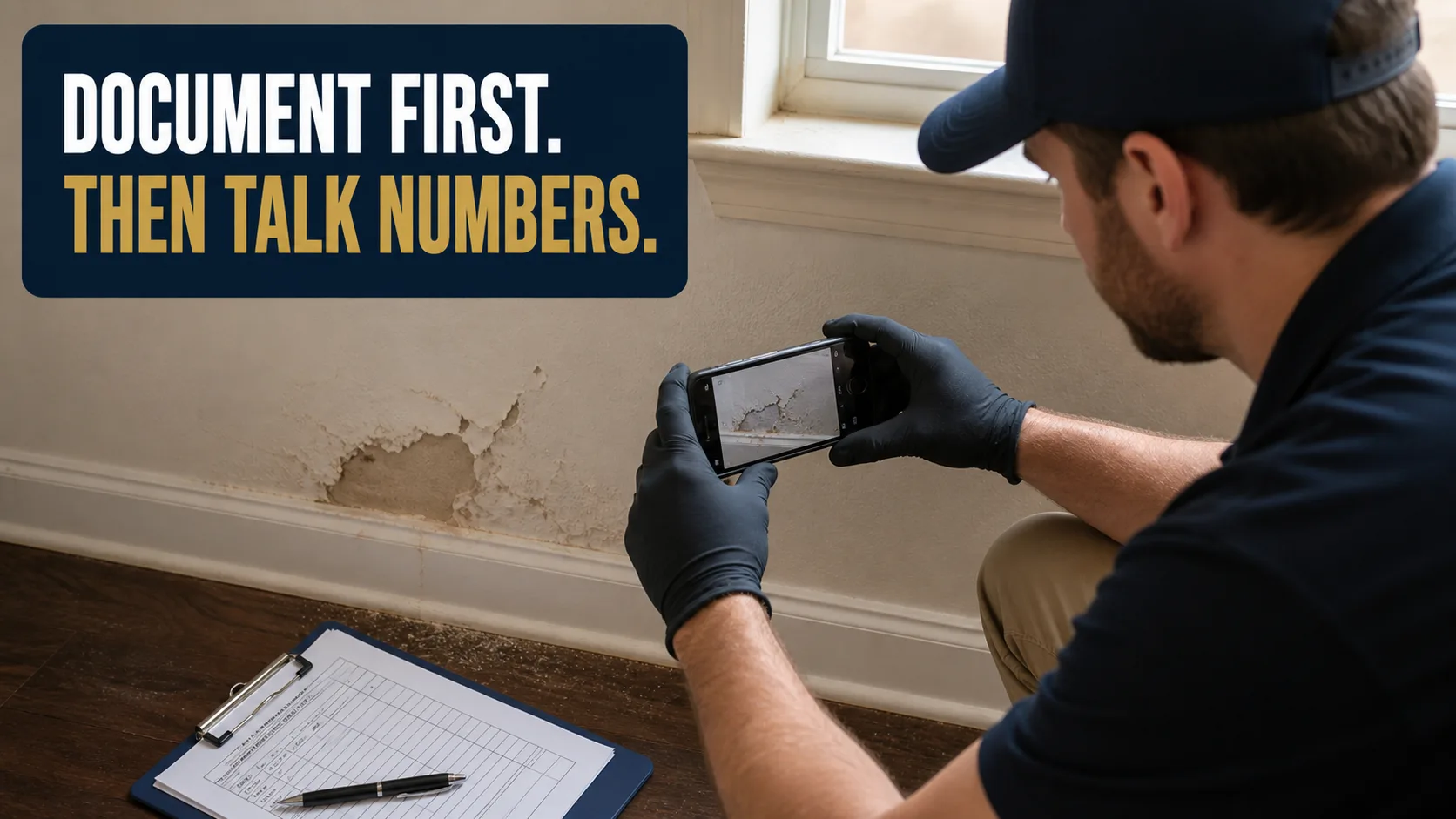
- Timestamped photos and video of the damage and the source
- The source of loss clearly identified (the failed part, kept if possible — see subrogation)
- Professional moisture readings and drying logs from your mitigation company
That’s the documentation we produce from the first visit, in the format adjusters expect — because it’s the format we used to work in. It’s also what keeps a “sudden” loss from drifting into “gradual” in the file.
A worked example: what the first cheque actually covers
Numbers invented to show the arithmetic. Nothing below is a quote or a promise about your policy.
A hallway bathroom supply line fails while the house is at work. Mitigation, removals, and the rebuild are scoped at $9,000. The policy is replacement cost on the dwelling, with a $2,000 deductible, and the flooring and vanity carried about a third of their expected life in depreciation.
| Line | Amount |
|---|---|
| Approved scope | $9,000 |
| Depreciation withheld, recoverable | -$2,600 |
| Deductible | -$2,000 |
| First payment | $4,400 |
| Released after completed work is invoiced | $2,600 |
| Total received | $7,000 |
The envelope says $4,400 against a $9,000 job, and that is where homeowners conclude the claim was underpaid. In this example the carrier did what the policy says: it advanced the depreciated value and is holding the rest until the work exists. The whole mechanic — and the paperwork that releases the second payment — is in actual cash value vs replacement cost.
Two things to notice. The deductible comes off once, against the claim, not once per contractor. And a scope of $1,800 against a $2,000 deductible is not a claim at all — knowing the metered extent before you file is worth more than any conversation with an adjuster afterward.
What to do, in order
- Stop the source and make the area safe. Nothing about a claim outranks that.
- Photograph and film before anything is cleaned, with the date stamp on.
- Start mitigation the same day. Policies generally require you to prevent further damage, and delay both grows the loss and weakens the file.
- Report the loss, with the discovery date and time, the source, and what you did.
- Write down the claim number, the adjuster’s name, and the date of every contact. A one-page log beats memory every time.
- Ask for the scope and the estimate in writing once the inspection is done.
- Read the estimate summary for the deductible, the depreciation, and whether it is recoverable.
- Ask questions in writing where an answer matters — email leaves a record that a phone call does not.
What to have in the folder before the inspection
Documentation is the part of a claim you actually control, and each item answers a specific question.
- Timestamped photos and video from discovery. They fix the extent on a date, which is what separates a sudden discharge from months of seepage.
- The failed part, bagged and labelled. It is physical evidence of cause, and its warranty status can bring your deductible back through subrogation.
- Daily moisture logs from the mitigation company. They show the loss was addressed promptly, which is the condition most mold coverage attaches to.
- A room-by-room inventory of damaged belongings, with rough age and value. Contents settle on their own basis and usually their own limit.
- Receipts for everything, including emergency costs and lodging.
- Your declarations page, so you know your deductible, your settlement basis, and your sub-limits before anyone discusses numbers.
None of that is persuasion. It is the record the decision gets made from.
The Texas timeline, generally
Texas claim-handling rules set windows rather than guarantees. An insurer normally has about 15 days after notice to acknowledge the claim, begin investigating, and request the items it needs, then about 15 business days after it receives everything requested to accept or reject the claim in writing — with a limited extension if it explains the delay in writing. Payment on an accepted claim follows shortly after acceptance. Deadlines can shift after a declared catastrophe, and details vary by policy.
Two practical notes. Those clocks generally start at notice, so reporting promptly starts them. And the clock on the insurer’s side often waits on you: a request for documents pauses progress until the documents arrive. The current requirements, and the complaint process when a file genuinely stalls, come from the Texas Department of Insurance.
Fire claims run the same windows with different questions. Expect to be asked about origin, who was home, and what was running, and expect a cause-and-origin investigator on a serious loss. The determination comes from that investigation and the fire department report — what a complete fire claim file contains is a longer list than the water version, because contents, structure, and living expenses are three separate coverages.
What NOT to do
- Don’t sign or accept a settlement figure before you have full documentation and an estimate.
- Don’t throw away the failed part or the removed materials before the claim is documented.
- Don’t delay mitigation to “wait for the adjuster.” Your policy expects you to prevent further damage; document, then dry.
If your claim has already been denied, here’s what to do next: water damage claim denied.
Do this tonight, free
- Find your declarations page and write down the deductible, the dwelling and contents settlement bases, and any sub-limits.
- Check whether a water backup endorsement is on it. Sewer backup is usually not in the base policy.
- Start a claim log — one page, dated entries, every call and email.
- Photograph the laundry connections, both water heater fittings, and under each sink while everything is dry.
- Put the failed part somewhere safe if you already have one, and label it with the failure date.
- Do not throw out removed materials while a claim is open.
What we are, and what we are not
TruePoint Restoration is a mitigation and remediation contractor. We are not your public adjuster, not your claims representative, and not your attorney. Texas keeps those roles separate from the company performing the repair work, and a public adjuster generally may not hold a financial interest in the repairs — so we do not negotiate your settlement, argue coverage on your behalf, or tell you what your policy means.
What we do is technical and documentary. We meter the loss, dry the structure to dry standard with daily logged readings, remove what cannot be saved, and produce a file written in line items an adjuster can read without translation. When the adjuster asks about extent, moisture, or materials, we answer that from the readings. When the question is coverage, that is your carrier’s answer to give and your declarations page that governs.
If a claim is genuinely disputed, the people for that are a Texas-licensed public adjuster, an attorney, or the Texas Department of Insurance. For the work itself, call (346) 271-7004. We serve Pearland, Manvel, Friendswood, League City and the Greater Houston area.