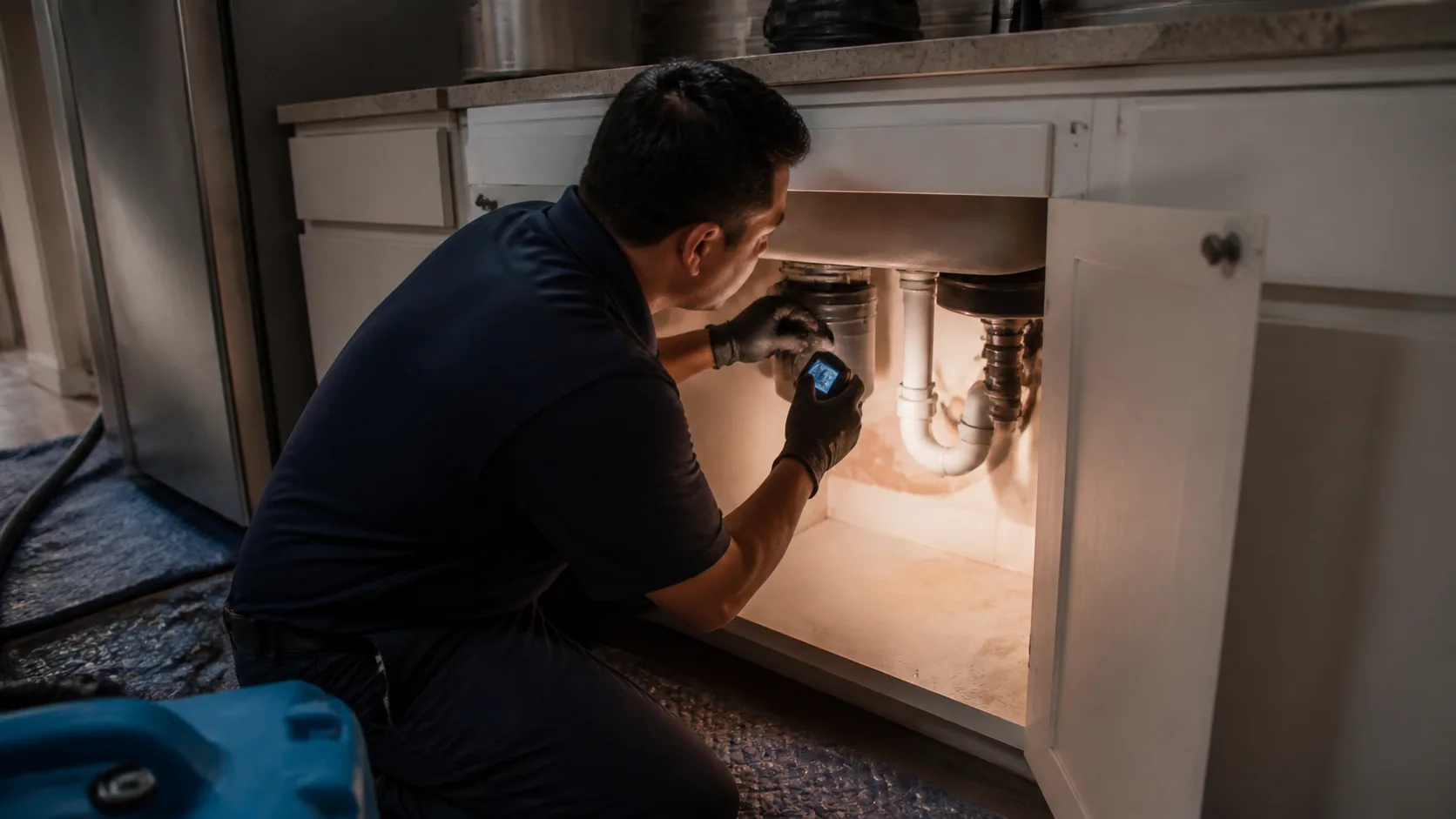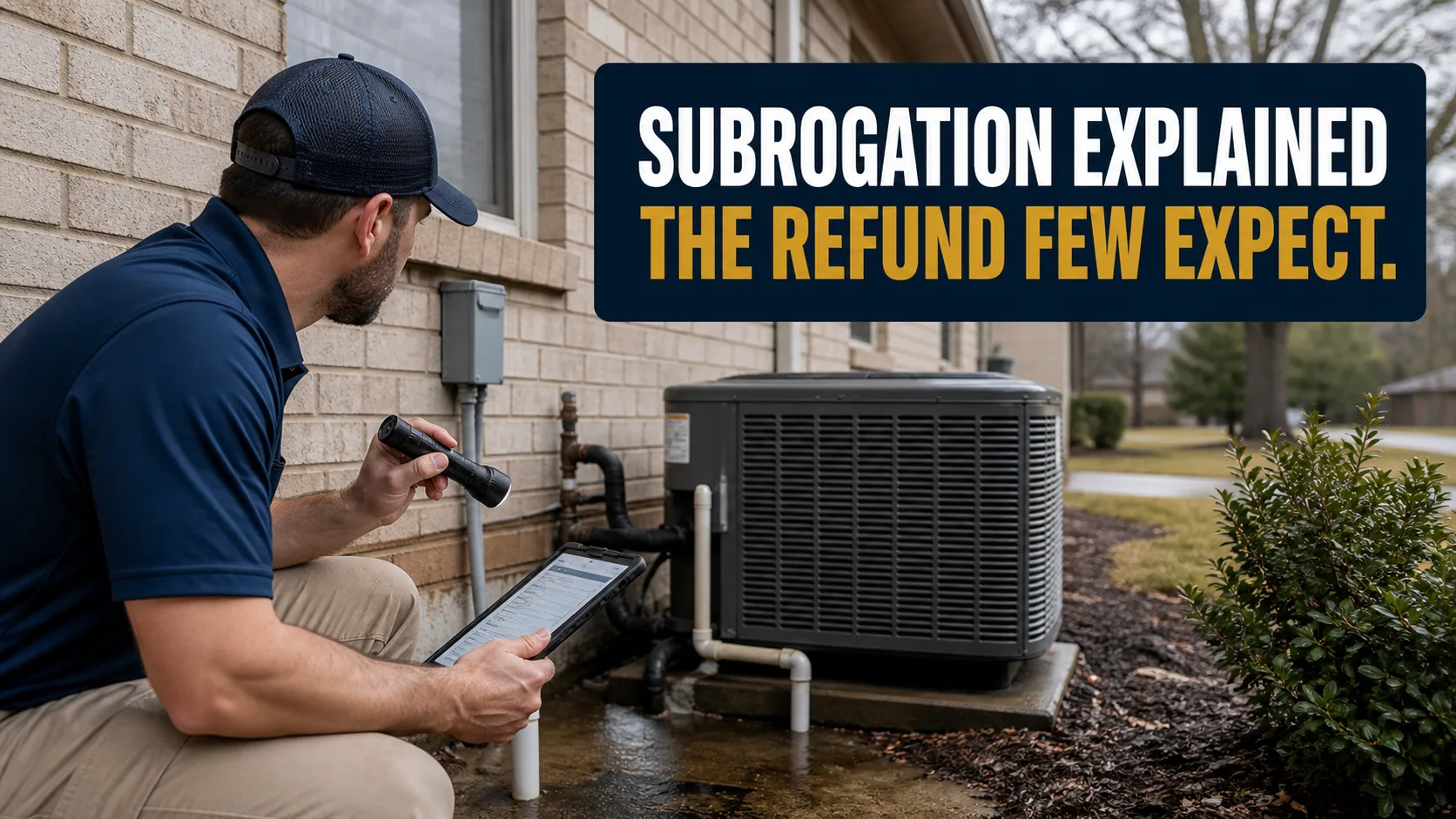
When the part that flooded your house failed **within its warranty period**, your insurance company can pursue the manufacturer to recover what the claim cost them — and when they recover, **your deductible typically comes back to you**. The catch: it only happens if the failed part survives the cleanup. Keep the burst hose, the split connector, the rusted tank. Photograph the data plate. Tell your adjuster the part's age. That's the whole homeowner playbook, and it is worth hundreds to thousands of dollars.
The mechanism, in one story
A water heater rusts through at year eight of its ten-year warranty and puts forty gallons through a ceiling. The insurer pays the claim: mitigation, drywall, flooring — say $18,000, minus the homeowner’s $2,000 deductible.
Then the insurer’s recovery team goes to work. The tank failed inside the manufacturer’s own warranty — the manufacturer said in writing this part should not have failed yet. The carrier pursues them (this is subrogation: the insurer “stands in” the homeowner’s rights), recovers its $18,000 — and the homeowner’s $2,000 deductible is reimbursed as part of the recovery.
The homeowner did exactly three things to make that possible, all in the first hour of the loss.
The three habits that make subrogation possible
1. Keep the part. The failed hose, connector, valve, or tank is the entire case — the manufacturer is entitled to examine it, and without it there is no proof of defect. Bag it, label it with the failure date, put it on a garage shelf until the claim and any recovery fully close. The single most common way homeowners forfeit this money is the burst hose leaving with the wet carpet on day one.
2. Photograph the identity. Data plate, model, serial, manufacture date — on the part or its packaging. For water heaters the plate is on the tank side; for hoses and connectors, the warranty lives on the package and receipt, which is one more reason the warranty-window program has you keeping that envelope of receipts.
3. Say the word. When filing, tell the adjuster: “The failed part was four years into a six-year warranty — I’ve kept it and photographed the plate.” Recovery teams triage thousands of claims; the ones with preserved evidence and a stated warranty angle rise to the top of the pile. You are not being difficult; you are doing their intake for them.
Which failures qualify
The recurring subrogation winners in water losses:
- Water heaters failing inside their 6/9/12-year warranties — the highest-dollar, most common case
- Supply hoses and connectors bursting inside 4–6 year warranties
- Appliance components — fill valves, pump seals, icemaker fittings — with defect patterns (some models have known recall/defect histories, which recovery teams track)
- Fresh professional work that failed — the connection that let go weeks after installation puts the installer’s liability in play instead of a manufacturer’s
What doesn’t qualify: parts that outlived their warranty (the 15-year-old hose is legally just an old hose — that risk is the replace-on-warranty argument from the other direction), ordinary wear, and losses where the evidence went to the curb.
When a person caused it, not a part
Manufacturers are the common case. They are not the only one.
A neighbour or an upstairs unit. Water crosses a party wall or a ceiling from a unit you do not own. Your own carrier normally handles your loss first, under your policy, so the work starts without waiting for anyone to accept blame — then it pursues the other party’s insurer on its own timeline.
A contractor whose work failed. A connection that lets go three weeks after installation puts the installer’s liability in play rather than a manufacturer’s. Keep the invoice, the date, and the name of whoever performed it.
A condo or HOA shared line. The association’s policy typically covers the building and the shared line; your HO-6 unit policy covers interior finishes, cabinets, flooring, and belongings. Report in writing to both the association and your carrier the same day, because associations set their own notice deadlines in the governing documents.
A fire that started somewhere else. The mechanic is identical, and it applies to the water the fire department put in as well as to the burn — what a fire claim file needs is a longer list, but the recovery works the same way.
Fault is not yours to establish and not your job to argue. Your part is preserving what the determination will be made from.
A worked example: the deductible that came back
Numbers invented to show the mechanic. Nothing below is a quote or a prediction.
A water heater splits at year seven of a nine-year tank warranty and empties into a hallway and two bedrooms. Assume a $2,000 deductible.
| Line | Amount |
|---|---|
| Mitigation — extraction, removals, six days of equipment | $5,600 |
| Reconstruction — flooring, baseboard, drywall, paint | $7,900 |
| Total claim paid by the carrier | $13,500 |
| Homeowner’s deductible, withheld from the payments | -$2,000 |
Nine months later the carrier’s recovery unit settles with the manufacturer. Because the homeowner’s deductible was part of the loss the carrier pursued, it is reimbursed as part of the recovery — a $2,000 cheque arriving long after the file felt closed.
What made it possible was three things done in the first hour: the tank was photographed in place, its data plate was photographed, and it went onto a garage shelf instead of the curb. Without the tank there is no defect to demonstrate and no recovery to share. The single most common way this money is forfeited is the failed part leaving with the wet carpet on day one.
What to do in order
- Stop the water and make the area safe. Nothing here outranks that.
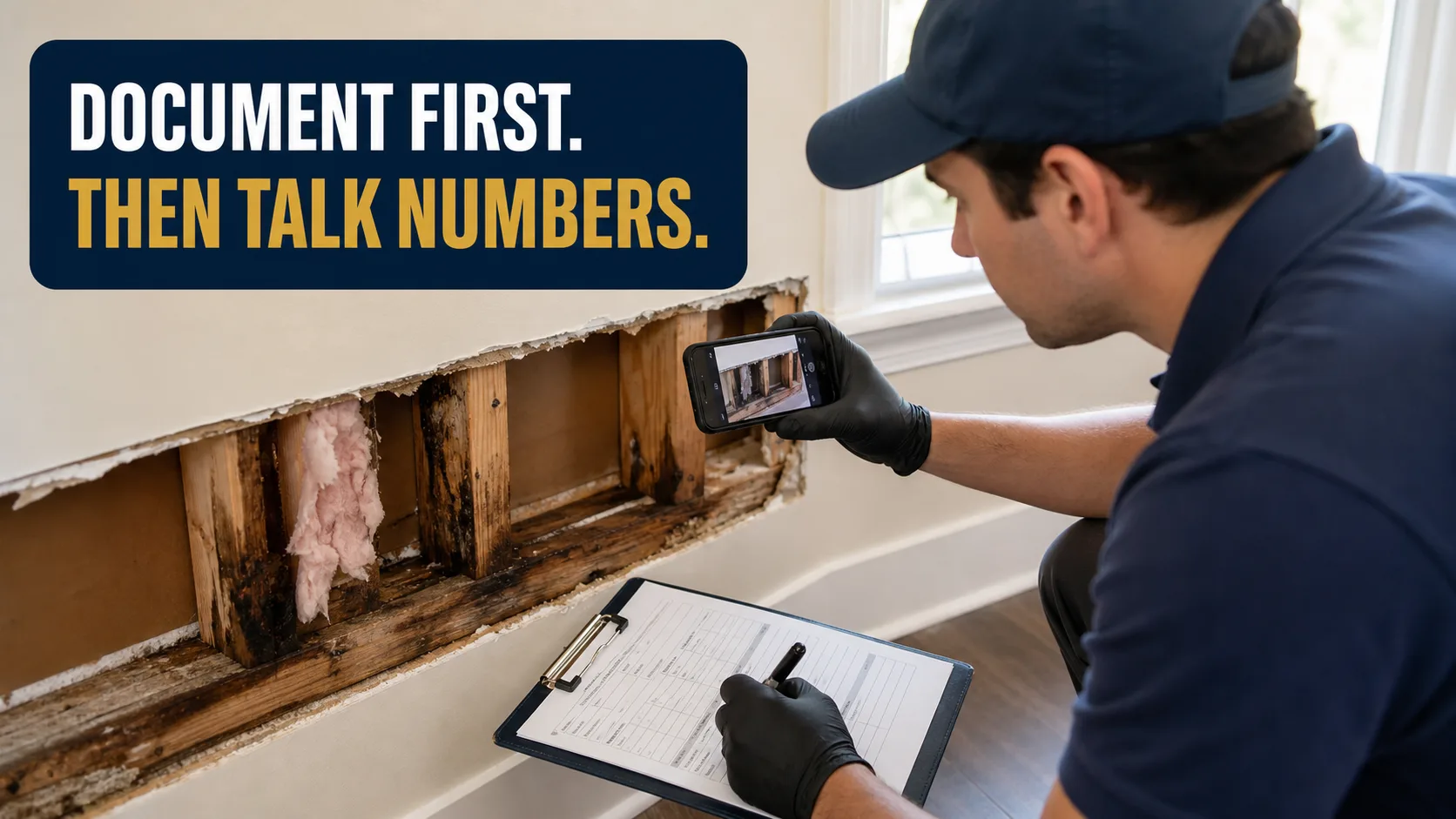
- Photograph the failed component in place, before it is touched or moved.
- Photograph the data plate — make, model, serial, manufacture date.
- Bag the part, label it with the failure date, and shelve it. It stays until the claim and any recovery fully close.
- Note the install date if you know it, and find the receipt or the invoice from whoever installed it.
- Report the loss and mention that the failed part has been preserved and photographed.
- Keep removed materials until the file is closed, not just the part.
- Do not let anyone dispose of anything because a cleanup crew found it inconvenient.
What the recovery file runs on
A recovery unit is deciding whether a case is worth pursuing, and it decides from the record rather than the story.
- The part itself, intact and identifiable. A manufacturer is entitled to examine it.
- The identity photographs — plate, model, serial, date of manufacture. Without these, warranty status cannot be established.
- Proof of age: purchase receipt, install invoice, or the permit record.
- Photographs of the failure in context, showing where the part sits and where the water went.
- The mitigation documentation — moisture map, daily readings, what was removed and why. It sizes the loss the recovery is worth.
- Any prior service history on the same appliance. A known defect pattern is what recovery teams track.
Everything on that list is free to produce on the day of the loss and impossible to produce three weeks later.
Where mitigation fits in
Part of a mitigation company’s job — done right — is protecting this recovery without the homeowner having to think about it mid-crisis. On our losses that means the failed component is identified, photographed in place, preserved, and flagged in the documentation package; the source-of-loss report names the part, its age where knowable, and its warranty posture. It costs nothing extra and it is routinely the difference between a deductible that comes back and one that doesn’t.
It is also, frankly, the kind of thing that becomes automatic once you have documented enough of these losses — which is where TruePoint Restoration comes from.
How long recovery takes
Your claim and the recovery run on different clocks, and only the first one involves you.
Your claim moves on the ordinary schedule — Texas rules generally give an insurer about 15 days from notice to acknowledge and begin investigating, and about 15 business days after receiving everything requested to accept or reject in writing, with a limited extension explained in writing. The repairs proceed from there.
The recovery runs between carriers and their counsel, usually over months and sometimes over a year. You are not a party to it and you will rarely hear about it until a deductible reimbursement arrives. What you should know is that legal deadlines apply to the underlying claim against a third party — property damage claims in Texas generally carry a two-year limitations period, and notice deadlines against a city can be far shorter. That is a reason to preserve evidence early rather than a reason to act on it yourself.
If you want to know where a recovery stands, ask your carrier’s claim representative in writing. If the question is whether to pursue something the carrier will not, that is a conversation for an attorney.
The takeaway habit
One sentence to remember at the worst moment: the thing that broke is evidence, not trash. Photograph it, bag it, shelf it, mention it. Everything else about subrogation happens without you — but none of it happens without that.
Live loss and not sure what to preserve? (346) 271-7004 — text a photo and we’ll walk you through it.
Do this tonight, free
- Photograph the data plates on your water heater, washer, dishwasher, and refrigerator, and keep the images somewhere you will find them.
- Note the install dates and the warranty terms on each.
- Keep the receipts for hoses, connectors, and any plumbing work in one envelope.
- Decide now where a failed part would go — a labelled bin in the garage, not the bin at the kerb.
- Check the age of your supply hoses. A part past its warranty is legally just an old part.
Where we fit
TruePoint Restoration is a mitigation and remediation contractor. We are not a public adjuster, not a claims representative, and not a law firm, and Texas keeps those roles separate from the company doing the work. We do not pursue recoveries, negotiate settlements, or advise you on liability — subrogation is your carrier’s process and it runs without you.
What we do on every loss is protect the evidence it depends on, so a homeowner is not thinking about warranty documentation in the middle of an emergency. The failed component gets identified and photographed in place, preserved and labelled, and named in the source-of-loss report along with its age where knowable. The moisture map and drying logs go in the same file. It costs nothing extra and it is routinely the difference between a deductible that comes back and one that does not.
If the question is whether a claim should be pursued further, that is work for a Texas-licensed public adjuster or an attorney. If you have a live loss and are unsure what to preserve, call (346) 271-7004. We serve Pearland, Manvel, Friendswood, League City and the Greater Houston area.