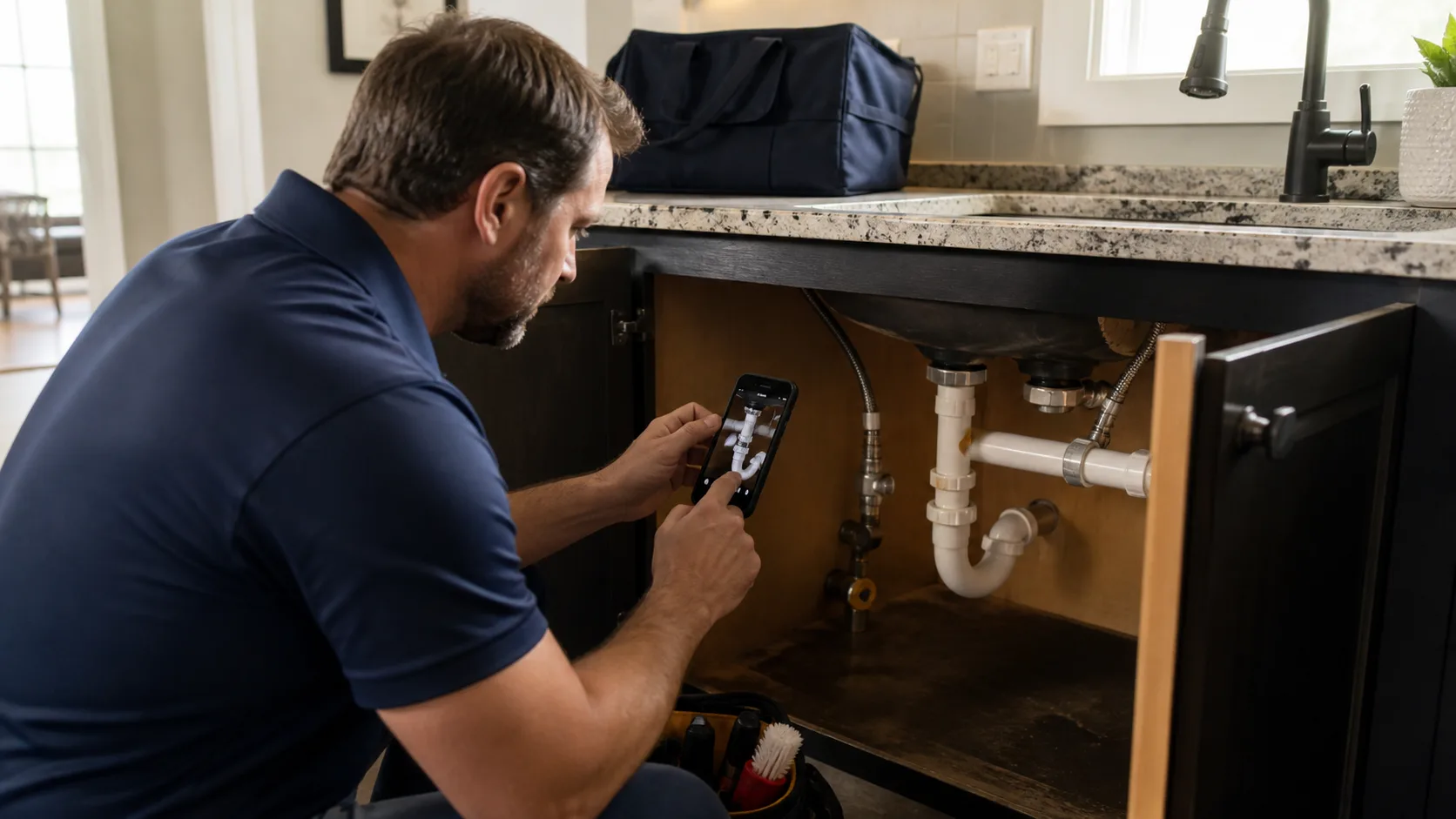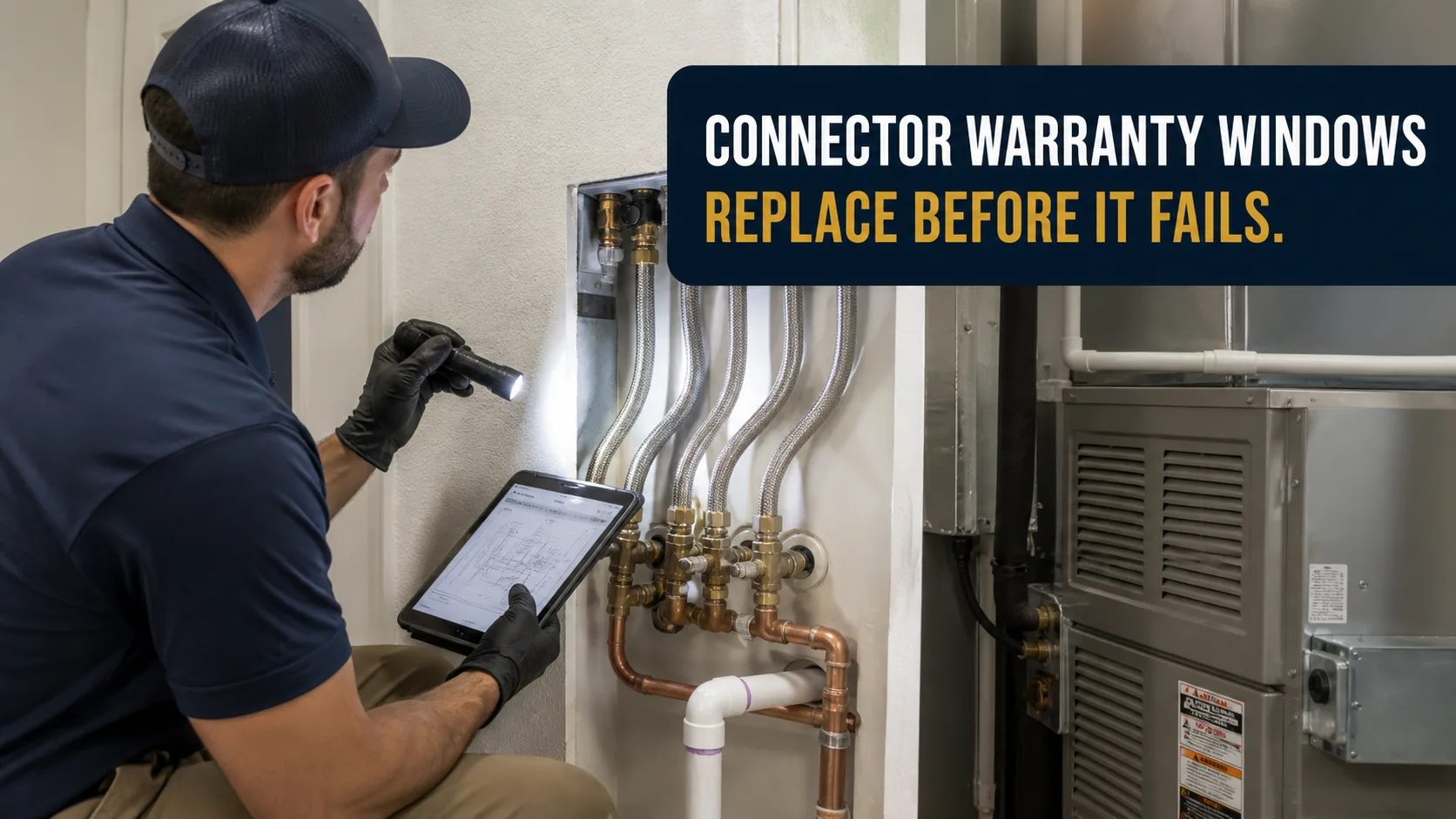
Every flexible water connector in your home — washer hoses, toilet and faucet supply lines, the icemaker line, water heater flex connectors — carries a manufacturer warranty of roughly 4–6 years. That number is the manufacturer's own estimate of the part's dependable life. The rule: **replace each connector when its warranty expires, not when it fails.** Mark install dates on the parts, keep the receipts, and you will prevent the most common category of residential water loss for about the price of a tank of gas.
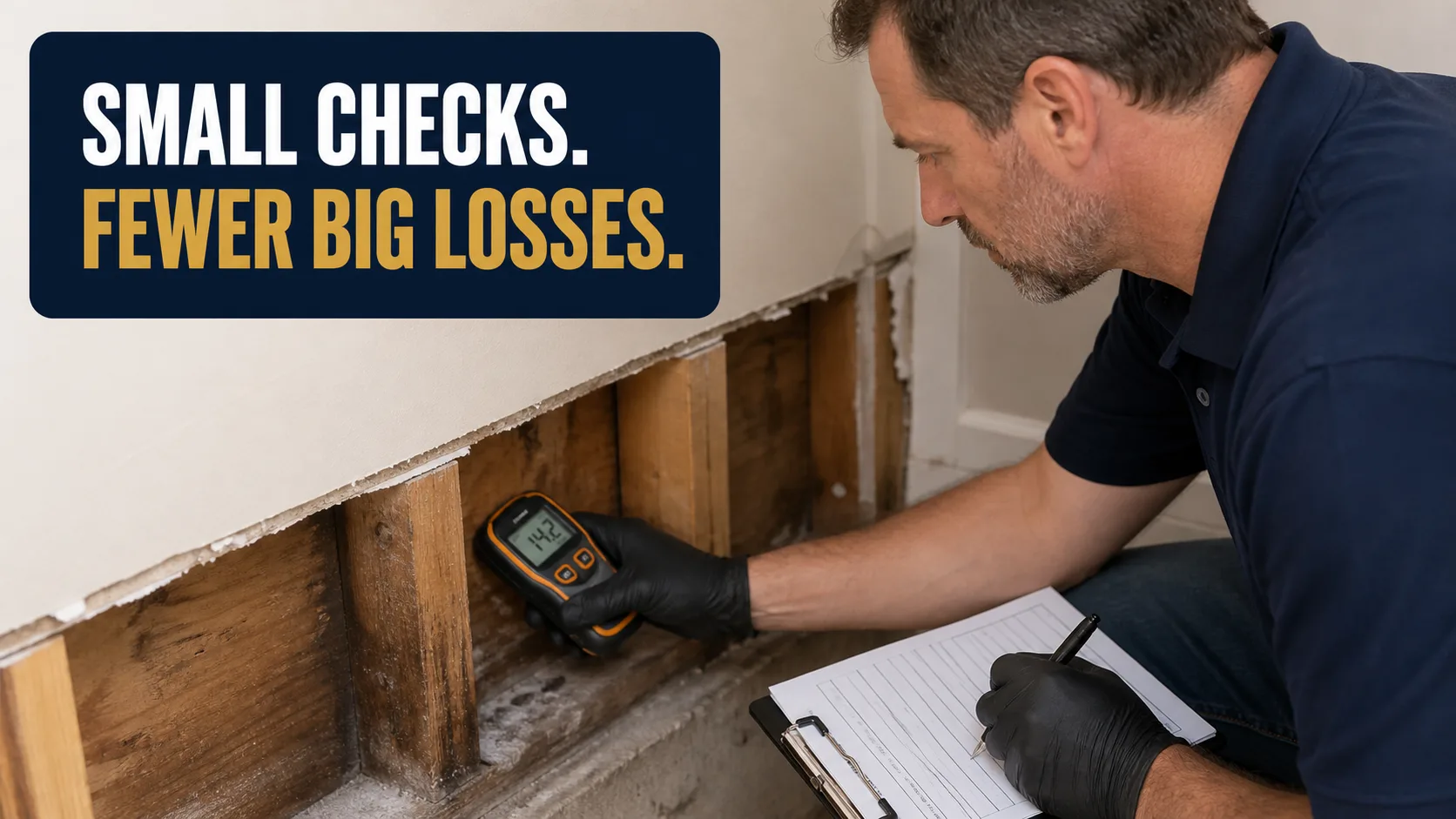
The idea in one sentence
A warranty is not a guarantee that a part lasts that long — it is the manufacturer drawing a line and saying: past this point, we will not put our money behind this part. When the people who made the connector stop backing it, that is your replacement date. Everything after is a bet, and the connector is pressurized 24/7 while you make it.
Your home’s connector inventory
Walk the house once and count. A typical three-bathroom Houston home:
| Connector | Count (typical) | Common warranty | Failure it causes |
|---|---|---|---|
| Washer supply hoses | 2 | 4–5 yrs | The most violent leak in the house |
| Toilet supply lines | 3 | 4–6 yrs | Burst or weep behind the toilet |
| Faucet supply lines | 6–8 | 4–6 yrs | The cabinet-floor eater |
| Dishwasher supply | 1 | 4–6 yrs | Under-cabinet soak |
| Icemaker line | 1 | varies; plastic = short | The slowest, sneakiest flood |
| Water heater connectors | 2 | 4–6 yrs | Crust, weep, attic pan overflow |
Fifteen to twenty pressurized flexible parts, every one of them rated for about half a decade, most of them installed the year the house was built or remodeled and never touched since.
The program
1. Amnesty replacement (once). Anything of unknown age gets replaced now — assume unknown means original. Braided stainless everywhere, longest warranty on the shelf, metal coupling nuts where offered.
2. Date everything. Paint marker on each part: install month/year. The next person to kneel under that sink — you, a plumber, a home inspector — reads the answer off the part.
3. Keep the receipts in one envelope or a photo album on your phone. This is your maintenance record, and it has two jobs: telling you what is due, and proving diligence to an insurer if a claim ever goes sideways.
4. Calendar the expirations. One recurring reminder per warranty cohort (“2031: replace washer hoses + master bath lines”) is enough.
5. Touch them twice a year anyway — the 15-minute walkthrough: dry finger on every fitting, eyes on every line. Crust, bulge, stiffness, or corrosion overrides any calendar: replace on sight.
What the program costs against what a failure costs
Braided stainless connectors run roughly $10 to $25 each depending on length and warranty tier. Fifteen to twenty of them is $150 to $300 in parts for a three-bath house, plus an afternoon. Hire a plumber for the whole set and labor generally adds $400 to $800. A paint marker is two dollars.
Against that, a supply line that lets go at full pressure releases hundreds of gallons an hour and does it unattended. A washer hose that fails while you are at work floods the laundry, the hallway and whatever is downstream of them — mitigation, rebuild and your deductible commonly put those losses well into five figures. An icemaker line that weeps behind a cabinet for four months is cheaper in gallons and often more expensive in outcome, because slow water inside a cabinet run turns into a mold job.
The whole program costs less than most deductibles and retires the most common category of residential water loss there is.
Check them yourself: the twenty-minute crawl
Do this twice a year, on the weekends the clocks change. Bring a flashlight, a dry paper towel and a phone.
- Under every sink, kitchen and bath. Wipe a dry paper towel around each angle stop, each supply nut and the trap joint. Damp paper is a leak; dry paper with white or green crust is a leak that dried between visits.
- Behind the washing machine. Look at both hoses along their whole length, especially where they bend behind the machine. Squeeze gently — a hose that feels hard or has a soft bulge is finished.
- Behind each toilet. Check the coupling nut at the fill valve. If it is plastic, put a metal-nut replacement on the shopping list regardless of age.
- At the water heater. Look at both flex connectors where they meet the tank, and look in the drain pan. Crust on a fitting is mineral left behind by water that was there.
- Behind the refrigerator. Pull it out far enough to see the icemaker line. Kinks, old saddle valves and brittle plastic tubing all replace on sight.
- Exercise every shutoff valve you touched — closed, then open. A stop that will not turn is a repair you want on a Saturday, not during a burst.
- Read the dates. Anything without a date gets replaced and marked. Anything past its warranty window gets replaced and marked. Photograph the marked dates with the date stamp on before you close the cabinet.
Warning signs that override the calendar
The schedule is the floor, not the ceiling. Replace on sight, whatever the date says, when you find any of these:
- A bulge, soft spot or kink anywhere in a braided or rubber line
- Rust bleeding through the braid, which means the liner has been weeping inside it
- White or green crust at a nut or a fitting
- Stiffness — a good hose flexes; an aged one has set
- A nut you have already re-tightened once. Re-seating a fitting buys weeks, not years.
- Any plastic coupling nut, at any age
The insurance dividend
The warranty window pays a second way:
- Failure inside the warranty = subrogation target. When a warrantied part causes a loss, your insurer can pursue the manufacturer to recover what they paid — and when they do, your deductible rides along and can come back to you. It only works if the part, its age, and its warranty are documented, which the paint marker and receipt envelope just handled. Full picture: subrogation, explained.
- Dated replacements defeat the neglect argument. The insurer’s standard counter on slow-leak claims is “gradual damage / poor maintenance.” A receipted, dated connector program is the quiet rebuttal that ends that conversation.
The Houston calendar for connectors
Two local conditions eat connectors faster than the warranty assumes, and both are worth planning around.
Hard water. Much of the Greater Houston supply is mineral-heavy. Scale builds inside fittings and valve seats, angle stops seize, and washers harden. Work off the short end of the four-to-six-year window here rather than the long end.
Heat. Attics and garages across Pearland, Missouri City and Manvel run 120 to 140°F through August, and rubber ages on heat. A part rated for six years in a conditioned utility closet is not getting six years above your ceiling.
The rhythm that fits the year:
- March and November, at the time change: the twenty-minute crawl above.
- April, before the heat: replace anything the spring crawl flagged, while attic work is still tolerable.
- Before any trip longer than a weekend: close the washing machine valves and the icemaker stop, and set the water heater to vacation.
- December, before a freeze: the same fittings are what a hard freeze finds first — the freeze checklist runs on the same parts.
The other expiration dates in the house
You are already walking the house with a marker. Everything below carries a date too, and none of them announce it.
- Smoke alarms expire ten years from the manufacture date printed on the back. You replace the unit, not the battery. One inside every bedroom, one outside each sleeping area, one on every floor, interconnected where possible.
- Carbon monoxide alarms run five to seven years, and every house with a gas appliance or an attached garage needs one on each level.
- Disposable fire extinguishers get replaced around the twelve-year mark, and the gauge gets a glance every month.
- Dryer duct: not a date, a habit. Clear the whole run to the exterior hood annually, and replace foil or vinyl transitions with metal. Lint burns.
- Water heaters run eight to twelve years — the timing is in water heater lifespan and replacement.
Put all of it on the same dated list. The house does not distinguish between a fire loss and a water loss, and neither do we — the aftermath of the first one is in what to do after a house fire.
Objections, briefly
“It looks fine.” They all look fine. Liners fail from the inside; the outside is a costume.
“It’s original and it’s lasted 15 years — clearly it’s good.” It has survived 15 years. Survivorship is not a rating; it is a longer run-up.
“I’ll just check them more often.” Inspection catches weeps, not bursts — and washer hoses mostly burst.
If a connector already failed
Emergency steps live on the incident pages (washer, toilet, water heater). Two rules from this page still apply mid-crisis: keep the failed part — it is subrogation evidence — and photograph it before anything gets cleaned up. Then get the wet zone metered: (346) 271-7004.
Where we fit, and where we don’t
TruePoint Restoration is not a plumbing company. We do not replace supply lines, swap angle stops, repipe, or repair fixtures — that work belongs to a licensed plumber, and so does any stop that will not close. Anything involving a gas line to a water heater or dryer stops being a homeowner job entirely; call the utility or a licensed plumber.
What we do is what happens after a connector lets go: extraction, structural drying with logged daily moisture readings, mold remediation, and smoke and soot cleanup on the fire side. We work out of Pearland and cover Manvel, Friendswood, League City, Pasadena and the Greater Houston area. (346) 271-7004.