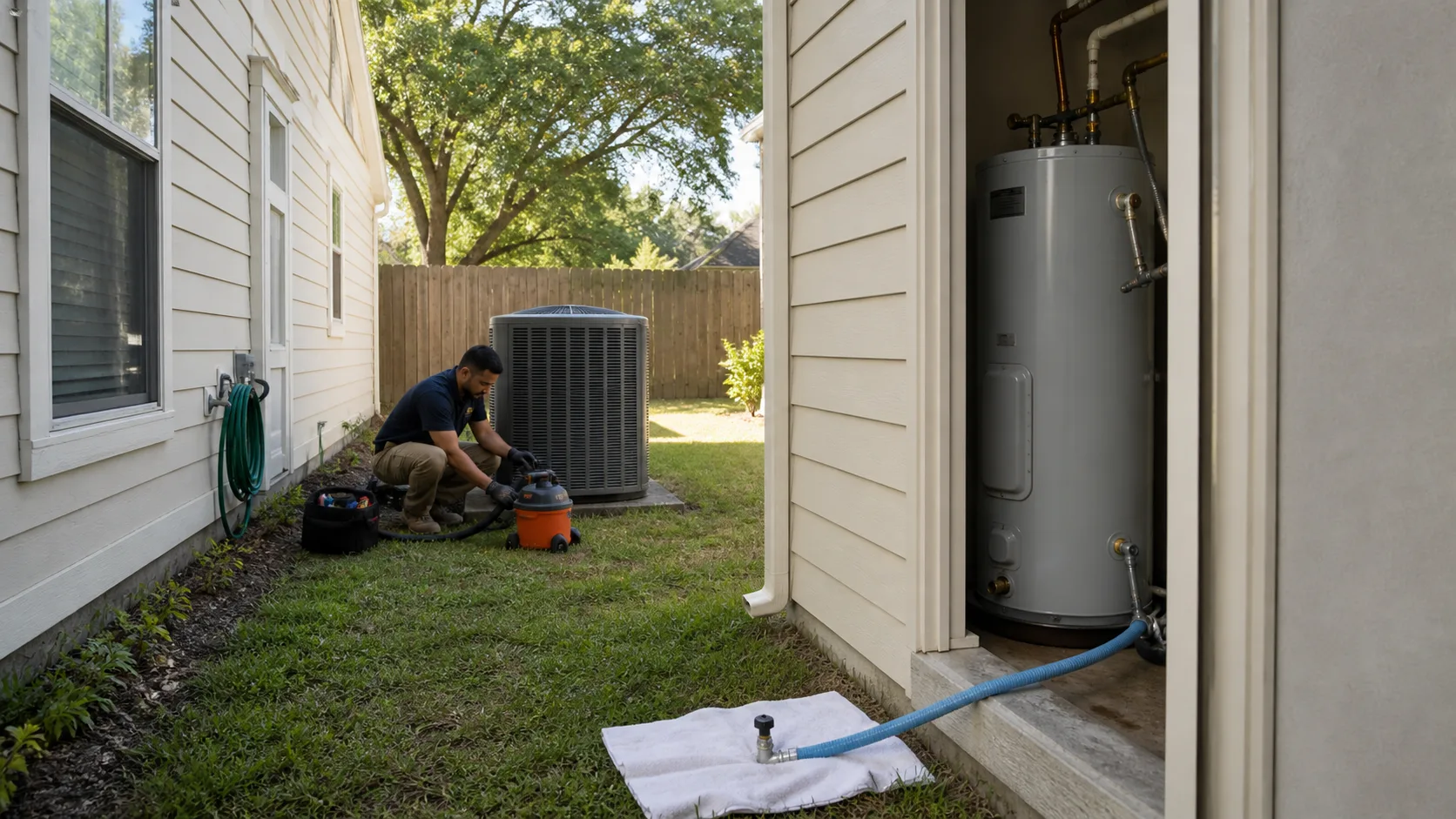
Close the cold-water inlet valve above the tank (or the house main), and cut the unit's power or gas. Connector leaks are the good news version of a water heater failure — a cheap flex line instead of the tank — but they are pressurized around the clock and only get worse. Replace the connector now, check the pan and the ceiling below (attic units), and put the other connector on the same replacement schedule: they were installed the same day.
Why connectors fail first
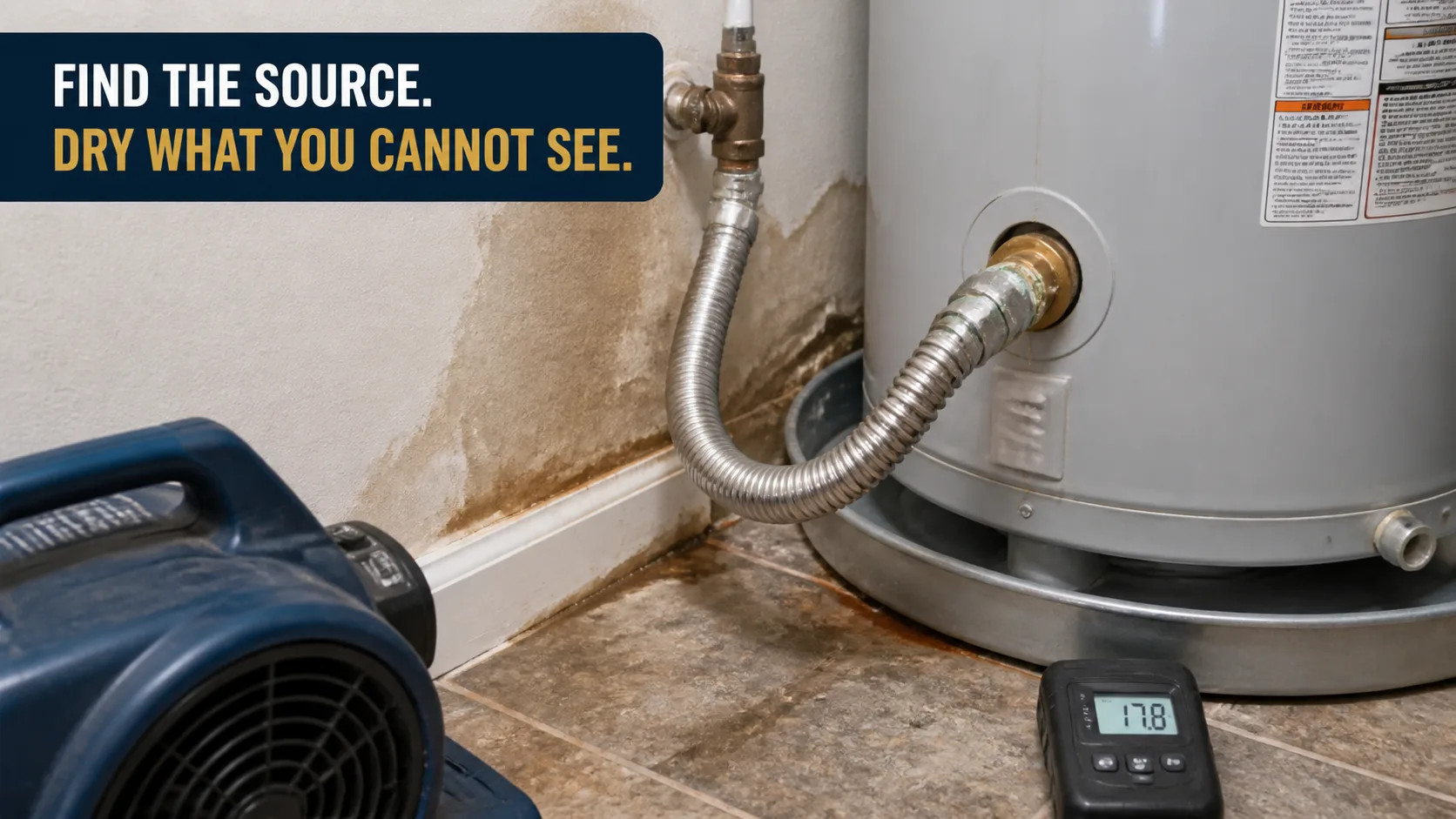
The tank is a heavy steel vessel built for a decade of service. The connectors on top of it are flexible lines — corrugated copper or braided stainless — chosen for easy installation, not longevity. They live with constant pressure, heat cycling on the hot side, Houston’s mineral-heavy water, and the slow galvanic chemistry of dissimilar metals meeting at the fittings.
So they weep. First as a micro-leak that evaporates at the fitting and leaves white or green crust — the signature of a connector already failing — then as a drip, then occasionally as a sudden let-go at full line pressure.
The first signs
- Mineral crust (white, green, blue-green) at either fitting on top of the tank
- Rust streaks running down the tank body from the top
- Dampness or drips you can feel on the connector with a dry fingertip
- Water in the drain pan of an attic or closet unit with a dry tank body
- Ceiling staining below an attic unit — by which point the pan has been overwhelmed
What to do right now
- Cold inlet valve off (the handle above the tank), or house main if seized.
- Power/gas off — breaker for electric, control knob to OFF for gas.
- Confirm the source. Dry your hand, trace both connectors, then the fittings, then the tank top. Connector leaks drip from the line or fitting; tank-body leaks show at seams or the bottom — different problem, different guide.
- Check what’s below. Pan, platform, closet floor — and for attic units, the ceilings underneath. Any staining means water has been escaping longer than today.
- Replace the connector — DIY if fittings turn freely, plumber if anything is corroded or seized.
- Keep the failed connector and photograph it with its packaging or model if findable — warranty-period failures fund deductible recoveries. How subrogation works.
The attic multiplier
On a garage slab, a connector drip is a puddle. In a Houston attic installation, the same drip lands in a shallow pan sized for condensation, not failures — and once the pan overflows or its own drain clogs, the water is in your insulation and ceiling. If your water heater is in the attic, connector checks belong on your twice-yearly walkthrough, and any pan water or fitting crust is a same-week action item.
Check it yourself, safely
Go up early in the morning. A Houston attic passes 130 degrees by afternoon, and heat exhaustion up there is a real risk rather than a caution label.
- Tell somebody you are going up, take a flashlight and your phone, and walk only on decking or directly on the joists.
- Look in the pan first. Standing water, a rust ring, or a dried mineral tide line all count — a dried ring means the pan filled once and evaporated.
- Put a dry finger on both fittings on top of the tank, then run it down the tank body. Damp at the fitting is the connector. Damp only lower down is a different problem.
- Look for white, green, or blue-green crust at either connection.
- Pour a cup of water into the pan and watch the drain line. If it does not come out the far end, the pan is a shallow reservoir over your ceiling rather than a safety device.
- Go downstairs and check the ceiling underneath with a flashlight held flat against the surface. Raking light shows a faint stain that straight-on light hides.
- Photograph all of it with the date stamp on, the tank’s data plate included. If this becomes a claim, that dated set is your discovery date and your warranty evidence.
Replace on the warranty clock
Flex connectors typically carry 4–6 year warranties. That number is the manufacturer’s own estimate of dependable service life — running a connector years past it is a bet at 24/7 line pressure. The pattern that works:
- Replace both connectors when either fails or at warranty expiry
- Write the install date on the line with a paint marker
- Braided stainless over corrugated copper when replacing
- Full framework: appliance connector warranty windows
What does a connector leak cost?
Before it fails this is the cheapest problem in the house. After it fails in an attic, it is not.
The part and the labor are predictable: a flex connector is $15 to $40, a plumber’s visit to swap it runs $150 to $300 when the fittings turn freely, and $300 to $500 when corrosion has seized them and new connections have to be cut and soldered. Houston’s mineral-heavy water makes the seized version common.
The damage depends on where the heater sits and how long the pan has been catching water:
- Garage or utility closet, caught at the crust stage. Replace the part. Nothing to dry.
- Water in the pan for an unknown time. The platform, the closet floor, and the wall behind the unit get metered before anything closes up.
- Attic unit that overflowed its pan. Wet blown-in insulation is bagged and replaced rather than dried, ceiling material is opened, and equipment runs for days — typically high hundreds to low thousands for a single room.
- Water that reached the walls below. The wall cavities join the scope and the number moves with them.
The insulation removal and reinstall is usually the biggest line on the invoice, which surprises people who were bracing for the drywall.
How long does the ceiling take to dry?
Three to five days for a single-room ceiling once wet insulation is out and equipment is running, and longer when water tracked down into wall cavities or across the ceiling plane into a second room. Attic decks and enclosed water heater closets hold moisture invisibly, and in this humidity the surrounding air will not pull it out for you.
Readings decide the end date, not the calendar. Ceiling framing, top plates, and drywall get metered against unaffected material of the same type and logged daily, and the insulation goes back only when those numbers match. Drying timelines are set by depth and access, not by the size of the stain.
Does insurance cover a failed connector?
A sudden connector failure and the damage it causes is typically covered. A crusted fitting that clearly seeped for months invites the gradual argument, which is the standard basis for a denied water damage claim.
Two things protect this loss specifically. Keep the failed connector, because a warranty-period failure lets your carrier pursue the manufacturer and that is how a deductible comes back. And photograph the pan and the ceiling the day you find them — with an attic unit the visible damage arrives long after the leak started, so the discovery date is the only date you can prove.
When to call mitigation
Connector caught at the crust stage: replace the part, no drying needed. Water in the pan for an unknown time, staining on a platform or ceiling, damp drywall behind the unit: get it metered before closing anything up — enclosed water heater closets and attic decks hold moisture invisibly, and in our humidity it does not leave on its own. Text a photo: (346) 271-7004.
Where the plumber ends and we begin
TruePoint Restoration is not a plumbing company. We do not replace connectors, swap inlet valves, install pans or expansion tanks, service the tank, or touch gas and electrical connections — and we are not the contractor who re-hangs and textures your ceiling. Call a plumber for the fixture, and call them the same week.
What we do is what the water reached: metering the ceiling, the top plates and the walls below, removing saturated insulation that cannot be dried in place, opening and drying the cavity with commercial equipment and logged daily readings, remediating mold where a slow leak ran long enough to start some, and documenting the loss so your adjuster has something to work from.
Send a photo of the pan and the ceiling below to (346) 271-7004. Sometimes the honest answer is that the pan caught it and nothing needs drying. We serve Pearland, Manvel, Friendswood, League City and the Greater Houston area.