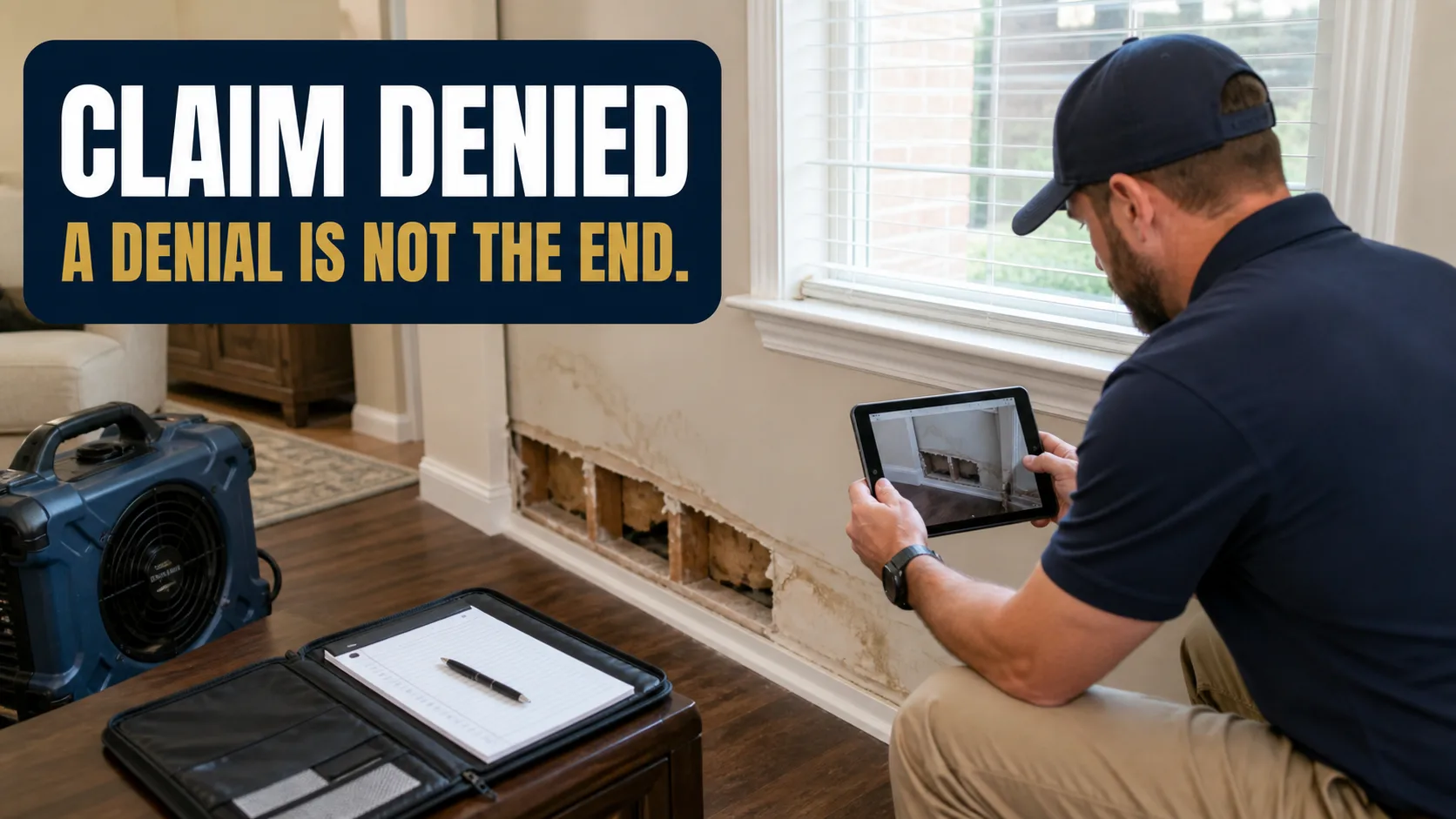
Most water-damage denials come down to how the loss was **classified** — ruled gradual, a maintenance issue, or outside flooding rather than sudden and accidental — or to thin documentation, not homeowner fault. A denial isn't always final. Request the specific reason **in writing**, preserve all evidence and damaged materials, gather professional moisture documentation showing a sudden cause and prompt mitigation, and appeal. In Texas you can also file with the Department of Insurance. Call **(346) 271-7004** and our team will help you build the documentation.

What a denial actually is
A denial is the insurer’s decision that, as they see it, your loss isn’t covered. The key words are as they see it — because that decision rests on how the cause and timeline of your loss were characterized. Reclassify a sudden burst as a “gradual leak,” and a covered claim becomes a denied one. That’s why a denial is frequently a documentation and framing problem, not a dead end.
The reasons claims get denied — and how each is answered
- “It was gradual / lack of maintenance.” The most common one. Answered with evidence the event was sudden and that you acted immediately — timestamped photos, the failed part, dated mitigation records.
- “It’s flood / outside water.” Homeowners policies exclude outside flooding; that’s a flood policy matter. If your water actually came from an inside source, documentation of that source is the answer.
- “You failed to mitigate.” If damage worsened because nothing was done, insurers push back. Fast, documented drying is the counter — and the reason not to “wait for the adjuster” before mitigating.
- “Mold exclusion / cap.” Many Texas policies limit mold. Framing the loss as a sudden event that was promptly dried keeps mold from becoming the headline — see what not to say to your adjuster.
- “Insufficient documentation.” The easiest to fix and prevent: photos, source of loss, moisture logs.
The denials that are not really denials
Three of the most common refusals in the Houston market are not judgements about your loss at all. They are the policy telling you the peril belongs somewhere else.
Windstorm. Along the coast, wind and hail are frequently written outside the homeowners policy. Texas Windstorm Insurance Association coverage applies in Galveston County and parts of coastal Harris County, and a separate windstorm policy means a separate claim, a separate deductible — often a percentage of the dwelling limit rather than a flat figure — and a separate adjuster. A wind-driven rain loss reported only to the homeowners carrier can come back refused while the coverage that would have paid it sits unclaimed.
Flood. Rising surface water is excluded from every standard homeowners policy in the state. It is covered by a National Flood Insurance Program policy or a private flood policy, and a new flood policy generally carries a 30-day waiting period before it takes effect. That waiting period is why flood coverage cannot be bought in the days before a storm — the storm and flooding side of this is a different claim with different paperwork.
Sewer backup. Water rising out of your own drains is usually not in the base policy either. It takes a water backup endorsement, added before the loss and typically inexpensive — the trap is laid out in sewer backup.
Getting the peril wrong is the most expensive administrative mistake in a claim. Ask which policy a loss belongs under before you assume the refusal was about the merits.
A worked example: a denial that turned on a date
Numbers invented to show the mechanic. Nothing below is a quote or a prediction about your claim.
A second-floor bathroom supply line fails. The homeowner mops, runs box fans for a week, and reports the loss eleven days later when the ceiling below starts sagging. Scope comes in at $11,000. The deductible is $2,500.
The carrier refuses the claim, citing the gradual damage exclusion and failure to mitigate. What the file contained by then: no photographs from discovery, no failed part, no moisture readings, a stained and delaminated ceiling that looks like weeks of exposure, and an eleven-day gap on the notice date.
The same loss, documented from hour one, produces a different file. Photographs of the burst line still on the fitting. A dated video from the day of discovery. A moisture map showing extent at discovery and daily readings falling toward dry standard. Notice given the same day. The scope is still $11,000, the deductible still $2,500, and the claim reads as a sudden discharge that was addressed immediately, which is what the coverage is written for.
On a replacement cost policy, that accepted version pays in two parts rather than one:
| Line | Amount |
|---|---|
| Approved scope | $11,000 |
| Depreciation withheld, recoverable on completion | -$3,000 |
| Deductible | -$2,500 |
| First payment | $5,500 |
| Released once the work is finished and invoiced | $3,000 |
| Total received | $8,500 |
That first cheque is half the job, and homeowners regularly read it as a second denial. It is not — the withheld portion is released on invoices itemised against the approved scope, and the whole mechanic is in actual cash value vs replacement cost.
Nothing in that comparison is a trick. It is the same house and the same water — the difference is whether the record of when it started and what was done exists. That record cannot be created eleven days late.
What to do when you’re denied
- Get the reason in writing. You can’t rebut what you can’t see. Request the specific policy basis for the denial.
- Preserve everything. Don’t repair, discard the failed part, or throw out removed materials until the dispute is resolved. The evidence is what wins an appeal.
- Read your policy language against the stated denial reason. Denials sometimes misapply an exclusion.
- Build the documentation that addresses the reason — professional moisture readings, drying logs, timestamped photos proving a sudden cause and prompt action.
- Appeal or escalate. Submit a formal appeal, request re-inspection, consider a public adjuster for a large claim, or file a complaint with the Texas Department of Insurance.
- Mind the deadlines. Appeal and legal windows are limited — act promptly.
Why documentation from the start prevents most denials
Nearly every denial reason above is answered by the same thing: evidence that the loss was sudden and promptly mitigated. That’s not something you can recreate weeks later — it has to be captured from the first visit. It’s exactly what A mitigation team that documents claims properly documents by default: source of loss, moisture readings, drying logs, timestamped photos. The best appeal is the one you never need because the file was clean from day one.
What to send with an appeal
An appeal is a documentation exercise, not an argument. Send what answers the stated reason, and send it in an organised set rather than as a stream of attachments.
- The written denial itself, and your policy pages relevant to the exclusion cited.
- Photographs and video from discovery, with visible dates.
- The failed component, or clear photographs of it including the data plate, model, and serial.
- The moisture map and daily drying logs from the mitigation company, which establish the extent on a date and show prompt action.
- A dated timeline: when it was discovered, when the water was stopped, when mitigation started, when notice was given.
- An itemised scope of work from a licensed contractor, written in the line items a carrier’s estimating software uses, so it can be compared to theirs without translation.
- Receipts for emergency costs and any temporary lodging.
The reason most appeals succeed is not new eloquence. It is a document that was always available and was never sent.
The Texas timeline, and where TDI fits
Texas claim-handling rules set general windows. An insurer normally has about 15 days from notice to acknowledge the claim, begin its investigation, and request what it needs, then about 15 business days after receiving everything requested to accept or reject in writing, with a limited extension when the delay is explained in writing. Payment on an accepted claim follows shortly after acceptance. Those periods can shift after a declared catastrophe, and your policy and the current rules govern.
A denial letter has to state a reason. If it does not, or if the file simply stops moving, the Texas Department of Insurance publishes the current requirements and takes consumer complaints. A complaint is free and it does not replace the claim process — it runs alongside it.
Deadlines run in the other direction too. Policies set limits on when suit can be brought and, on a replacement cost policy, on how long you have to complete repairs and claim the withheld depreciation. Find those dates early. Missing one is the version of a denial nobody can appeal.
Where the dispute is genuinely about coverage rather than documents, the people qualified to take it up are a Texas-licensed public adjuster or an attorney.
What NOT to do
- Don’t accept the denial as final without seeing the written reason and checking it against your policy.
- Don’t repair or discard evidence while a dispute is open.
- Don’t miss the appeal window — deadlines are real and short.
If a warrantied part failed, there may also be a path to recover your deductible directly from the manufacturer: subrogation explained.
Do this tonight, free
- Read the denial letter for the exact policy provision cited, and find that provision in your policy.
- Find your declarations page and confirm the deductible, the settlement basis, and every sub-limit.
- Check which policies you actually hold — homeowners, windstorm, flood, and whether a water backup endorsement is on any of them.
- Photograph everything again today, including the materials still in place, with the date stamp on.
- Do not repair, discard, or clean anything while the dispute is open.
- Write the timeline down while you still remember the hours: discovery, shut-off, first call, notice.
- Put the appeal deadline and any repair-completion deadline in your calendar with a two-week warning.
Where we fit, and where we do not
TruePoint Restoration is a mitigation and remediation contractor. We are not a public adjuster, not a claims representative, and not a law firm. Texas keeps those roles separate from the company performing the work, and a public adjuster generally may not hold a financial interest in the repairs — so we do not appeal your denial for you, negotiate your settlement, or tell you what your policy covers.
What we can do is technical. We meter the loss and put the extent on paper, dry the structure with daily logged readings, document what was removed and why, and write a scope in the line items a carrier’s software reads directly. On a disputed file that documentation is usually the missing piece, and it is the piece we produce as a matter of routine.
For the appeal itself, a Texas-licensed public adjuster, an attorney, or the Texas Department of Insurance is the right call. For the work and the record behind it, call (346) 271-7004. We serve Pearland, Manvel, Friendswood, League City and the Greater Houston area.