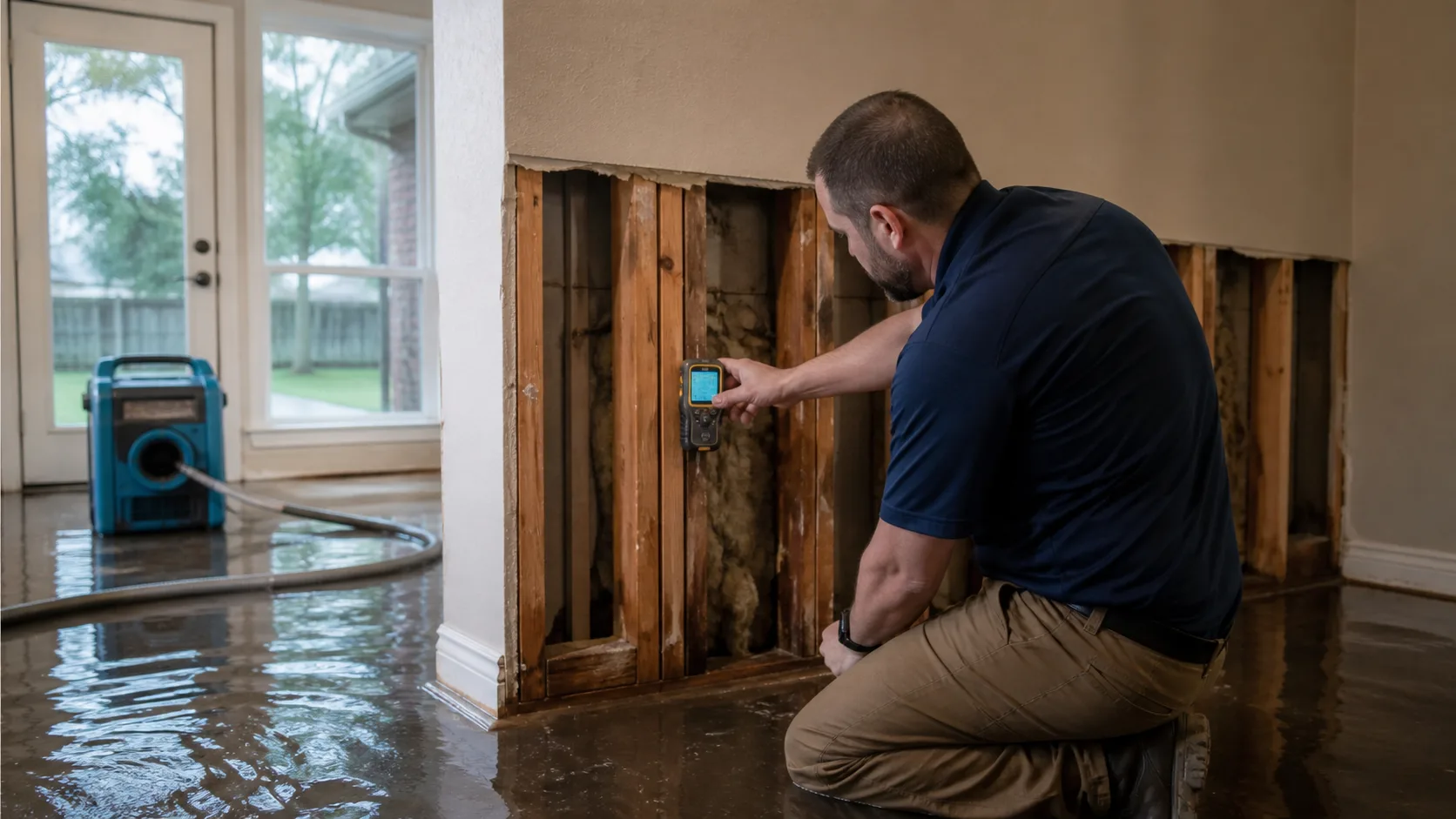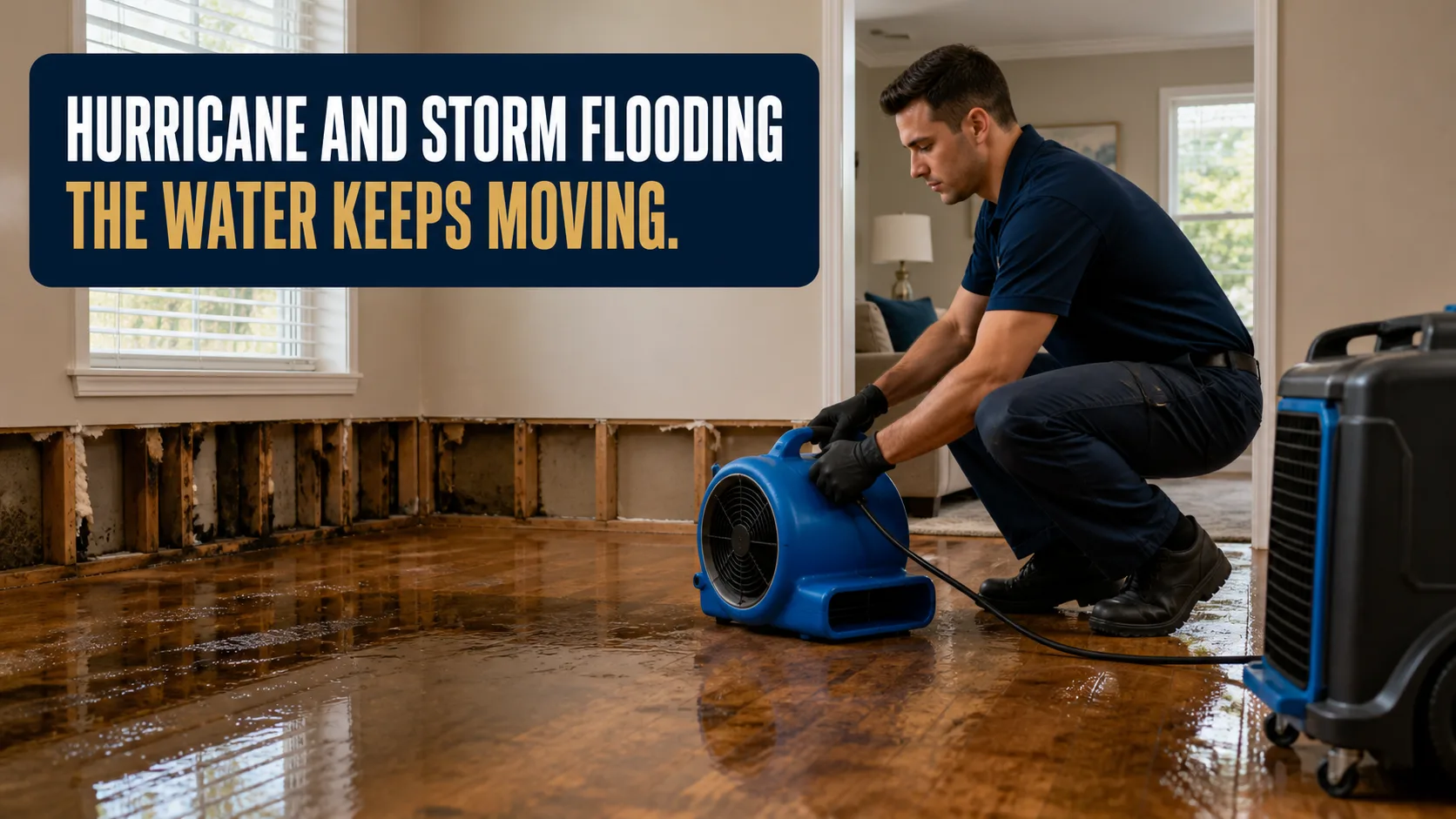
Safety first — stay out of standing water near outlets or the panel, and cut power only if you can do it safely. Then document everything with photos and video, get people and pets out of the water, and start removing water and contaminated contents. Treat storm floodwater as **contaminated ("black") water**: wear protection and discard porous materials it soaked. Critically, standard homeowners insurance usually does **not** cover outside flooding — that needs a separate flood policy. Call **(346) 271-7004** and we'll help you dry it out safely.
Why storm flooding is different from a pipe leak
A burst pipe is clean water you can often dry in place. Storm and hurricane floodwater is the opposite: it comes from outside, carrying sewage, chemicals, bacteria, and debris. That makes it Category 3 “black water,” which changes the rules — most porous materials it touches (carpet, pad, drywall, upholstered furniture) can’t be disinfected and have to be removed, not dried. Handling it safely means protection, aggressive removal, and disinfection, not just extraction and fans. It has more in common with a sewer backup than a supply-line leak.
The insurance surprise most Houston homeowners hit
Here’s the hard truth people learn after a storm: your homeowners policy almost certainly excludes flooding from outside. Rising water, storm surge, and bayou overflow are covered only by a separate flood policy — federal (NFIP) or private. Wind-driven rain that enters through a storm-damaged roof may fall under homeowners. Because that line decides who pays, document the water’s source and path carefully, and check both policies. Houston’s flat terrain, clay soil, and bayou network mean flooding reaches homes well outside mapped flood zones — Harvey proved that. Being “not in a flood zone” is not the same as being safe. More on the coverage line: does insurance cover water damage.
Warning signs the water went further than the water line shows
The stain on the wall is where the water stopped rising. It is not where the water stopped going.
It climbed higher than the mark:
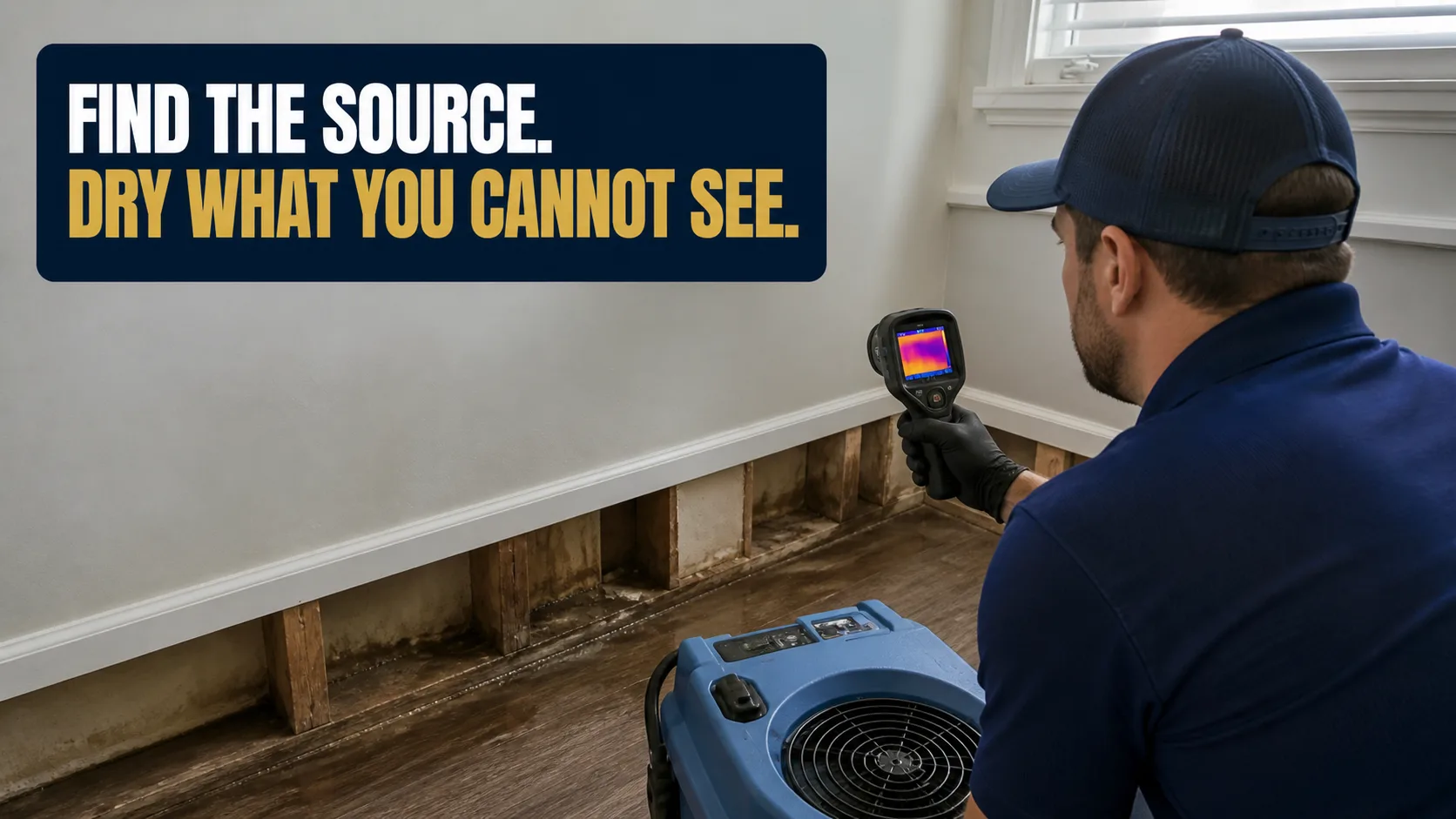
- A wet line on the drywall that keeps creeping up for two days after the water receded — wicking pulls floodwater a foot or more above the visible mark
- Insulation in the cavity slumping, or the wall sounding dull instead of hollow when tapped
- Baseboard and door casing swelling and separating at the miters
It went sideways and down:
- Cool, heavy carpet in a room the water never visibly reached
- Vinyl plank lifting at the seams, or a tile that sounds hollow underfoot
- Cabinet kicks and the bottom shelf of a vanity holding standing water hours later
The contamination is doing its work: silt lines, a sewage smell, or a slick film on hard surfaces. Storm water outside a house is Category 3 water inside it, and the category does not improve as it sits.
The building is unsafe: a sagging ceiling, a buckled floor, or a submerged panel or outlet. None of those are a wait-and-see.
What to do, in order
- Safety. No standing water near electricity. Cut power safely or call the utility. Watch for weakened floors and displaced hazards.
- Document before you remove. Photos and video of every room and the water line — this is your flood claim.
- Protect yourself. Boots, gloves, covered cuts. Keep kids and pets out of the water.
- Remove water and contaminated contents. Extract, then pull soaked porous items to the curb (photograph them first).
- Flood-cut and disinfect. Wet drywall comes out above the water line, insulation out, structure cleaned and disinfected.
- Dry and verify. Commercial dehumidifiers and air movers until a meter says the framing and subfloor are dry. (346) 271-7004.
What to check yourself once it is safe
Boots, gloves, and nothing barehanded.
- Photograph the water line before you touch anything, in every room, with something for scale in the frame.
- Mark the high water line on the wall in pencil and date it. It is the single most useful measurement in the whole claim, and it disappears the moment demolition starts.
- Check the wall four feet up, not just at the line. Press with a flat palm above the mark. Wicking climbs, and where it stops is where the flood cut goes.
- Look under and behind the cabinets with a flashlight. Kicks and vanity bases hold water for days after the floor looks dry.
- Note whether the water came in or came up. Water through a door or a wall is intrusion. Water rising from a floor drain or a toilet at the same time is a sewer surcharge, and that is a different coverage question.
- Photograph every discarded item with the date stamp on before it goes to the curb. Contents claims are settled from photos, and a pile at the street is not a photograph of a sofa.
What storm flood cleanup costs
Removal drives the number here, not drying. That is the difference between this and a clean-water loss.
- How high it got. Cost scales with the flood cut height, because the cut is priced by the running foot of wall.
- How much porous material is in the path. Carpet and pad, drywall, insulation, cabinet boxes, and upholstered contents come out rather than getting dried. That removal is the biggest line.
- Whether the water was contaminated, which it almost always is outdoors, adding cleaning and antimicrobial treatment to every surface that stays.
- Building age. Pre-1980s texture and joint compound get sampled before demolition, and a positive asbestos result moves that work to a licensed abatement contractor.
- Contents volume and where they went. Pack-out, cleaning, and storage are a separate scope from the structure.
Expect a whole-floor flood cut with removal and drying to run into five figures on a typical single-story Houston house, and further once contents and a rebuild are added.
How long a flooded house takes
One to two weeks for the mitigation on a single-story home: demolition and removal first, then cleaning and antimicrobial treatment, then structural drying. Two to four weeks once several rooms, a second story, or a slab-level source is involved. The rebuild that follows is longer than all of it, and after a named storm it is longer still, because every contractor in the region is booked the same week.
Readings decide, not the calendar. Framing, bottom plates and subfloor get metered daily until they hit dry standard, and nothing gets closed up before that. On a Category 3 loss the removal record matters as much as the readings — smell fading is not a clearance test.
What NOT to do
- Don’t wade into water near electrical outlets or a submerged panel. Get it de-energized safely first.
- Don’t try to save contaminated porous materials. Drying sewage-touched carpet or drywall risks your health; it comes out.
- Don’t assume homeowners covers it. Check your flood policy — and if you don’t have one, this is the reason to get one before next season.
- Don’t close walls back up wet. In Houston humidity, that’s a mold guarantee.
The free things worth doing tonight
- Mark and date the high water line in every room, and photograph it.
- Get contents up and out — anything porous that can still be saved, plus documents, photographs, and electronics.
- Pull carpet and pad back off the wet edge if you can do it with gloves on. It is the fastest single thing that shortens the dry-out.
- Take the baseboards off. They cap the wettest part of the wall.
- Run the AC if you have power, not open windows. In Gulf Coast air, opening the house adds moisture rather than removing it — dew point decides that, not temperature.
- Find both declarations pages, homeowners and flood, and read what each one covers. They are two different policies with two different adjusters.
- Report to both carriers in writing today and keep the confirmations. Flood claims run on their own deadlines.
Before next season, the preparation list is in hurricane season water damage prep.
Where the adjuster and the rebuilder end and we begin
TruePoint Restoration is a mitigation and remediation contractor. We are not a public adjuster and we do not negotiate your claim for you. We do not repair roofs, pipes, HVAC, or electrical systems, and we are not the general contractor who rebuilds your kitchen and re-hangs your drywall. Those are separate trades, and after a named storm they are separate waiting lists — which is exactly why the mitigation should not wait on any of them.
What we do is the part with a clock on it: extraction, removal and bagging of contaminated porous material, flood cuts at the right height rather than a guessed one, cleaning and antimicrobial treatment of what stays, structural drying with logged daily readings, and a documented file — category of loss, water line, affected materials, disposal records, daily readings — that both of your carriers work from and that a buyer’s inspector may ask about years from now.
Call (346) 271-7004. We work out of Pearland and serve Manvel, Friendswood, League City, Pasadena, Sugar Land and the Greater Houston area.