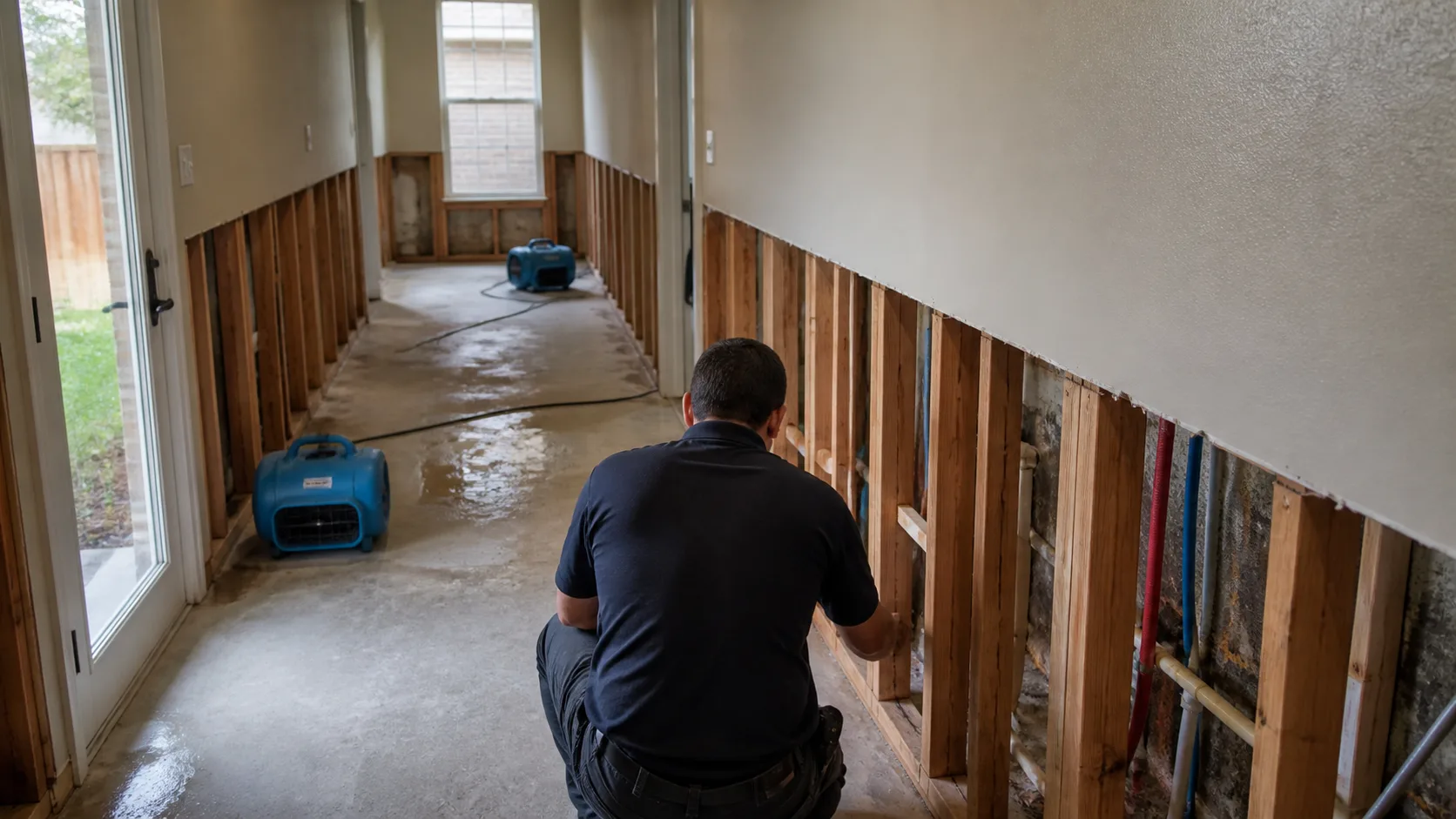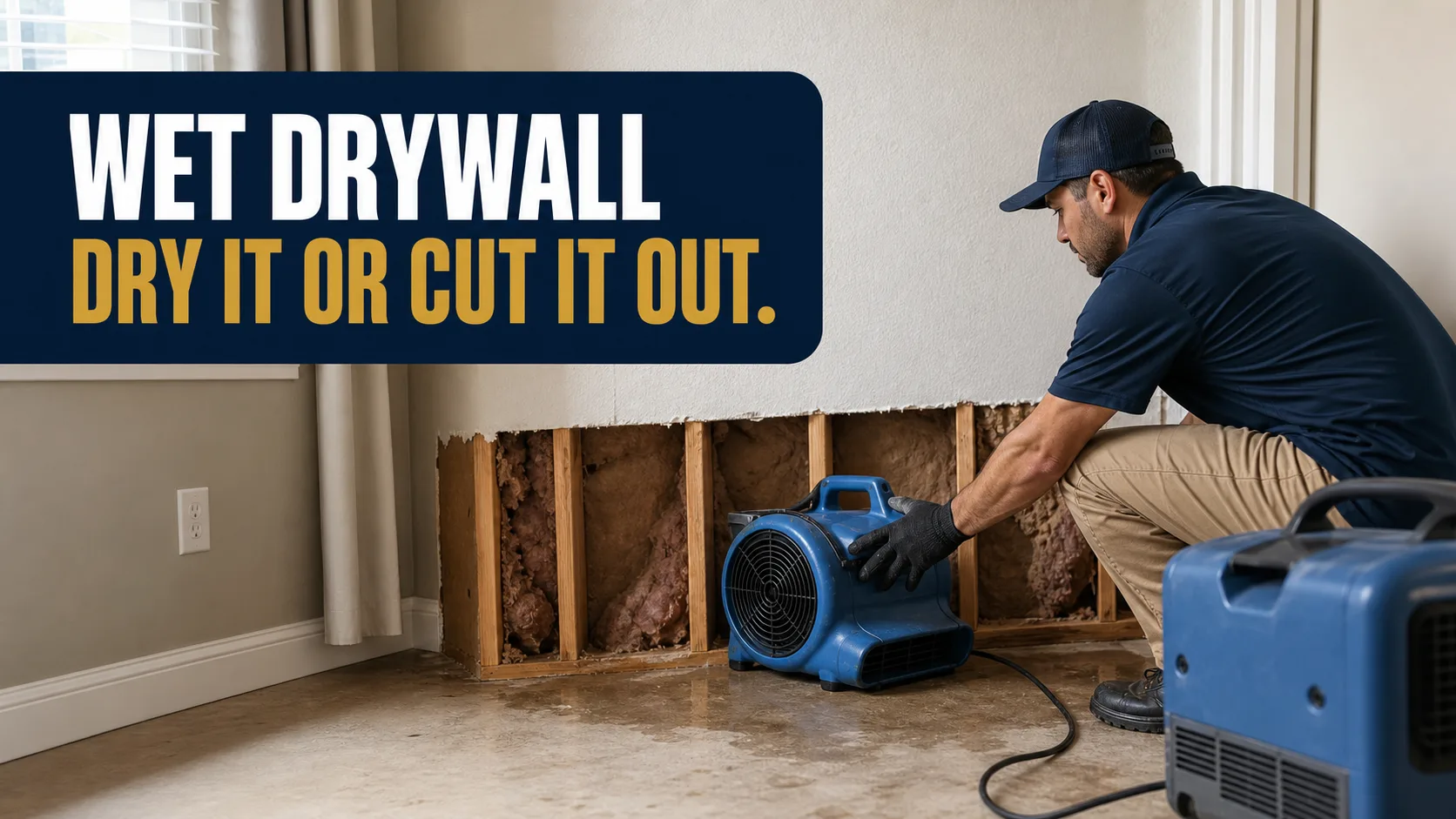
Wet drywall can sometimes be saved — if it was only briefly wet with **clean** water, is still firm, and you dry it fast with air movers and a dehumidifier. Remove it if it's soft, sagging, crumbling, stained through, wicked high up the wall, or was touched by contaminated water. Because drywall's paper facing is ideal mold food, the dry-or-remove call has to happen within 24–48 hours in Houston. Not sure which you've got? Call **(346) 271-7004**.
Why drywall is a special case
Drywall is a gypsum core wrapped in paper. The paper is the problem: it’s an excellent mold food, and once the gypsum core saturates, it loses structural strength and doesn’t fully recover. So the question isn’t just “can it dry” — it’s “will it still be sound and mold-free after it dries.” That’s a higher bar than it sounds.
Two factors decide it: how long it was wet, and what kind of water touched it.
The water category decides a lot
- Category 1 (clean water) — a supply line, a fresh overflow. Firm, briefly-wet drywall dried fast can often stay.
- Category 2 (gray water) — appliance discharge, some overflows. Usually removed where saturated.
- Category 3 (black water) — sewage or ground floodwater. Contaminated drywall is removed, no exceptions — you can’t disinfect the inside of a wall cavity.
Warning signs the wall is wetter than its face suggests
Drywall dries from the outside in, so the painted face is the last surface to tell you the truth.
The cavity is still holding water:
- A wet line that sits higher tonight than it did this afternoon — wicking climbs, and a climbing line means the bottom plate is saturated
- Baseboard that has swelled, cupped, or pulled a fraction away from the wall
- Paint or wallpaper bubbling in a band along the floor, or a seam of tape lifting
The core is already compromised:
- A thumb press that leaves a dent, or a face that feels cool and slightly giving
- Screw or nail heads dimpling through the paint as the board sags off them
- A chalky, gritty residue at the cut edge, which is gypsum that has lost its bind
Something is growing behind it: a musty smell in a closed room, a grey or dark shadow bleeding through the paint, or discoloration in the corner where two walls meet the floor.
When wet drywall can be dried in place
- It’s still firm, not soft or crumbling.
- The water was clean and recent (caught within a day).
- The cavity behind it can be opened and dried — baseboards off, weep holes drilled, air moving inside the wall, wet insulation removed.
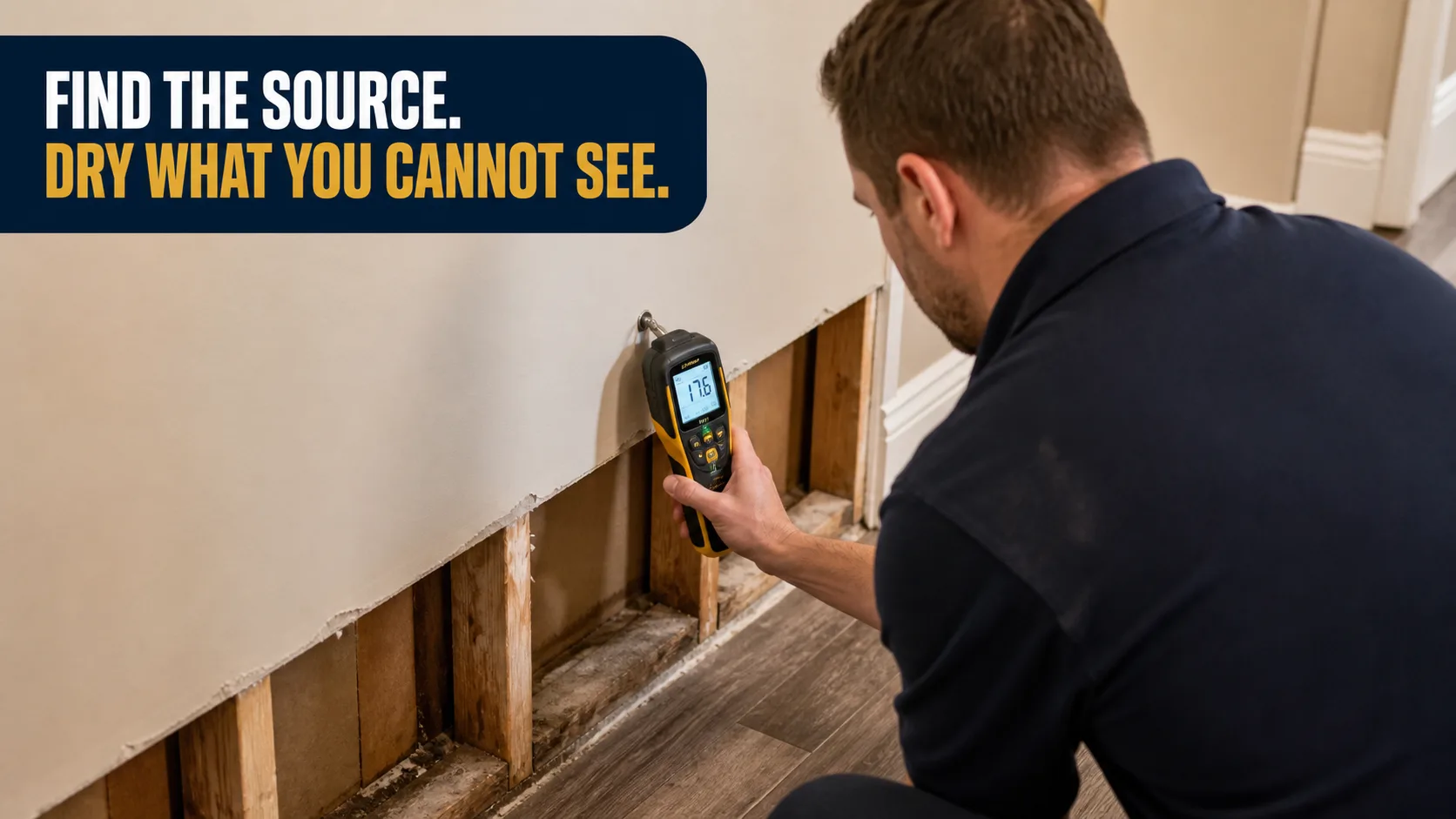
- A moisture meter confirms it’s actually returning to dry, not just feeling dry on the face.
When it has to come out
- Soft, sagging, bulging, or crumbling — the core is compromised.
- Wicked high up the wall (the moisture line keeps climbing days later).
- Wet insulation behind it (which holds water and usually can’t be dried in place).
- Any contaminated-water contact.
- It stayed wet long enough that mold is a real risk — in Houston, that’s fast.
The common method is a flood cut: removing drywall in a straight line above the wet zone so the cavity dries, wet insulation comes out, and new drywall installs cleanly.
How to read your own wall tonight
You do not need a meter for the first pass. You need a flat palm, a flashlight, and ten minutes.
- Press with a flat palm, low and high. Start at the floor line and work up in four-inch steps until the wall feels normal. Mark the change with painter’s tape — that is your wet line.
- Repeat it in three hours. A line that has climbed means water is still moving up the board and the cavity is full.
- Check the other side of the wall. Water crosses through the bottom plate into the next room, and the far side is often wetter than the side you found first.
- Pull one baseboard at the wettest point and look behind it with a flashlight. The back of the board and the drywall behind it show wet and growth long before the painted face does.
- Feel the carpet or flooring for two feet out from the wall. Cool and heavy means the water went down as well as up.
- Photograph the taped wet line with the date stamp on, then photograph it again tomorrow at the same height. Two dated photos of a line that moved is the clearest evidence of an active loss anyone can produce.
When the house was built changes the scope
Two building-era facts change who may legally open a wall, and both are common across older Houston neighborhoods.
Asbestos. Joint compound, wall texture, and popcorn ceiling texture in homes built or renovated before the early 1980s can contain asbestos. Cutting, sanding, or scraping that material makes it airborne. On a pre-1980s house, the material gets sampled and tested before demolition, and a positive result moves the removal to a licensed abatement contractor working under its own containment.
Lead. Paint in homes built before 1978 can contain lead, which puts renovation work under federal lead-safe work practice rules.
Neither one stops the job. Both change the order, the containment, and who holds the license — and both are cheaper to find out about with a sample than with a stop-work notice.
What a flood cut and dry-out costs
Priced by linear feet of wall, not by the size of the stain.
- How much board comes out. A flood cut is charged by the running foot of wall at a set height. A two-foot cut down one wall is a small number. The same cut across a whole floor plan is not.
- Whether the insulation goes. Wet fiberglass or cellulose in the cavity comes out with the board. It will not dry usefully in Gulf Coast humidity.
- Water category. Clean water can be dried in place if you catch it fast. Contaminated water means removal, and category degrades with time, so the same water is a worse category on day three.
- Testing and abatement on a pre-1980s house, if the texture or compound tests positive.
- Equipment days, because the cavity has to reach dry standard before new board goes on.
The rebuild — hanging, taping, texturing and painting the new board — is a separate contractor and a separate invoice. Pricing structure is in what mitigation costs in Houston.
How long wet drywall takes
Two to four days for surface-wet board with an open, ventilated cavity. Four to seven days once the insulation is out and the framing and bottom plate are the materials being dried. Removal changes the shape of the schedule rather than the length — cutting the board out shortens drying and adds rebuild time on the back end.
Readings decide, not the calendar. The bottom plate and the studs get metered daily, and the wall gets closed after they hit dry standard. A wall closed on a schedule instead of a reading is a musty smell in six weeks.
Does insurance pay for wet drywall?
Usually, when the water event itself is covered and you acted promptly. Carriers pay for the resulting damage — the removal, the drying, and the replacement of the board — rather than for the failed part that let go.
Two things decide how completely it pays. Documentation: dated photos of the wet line, daily moisture logs, and a record of what came out and why. And speed, because a wall that stayed wet long enough to grow mold gets read as a maintenance issue rather than a sudden one, and mold carries its own sublimit or exclusion in most Texas policies. What denials usually turn on is in water damage claim denied.
What NOT to do
- Don’t paint or seal over it while it’s damp. You trap moisture and mold behind a fresh coat of paint.
- Don’t leave the baseboards on. They cap the wettest part of the wall and stop the cavity from drying.
- Don’t “wait and see.” Drywall’s mold window is 24–48 hours; waiting is choosing removal later instead of a possible save now.
For the full timeline behind these decisions, see how long water damage takes to dry and mold after water damage.
The free things worth doing tonight
- Stop the source, or shut the valve feeding it.
- Take the baseboards off the wet run. They cap the wettest part of the wall and stop the cavity from breathing.
- Tape the wet line and date it, then photograph it.
- Pull carpet and pad back off the wet edge so the slab or subfloor underneath is exposed to air.
- Run the AC, not open windows. On a humid Houston day the outdoor air carries more moisture than the indoor air, so opening up adds water to the room instead of removing it. Dew point decides that, not temperature.
- Get furniture off the wet floor and put foil or blocks under legs that have to stay.
- Do not put a space heater on a wet wall. Fast surface heat drives moisture deeper into the cavity instead of out of it.
Where the drywall contractor begins and we end
TruePoint Restoration is a mitigation and remediation contractor. We do not hang, tape, float, texture, or paint new drywall, we do not repair the pipe or the roof that soaked it, and we are not a public adjuster. The rebuild is a separate trade with a separate contract, and we say that on the phone rather than after the estimate.
Our part is the decision and the dry-out: metering the board, the plate and the studs to find the real edge of the loss, cutting only what has to come out, bagging contaminated material at the source, drying the cavity to a documented standard with daily readings, and handing you the file — category of loss, affected materials, moisture logs, disposal records — that your adjuster and your rebuild contractor both work from.
Call (346) 271-7004. We work out of Pearland and serve Manvel, Friendswood, League City, Pasadena, Sugar Land and the Greater Houston area.