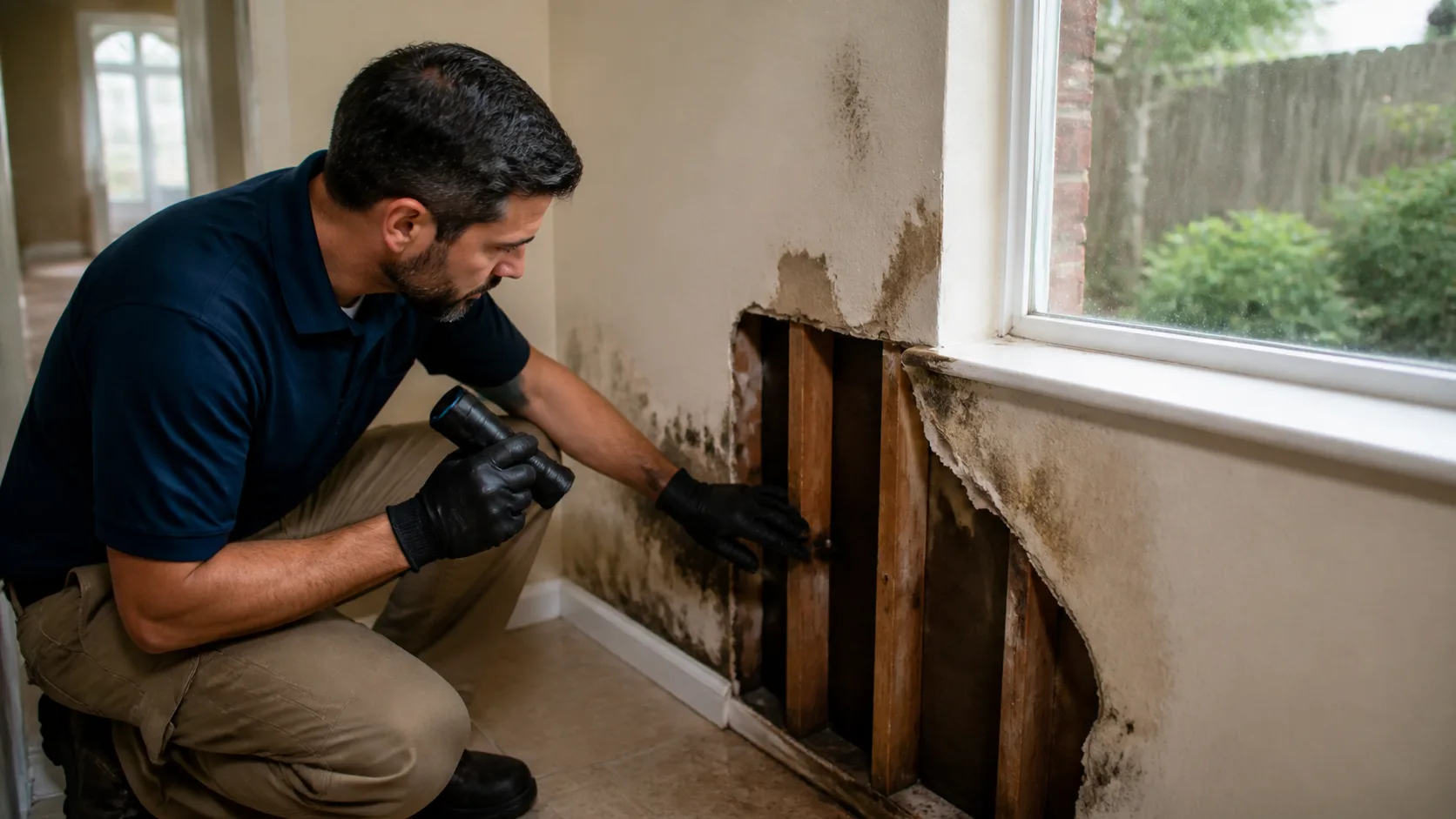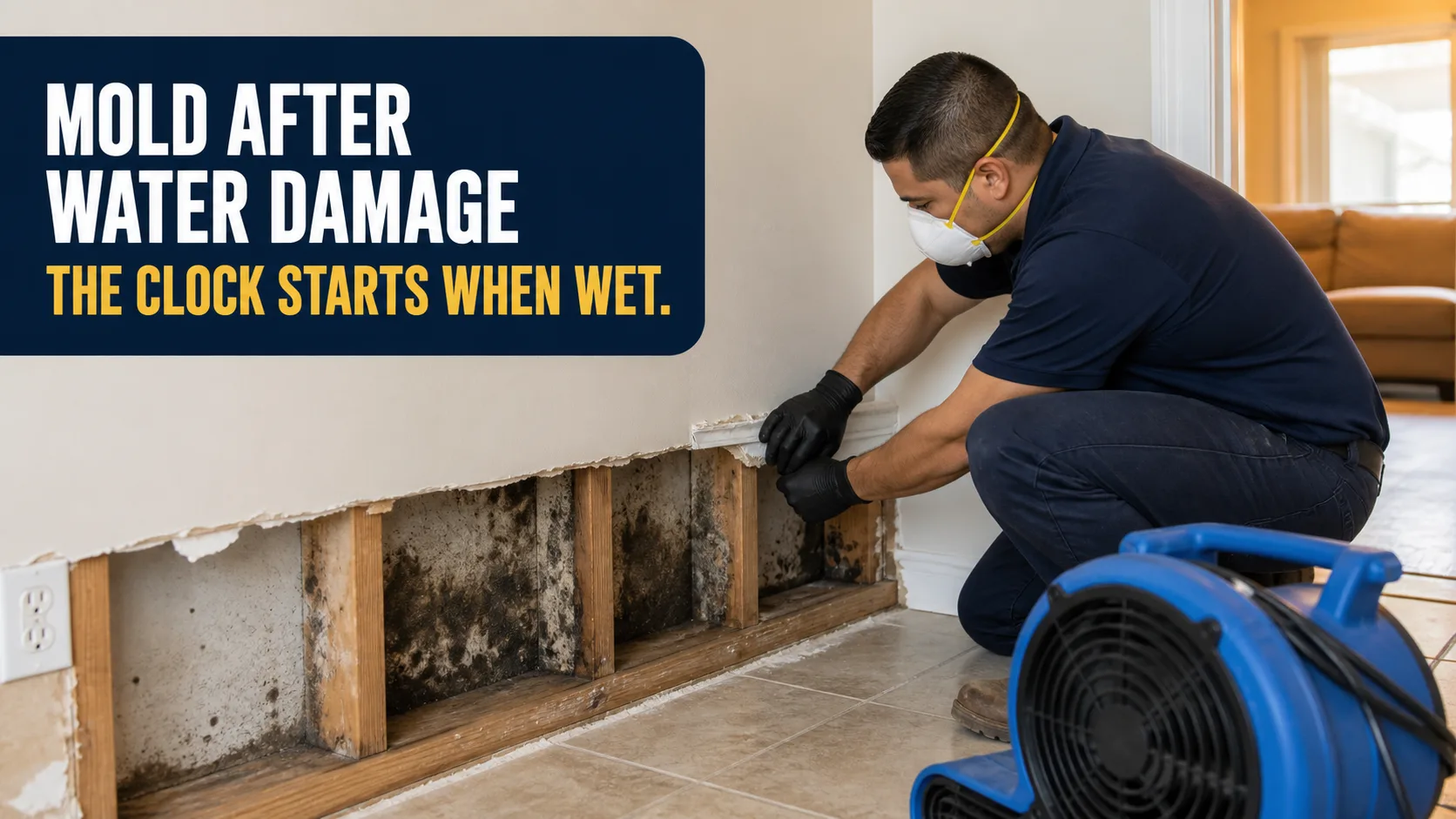
Mold can start growing within **24 to 48 hours** of materials staying wet, and Houston's humidity is close to ideal for it. The spores are already in your home — they only need moisture and time. That is why the single most important thing after any leak is drying everything completely and fast, including the water you cannot see inside walls and under floors. If materials are still wet a day later, treat it as a mold risk and call **(346) 271-7004**.
Why Houston is a mold-friendly city
Mold needs three things: spores (always present), a food source (drywall, wood, dust — always present), and moisture. In a dry climate, a wet wall might dry on its own before mold gets going. On the Gulf Coast, the outdoor humidity that fogs your windshield in the morning is the same humidity that keeps a wet wall cavity wet for days. That extra drying time is exactly the window mold needs.
So the mold question is really a moisture question: how fast and how completely did everything dry?
The 24-to-48-hour window
- 0–24 hours: spores settle on wet surfaces. Nothing visible yet.
- 24–48 hours: colonization begins in the warmest, wettest, darkest spots first — inside wall cavities, under flooring, behind cabinets.
- 3–14 days: visible growth and a musty smell appear; by now it is usually in places a towel never reached.
Everything about a good water-damage response is built around beating that first window. It is why we push extraction and commercial drying hard in the first day, and why “it looks dry on top” is not the same as dry.
How to check for mold after water damage
- Smell. A persistent musty, earthy odor is often the first sign — frequently before anything is visible. If you can smell it, moisture is feeding something. (More on this: the musty smell that won’t go away.)
- Look at the edges. Discoloration at baseboards, ceiling corners, grout lines, and the bottom of drywall. Mold starts where water pools and lingers.
- Touch for soft or warped material. Spongy drywall, cupped flooring, and swollen trim all mean water sat there.
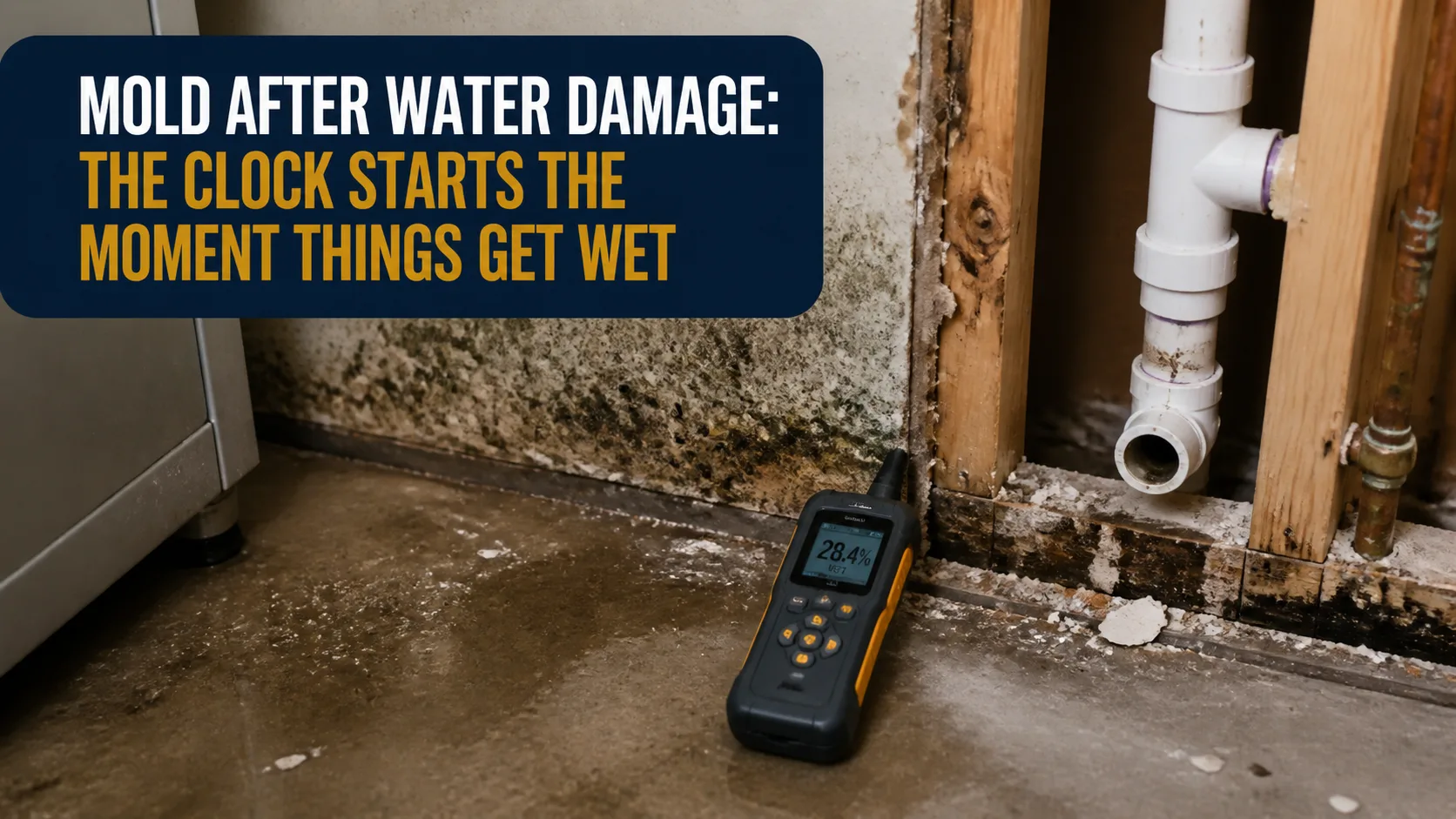
- Meter the cavity. The reliable test is a moisture meter on the wall bottoms and subfloor. Materials that still read wet days later are a mold risk whether or not you see growth.
Warning signs it has already started
The window closes quietly. These are the signals that it has.
The room tells you first:
- A musty, earthy smell that is strongest after the house has been closed up all day
- An odor that returns within an hour of airing the room out
- Symptoms that ease within an hour of leaving and come back on the way in
The materials tell you next:
- Discoloration at the bottom four inches of drywall, in the floor corner where two walls meet, or along a grout line
- Drywall that dents to a thumb press, or a baseboard that has swelled and lifted
- A cabinet kick or a vanity base that is soft at the bottom
The air system tells everyone: a musty smell that arrives when the AC starts, or a filter loading grey faster than it used to. In Houston the air handler usually sits in the attic, which puts the source upstream of every room in the house.
A burned house is a mold risk too. Fire-hose water plus an open roof or broken windows plus Gulf Coast humidity is the fastest growth condition there is, which is why a fire-damaged house gets dried and secured rather than left standing open — the sequence is in what to do after a house fire.
What to do to stop mold from starting
- Extract now. Every gallon of standing water removed is drying time saved.
- Move air and pull humidity. Commercial air movers plus a dehumidifier; run the AC to help drop indoor humidity.
- Open the wet cavities. Remove baseboards and drill or remove sections where water is trapped so the inside can dry, not just the surface.
- Remove what can’t be saved. Saturated carpet pad and soaked drywall hold water and mold; drying them in place rarely works. Cutting them out is faster and safer.
- Don’t close up until it’s measured dry. Sealing a damp wall traps the exact conditions mold needs.
Who is allowed to do the work in Texas
Once mold has started, area decides who may legally handle it. Texas mold assessment and remediation rules apply above roughly 25 contiguous square feet of affected material — about a four-by-six patch, which a wall cavity passes easily.
- Independence is required. The licensed consultant who writes the protocol and verifies the result cannot be the firm doing the removal. Anyone offering to inspect, remediate, and clear their own licensed-size job is describing an arrangement the rules do not allow.
- The project ends with a Certificate of Mold Damage Remediation, and that certificate follows the property. Keep it in your closing file — a buyer’s agent will ask for it, and its absence on a house with a known mold history is a live problem at resale.
- Below the threshold, a homeowner or a general contractor may handle it, which is exactly why moving fast on the water matters. Staying under 25 square feet is a speed question, not a luck question.
What it costs once mold has started
The number moves from drying to removal, and removal is more expensive than drying.
- Affected area, measured on the material rather than on what shows. Growth spreads inside a cavity further than it does on the painted face.
- Whether the job crosses the licensing threshold, which adds a consultant’s protocol, a containment build, and post-remediation verification on top of the removal.
- What comes out. Drywall, insulation, carpet pad and cabinet kicks are removed rather than cleaned. Framing and subfloor are cleaned and dried in place.
- Access. An attic, a crawl space, or a wall behind a tiled shower costs more to reach than an open bedroom wall.
- Contents. Porous items that grew mold are cleaned, or they are not saved.
Catching the same loss inside the first day is usually a drying invoice. Catching it in week three is a remediation invoice with demolition, containment, and a rebuild behind it. The line items are in the mold remediation cost breakdown.
How long remediation takes
Two to four days for a contained single-wall job: containment, removal, cleaning, then drying the structure behind it. One to three weeks for a licensed multi-room project, because the protocol, the containment build, the removal, and the clearance sample each take their own time and nothing gets closed up before the sample comes back.
Readings decide, not the calendar, and smell decides nothing. Odor drops off the moment the bulk material leaves the building while whatever soaked into a bottom plate stays exactly where it is. The job ends when the affected materials read dry standard on a meter and — on a licensed project — an independent consultant signs off.
What NOT to do
- Don’t just paint or bleach over it. Surface treatment on a wall that is still wet inside hides the problem while it grows.
- Don’t assume “dry to the touch” means dry. The subfloor and wall cavity hold water long after the surface feels fine.
- Don’t wait to “see if it smells.” By the time it smells, the window has usually already closed.
The insurance angle homeowners get wrong
Here is something most people never hear until it costs them: the word “mold” changes how an insurer reads your claim. Because mold is associated with long-term, gradual damage — which policies generally do not cover — leading with it can get a claim flagged for possible denial. The honest framing is to report the sudden event (the burst pipe, the overflow) and the prompt action you took. Fast, documented drying is what keeps your loss in the “sudden and accidental” category that is actually covered. We walk homeowners through this on every call — more in what not to say to your insurance adjuster.
The free things worth doing tonight
- Stop the water, or shut the valve feeding it. Everything else is secondary to this.
- Take the baseboards off the wet run and pull carpet pad back off the wet edge.
- Run the AC, not open windows. Houston outdoor air is usually carrying more moisture than the air inside, so opening up feeds the problem — dew point decides that, not temperature.
- Photograph everything with the date stamp on, and write down the hour the water started.
- Close the door on any room that already smells, and stop running fans in it.
Where the plumber and the assessor end and we begin
TruePoint Restoration is a mitigation and remediation contractor. We do not locate or repair pipes, service HVAC, do roofing or electrical work, or act as the rebuild contractor who hangs and paints new drywall, and we are not a public adjuster. On a licensed-size mold project we do not write our own clearance either — an independent consultant does, and that separation is there to protect you rather than to add a step.
What we do is the part with the 24-to-48-hour clock on it: extraction, opening wet cavities, removal of material that will not dry, structural drying with logged daily readings, and — when growth has already started — containment, HEPA filtration, negative air, and removal at the source. You get a documented file: category of loss, affected materials, daily readings, disposal records. That file is what your adjuster settles from, and what a buyer’s inspector may ask about years from now.
Call (346) 271-7004. We work out of Pearland and serve Manvel, Friendswood, League City, Pasadena, Sugar Land and the Greater Houston area.