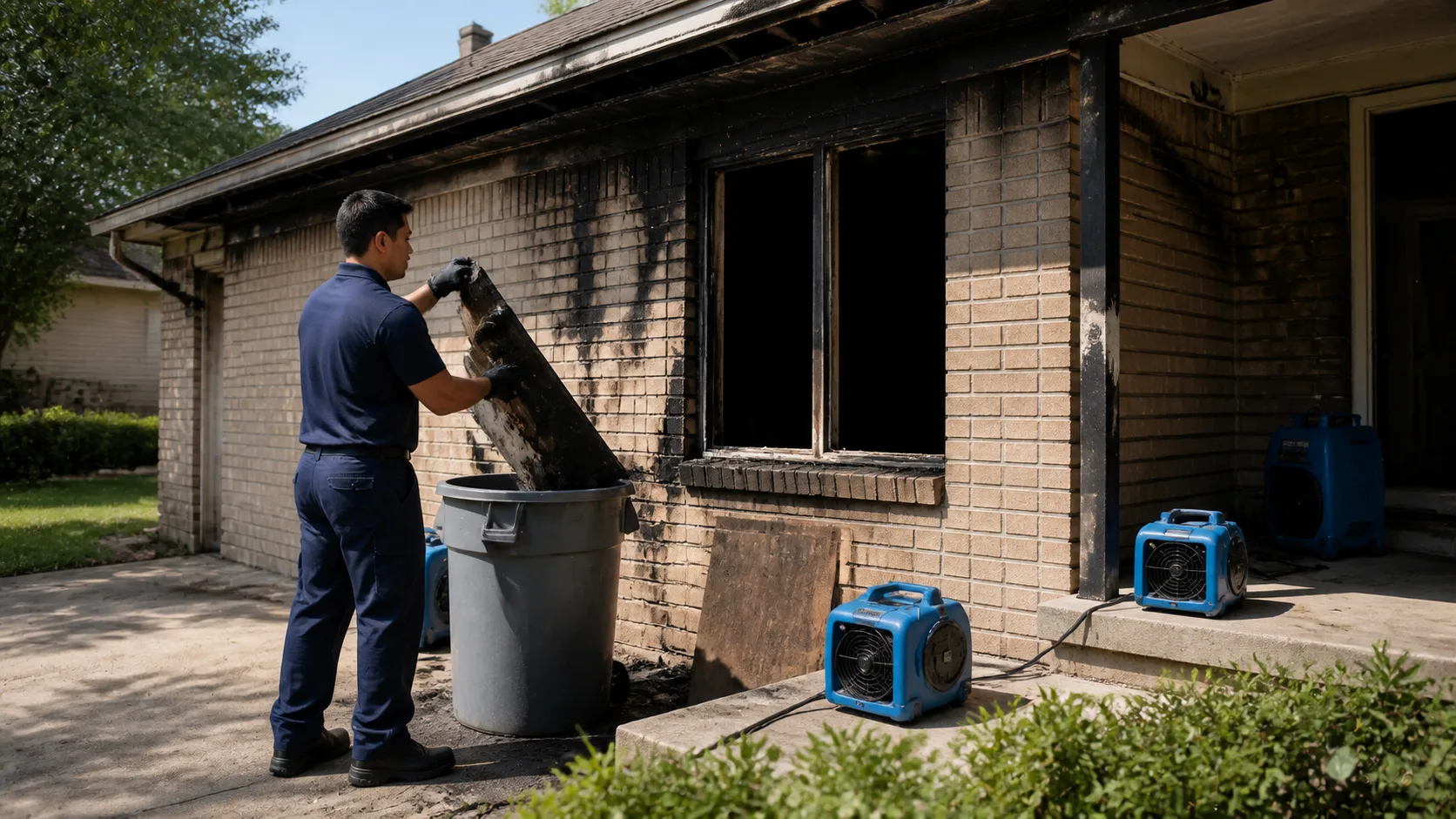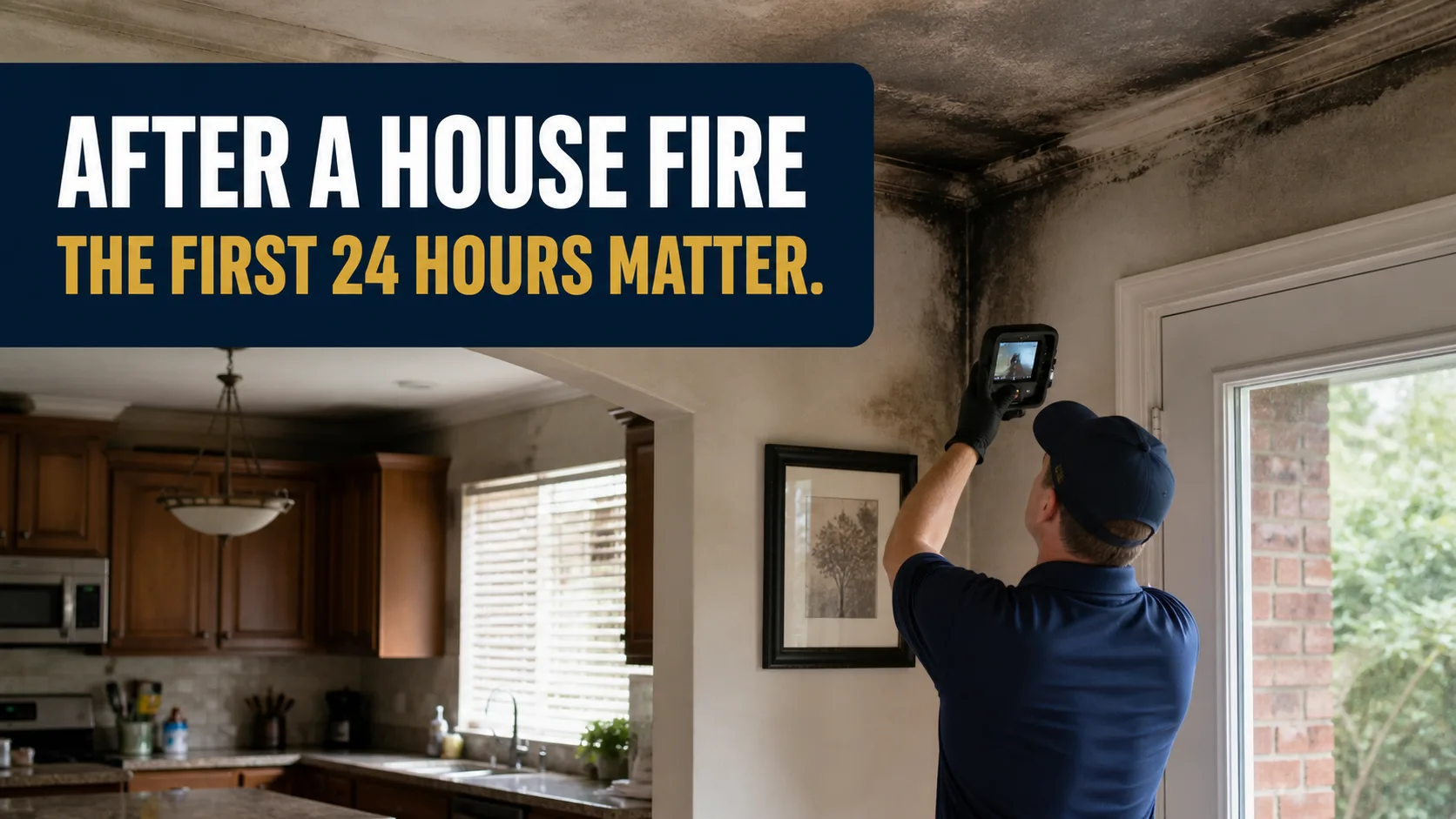
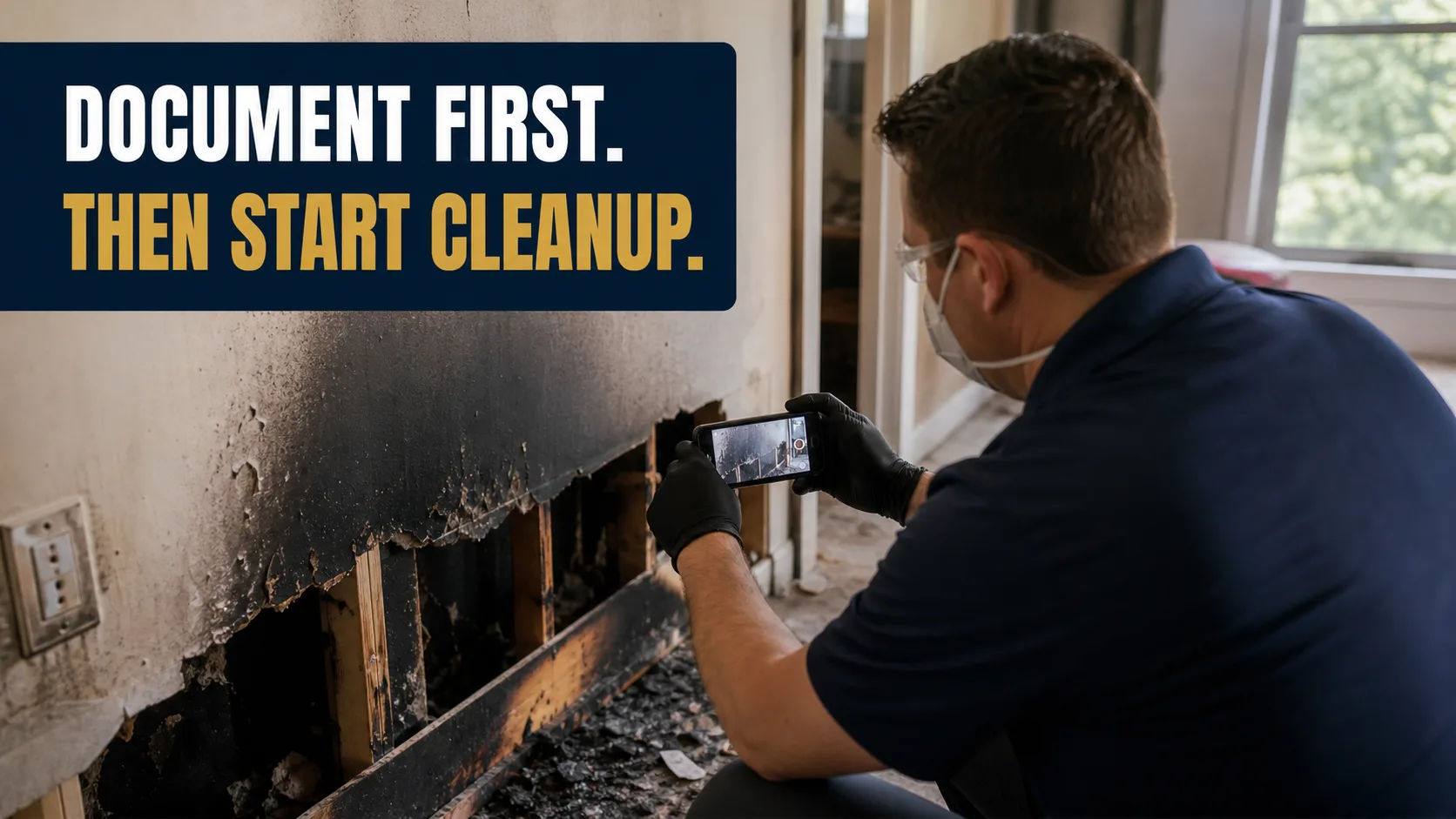
Wait for the fire department to declare the structure safe before you re-enter. Then, before you clean or move anything, photograph and video the whole house, open your insurance claim, and secure the property (board-up, tarp, lock up). Do not wipe soot — it's acidic and smears into a permanent stain. Save every receipt for lodging and essentials under your loss-of-use coverage. For emergency mitigation, call or text **(346) 271-7004**.
First: safety, then the claim
A fire scene stays dangerous after the flames are out. Structural members can be weakened, wiring and gas can be compromised, and air quality can be poor. Do not re-enter until the fire department clears you, and do not turn utilities back on yourself.
Once you’re cleared to approach, the order that protects both your home and your claim is: document, notify, secure.
What not to touch
The instinct is to start wiping soot off the walls. Resist it. Soot is acidic and abrasive, and a dry or damp wipe usually grinds it deeper and spreads it across the surface — a wall that could have been cleaned becomes one that has to be replaced. Cleanup follows a set order, and dry residue removal comes first. Photograph the condition and leave the residue for a crew that handles it in sequence.
Do not run the HVAC either — every cycle pushes residue into rooms that are still clean.
Warning signs the damage went past the room that burned
A fire’s footprint is almost never the burned footprint.
Smoke went where the air went:
- An HVAC filter loaded grey or black that was clean a month ago
- Film on window glass and mirrors far from the fire
- Odor inside closed closets, cabinets, and drawers
Water went where gravity took it:
- Ceiling stains or sagging on the floor below the fire
- Damp carpet at wall bases, baseboards swelling along the bottom inch
Heat went outward: warped vinyl or blistered paint in the next room, melted plastic on switch plates.
Write them down. Undocumented damage tends not to get paid.
Document everything before cleanup
Before anyone moves or cleans a thing, capture the whole house on camera:
- The burned area, wide and close.
- Every room with smoke or soot on walls, ceilings, and contents.
- Standing water and saturated materials from firefighting.
- Damaged belongings, individually where you can.
- A slow video walkthrough, room by room, with your phone’s date stamp on.
This record is the single most valuable thing you can create in the first hours. It’s the backbone of the claim, and it can’t be recreated once cleanup starts.
Secure the property
An open or unlocked structure invites weather and intruders, and further damage after the fire can complicate your claim. Board up broken windows and doors, tarp a compromised roof, and lock what you can. Preventing further damage isn’t optional — your policy expects it, and emergency mitigation like this can begin before the adjuster arrives.
Keep the receipts — emergency protective work is normally reimbursable.
The fire hose problem: why almost every fire is also a water loss
An attack line moves hundreds of gallons per minute, and it keeps flowing until the fire is out — not until the flooring is at risk. That water goes down. Through the burned ceiling, into the floor below, along the top plates of walls, under cabinets where nobody looks.
The fire was upstairs and the expensive problem is downstairs. A crew that only does soot leaves the cavity wet, and two months later a room that never saw flame starts to smell. Genuine 24 hour emergency fire and water damage restoration starts both scopes on day one, the way the first 24 hours of any water damage run.
The fire damage restoration process, in order
- Emergency stabilization — board-up, tarp, temporary power, safety assessment.
- Documentation and scope, room by room, with moisture readings, before work starts.
- Water extraction and structural drying, first, because wet materials cannot be cleaned or sealed and mold after water damage does not wait.
- Debris removal, photographed and itemized on the way out.
- Soot cleaning, dry pass before wet pass, top down — detail in smoke damage cleanup.
- Contents cleaning or pack-out.
- Deodorization, once the source is gone rather than instead of removing it.
- Handoff to reconstruction with a documented file.
What does emergency fire damage cleanup cost?
No honest number exists before somebody walks the house. What moves it:
- How much burned versus how much only took smoke and water
- How many rooms carry residue, nearly always the whole house
- How much water went in, and how long it sat before extraction
- Contents volume, and whether they are cleaned on site or packed out
Emergency mitigation on a small contained residential fire commonly runs in the low-to-mid thousands. A whole-house residential fire damage restoration scope with pack-out and full drying runs into five figures, and the rebuild after it is a separate number.
Fire restoration, smoke mitigation, and the rebuild contractor
Three different jobs, routinely quoted as though they are one.
- Fire damage restoration handles the emergency phase and the structure.
- Smoke and soot mitigation removes residue and odor, dries the firefighting water, cleans contents, and documents it.
- The rebuild contractor replaces what came out — drywall, paint, cabinets, flooring.
The split works the way it does on the water side, where the plumber and the mitigation company do not overlap.
How long does house fire damage repair take?
Mitigation on a contained single-room fire is usually one to two weeks. A whole-house loss runs three to six weeks before reconstruction begins, and the rebuild itself is measured in months.
Readings decide the handoff, not the calendar. Moisture has to hit dry standard and odor has to hold with the house closed up and the HVAC running.
What your policy covers in the first week
Fire is a named peril on virtually every standard homeowners policy, and coverage follows the damage — smoke and soot in rooms that never burned, the water used to put the fire out, and loss of use for temporary lodging. Keep every receipt from the first night.
Two things to understand before the first call: the difference between actual cash value and replacement cost, and what a complete documentation package contains, covered in the fire damage insurance claim guide.
The free things worth doing tonight
- Turn the HVAC off and leave it off until someone has looked at the ducts.
- Photograph and video the whole house with the date stamp on, before anything moves.
- Start a receipt folder — hotel, meals, clothes, board-up, pet boarding.
- Find your declarations page and read the limits, deductible, and loss-of-use section.
- Do not clean anything. This is the item people break, and it costs the most.
Then start mitigation
Almost every fire is also a water loss. The water from hoses and sprinklers grows mold within 24 to 48 hours in Houston humidity, so water removal and drying start right away, alongside the smoke and soot work. Call or text (346) 271-7004 and we’ll tell you what your loss needs — honestly.
Where the fire department ends and we begin
The fire department’s job finishes when the fire is out and the scene is safe. Ours starts there. TruePoint Restoration is not a rebuild contractor — we do not frame, hang cabinets, or repaint the house back to new. What we do is emergency fire damage cleanup and mitigation: stabilizing the property, drying the firefighting water with logged readings, removing soot in the order that keeps materials salvageable, inventorying contents, and building the documented file your adjuster needs.
Send photos to (346) 271-7004. We serve Pearland, Manvel, Friendswood and the Greater Houston area.