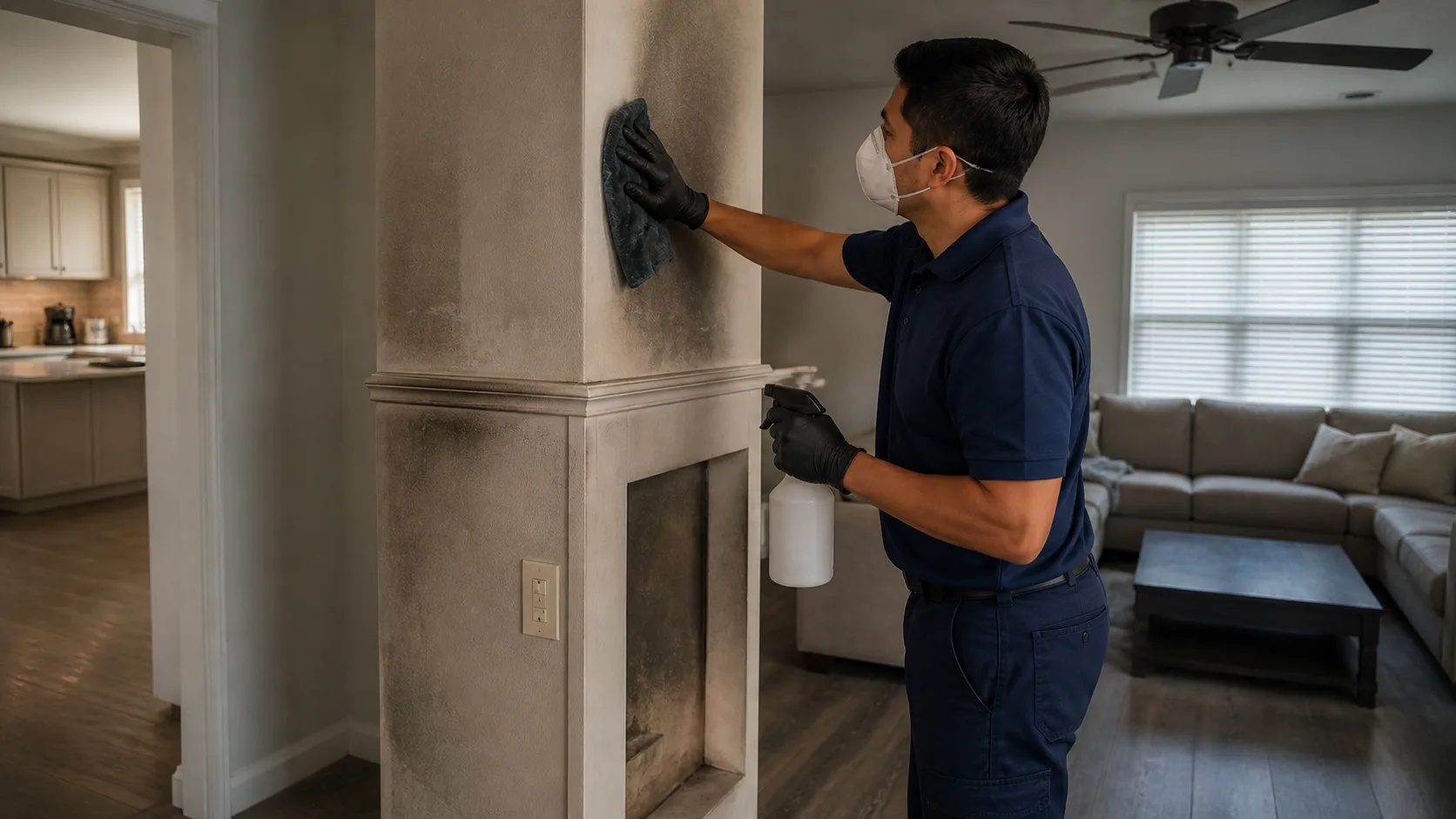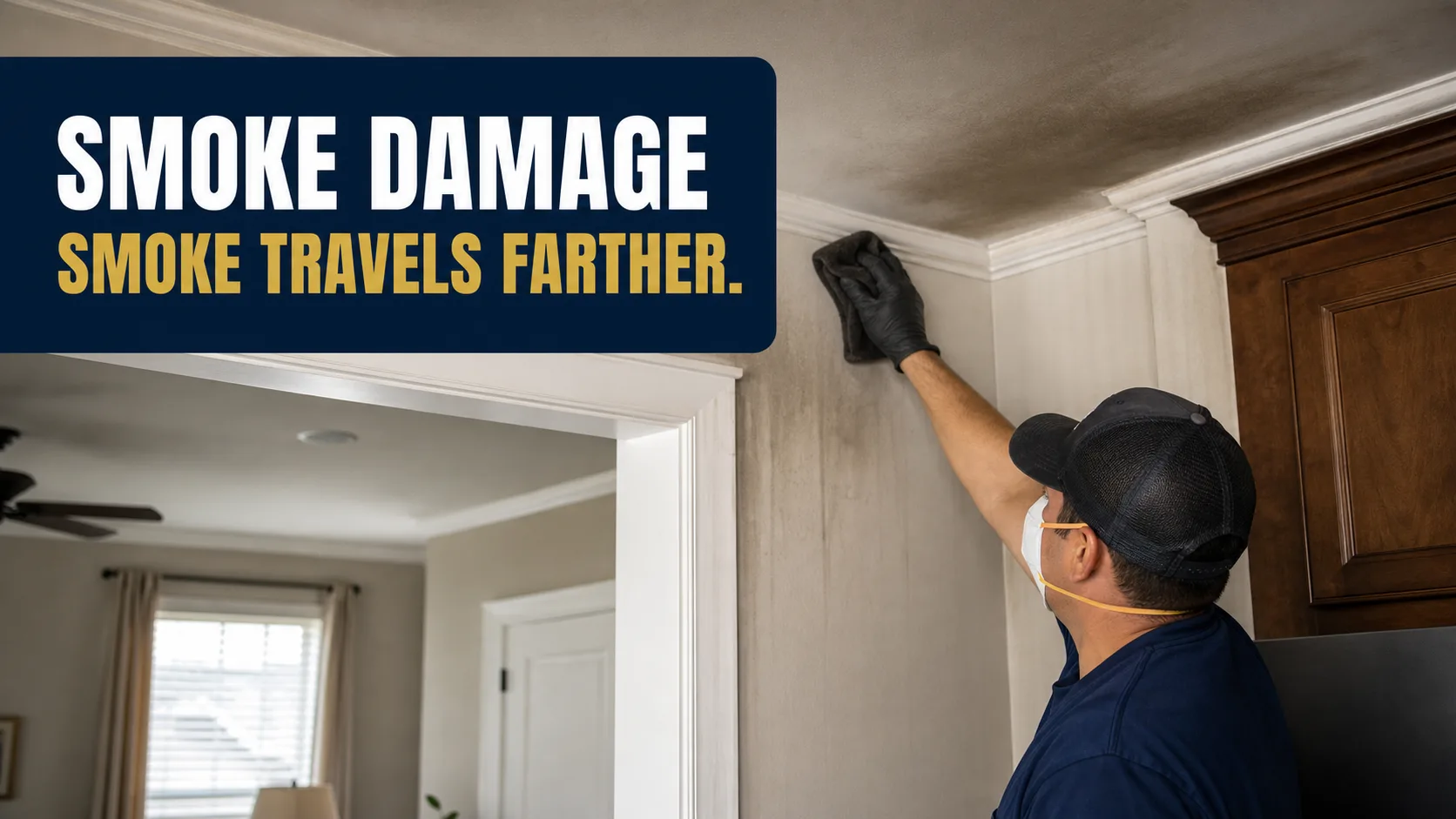
Smoke damage cleanup works in a fixed order: contain the area, remove loose soot with dry methods (HEPA vacuuming and dry chemical sponges) before anything wet touches it, clean each surface with the product matched to its residue type, then deodorize the source instead of masking it. Smoke travels through the whole house and settles far from the fire, so the job is rarely limited to the room that burned. Heavy, greasy, or protein residue is professional work — call or text **(346) 271-7004**.
What smoke damage restoration actually is
Smoke damage restoration is getting combustion residue and its odor out of a building and its contents — including every room the flames never reached. It is not firefighting, and it is not rebuilding. Fire and smoke damage restoration sits between the two: the structure is standing, the residue is everywhere, and it does more damage every hour it sits.
Soot is acidic, so it etches chrome, glass, and paint on a clock rather than at your convenience. Odor bonds into porous materials, so it survives surface wiping. And the residue went wherever the air went.
Why smoke reaches rooms that never saw flames
Smoke follows air and heat. It rides HVAC ducts, slips through gaps around light fixtures and outlets, and settles on cooler surfaces all over the house — the backs of closets, the insides of cabinets, the tops of door frames. That’s why a small, contained fire can leave a film and a smell in every room, and why cleaning only the burned area leaves the house smelling like smoke for months.
Houston construction makes it worse. Most homes here run a central system off one or two returns, so the moment the blower cycles it pulls smoke out of the fire room and pushes it through every supply register — and newer Pearland and Manvel builds are sealed tight enough that what goes in has nowhere to leave.
The first step in real smoke cleanup is a whole-house assessment: where the residue went, and what kind it is.
Where the residue actually lands
High surfaces — heat carried it up:
- Ceilings, especially above the fire and along the path to the nearest doorway
- Crown molding, tops of door frames, and the upper third of every wall
- The upward faces of fan blades and the tops of light fixtures
Cool surfaces — smoke condensed where the temperature dropped:
- Window glass and mirrors, which cool fastest and film first
- Chrome and brass fixtures — the materials soot etches soonest
Enclosed spaces — smoke got in and had nowhere to go:
- Closets, cabinet interiors, drawers, and the back of the pantry
- The HVAC system: return, plenum, ducts, coil, and filter
- Attic insulation, if the ceiling was breached
Porous materials — where the odor lives: carpet and pad, upholstery, mattresses, curtains, drywall and the paper facing behind it, clothing, books, and anything with a fabric surface.
What can you check yourself before anyone arrives?
None of this costs anything, and all of it beats guessing.
- Pull the HVAC filter. Grey loading on a filter that was clean last month proves smoke moved through the system — so the ducts have already delivered it to rooms nobody has walked into.
- Run one dry test stroke. White cotton cloth, one light pass, low on a wall in a room that did not burn. Grey on the cloth is residue. Do not repeat the stroke, and do not use water.
- Smell inside a closed cabinet and a closet. Enclosed air concentrates odor, which is why a house can smell fine at the front door and sharp inside a wardrobe.
- Look behind the picture frames. A clean rectangle is a measurement — the surrounding wall is that much dirtier.
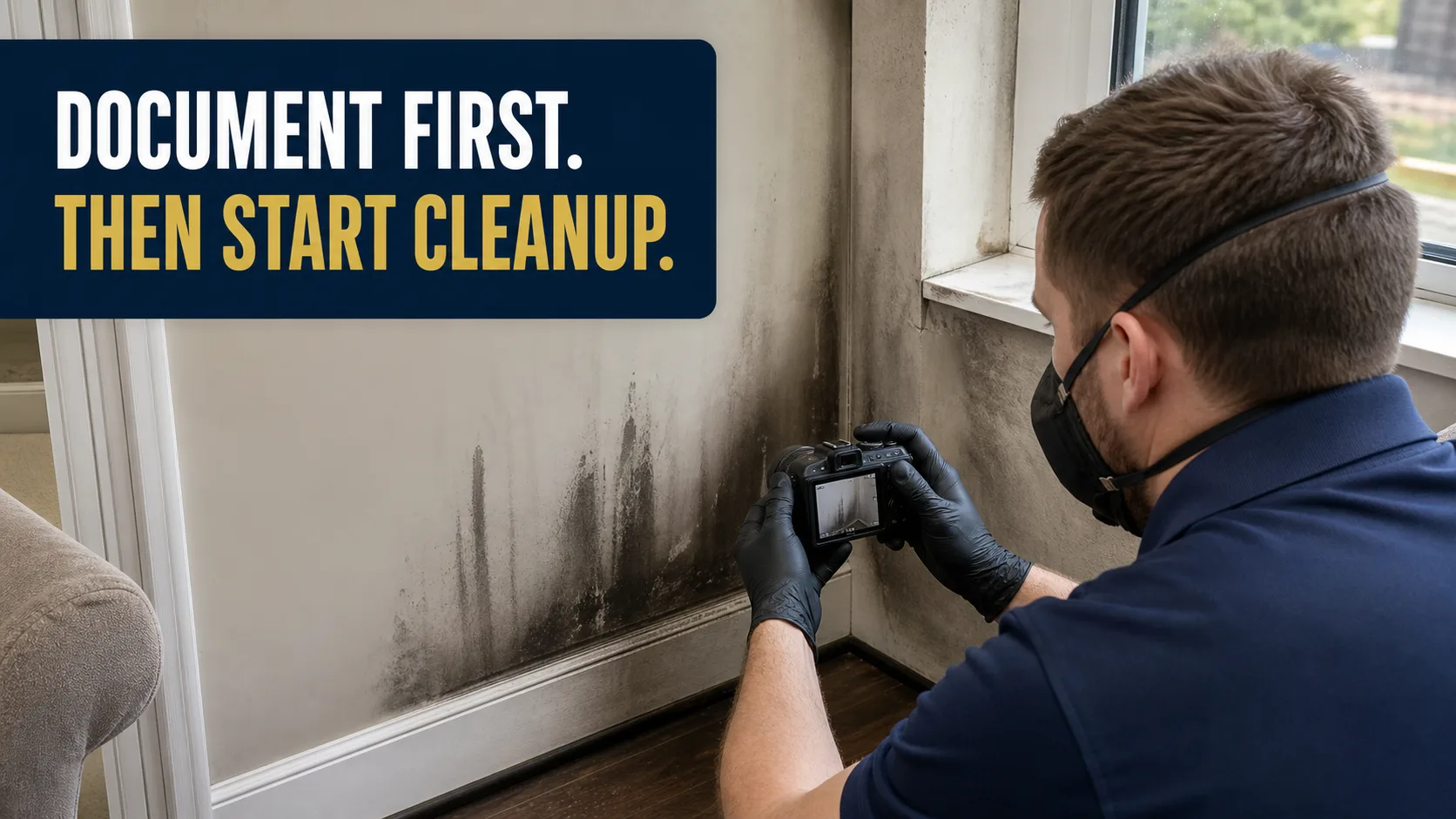
- Photograph everything with the date stamp on, before anything is cleaned or moved.
The three residue types, and why it matters
Not all smoke leaves the same mess, and the wrong method makes each one worse:
- Dry smoke comes from fast, hot fires. The residue is dry and powdery and comes off comparatively easily — as long as it’s removed dry first.
- Wet smoke comes from low, smoldering fires. It’s sticky, greasy, and strong-smelling, and it smears badly if you wipe it.
- Protein residue comes from kitchen and grease fires. It’s nearly invisible but carries an intense odor and yellows paint and finishes.
Identifying the residue before touching it is what decides whether a surface gets cleaned or ruined.
Residue type, method, and what does not survive
| Residue | Comes from | What removes it | What gets replaced |
|---|---|---|---|
| Dry smoke — powdery | Fast, hot fires: paper, wood, most structure fires | HEPA vacuum, then dry sponge; mild degreaser last | Least of the four. Loaded carpet pad, filters |
| Wet smoke — sticky, sharp | Smoldering fires: plastics, rubber, synthetics | Patient dry pass, then solvent cleaners, several passes | Carpet and pad, upholstery, insulation, drywall near the origin |
| Protein — invisible amber film | Kitchen and grease fires | Alkaline degreasers by hand; ordinary cleaners leave the smell | Painted cabinet interiors, yellowed woodwork, porous contents |
| Puffback soot — greasy, atomized | Misfiring combustion equipment | Dry pass, then solvent cleaners; HVAC in scope | Filters, duct liner, ceiling paint in the plume |
Two residue types in one house is normal. A kitchen fire that pushed into a living room leaves protein film over one zone and dry smoke over another, and each gets its own method and its own line on the estimate.
The order that saves materials
The reason cleanup is a sequence, not a scrub, is that soot is a fine, acidic solid. Push a wet rag across it and you grind it into the pores of the paint. So the professional order is:
- Contain the area so residue doesn’t spread further during work.
- Dry-remove loose soot with HEPA vacuums and dry chemical sponges.
- Wet-clean with the product matched to the residue type, only after the dry pass.
- Deodorize the source — sealing, thermal or hydroxyl treatment — rather than spraying over the smell.
Every step exists because of a specific failure. Wet before dry sets the stain. Cleaning before containment carries residue into rooms that were fine an hour ago. The wall-and-ceiling half has its own rules — see soot removal from walls and ceilings.
The smoke damage restoration process, step by step
- Scope and document. Room-by-room record of residue type and coverage, plus moisture readings anywhere hoses reached — see what a fire damage insurance claim needs.
- Stabilize the building. Board-up, roof tarp, temporary power, alongside the first 24 hours after a house fire.
- Extract and dry the firefighting water. Early, not last. Wet drywall cannot be cleaned, will not hold a sealer, and starts growing mold on its own schedule.
- Contain and set negative air, so cleaning does not redistribute what it lifts.
- Dry-clean, top down. Ceilings, then walls, then horizontals, then floors.
- Wet-clean by residue type, one matched chemistry per zone.
- Handle contents. Clean on site, pack out, or discard — itemized before anything leaves.
- Clean the HVAC. Skip it and the system re-seeds every room you just finished.
- Deodorize as the finishing step, never the substitute — detail in smoke smell removal.
- Seal, then hand off to the rebuild contractor.
What does smoke damage restoration cost?
Nobody can price this from a phone call. What is honest is naming the variables that move it.
- How many rooms carry residue — almost always more than burned.
- Residue type. Protein and wet smoke take multiple passes and specialty chemistry.
- How long it sat. Soot removed in the first days cleans off. Soot left three weeks has etched, and cleaning turns into sealing and repainting.
- Contents volume, and whether they are cleaned on site or packed out.
- Whether the HVAC is in scope, which it usually is.
- Firefighting water, and any demolition the drying forces.
Working ranges: a single-room fire with light residue elsewhere commonly lands in the low thousands. A whole-house smoke loss with contents cleaning and duct work runs well into five figures. A protein fire in a kitchen open to a great room sits in between and surprises people — very little to see, an enormous amount to clean.
Fire restoration, smoke mitigation, and the rebuild contractor are three different jobs
People assume one company does all of it. Usually three do.
- Fire damage restoration stabilizes the structure, removes what burned, and runs the emergency phase.
- Smoke and soot mitigation — our part — is residue removal, contents cleaning, drying the firefighting water, deodorization, and the documented file behind it.
- The rebuild contractor puts the house back: drywall, texture, paint, cabinets, flooring.
The line matters for the same reason it does on the water side, where the plumber and the mitigation company are not interchangeable. Mitigation is measured work with a defined endpoint. Reconstruction is a build.
Commercial smoke damage restoration
Same chemistry, against a revenue clock. A restaurant with a hood fire has protein residue over the dining room, a health inspector in the conversation, and payroll running whether the doors open or not.
- Phasing. Release the areas that can reopen first rather than closing the whole footprint.
- Inventory. Stock, textiles, and paper exposed to smoke are a documented loss, not a cleaning question.
- Electronics. Soot is conductive and acidic — servers and control panels need specialist cleaning before power goes back on.
The building is half the loss. The time it stays closed is the other half.
How long does smoke damage cleanup take?
A contained room with light residue elsewhere is typically three to five days of cleaning. A whole-house loss with contents pack-out and duct work runs two to four weeks before the rebuild starts. Protein fires take longer than they look like they should, because the film is invisible and every surface still needs a pass.
Readings decide the end date, not the calendar. Odor gets checked with the house closed up and the HVAC running, and moisture is metered to dry standard before anything is sealed.
Does insurance cover smoke damage cleanup?
Fire is a named peril on virtually every standard homeowners policy, and smoke and soot travel with it — including rooms that never burned, and including the water used to put the fire out. Your own declarations page is the authority on your own policy.
What decides how completely a smoke claim pays is usually the record. Residue in rooms nobody photographed, contents nobody itemized, and firefighting water nobody metered are the three gaps that show up again and again. A complete file shapes a settlement more than any argument does.
Don’t forget the water — smoke and water damage restoration are one job
If the fire was put out with hoses or sprinklers, you also have a water loss underneath the smoke — and mold starts within 24 to 48 hours in Houston humidity. We handle the water and the smoke together. Text a photo to (346) 271-7004 and we’ll tell you what your loss needs.
Clean soot off drywall that is still holding firefighting water and you get a wall that looks finished, smells fine for a month, and fails a moisture meter the entire time. Gulf Coast humidity will not dry it for you.
The free things worth doing tonight
- Shut the HVAC off at the thermostat. Every cycle moves more residue into clean rooms.
- Change the filter and bag the dirty one. It is your evidence that the ducts are involved.
- Ventilate only if the outside air is drier than the inside. After an August fire here it usually is not.
- Photograph every room, closed cabinets and closets included, before anything moves.
- Do not wipe anything. Not dry, not wet, not one wall.
- Bag food, medication, and cosmetics that were open or stored in the fire room.
- Write down when the fire started and when it was out. Duration correlates with residue depth.
Where smoke damage cleanup ends and we begin
TruePoint Restoration is not a rebuild contractor. We do not frame, hang cabinets, or repaint a room back to new — and we say so on the phone rather than after the estimate. What we do is the mitigation: assessing what the smoke reached, removing residue in the order that keeps materials salvageable, drying the firefighting water with logged readings, cleaning and inventorying contents, deodorizing the source, and handing you a documented file your adjuster can work from.
Not sure whether you are looking at a two-day clean or a whole-house job? Send photos to (346) 271-7004. We serve Pearland, Manvel, Friendswood, League City and the Greater Houston area.