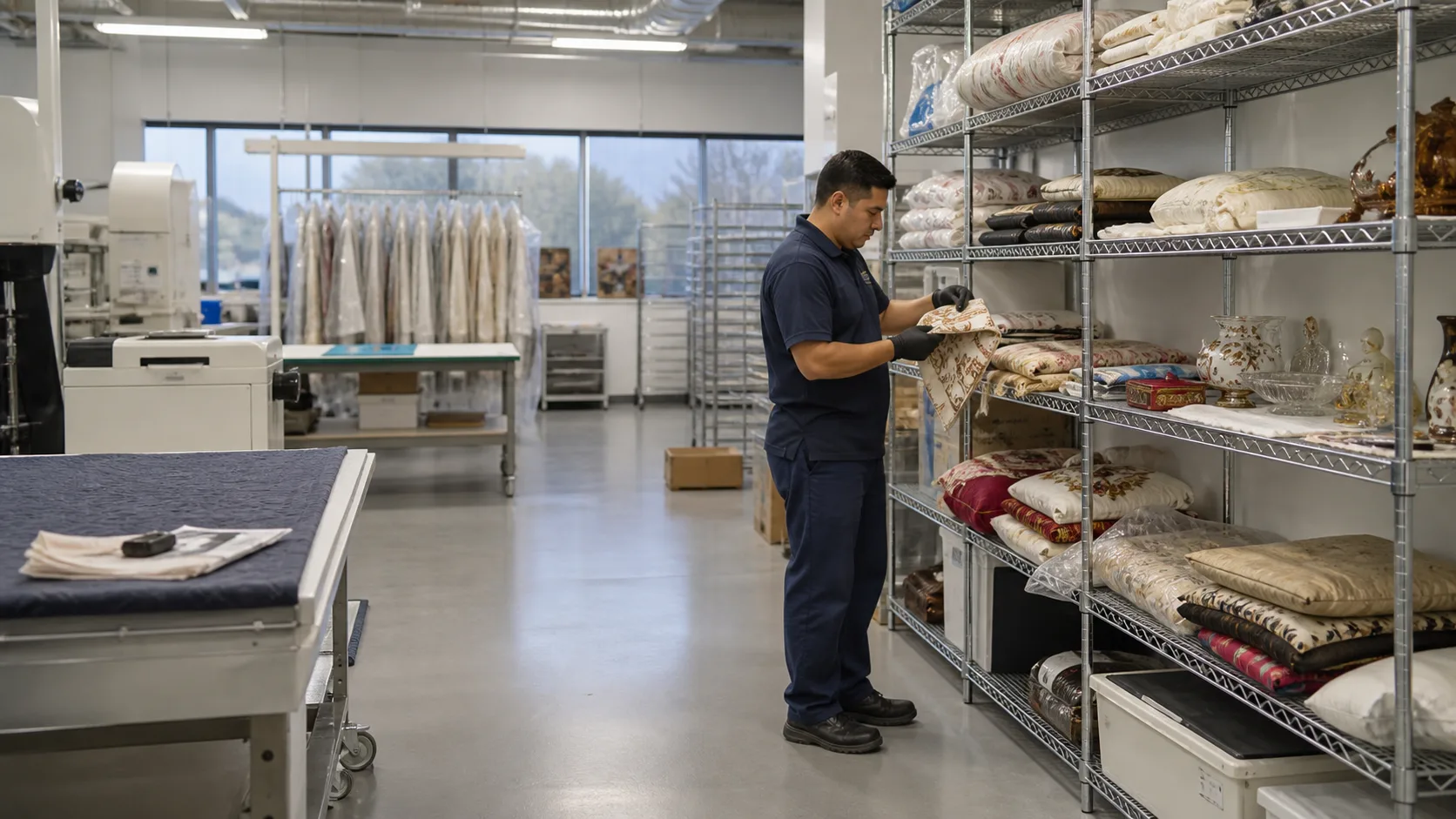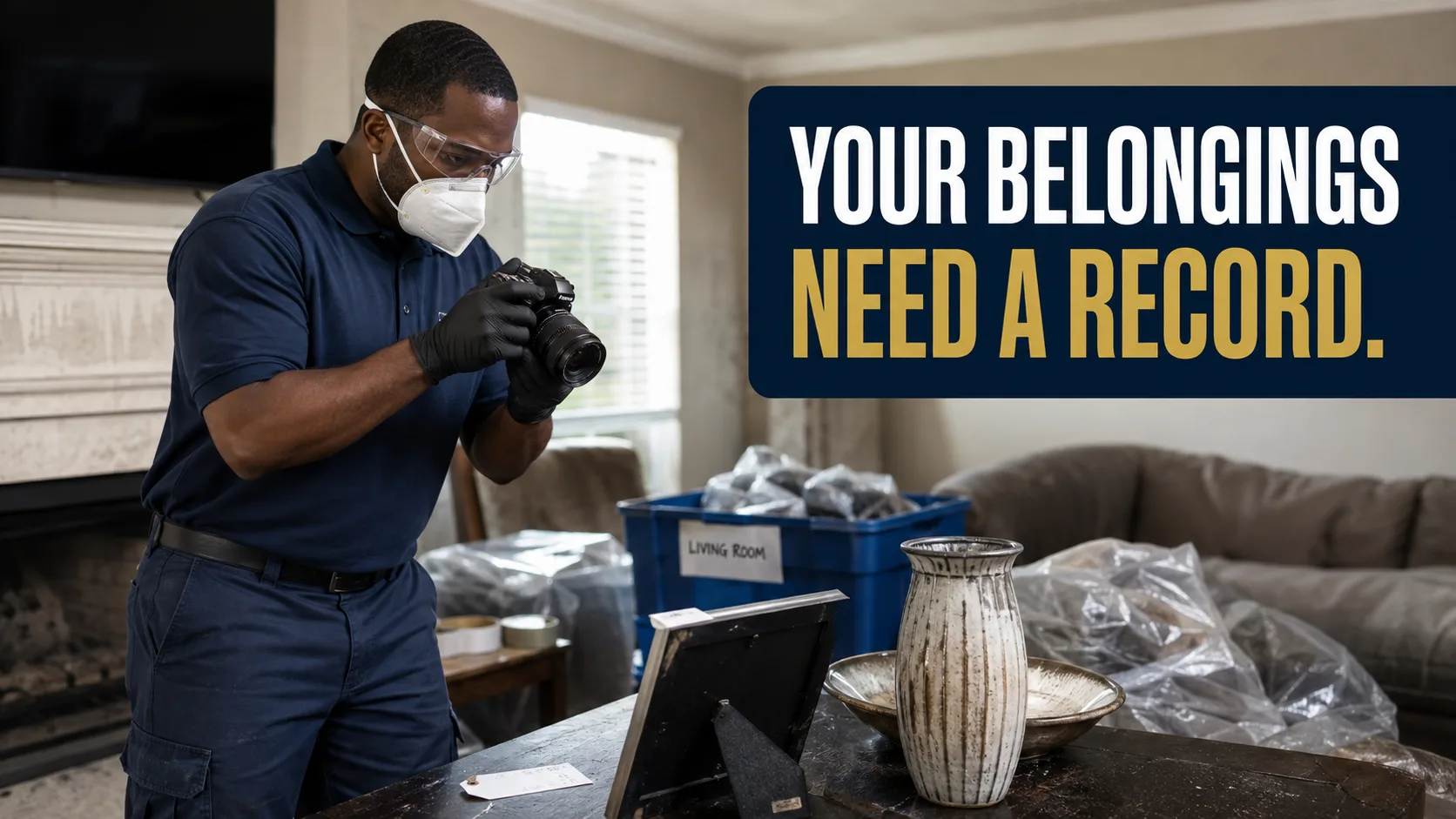
Contents restoration is cleaning, deodorizing, and documenting your belongings after a fire, either on site or through a pack-out to a controlled facility. Hard surfaces and most textiles usually come back. Porous items that absorbed odor often do not. Electronics need attention within days, because soot is acidic and keeps corroding. Contents are a separate coverage from the structure — call or text **(346) 271-7004**.
What contents restoration actually is
Contents restoration is the cleaning, deodorizing, and documenting of everything that is not the building — furniture, clothing, dishes, electronics, books, artwork, photographs, and the contents of every closet. It is a separate scope from structural mitigation, priced separately, and on most policies paid from a separate coverage.
It is also the half of a fire loss that runs longest — a house can be dry and clean in three weeks while the belongings are still being worked through. It is its own trade because a house has four or five materials and your belongings have four hundred, each answering the same question differently: cleaned, or documented as a loss?
Warning signs your contents are worse off than they look
The residue got further than the flame:
- Grey film on the tops of stacked dishes inside a closed cabinet
The acid is already working:
- Silverware, jewelry, and metal hardware clouding or pitting within a day or two
What you can check yourself before anyone arrives
- Open one closed cabinet and one closet in a room that did not burn, and smell before you look. Enclosed air concentrates odor and tells the truth faster than an open room.
- Do not power up any electronics that were in the smoke. Not to test them, not for a minute.
- Pull out what you need in the next 48 hours — medication, documents, phones and chargers, clothing — and photograph it before it leaves.
- Bag smoke-exposed clothing where it is, and throw nothing away until it is on a list.
- Photograph and video every room with the date stamp on, cabinets and drawers open, before anything moves.
Pack-out or clean on site?
- Pack-out means inventory, photograph, box, and move everything to a controlled facility for cleaning and storage. It wins when the house has no power or climate control, when demolition will run for weeks, or when cleaning in place would recontaminate what you finished.
- On-site cleaning wins on lighter losses, on items you need access to, and where the risk of moving something outweighs the benefit.
- The inventory is the real deliverable either way — it is what makes the personal property side of a claim work.
The decision is made room by room, and it accounts for storage, which is billed monthly for as long as the house is not ready.
What survives, and what does not
| Material | Typical outcome | How it is handled | What kills it |
|---|---|---|---|
| Glass, ceramics, metal | Almost always saved | Ultrasonic or hand cleaning, corrosion treatment | Acid etch left for weeks |
| Clothing, linens, curtains | Usually saved | Specialty laundering and ozone chamber | A home wash on the first pass |
| Upholstery, mattresses | Often replaced | Cleaned where the foam is uncontaminated | Odor bonded into foam and padding |
| Electronics | Saved when addressed fast | Specialist cleaning and drying before power | Powering it up, or waiting weeks |
| Books, documents, photographs | Mixed, time-critical | Freezing to stabilize, then specialist drying | Air drying, or pulling wet photos apart |
| Food, medication, cosmetics | Discarded | Photographed, listed, disposed of | Residue penetrates packaging |
Non-porous survives; anything that absorbed odor into a material you cannot launder is usually a loss.
Textiles, electronics, and the things you cannot replace
Textiles are the biggest volume and the best odds. Restoration laundering uses different chemistry and several cycles, and heavier items go into a sealed ozone chamber — which works precisely because the space is unoccupied. Either way the source has to come out first.
Electronics are on the shortest clock in the house. Burning wire insulation releases chlorides, and chlorides plus Houston humidity make an acid that keeps eating boards and connectors after the fire is out. That is why residue from an electrical fire is harder on a laptop than a paper fire is. Get devices to a specialist within days, and do not test them first.
Photographs and documents are triaged urgently. Wet paper and emulsion are commonly stabilized by freezing, then dried by specialists. Air drying fuses pages; pulling wet photographs apart takes the image off. Say on day one which items are irreplaceable, because patience is a scoping decision made before the boxes are packed.
What contents restoration costs
Contents are priced per item handled, in stages: pack-out, cleaning, storage, and return. The number tracks item count and difficulty, not square footage.
What moves it:
- Item count, which is what pack-out is actually measuring
- Material mix. Textiles and electronics cost more per item than dishes
A modest scope lands in the low thousands. A full pack-out with textiles, electronics, documents, and months of storage runs into five figures. How the pieces add up across a whole loss is in fire damage restoration cost.
Contents, structure, and the rebuild are three scopes
- Structural mitigation dries and cleans the building — the work in smoke damage cleanup.
- Contents restoration handles everything not attached to it, on its own inventory and often its own coverage limit.
- The rebuild contractor puts the house back afterward, and contents come home last.
They overlap in time and never in scope. Contents returned to an unfinished house get contaminated twice, which is why the structure sets the return date.
The process, in order
- Document before anything moves — photographs and video, room by room, following the first 24 hours after a house fire.
- Triage. Clean on site, pack out, or document as a loss, decided room by room.
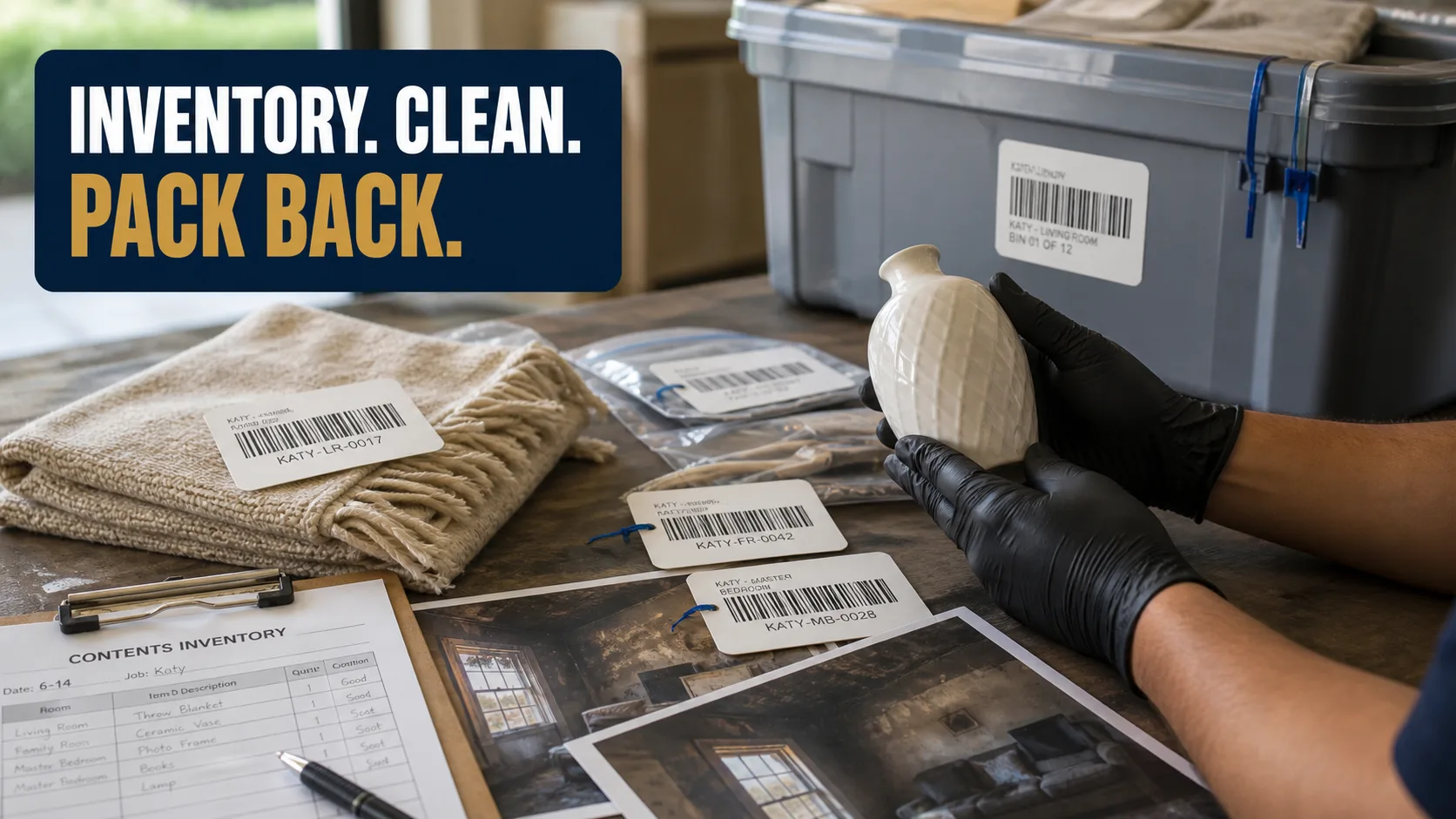
- Inventory and photograph every item on the way out, with a numbered log.
- Pull the urgent items first — documents, medication, electronics, photographs.
- Clean and deodorize by material, at the facility or in place.
- Store in climate-controlled space, then return and reconcile against the inventory once the house passes its own inspection.
How long contents take
Pack-out is days. Cleaning and deodorizing run for weeks. Storage lasts as long as the house is not ready, which on a whole-house loss means months.
Readings decide the return date, not the calendar. The structure has to meter dry and the odor check has to hold with the house closed up and the HVAC running before a box comes back through the door.
How contents are handled on a claim
On most standard homeowners policies the dwelling and personal property are separate coverages with separate limits, and jewelry, furs, firearms, and collectibles frequently carry sub-limits inside the personal property coverage. A serious contents loss can exhaust that limit while the dwelling limit is barely touched. Those numbers are on your declarations page.
Personal property is often settled at actual cash value first, with the balance released once items are replaced and receipts submitted — the structure described in actual cash value versus replacement cost. The inventory is what makes any of it payable, and what a complete file contains is in the fire damage insurance claim guide.
The free things worth doing tonight
- Photograph and video every room with the date stamp on, cabinets, closets, and drawers open.
- Throw nothing away until it is photographed and listed, however ruined it looks.
- Bag smoke-exposed clothing separately and do not wash it at home.
- Write down model and serial numbers for electronics, and leave them switched off.
- Photograph the pantry and refrigerator before you empty them. Food loss is claimable and routinely forgotten.
- List the irreplaceable items for the crew on day one.
Where sorting through boxes ends and we begin
You can wash a load of towels and wipe down a set of dishes yourself, and after a small contained fire that may be most of the contents work. We will say so rather than packing out a house that does not need it.
TruePoint Restoration is not a rebuild contractor and not a moving company. What we do is the mitigation and the record: triaging contents room by room, inventorying and photographing everything that moves, cleaning and deodorizing by material, getting electronics and documents to the right specialist while it still helps, and handing your adjuster a file he can work from.
If you are looking at a house full of belongings and no idea what is salvageable, send photos to (346) 271-7004. We serve Pearland, Manvel, Friendswood, League City and the Greater Houston area.