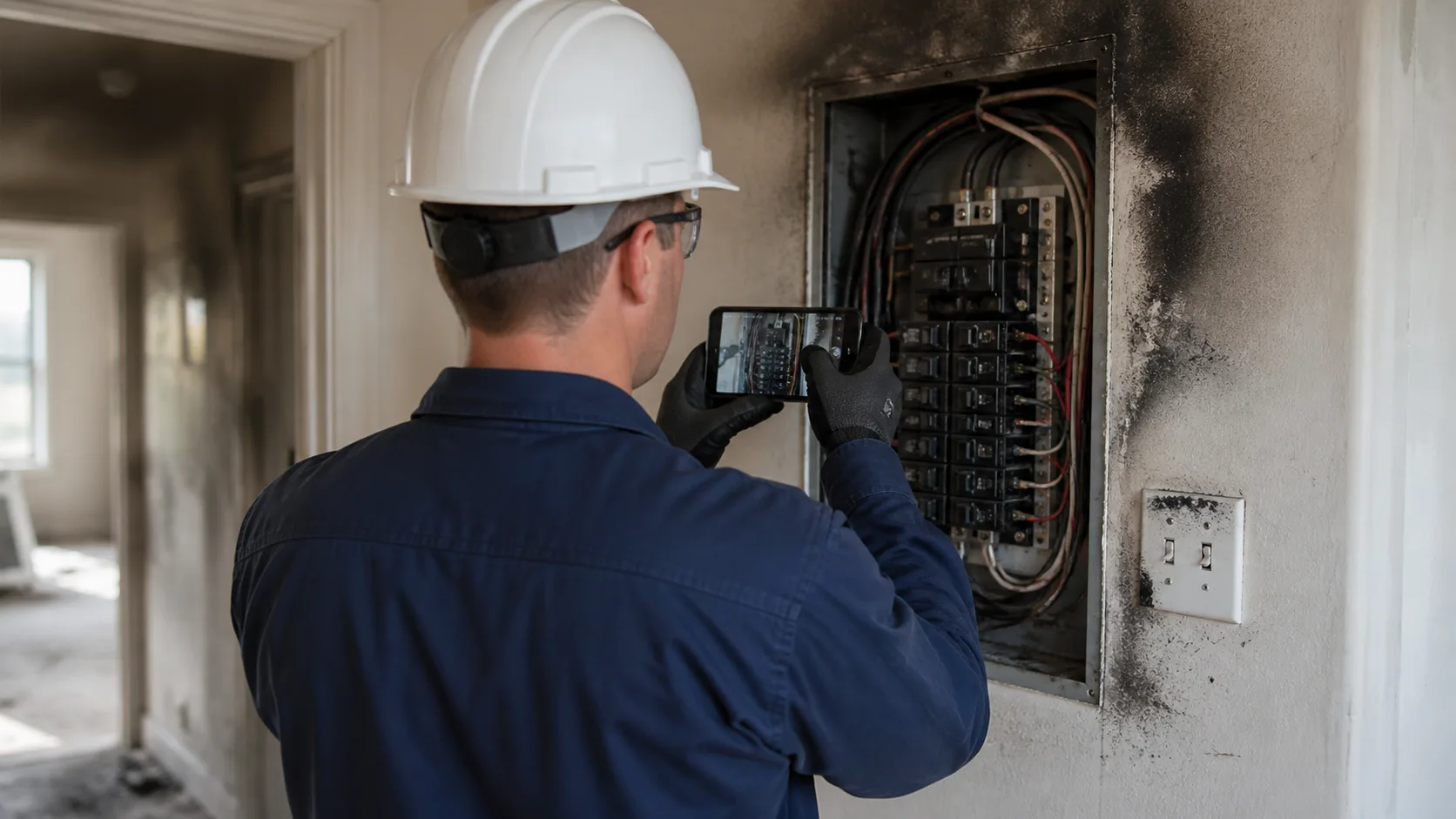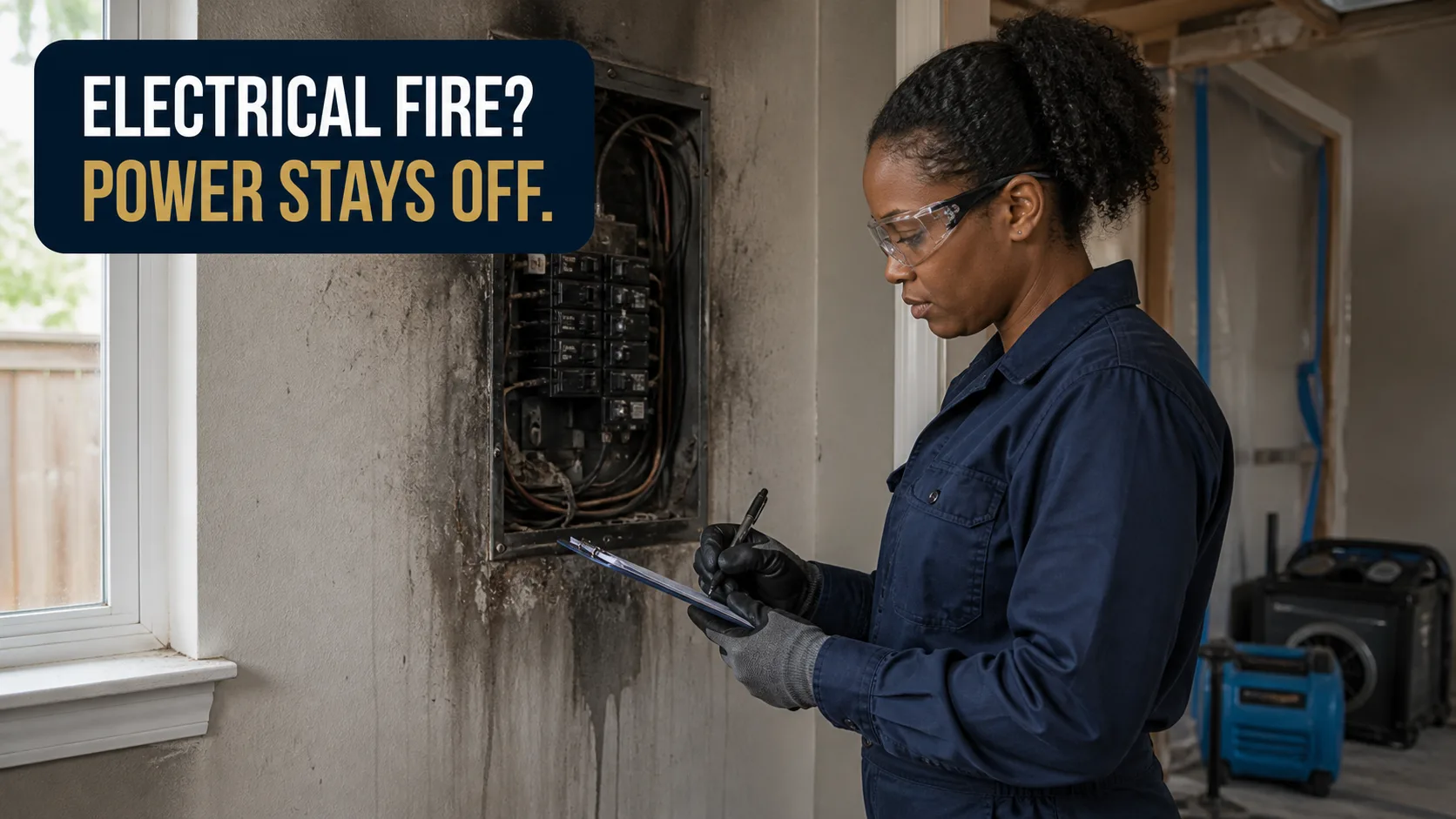
Electrical fires start inside walls, panels, and attics, and they burn wire insulation and plastics — which leaves a chloride-bearing soot far more corrosive than ordinary smoke. Two trades are needed: a licensed electrician to make the system safe and repair it, and a mitigation contractor to remove the residue before it eats metal, wiring terminations, and electronics. Call or text **(346) 271-7004**.
What makes an electrical fire different
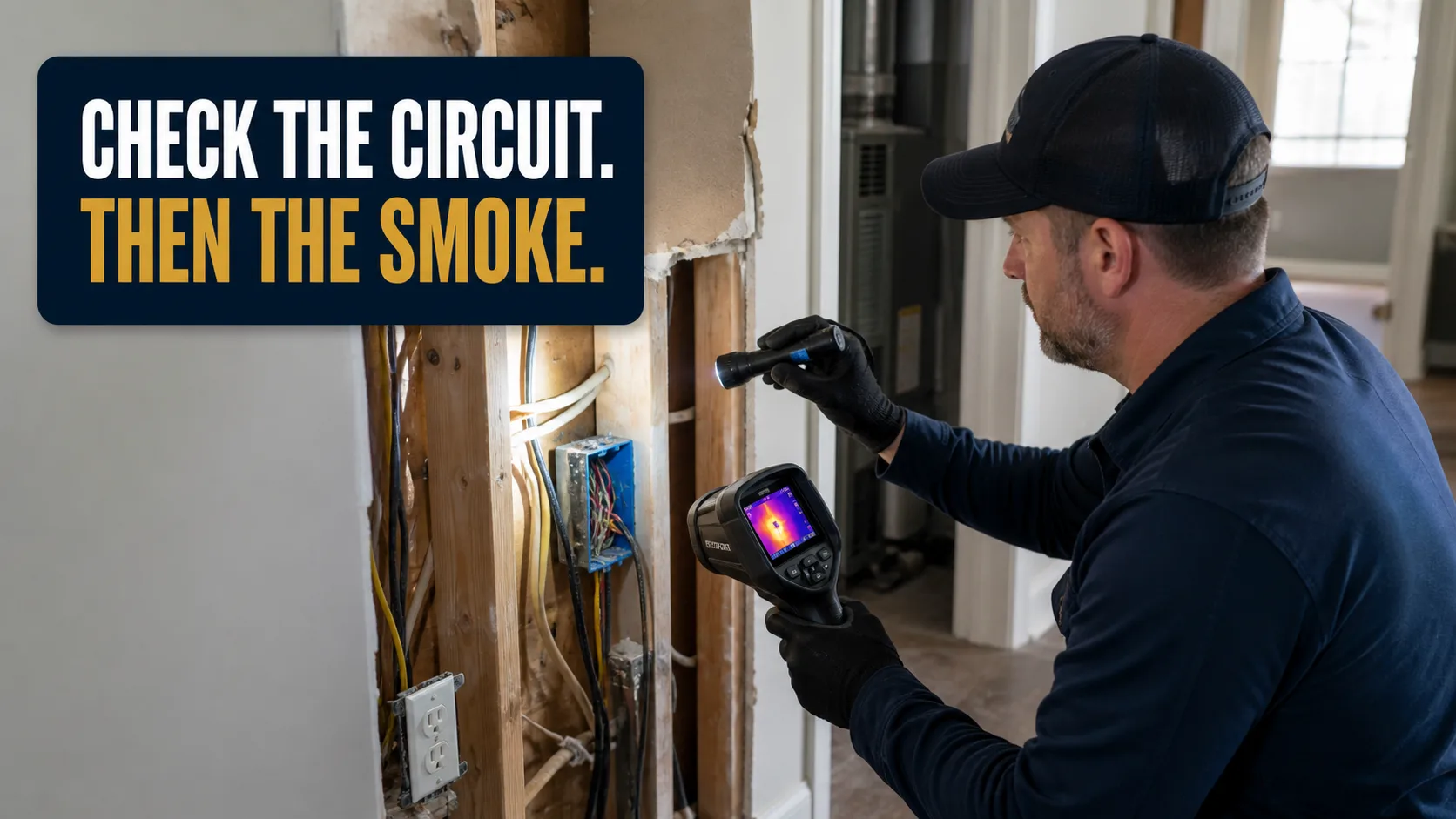
Most house fires start in a room. Electrical fires start inside the building — in a wall cavity, a junction box, a panel, or an attic — and they are often well established before anybody sees flame.
That changes two things. The structure takes damage where nobody can see it without opening finished surfaces. And the fuel is different — wire insulation, device bodies, and cable jacketing are plastics, and plastics burn cool and dirty, leaving the dense greasy residue restoration calls wet smoke, carrying chlorides from the PVC.
Chlorides plus humidity make acid. Ordinary smoke residue is corrosive; electrical fire residue is aggressively corrosive, and Gulf Coast humidity keeps the reaction fed long after the fire is out.
Why Houston sees a particular version of this
Much of the housing stock across Pearland, Pasadena, and southeast Houston went up in the 1960s and 1970s — an era of aluminum branch circuits, absent equipment grounding, and panel designs since recognized as unreliable. Fifty years of thermal cycling loosens connections that were tight when they were made, and the failure appears where metal meets metal: outlet terminations, splices, and panel lugs.
The second driver is seasonal. Houses here are built to be cooled, so a hard freeze sends an entire region to portable heaters, extension cords, and generators on the same night, on circuits never sized for continuous draw. Freeze events produce a spike, alongside the frozen pipe calls.
Warning signs of electrical fire damage — including the one you nearly had
A circuit is failing, before there is a fire:
- A breaker that trips repeatedly on the same circuit
- A faint hot-plastic or fishy smell with no visible source, which is heated PVC insulation
A fire has damaged more than the visible area:
- Soot fanning above supply registers, which means the ducts carried it
The residue is doing damage right now: chrome, brass, and stainless clouding or pitting within a day or two.
What you can check yourself before anyone arrives
- Confirm the affected circuits are off and leave them off.
- Turn the HVAC off. Every cycle pushes residue through the whole house.
- Pull the HVAC filter. Grey or black loading on a filter that was clean last month proves the ducts are in scope.
- Do not power up any electronics that were in the smoke, however fine they look.
- Photograph all of it with the date stamp on, before anything is cleaned, moved, or repaired.
How professionals handle electrical fire residue
- Power stays off in the affected zone until an electrician clears it. Soot is conductive as well as acidic, so energizing sooty equipment invites a second fault.
- Containment and negative air first, so cleaning does not carry chloride residue into clean rooms.
- Dry removal before anything wet. HEPA vacuuming and dry sponges lift the residue; a wet wipe grinds it in, exactly as in ordinary soot removal.
- Corrosion control on metals early, because etching does not reverse.
- Electronics triaged fast, cleaned by a specialist and dried before power is restored — detail in contents restoration after a fire.
- HVAC decontamination and attic insulation removal, because the air handler in most Houston homes sits in the attic where an attic fire puts its smoke, and insulation cannot be cleaned in place.
What electrical fire damage restoration costs
Two separate numbers from two separate trades.
The electrical repair runs from a few hundred dollars for one circuit and a device up into five figures for a service and panel replacement with rewiring. What moves it: how many circuits were affected, whether the panel is replaced, and how much finished wall has to come open.
The mitigation is priced the way any smoke loss is priced — rooms carrying residue, residue type, how long it sat, contents volume, and whether the HVAC and firefighting water are in scope. Electrical fires sit above the average per square foot because the residue needs more passes, the damage is inside finished assemblies, and electronics and metals need attention on a clock. The breakdown is in fire damage restoration cost.
The electrician, the mitigation contractor, and the rebuild contractor
- The licensed electrician owns the system: evaluation, panel and circuit repair, permits, and the inspection sign-off.
- The mitigation contractor — our part — owns the residue, the moisture, the contents, the odor, and the documented file.
- The rebuild contractor closes the walls and ceilings back up, and paints.
Three trades, one loss — split the way the plumber and the mitigation company are on the water side.
The process, in order
- Fire department clears the scene, and the affected circuits stay de-energized.
- The electrician evaluates the panel, service, and affected circuits before anything else is planned.
- Document the whole house room by room, following the first 24 hours after a house fire.
- Contain, then dry-clean top down, with corrosion control on metals early.
- Extract and dry firefighting water, because mold starts within 24 to 48 hours in Houston humidity.
- Triage electronics and contents, then run HVAC and attic work.
- Deodorize, seal, and hand off to the electrician’s final work and the rebuild.
How long it takes
The electrical repair is often days once the scope is written, subject to permits. Mitigation on a contained wall or panel fire is one to two weeks. An attic fire runs longer, because the affected footprint is the whole ceiling plane rather than one room.
Readings decide the end date, not the calendar. Moisture has to reach dry standard, surfaces have to pass a fresh dry-cloth stroke, and the electrical inspection has to sign off before power comes back on for good.
Does insurance cover electrical fire damage?
Fire is a named peril on virtually every standard homeowners policy, and an accidental electrical fire is a fire. Coverage follows the damage — smoke and soot in rooms that never burned, the water used to put it out, contents and electronics, and loss of use. Read your own declarations page.
Two notes specific to this loss type. Corrosion evidence is time-sensitive, so early photographs of clouded metal and corroded connectors beat a description written later. And electronics need itemizing with model and serial numbers before anyone cleans them. What a complete file looks like is in the fire damage insurance claim guide.
The free things worth doing tonight
- Leave the affected breakers off and put a note on the panel so nobody helpfully flips them.
- Turn the HVAC off and change the filter, bagging the old one.
- Photograph every room with the date stamp on, outlets and metal fixtures included.
- Write down model and serial numbers for every affected electronic device.
- Do not power anything up, and do not wipe anything.
- Call a licensed electrician if there was any hot-plastic smell, even without a visible fire.
Where the electrician ends and we begin
TruePoint Restoration is not an electrical contractor. We do not evaluate panels, replace circuits, or pull permits, and we say so on the phone rather than after the estimate.
What we do is everything the residue touched: containment, dry-then-wet removal in the order that keeps materials salvageable, corrosion control on metals while it still helps, drying the firefighting water with logged readings, triaging electronics before the acid finishes them, decontaminating the HVAC, and handing you a documented file your adjuster can work from.
If you have had an electrical fire, or a hot-plastic smell you cannot place, send photos to (346) 271-7004. We serve Pearland, Manvel, Friendswood, League City and the Greater Houston area.