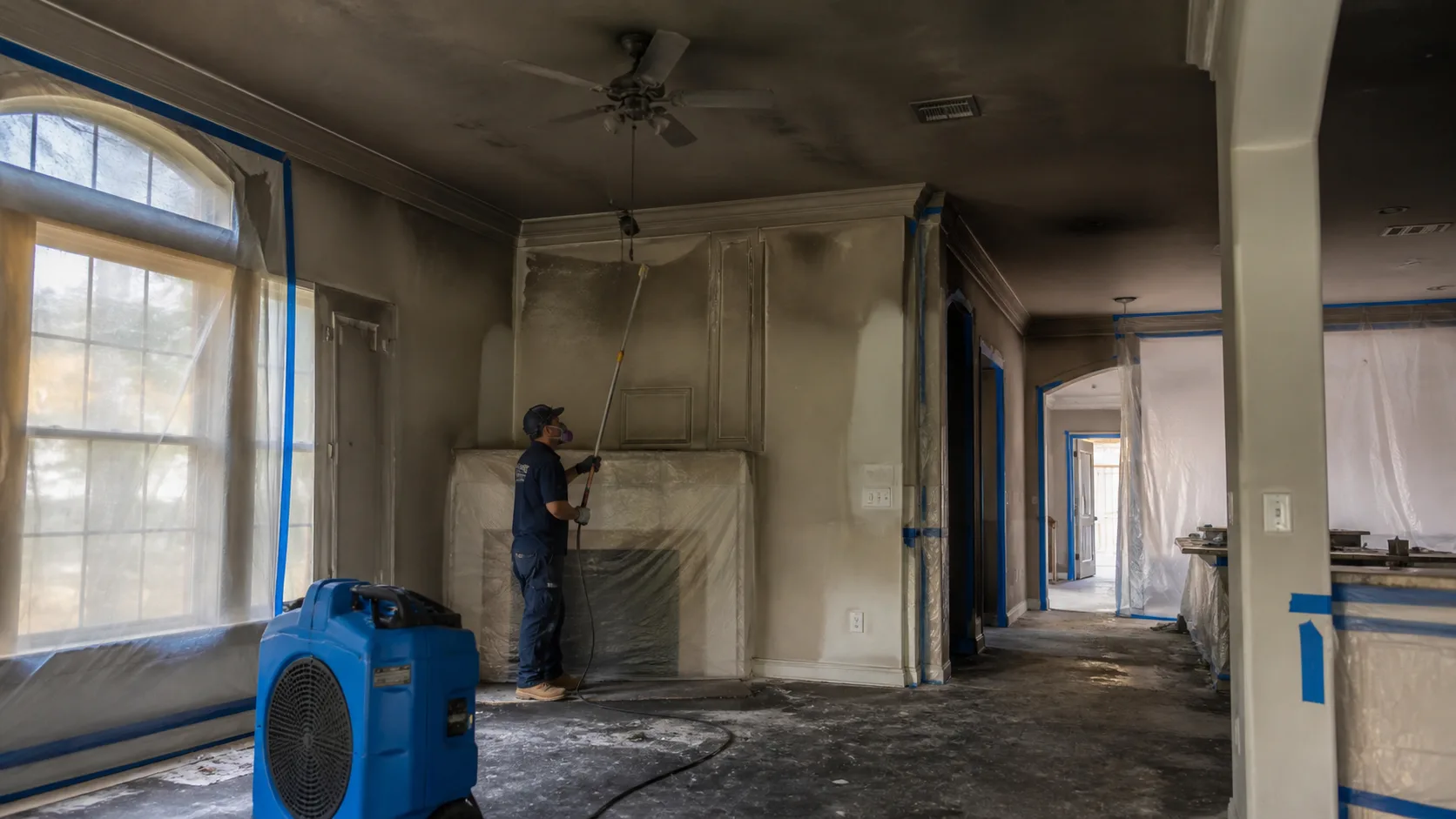
There is no flat rate. Fire damage restoration is priced from measured scope: how many rooms carry residue, which residue type, how long it sat, contents volume, whether the HVAC is involved, and how much firefighting water went in. Single-room mitigation commonly runs low to mid thousands; a whole-house loss runs well into five figures. Get a written scope after somebody walks the house — call or text **(346) 271-7004**.
What you are actually paying for
Fire damage restoration cost is not one number. It is three, and they arrive at different times.
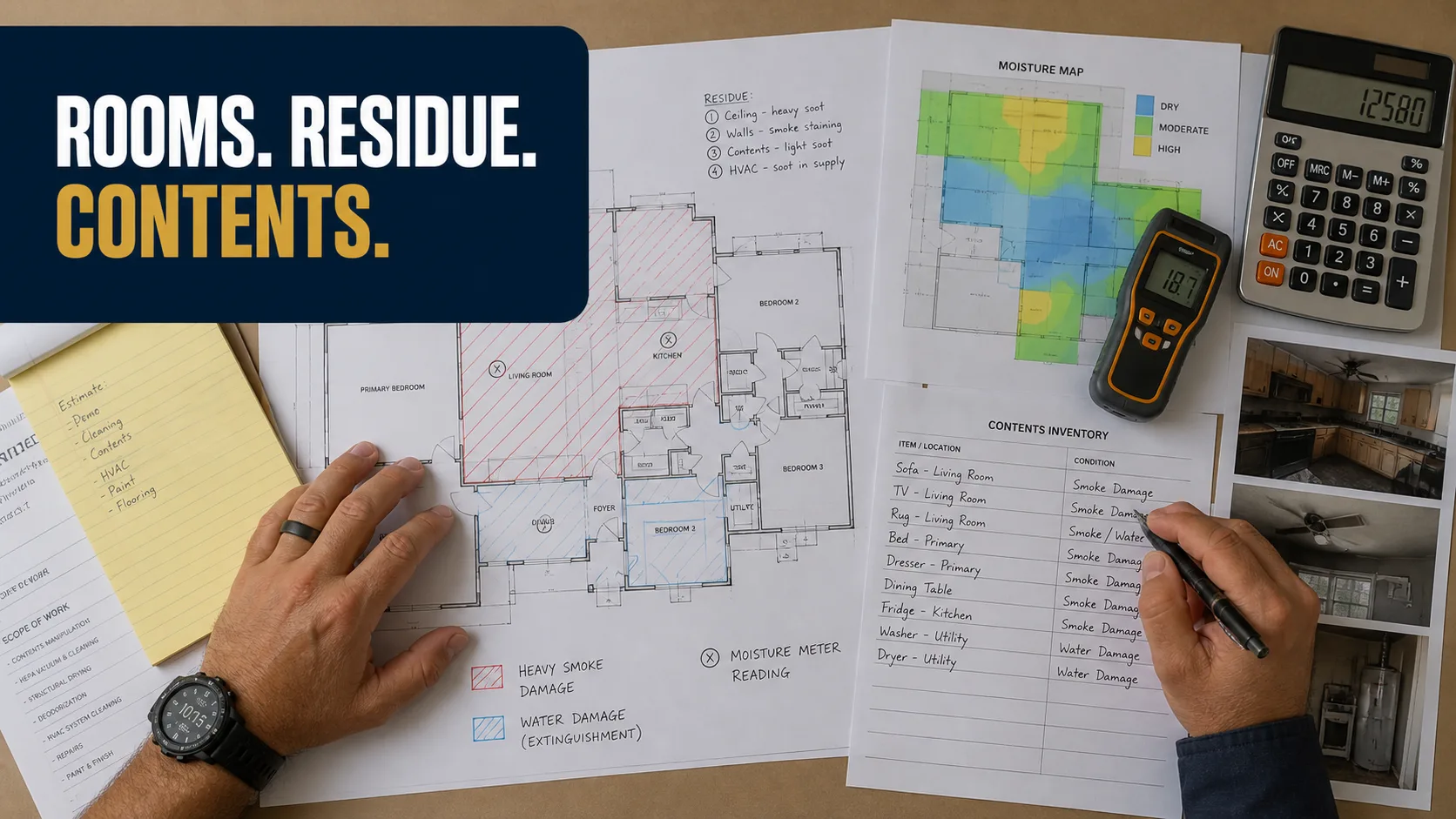
Mitigation is the emergency and cleaning phase: drying the firefighting water, removing soot in the order that keeps materials salvageable, cleaning contents, decontaminating the HVAC, deodorizing, and documenting all of it. Reconstruction is the rebuild — drywall, texture, paint, cabinets, flooring. Contents is its own scope, priced per item, usually under its own coverage limit.
Most quotes people compare are only one of the three. That is why two estimates for the same house differ by a factor of four and both are honest.
Warning signs your loss is bigger than the room that burned
Each of these adds a line to the estimate, and each is free to check tonight.
Residue reached the whole house — the largest single multiplier:
- An HVAC filter loaded grey that was clean last month
- Odor inside a closed closet at the far end of the house
- Film on window glass and mirrors two rooms from the fire
There is a water loss under the fire — a second scope with its own price:
- Ceiling stains or sag on the floor below the burned room
- Baseboards swelling along the bottom inch, damp carpet at wall bases
The clock has already cost you money:
- Chrome and brass clouding or pitting, which is acid etch
- Paint yellowing near a kitchen fire, which is protein residue setting
How to size your own loss before anyone quotes you
- Count the rooms that smell, not the rooms that burned. Estimates are priced by affected area, and residue outruns flame.
- Pull the HVAC filter. Grey loading puts the return, plenum, ducts, and coil in scope — normally a four-figure line by itself.
- Run one dry test stroke. White cotton cloth, one light pass, low on a wall in a room that did not burn. Grey means that room is in the scope. Do not repeat it, and do not use water.
- Check the floor below and the wall bases for firefighting water. Wet materials mean drying equipment, and equipment bills per unit per day.
- Open one closet and count. Contents are priced per item handled.
- Photograph all of it with the date stamp on, before anything is cleaned or moved.
How a restoration estimate is actually built
Restoration is not bid like a remodel. It is written as line items against measured quantities, which is why walking the house comes before any number.
- Unit pricing. Cleaning is billed per square foot of affected surface, not per room, so ceiling height changes the total on identical floor plans.
- Equipment days. Air movers and dehumidifiers bill per unit per day, and the count comes from the size of the wet area.
- Labor category. Soot cleaning, contents handling, and duct decontamination are separate lines at separate rates.
- Chemistry matched to residue. Protein and wet smoke need specialty products and several passes, so the same wall costs more.
- Contents per item. Pack-out, cleaning, storage, and return are each their own charge — the detail is in contents restoration after a fire.
- Supplements. Damage found behind a wall after demolition is added in writing with photos, not sprung on you at the end.
What fire damage restoration costs by scope
Working ranges for the Greater Houston market, for mitigation unless the row says otherwise.
| Scope | Typical range | What pushes it up |
|---|---|---|
| One room, light residue elsewhere | Low thousands | Vaulted or textured ceilings, protein residue |
| Several rooms or an open plan | High four figures into low five | Two residue types, firefighting water |
| Whole-house smoke loss | Well into five figures | Contents volume, sealing rather than cleaning, storage |
| Contents only | Low thousands to low five figures | Item count, textiles, electronics, documents |
| HVAC decontamination | Four figures, typically | Duct length, attic access, rooftop units |
| Structural repair and rebuild | Five to six figures | Extent of burn, permitting, engineering |
Two rows apply to one house often enough. A kitchen fire that pushed protein residue across an open plan and put water into the room below is a several-rooms scope, a contents scope, and an HVAC line on one estimate.
The variables that move the number most
- How many rooms carry residue. Almost always more than burned, and this multiplier matters more than any other.
- Residue type. Protein and wet smoke take multiple passes — the differences are in smoke damage cleanup.
- How long it sat. Soot removed in the first days cleans off. Soot left three weeks has etched, so cleaning becomes sealing and repainting.
- Firefighting water. Drying is equipment days plus whatever demolition the readings force, and left long enough it adds a mold remediation scope that did not exist on day one.
- What burned. Plastics and wiring leave the most corrosive residue, which is why an electrical fire costs more per square foot than a paper fire the same size.
Three trades, three prices
- Mitigation — our part. Residue removal, drying with logged readings, contents, deodorization, and the file. It has a defined endpoint, proven with a meter.
- Reconstruction. A rebuild contractor replaces what came out, priced like a build.
- Contents restoration. Sometimes the same company, sometimes a specialist, always its own line.
The split works the way it does on the water side, where the plumber and the mitigation company are not interchangeable.
How the number gets set, step by step
- Somebody walks the house and maps residue and moisture room by room, building on the record you started in the first 24 hours.
- The scope is written as line items against measured quantities, with photos attached.
- The carrier reviews it against the policy and the record — what a complete file contains is in the fire damage insurance claim guide.
- Work begins, with daily readings logged.
- Hidden damage is supplemented in writing, before it is performed.
- The file closes at dry standard, and the rebuild contractor picks up.
When is the price final?
Not on a fixed day. Readings decide, not the calendar. A mitigation number stays provisional until the structure meters dry, surfaces pass a fresh dry-cloth stroke, and an odor check holds with the house closed up and the HVAC running. Contained single-room work is three to five days of cleaning. A whole-house loss runs two to four weeks, and the contents scope often outlives both.
Who actually pays
Fire is a named peril on virtually every standard homeowners policy, and coverage follows the damage — smoke and soot in rooms that never burned, the water used to put the fire out, and loss of use for temporary lodging.
The deductible is paid once against the claim, not once per contractor. On a replacement cost policy the carrier commonly issues the depreciated amount first and releases the held-back depreciation once the work is finished and invoiced. On an actual cash value settlement that depreciation is never returned — the difference between actual cash value and replacement cost changes what a five-figure scope puts in your account.
A small loss can land under the deductible, in which case filing costs you a claim on your history and pays nothing. What decides how completely a claim pays is usually the record: residue photographed room by room, contents itemized, firefighting water metered. Your declarations page governs your policy, and a Texas-licensed public adjuster or an attorney is who advises you on a coverage dispute.
The free things worth doing tonight
- Shut the HVAC off at the thermostat. Every clean room that gets dirty is a line on the estimate.
- Photograph every room with the date stamp on, cabinets and closets included, before anything moves.
- Find your declarations page and write down dwelling, contents, loss of use, and deductible.
- Start a receipt folder — lodging, meals, clothing, board-up, pet boarding.
- Do not wipe anything. A wet rag on soot turns a cleanable wall into a replaceable one.
- Write down when the fire started and when it was out. Duration correlates with residue depth, and residue depth is priced.
Where the estimate ends and we begin
TruePoint Restoration is not a rebuild contractor and not a public adjuster. We do not frame, hang cabinets, or repaint a room back to new, and we do not negotiate your settlement. What we price and perform is the mitigation: assessing what the smoke reached, removing residue in the order that keeps materials salvageable, drying the firefighting water with logged readings, cleaning and inventorying contents, deodorizing the source, and handing you a documented file your adjuster can work from.
If you want a real number instead of a range, send photos to (346) 271-7004. If the honest answer is that it is a two-day clean, we will say that. We serve Pearland, Manvel, Friendswood, League City and the Greater Houston area.