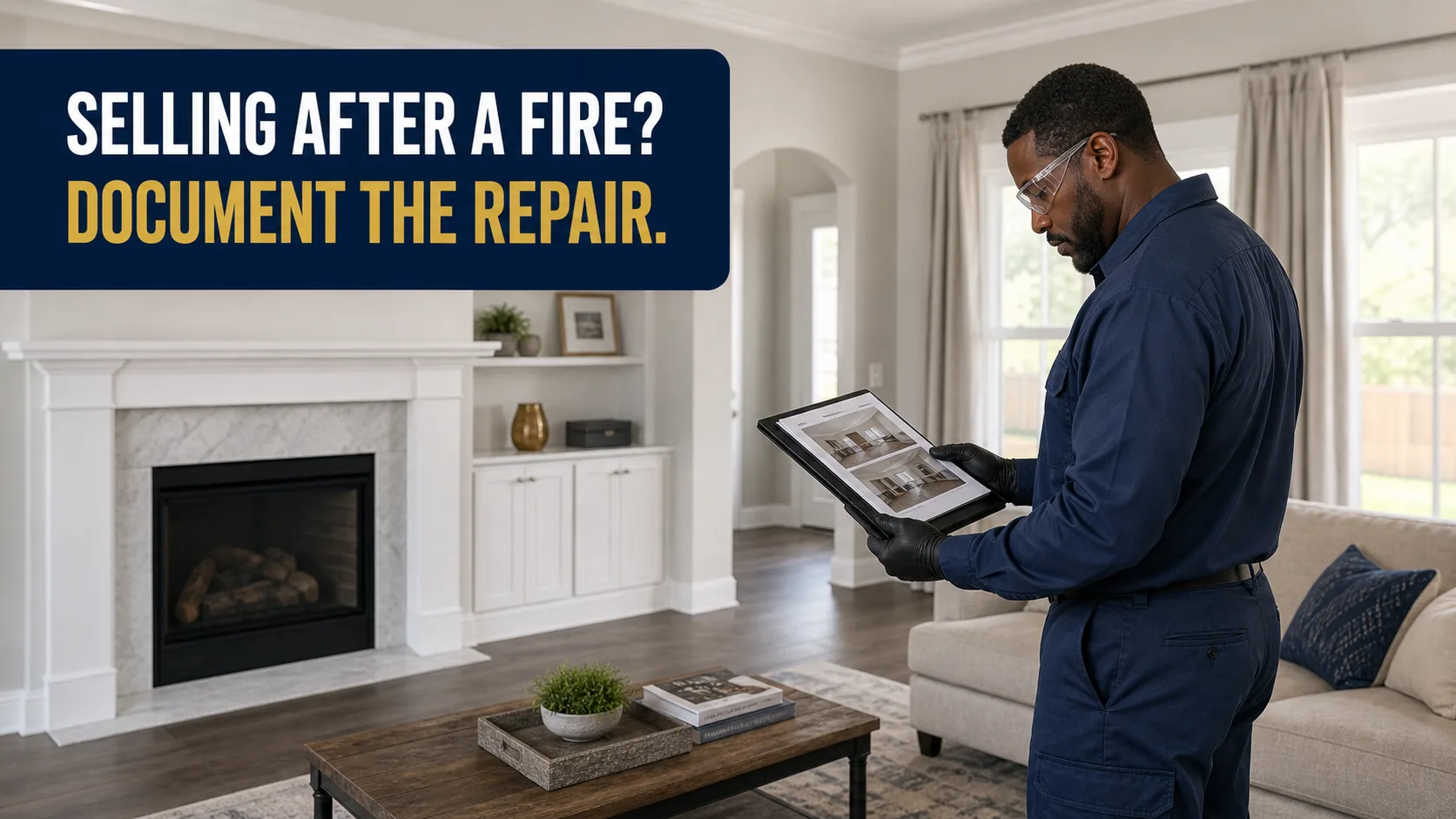
Yes. A fire-damaged house can be sold in Texas, either as-is to a cash buyer or on the open market after restoration. The known fire gets disclosed either way. Which path nets more usually comes down to financing: unremediated smoke odor and visible soot push most lenders out, which shrinks the buyer pool to cash and prices it accordingly. Questions on the remediation side — **(346) 271-7004**.
Yes, you can sell a house with fire damage
Nothing in Texas stops the sale. Fire-damaged houses change hands here constantly, in two ways: as-is to a cash buyer or investor, or on the open market after the damage is addressed.
The real question is which path leaves more in your pocket, and that turns on one mechanical fact — a house a lender will not finance can only be bought by somebody with cash, and cash buyers price for their own risk.
Warning signs the house will not sell as-is at the number you want
Buyers will smell it before they see it:
- Odor that returns after the house has been closed up a few hours, which is odor coming out of materials rather than hanging in the air
- A sharper smell inside closets and the pantry than in the open rooms
- The smell worsening in July, because Houston humidity accelerates release from porous materials
An appraiser or inspector will write it down:
- Soot lines above door frames and on ceilings, or grey film on window glass
- Staining that has bled back through fresh paint, which reads as a cover-up
- Charred framing, a damaged panel, or wiring never signed off by an electrician
The paperwork has a hole in it: no record of what was cleaned or replaced, and no moisture readings. Buyers price unknowns aggressively.
How to work out which path nets more, before you list
- Separate the cosmetic from the structural. Soot on painted drywall is cleaning. Charred framing, a burned panel, or a compromised roof is a rebuild, and rebuilds are where restore-first math stops working.
- Get the mitigation scope priced on its own — odor, soot, contents, drying — separately from any cosmetic rebuild, because the two numbers behave very differently.
- Ask an agent for two opinions of value: as-is today, and restored. The spread, minus the restoration cost, is your actual decision.
- Read your policy on recoverable depreciation. If your settlement holds it back until repairs are done, selling unrepaired can leave that money behind.
- Photograph the condition with the date stamp on, before anyone cleans anything. That record supports the claim and later answers the buyer’s question about what was done.
What buyers, appraisers, and lenders actually look at
- Odor first. It is the fastest signal a buyer has, and it reads as hidden damage whether or not any exists.
- Electrical sign-off. A licensed electrician’s clearance on a panel or circuit closes a question no amount of paint answers — scope is in electrical fire damage.
- The file. Photos, an itemized scope, disposal records, and dated moisture logs turn an open-ended risk into a known quantity.
What each path costs, and what it returns
There is no fixed percentage for what a fire takes off a house. What is honest is naming the trade.
- Sell as-is to a cash buyer. Fast, no construction risk. The offer is roughly after-repair value minus their repair estimate, minus holding and selling costs, minus their margin — and their estimate is deliberately conservative. Expect the discount to exceed the real cost of the work.
- Mitigation only, then list. Odor, soot, contents, and drying at mitigation cost — commonly low thousands for a contained loss, into five figures for a whole-house smoke loss. This is the option that most often changes the price by more than it costs, because it removes the reason buyers discount without paying for finishes the next owner will replace anyway.
- Full restoration, then list. Highest sale price, highest spend, and cosmetic rebuild rarely returns dollar for dollar. It fits when the damage is small and localized, or when the claim is paying most of it.
- Total loss. When the structure is beyond economic repair, the land carries most of the value. Confirm which situation you have before spending anything on cleanup.
The cheapest item on that list with the largest effect on offers is nearly always source-level odor removal — not a sales pitch, just that smoke smell removal costs a fraction of a rebuild and eliminates the one objection every buyer raises.
The agent, the investor, and the restoration company
- A listing agent is paid on the sale price and on the sale happening. Ask for both opinions of value in writing, and what has actually sold nearby in each condition.
- A cash buyer is paid on the spread. A legitimate business and a real option — but priced from their risk, not from your repair invoice.
- A restoration company — our side — removes residue, dries the structure, and documents it. We are not the right people to tell you what your house will sell for.
- A Texas real estate agent or attorney handles disclosure language and anything involving assigning a claim. Legal ground, not restoration ground.
What Texas expects you to disclose
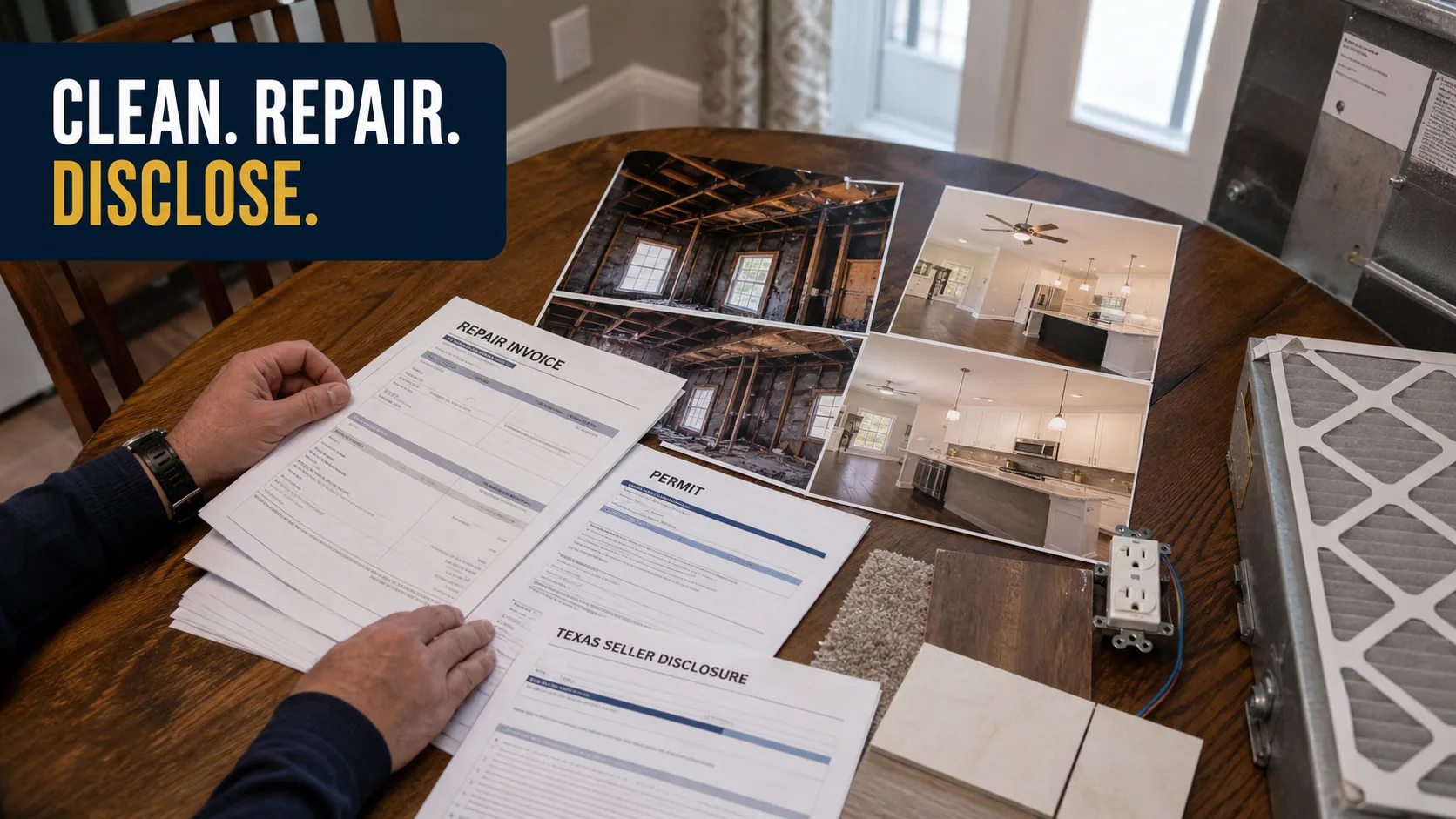
The Texas seller’s disclosure notice asks directly about previous fires and about repairs to the property, and selling a house as-is does not remove a seller’s disclosure obligations. A known fire is a known fire.
Take the specifics to a Texas real estate agent or a real estate attorney rather than to a general article, including this one. What restoration contributes is the evidence: a scope of what was cleaned and replaced, dated photos, disposal records, and moisture logs proving the structure reached dry standard. Documented and disclosed reads as a solved problem. Disclosed with no file reads as an unknown.
How the claim and the sale interact
- Depreciation. On a replacement cost policy the held-back depreciation is typically released only after repairs are completed and invoiced. Sell unrepaired and that portion may stay unrecovered — mechanics in actual cash value versus replacement cost.
- Your mortgage company. Claim proceeds on a financed home are commonly issued to you and your lender jointly, held, and released against completed work.
- The record. A claim documented the way a fire damage insurance claim should be is the same file that answers a buyer’s inspector.
How long each path takes
As-is sales close on a cash timeline, often inside a few weeks. The restore-then-list path is set by the work: mitigation on a contained fire is one to two weeks, a whole-house smoke loss three to six, and cosmetic rebuild sits on top.
The listing date is decided by readings, not the calendar. Moisture has to hit dry standard and the odor check has to hold with the house closed up and the HVAC running. Listing a house that still smells is how a property sits, takes a price cut, and sells for less than it would have after one more week of work.
The free things worth doing this week
- Run the closed-house smell test and write down which rooms are worst.
- Pull the HVAC filter. Grey loading means the ducts carried smoke through the whole house — and a buyer’s inspector can pull that filter too.
- Photograph everything with the date stamp on before any cleanup.
- Gather the file — incident number, claim number, every invoice, every receipt.
- Ask an agent for both opinions of value in writing, as-is and restored.
- Do not paint over soot. It bleeds back through in weeks, and a failed cover-up reads worse to an inspector than the original damage.
Where the sale ends and we begin
TruePoint Restoration is not a real estate brokerage, not an investor, and not your attorney. We do not buy houses, we do not value them, and we will not advise you on disclosure language.
What we do is the mitigation and the record behind it: removing soot in the order that keeps materials salvageable, drying firefighting water with logged readings, cleaning contents, removing odor at the source instead of covering it, and handing you a file that answers a buyer’s inspector as cleanly as it answers an adjuster. Sometimes the honest answer is that the odor work alone is worth doing and the rest is not, and we will tell you that.
Send photos to (346) 271-7004 and we will tell you what your house needs before you list it. We serve Pearland, Manvel, Friendswood, League City and the Greater Houston area.