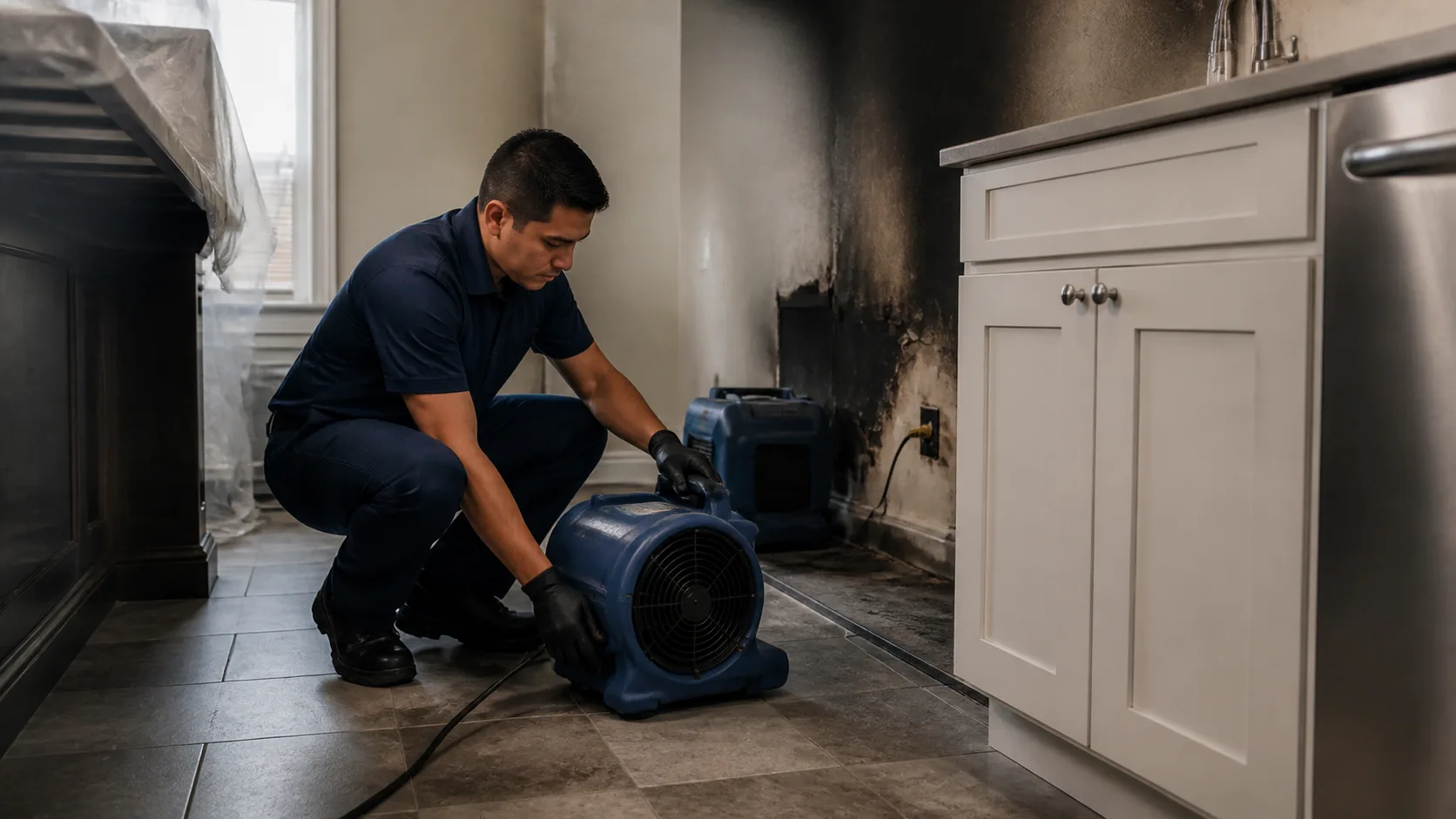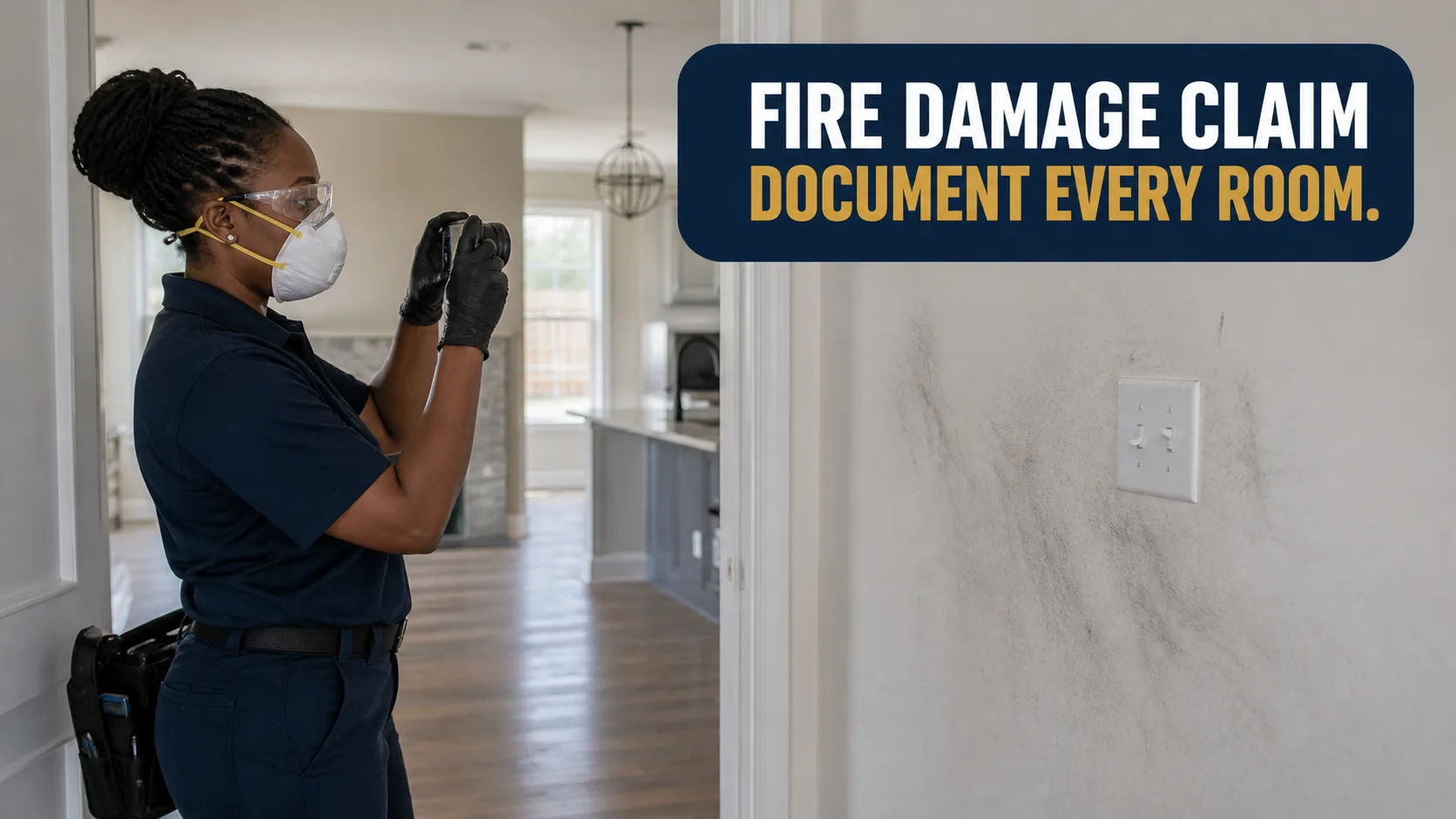
Fire is a named peril on virtually every standard homeowners policy, and coverage extends to smoke, soot, and the water damage from putting the fire out, plus loss-of-use for temporary lodging. A fire claim is paid in full when it's documented in full: source of loss, a room-by-room record of fire, smoke, soot, and water, an itemized contents inventory, and photos taken before cleanup. What isn't documented tends not to get paid. We document the loss the way adjusters need — call or text **(346) 271-7004**.
What a fire policy actually covers
On a standard homeowners policy, an accidental fire triggers coverage for far more than the burned area:
- Structure and contents damaged by fire, smoke, and soot — including rooms that never saw flames.
- Water damage from the hoses and sprinklers used to put the fire out.
- Loss of use — temporary lodging and essentials while the home is unlivable. Keep every receipt.
The one exclusion worth naming is arson by the homeowner. Ordinary accidental fires are covered.
Does house insurance cover fire damage?
Yes. Fire is a named peril on virtually every standard homeowners policy sold in Texas. What varies is which part of the policy pays for which part of the loss.
- Dwelling — the structure: framing, roof, drywall, cabinets, flooring.
- Other structures — a detached garage, shed, or fence.
- Personal property — contents, often with sub-limits on jewelry.
- Loss of use — living expense while the home is unlivable.
Read those four sections on your own declarations page. No general article outranks your policy.
Does renters insurance cover fire damage to the house?
No, and this catches tenants out. Renters insurance covers your belongings, your living expenses, and your liability. The building is on the landlord’s policy, so two policies respond to one fire separately. If that carrier believes a tenant’s negligence caused the fire, it may pursue the tenant’s liability coverage — the mechanism is subrogation.
Why fire claims get underpaid
A fire claim rarely comes up short because the policy was thin. It comes up short because damage went unrecorded. Smoke and soot spread into rooms that didn’t burn, odor sinks into porous materials, and there’s almost always water damage under the burned area — and a fire-only cleanup crew often ignores the water entirely. Every one of those, undocumented, is money left on the table.
The claim is only as complete as the record behind it.
Warning signs a claim is heading for a shortfall
Scope gaps — damage nobody wrote down:
- The estimate covers the burned rooms only, in a house where every room smells like smoke
- No moisture readings anywhere, after a fire put out with hoses
Documentation gaps — damage nobody proved:
- Cleanup started before the whole-house photo record was taken
- Contents were discarded before they were itemized
Each is cheap to fix early and expensive later.
What documentation a fire claim needs
From an adjuster’s side of the table, a clean fire claim has:
- Source of loss established and recorded.
- A whole-house damage map — fire, smoke, soot, and water, room by room, not just the origin.
- An itemized contents inventory of damaged belongings.
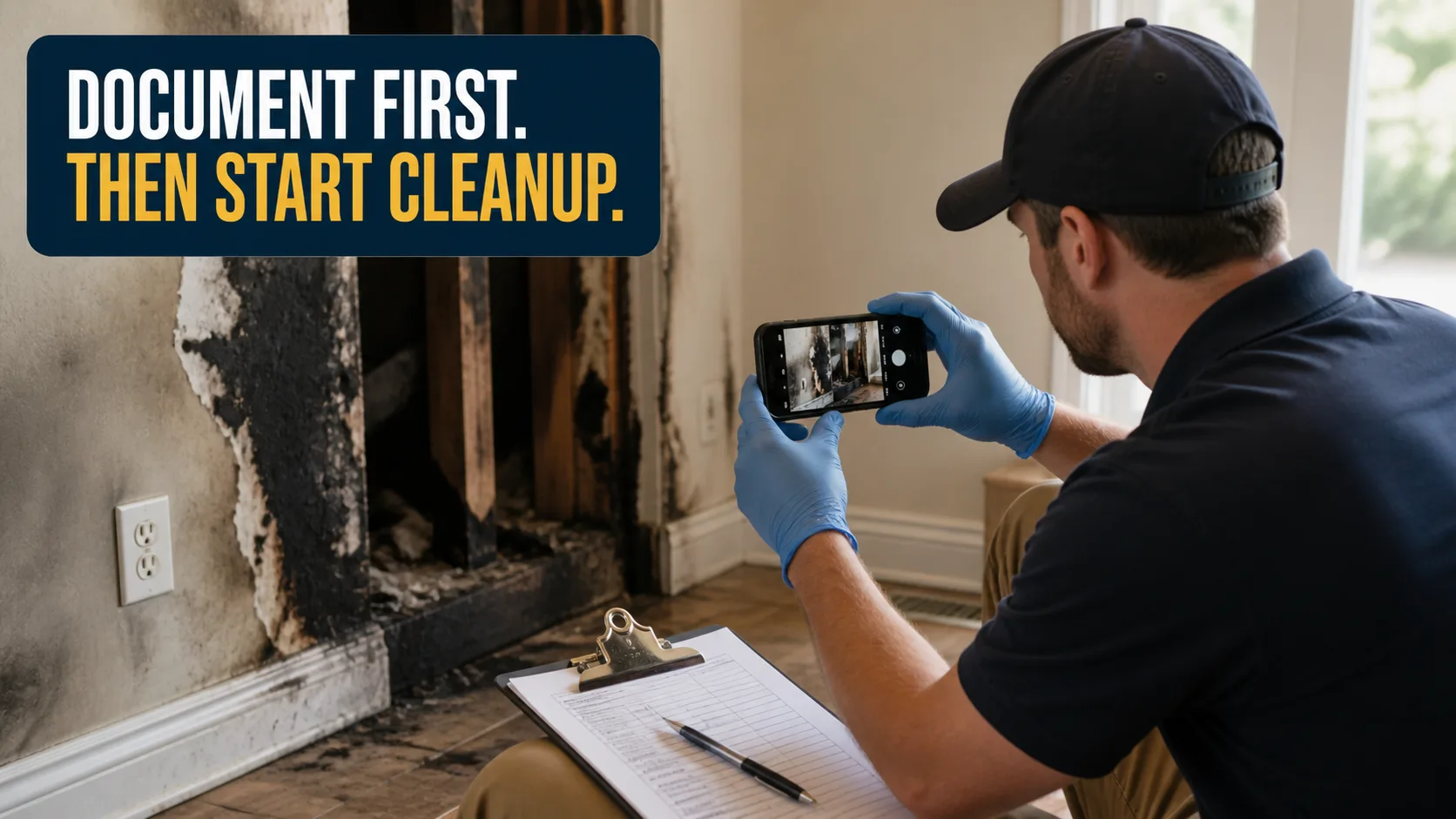
- Photos and video before cleanup, wide and close.
- Loss-of-use receipts for lodging and essentials.
- Moisture readings on anything the hoses reached, dated and logged.
- A disposal record — what came out, from where, when.
Take all of it on a phone with the date stamp on, before anyone cleans. This is where documentation changes the outcome. We document a fire loss the way the carrier’s own people expect to see it — which tends to make the claim move faster and land more completely.
How to file an insurance claim for fire damage
- Get the fire department’s incident number before you leave the scene. Every step in the first 24 hours after a house fire feeds this claim.
- Photograph and video the entire house before anything is touched.
- Notify the carrier the same day, factually — the incident, the rooms affected, the date and time. Guessing at cause or dollar figures helps nobody; what not to say to an adjuster covers the common missteps.
- Start emergency mitigation. Policies expect it.
- Build the contents inventory room by room, and keep every receipt under loss of use.
- Walk the house with the adjuster, with your record in hand.
- Compare the estimate to the documented scope. Anything documented but missing is a supplement conversation.
What a total loss fire claim means
A total loss is a claim where repairing the structure is not economically or practically possible, so the carrier settles the dwelling coverage instead of a repair scope. It does not always mean the house burned to the ground.
The settlement is driven by your limit and by whether you carry replacement cost or actual cash value. Loss-of-use runs long enough that its limit is worth knowing at month one, not month nine.
What moves the number on fire damage restoration cost
The figure is assembled from parts:
- How much burned versus how much only took smoke and water
- How many rooms carry residue — nearly always the whole house
- Residue type, since protein and wet smoke take multiple passes
- How much firefighting water went in, and how long it sat
- Contents volume, and whether they are cleaned on site or packed out
Mitigation on a small contained fire runs in the low-to-mid thousands. A whole-house scope runs into five figures — see smoke damage cleanup.
The adjuster, the mitigation company, and the rebuild contractor
- The adjuster determines what the policy pays. The carrier assigns one; you may also engage a licensed public adjuster, a separate profession.
- The mitigation company — our role — stops the damage getting worse and records the physical facts: what is wet, what is sooty, what came out, what the readings said.
- The rebuild contractor puts the structure back afterward.
Texas keeps those lanes separate: under state law a public insurance adjuster may not also perform the repair work on the same claim.
How long does a fire insurance claim take?
Straightforward residential fire claims often settle in one to three months. Larger and total losses commonly run six months to a year, because the contents inventory and the rebuild scope take that long to assemble.
Texas sets statutory deadlines on acknowledgement, decision, and payment once a claim is filed and requested information is provided. What paces a claim is how fast complete information reaches the file — and when one comes back denied, the reasons are usually documentation or policy language.
Don’t wait to mitigate
You don’t have to wait for the adjuster to start emergency mitigation — policies expect you to prevent further damage. Document thoroughly, then let board-up, water removal, and soot control begin, because soot etches and mold grows (within 24 to 48 hours in Houston humidity) while an inspection is being scheduled. Call or text (346) 271-7004 and we’ll handle the mitigation and the documentation together.
The free things worth doing tonight
- Find your declarations page and read four numbers: dwelling, contents, loss-of-use, deductible.
- Photograph and video the whole house with the date stamp on.
- Start a receipt envelope — lodging, meals, clothing.
- Write the timeline down, including the incident number.
- Do not throw anything away until it is photographed and itemized.
Where the claim ends and we begin
TruePoint Restoration is a mitigation company. We are not your attorney, we are not your public adjuster, and we do not negotiate your settlement or represent you against your carrier.
What we do is the physical work and the record behind it: emergency stabilization, drying the firefighting water with logged readings, removing soot in the order that keeps materials salvageable, and producing a room-by-room file your adjuster can work from. Call or text (346) 271-7004. We serve Pearland, Manvel, Friendswood and the Greater Houston area.