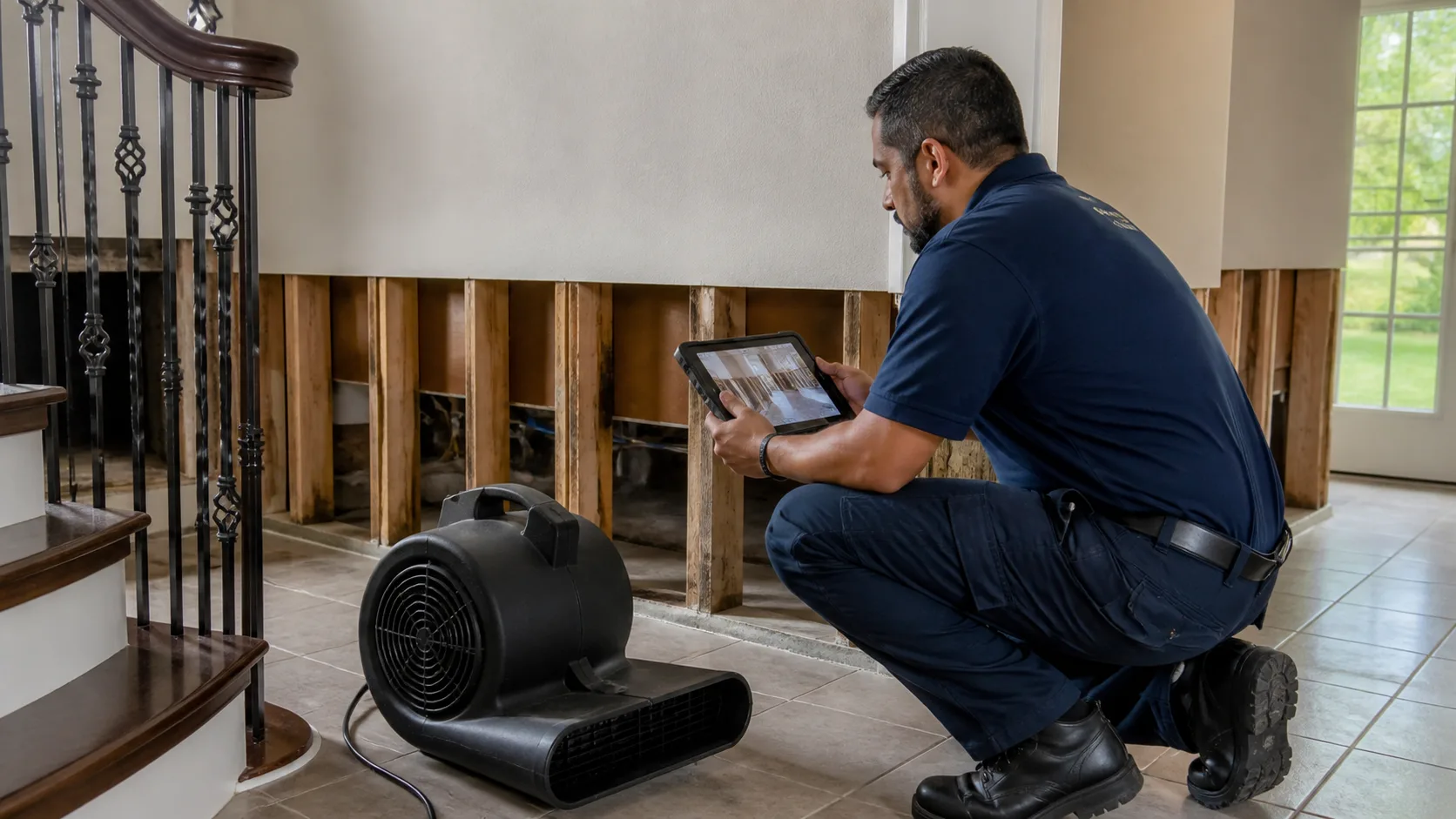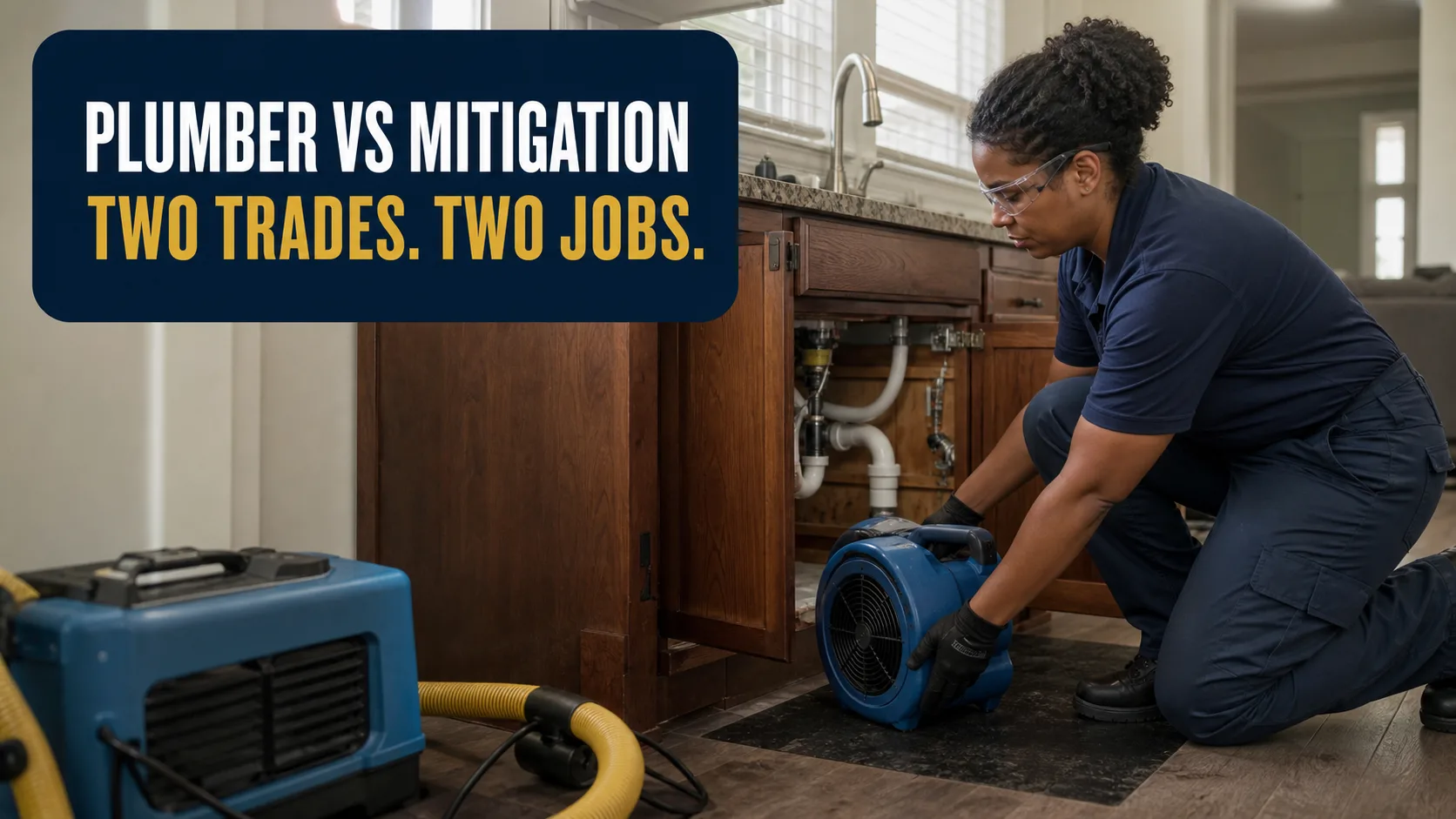
Two different jobs. The **plumber** stops and repairs the failed system. The **mitigation company** deals with the water that already escaped: extraction, metered structural drying, mold prevention, and insurance documentation. Active flow you can't stop → plumber first. Water stopped, materials wet → mitigation first, plumber scheduled. Significant loss → both, in parallel. The costly mistake is calling only the plumber and assuming a fixed pipe means a dry house.
Cause and consequence
Every water loss has two halves, and Texas licenses two different trades for them:
The cause — a failed connector, a clogged condensate line, a cracked tank, a blocked sewer. Plumber’s territory (or HVAC tech’s, when the AC is the source). Their job is done when the system holds pressure and drains correctly.
The consequence — the fifty gallons that left the system before anyone stopped it, now living in your drywall, insulation, flooring underlayment, and cabinet bases. That is mitigation: find every wet material with meters and thermal imaging, extract, dry with commercial equipment, verify against dry standard, and produce the documentation your insurance claim stands on.
The gap between the trades is where homes get hurt. “The leak is fixed” and “the house is dry” are different sentences — and in Houston humidity, the second one never becomes true on its own.
Who first: the scenario table
| Situation | First call | Why |
|---|---|---|
| Water actively flowing, no valve works | Plumber (emergency) | Nothing else matters while it flows |
| You stopped it at a valve; floors/walls wet | Mitigation | The drying clock (24–48h to mold) is the live deadline; the repair can be scheduled |
| Slow leak discovered (cabinet, ceiling stain) | Mitigation | Mapping how far weeks of moisture traveled drives everything, including what the plumber opens |
| Sewer backup | Both, in parallel | Line must be cleared AND contamination handled professionally |
| Slab leak suspected | Plumber (leak detection) | Locate before anyone cuts; mitigation joins for the drying phase |
| AC water through ceiling | HVAC tech + mitigation | Tech fixes condensate system; ceiling cavity needs metered drying |
| Water heater failed | Plumber + mitigation | New tank and dry structure are separate deliverables |
The handoff most homeowners fumble
The standard failure pattern:
- Pipe bursts. Homeowner calls plumber. Plumber does exactly their job: pipe fixed by dinner.
- Homeowner mops, runs box fans overnight, and files this under handled.
- The wall cavity, wet insulation, and flooring underlayment — which no box fan can reach — sit saturated in Gulf Coast humidity.
- Six weeks later: the smell. Then the mold remediation quote, at multiples of what drying would have cost. And now the insurer is asking why mitigation never happened — policies require preventing further damage.
The fix costs one question at step 1: “Separate from the repair — what got wet, and who is drying it?”
And the third trade nobody warns you about
Two calls fix the emergency. Three trades finish the job.
The rebuild contractor puts back what came out — drywall, texture, paint, baseboard, cabinets, flooring. That is reconstruction, it is general contracting, and it is a separate scope with a separate contract. Some firms carry both mitigation and reconstruction; many hand off. Either way it should be written against the same line items as the mitigation file so the claim reconciles without anyone translating.
Two more show up often enough to plan for. Abatement is its own licensed trade when demolition reaches asbestos or lead in an older Houston home, and it can pause everything until it is finished. Mold remediation appears when drying started too late, and past twenty-five contiguous square feet it carries its own Texas licensing and its own written protocol.
Fire runs the same way with different names — mitigation covers board-up, tarping, soot removal, and drying the firefighting water, and a rebuild contractor follows. The scope split is laid out in what fire damage restoration costs.
A worked example: two invoices, one deductible
Numbers invented to show how the trades divide on a claim. Nothing below is a quote.
A water heater connector fails overnight in a garage that shares a wall with a bedroom. The plumber replaces the connector for $380. Mitigation meters wet drywall four feet up that wall, wet insulation behind it, and carpet pad in the bedroom, and the drying scope comes to $4,700. The rebuild — drywall, texture, paint, pad, trim — is $3,100. Assume a $1,500 deductible.
| Line | Amount | Who pays |
|---|---|---|
| Plumbing repair, the failed part itself | $380 | Homeowner — policies pay for what the water did, not the part that failed |
| Mitigation, drying and removals | $4,700 | Claim |
| Reconstruction | $3,100 | Claim |
| Claim scope | $7,800 | Less the deductible, once |
The deductible applies to the claim, not once to each contractor. If the connector failed inside its warranty, the $1,500 may come back later through subrogation — which requires the connector to be on a garage shelf rather than in the plumber’s truck.
Now delete the middle row. The plumber replaces the connector, the homeowner runs box fans, and nobody meters the wall. Six weeks later there is a remediation scope, a bigger rebuild, and a carrier asking why mitigation never happened. The $4,700 line was the cheap one.
What a real mitigation response includes
So you can tell the real thing from a truck with fans:
- Moisture mapping before any equipment placement — meters and thermal imaging, documented
- Extraction as the first physical step; every extracted gallon is days off the drying
- Selective removal only where materials can’t be saved (soaked carpet pad, swollen baseboard) — not demolition by default
- Commercial dehumidification and air movement, sized to the loss
- Daily readings, on paper, until materials hit dry standard — the log that closes your claim cleanly
- No pressure toward rebuild services before the structure is verifiably dry
That last line is the tell. Anyone eager to schedule drywall and paint before showing you dry readings is selling the wrong end of the job first.
What to do in order
- Stop the water at its valve, or the house main if the valve will not turn.
- Kill power to any room where water reached outlets or appliances, without standing in water to reach the panel.
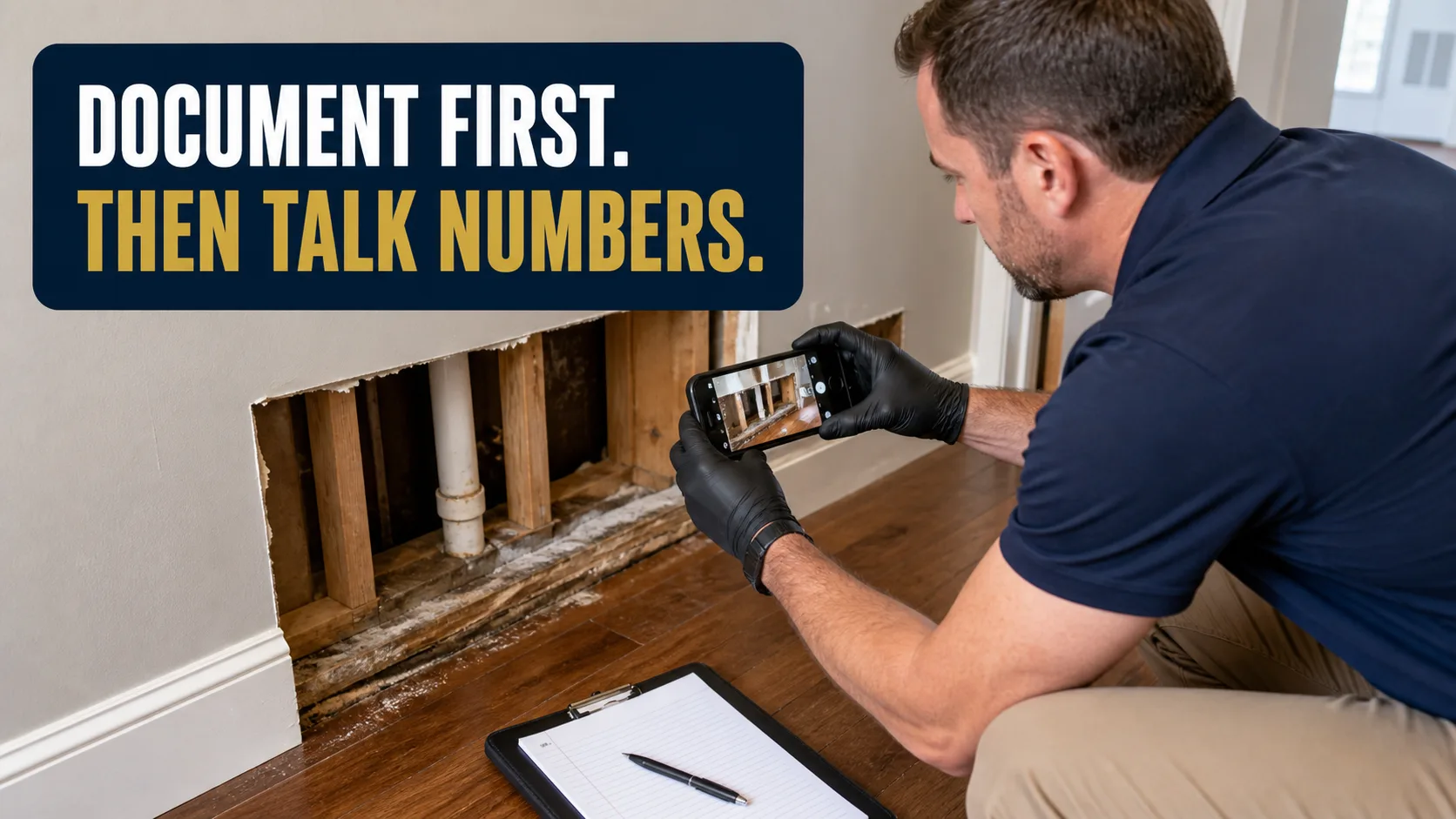
- Photograph everything before anyone works on it, with the date stamp on.
- Call the plumber for the cause and mitigation for the consequence. On a live flow the plumber goes first; once the water is off, both calls are the same morning.
- Ask the plumber one question on the way out: separate from the repair, what got wet?
- Keep the failed part, bagged and labelled with the date.
- Report the loss with the discovery time, the source, and what has been done.
- Book the rebuild last, once readings show dry standard.
What to document while both trades are on site
The two trades produce different evidence and a claim file needs both.
- From the plumber: the failed part itself, its data plate, the invoice describing what failed and what was replaced, and the date. This is what establishes a sudden discharge.
- From mitigation: the moisture map at discovery, daily readings, equipment count and days, and photographs of anything removed with the reason. Equipment bills per unit per day, so the log is also the justification for the invoice.
- From you: timestamped photos and video from before anyone touched anything, and a dated note of when you found it and when you shut it off.
- From the rebuild: invoices itemised against the approved scope, proof of payment, and finished-work photographs from the same angles as the loss photos. That set is what releases held-back depreciation.
The usual failure is a plumbing invoice that says “replaced connector” with no mention of water, sitting next to a drying invoice with no source named. Two documents that do not reference each other are harder to pay than one file that does.
Two timelines, running at once
The plumber’s timeline is short. A connector, a valve, or a water heater is hours to a day. A slab leak takes longer because locating comes before cutting — what that involves is a different job again.
The drying timeline is set by materials, not by preference. Three to five days is typical for a contained loss on drywall and carpet. Hardwood, plaster, and anything against a slab run longer, and whether wet drywall gets dried or removed is a readings decision made on day one or two. Reconstruction starts after dry standard, not alongside it.
The claim timeline runs separately. Texas rules generally give an insurer about 15 days from notice to acknowledge and start investigating, then about 15 business days after receiving everything requested to accept or reject in writing, with a limited extension explained in writing. None of that is a reason to delay drying. Waiting for an adjuster before mitigating costs materially and reads as neglect in the file.
For the plumbers and HVAC techs reading this
You are first on scene at more water losses than we will ever be. When you fix the failure and the floor squishes on the walk out, the homeowner deserves the second half of the answer. TruePoint Restoration runs a straightforward referral partnership for exactly that handoff — call (346) 271-7004 and ask about it.
And homeowners: either order you dial, the two calls together are the complete response. We coordinate with your plumber routinely — it is the most normal thing in this business.
Do this tonight, free
- Find your main shut-off and turn it once to confirm it works. Then show someone else in the house.
- Check the age of your washer hoses and water heater connectors, and photograph both data plates.
- Put a plumber’s number and a mitigation number in your phone before you need either.
- Find your declarations page and write down the deductible and the settlement basis.
- Decide where a failed part would go — a labelled bin in the garage, not the kerb.
Where our scope stops
TruePoint Restoration is a mitigation and mold remediation company. We are not plumbers, not HVAC techs, and not a rebuild contractor — we do not clear lines, replace tanks, or hang cabinets, and we say that on the phone rather than after the estimate. We are also not a public adjuster or a claims representative; Texas keeps that role separate from the firm doing the work, and we do not negotiate settlements or interpret policies.
What we do is find every wet material with meters and thermal imaging, extract, remove only what cannot be saved, dry to dry standard with daily logged readings, and hand over a documented file an adjuster can read directly. When the structure meters dry, our part is finished and the rebuild contractor’s begins.
If a claim is genuinely disputed, a Texas-licensed public adjuster, an attorney, or the Texas Department of Insurance is who takes it up. For the drying and the record, call (346) 271-7004. We serve Pearland, Manvel, Friendswood, League City and the Greater Houston area.