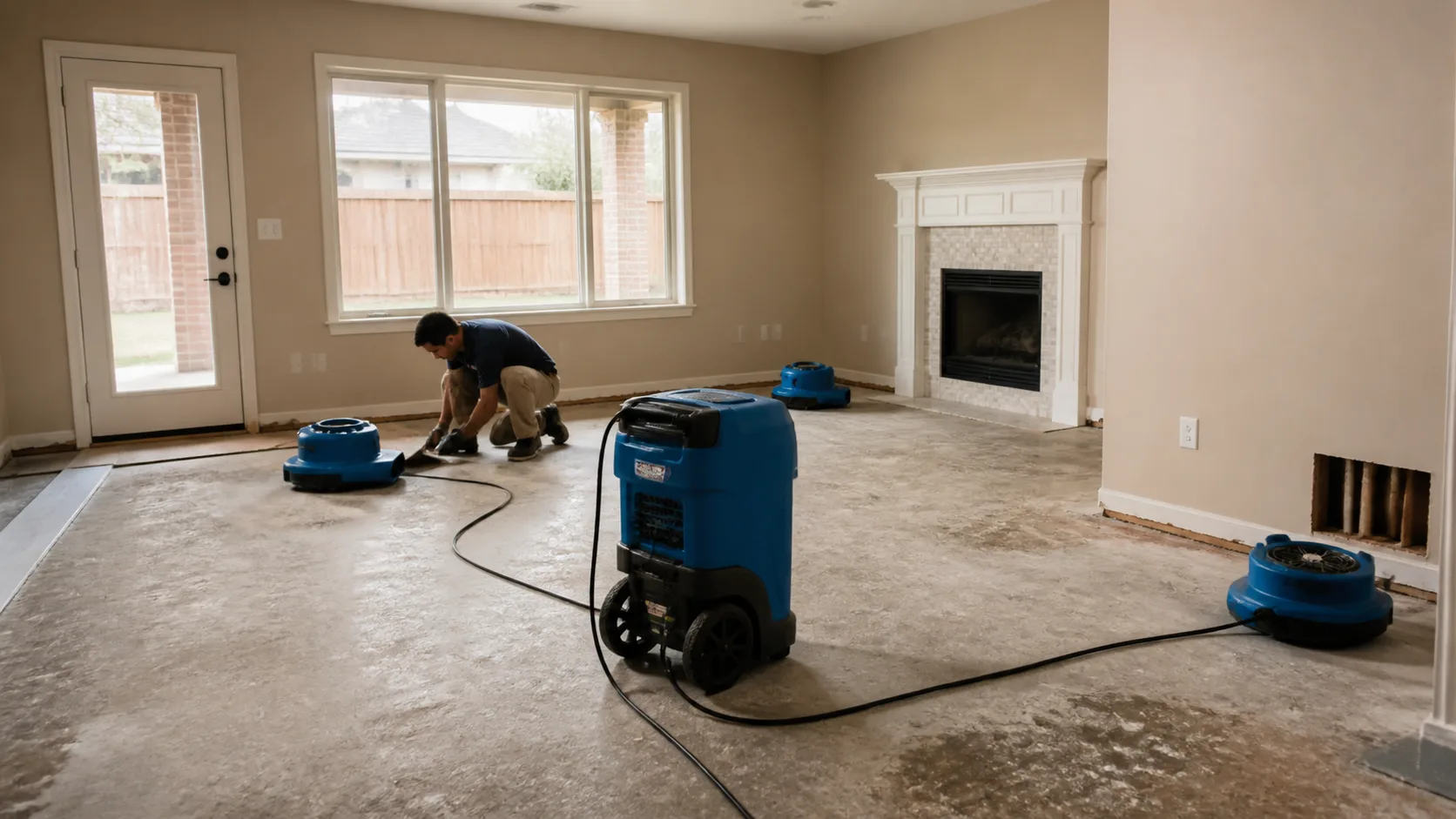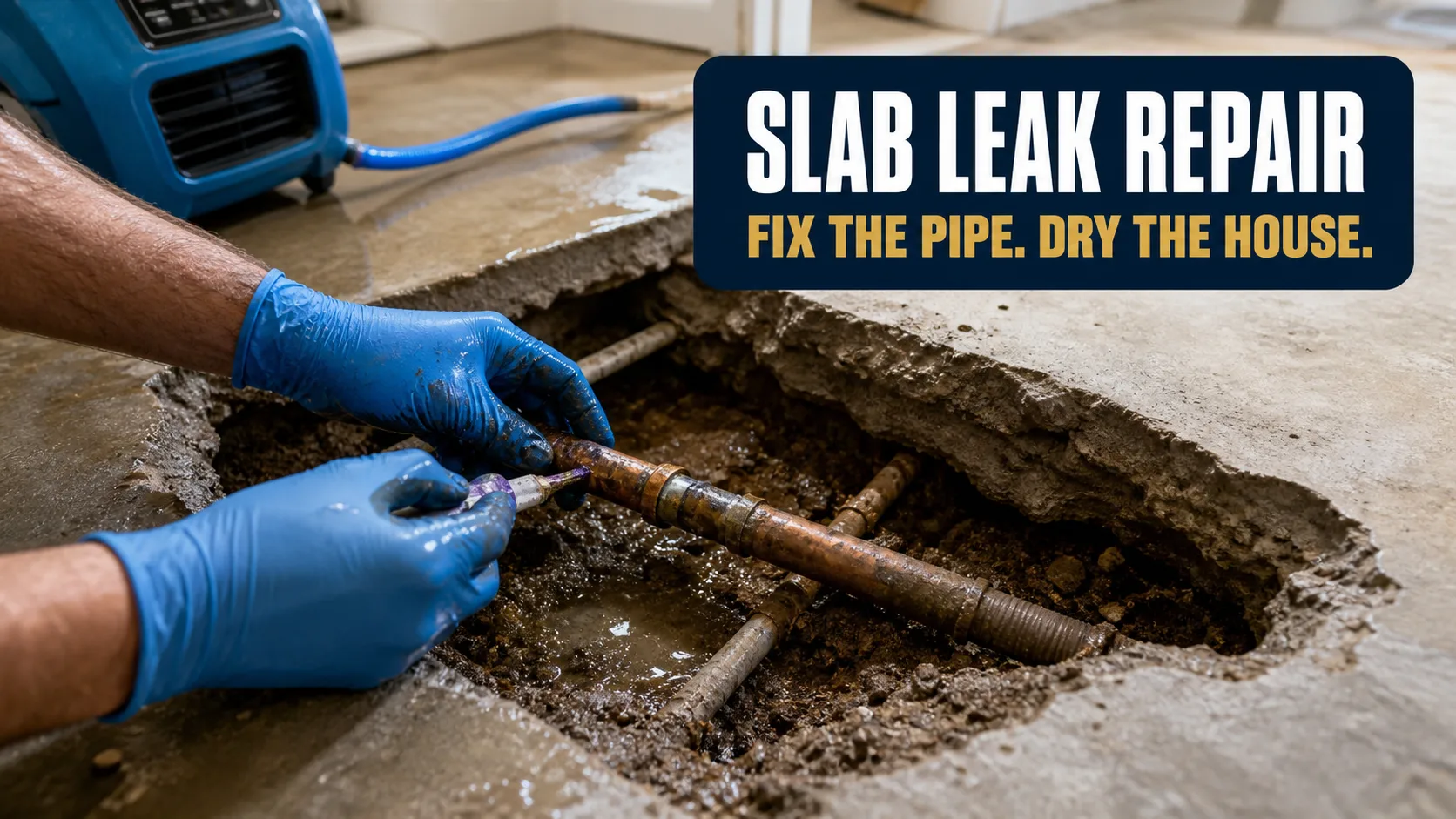
A slab leak is a pressurized supply line failing under or inside your concrete foundation. The sequence that works is find it, fix it, dry it, document it. A plumber locates and repairs the pipe. What that water left behind in the slab, subfloor, and wall bases is a separate job with its own equipment and readings, and that part is ours at **(346) 271-7004**.
What is a slab leak, and why does Houston get so many?
A slab leak is a pressurized water line that has failed inside or underneath the concrete slab your house sits on. Houston produces them at a rate that startles people who moved here from other parts of the country, and it is not bad luck. It is three local conditions stacked on top of each other.
Nearly every house here is slab-on-grade, so supply lines run in or beneath the concrete instead of through a crawlspace where you could see them. The soil is expansive clay that swells through a wet spring and shrinks through a dry August, moving the slab a little every season. And the pipe is locked into that slab, so the movement lands on joints and on the places where a line bends or exits the concrete. Add decades of that cycle to copper already thin at a bend, and you get a pinhole.
One thing to understand before you call anyone: a slab leak is two separate problems sharing one name. There is a plumbing problem — a pipe that no longer holds pressure. And there is a water damage problem — everything that pipe soaked before anybody noticed. Different trades handle each, and the order they happen in matters.
What are the warning signs of a slab leak?
The signs people actually notice are a warm patch on the floor, a water bill that climbed with no change in how you live, the sound of running water when nothing is on, damp flooring in one spot that keeps coming back, and cracks that were not there a year ago.
Hot-side leaks — more common, and easier to catch:
- A spot on the floor noticeably warmer than the floor around it. Tile shows it best, and bare feet find it faster than any tool.
- A water heater cycling more than it used to, because it is quietly reheating water that is going into the ground
- Gas or electric use creeping up alongside the water bill
Cold-side leaks — quieter, usually found later:
- Flooring failing in one area: grout darkening, wood cupping at the edges, vinyl lifting or bubbling
- Carpet damp near a wall with no fixture behind it, or a pad that smells before the carpet looks wrong
- Baseboards swelling and paint blistering along the bottom few inches of a wall
Either side:
- A bill jump with no explanation
- The sound of water with the house shut down, often clearest at night with an ear near the floor
- Foundation symptoms — new cracks in slab or brick, doors and windows sticking, trim separating. A leak soaks one zone of clay while the rest holds normal moisture, and uneven support is what those cracks are reporting.
Supply-line leaks behave the same way everywhere in a house, whether they are in a wall or under concrete. More on the general pattern: the leak you cannot see.
How do I confirm a slab leak myself before calling anyone?
Run the meter test. It takes about fifteen minutes and costs nothing. Turn off every fixture and appliance that uses water, including ice makers and irrigation, then find your water meter and watch the low-flow indicator — usually a small triangle, star, or dial that spins on flows too small to move the main numbers. If it moves with the house shut down, water is leaving your system somewhere.
That test proves there is a leak. It does not prove the leak is under the slab. To narrow it, close the shut-off valve on top of your water heater and watch the meter again. If the movement stops, the leak is on the hot side, which is where most slab leaks live. If it keeps moving, you are looking at the cold side or something upstream of the heater.
Record the moving dial on your phone. It confirms the problem, and it is dated evidence later.
How do plumbers locate a slab leak without tearing up the floor?
They locate it with detection equipment rather than guesswork, usually combining two or three methods before marking a spot on your floor.
- Electronic acoustic detection — sensitive ground microphones listen for the hiss of pressurized water escaping into soil under concrete. This is the workhorse method.
- Pressure isolation testing — sections of the system are isolated and pressurized to prove which line is failing and roughly where.
- Thermal imaging — a hot-side leak warms the slab above it in a plume that a thermal camera reads clearly.
- Tracer gas — an inert gas is put into the drained line and detected where it surfaces, for when acoustic conditions are poor.
- Line camera — for waste-side leaks, a camera down the drain finds breaks, bellies, and root intrusion.
Detection is normally billed separately from the repair and typically runs in the low hundreds — cheap next to opening concrete in the wrong place.
Concrete slab leak repair options compared
Once the leak is located, there are four honest paths. The right one depends on where the pipe failed, how old the system is, and how much flooring you are willing to lose.
| Option | What it involves | Best when | Typical cost range | Disruption |
|---|---|---|---|---|
| Spot repair through the slab | Flooring lifted, concrete opened at the leak, failed section replaced, slab patched | One isolated failure in piping that is otherwise sound | Low thousands, typical | High in one room — flooring in that area usually does not survive |
| Reroute overhead | The buried section is abandoned; a new line runs through the attic and down inside walls | The leak is in a hard-to-reach spot, or you want that run retired for good | Low to mid thousands, typical | Moderate — drywall patches, no floor demolition |
| Tunneling under the slab | A tunnel is dug from outside to reach the pipe from below; the slab is never opened | Leak sits under cabinets, tile you cannot replace, or a load-bearing area | Mid thousands and up; priced largely by tunnel length | Outside excavation, interior mostly untouched |
| Whole-home repipe | The entire supply system is replaced, generally overhead | This is the second or third leak, or the piping has a known failure pattern | High thousands and up | Highest, and it ends the recurring-leak problem |
Those ranges are typical and highly variable — depth, pipe material, access, permits, and finish work all move the number. Ask for the estimate in writing after detection, not before.
What does slab leak repair cost in Houston?
Expect three separate numbers, not one. Detection is its own line item in the low hundreds. The plumbing repair itself follows the table above. And the water damage work — drying what got wet, plus any flooring or drywall that has to come out — is a third number that depends entirely on how long the leak ran before you found it.
Five things move the total more than anything else:
- How long it leaked. A leak found in a week is a dry-out. A leak found in six months is a dry-out plus removals plus, sometimes, mold work.
- Where it sits. Under an open tile floor is straightforward. Under a kitchen island or a wall of cabinets is not.
- Pipe material and system age. Isolated copper failure is a spot repair. Repeated failures in aging pipe are a repipe conversation.
- Flooring type. Tile and engineered wood over a wet slab often cannot be reinstalled. That is a finish cost, not a plumbing cost, and it surprises people.
- Whether the slab and framing get dried properly. Doing it costs days of equipment. Skipping it costs a remediation next year.
Does the plumber dry the house too?
No, and this is the single most useful thing on this page. A plumber’s scope ends at a pipe that holds pressure. Nothing in that scope covers the moisture already sitting in your slab, subfloor, wall bases, cabinet kicks, and insulation — and nobody is being dishonest about it. It is simply a different trade with different equipment.
The sequence that works is find, fix, dry, document. Detection locates the leak. The plumber repairs or reroutes the line. Then the structure gets metered, dried, and verified, and all of it gets written down for the claim. Skip the third step and you have a house that passed a pressure test and failed a moisture test, which is a problem that surfaces later as a smell, a stain, or a buckled floor.
What happens to the water already in the slab, subfloor, and walls?
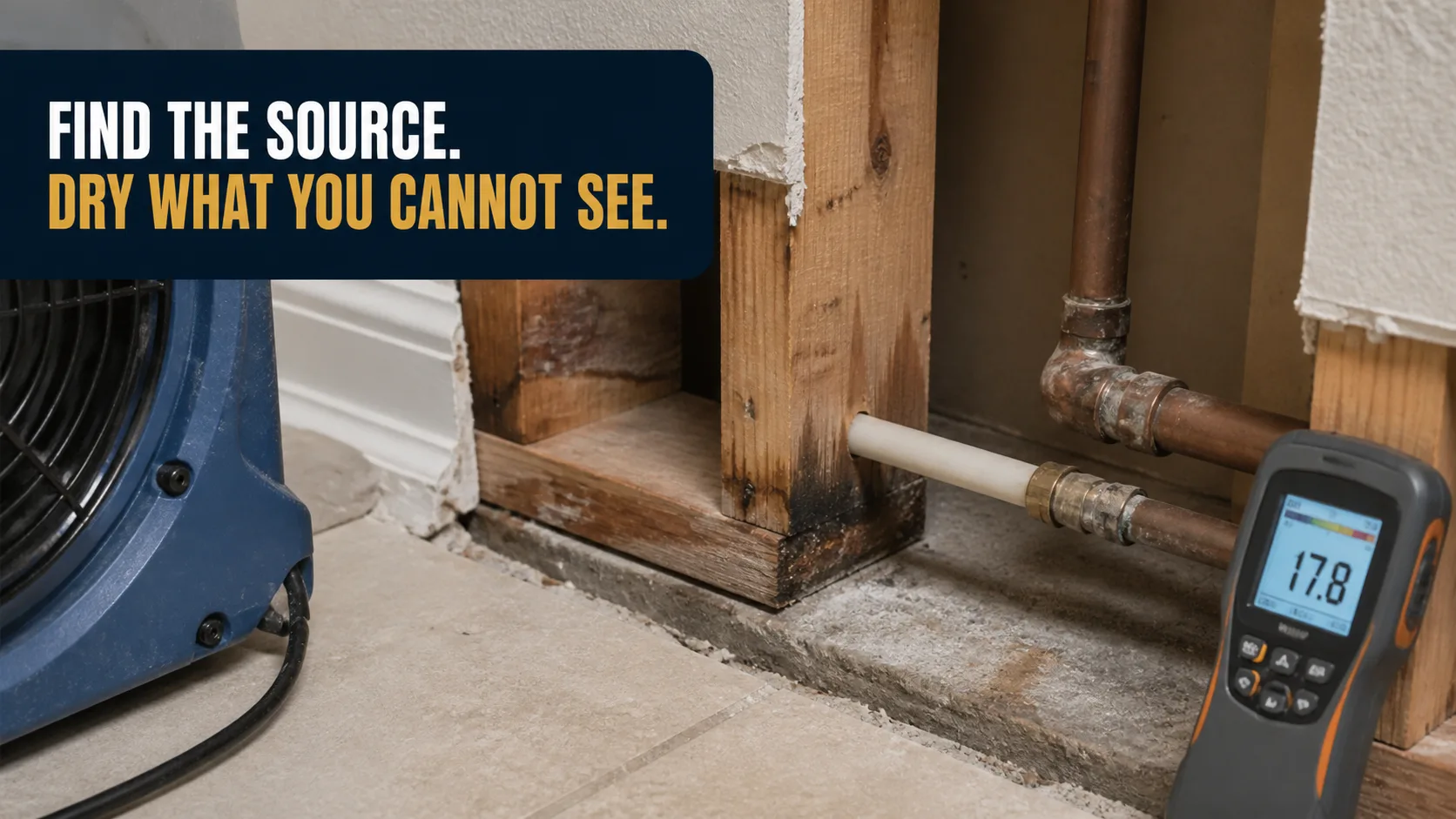
It stays there, quietly, longer than anyone expects. Concrete is porous. A slab that has been fed by a leaking supply line holds water through its depth and releases it slowly, and the materials sitting on it — subfloor, tack strip, bottom plates, baseboards, cabinet toe kicks, the bottom edge of drywall — wick it upward and hold it. Gulf Coast humidity means the surrounding air is not going to pull it out for you.
Proper drying after slab leak repair looks like this:
- Moisture mapping. Readings across the affected rooms, including materials that look fine, so the scope reflects the actual wet area instead of the visible one.
- Remove what cannot be dried. Saturated carpet pad, swollen laminate, and drywall that wicked water above the salvage line come out. Which drywall to dry and which to cut is a judgment call made with a meter, not by eye.
- Open the trapped spaces. Baseboards off, cavities vented, cabinet kicks opened. Airflow that cannot reach wet material does nothing.
- Equipment. Commercial air movers plus dehumidification sized to the space, running continuously rather than a box fan running overnight.
- Daily readings, logged. The job ends when materials hit dry standard and the log proves it — not on a fixed day.
If any of that gets skipped, the risk is predictable: materials that stay wet past a day or two in this climate are where mold starts.
How long does drying take after a slab leak?
Most single-room slab leak dry-outs run about three to five days with proper equipment, and the readings decide the end, not the calendar. Concrete is the slow material in the room, so slab-adjacent wood and anything sitting directly on the slab are usually the last to reach dry standard. Hardwood flooring, cabinets, and multi-room losses stretch it further. What actually sets the drying timeline is the same everywhere: how much material got wet, how deeply, and how fast equipment arrived.
Does insurance cover slab leak repair in Texas?
Usually in parts, and the split catches people off guard. Many Texas policies cover the resulting water damage and the access cost — opening the slab and repatching it — while excluding the pipe repair itself as a maintenance item. Some policies handle it differently. A few exclude slab work more broadly.
Two practical notes. First, read your own declarations page rather than trusting anyone’s summary, including this one. Second, how the loss is characterized matters: sudden failures are treated very differently from leaks that obviously ran for a long time, which is why dated photos, the meter video, and a mitigation file with daily readings are worth more than any argument you can make on the phone. More on how carriers approach this: does insurance cover water damage.
The check worth running tonight, whether or not you call anyone
This is free and takes about twenty minutes, and it is genuinely the most valuable thing in this article.
- Find your main shut-off and confirm it turns. Do this before you ever need it.
- Walk your floors barefoot, especially tile, in the morning before the house warms up. You are feeling for one spot warmer than the rest.
- Run the meter test. Everything off, watch the low-flow indicator for fifteen minutes. Write down the date and the result even if it does not move — a clean baseline is useful the next time your bill looks odd.
- Pull twelve months of water bills from your utility account. A slab leak usually shows as a step change, not a spike.
- Repeat quarterly. Two minutes, four times a year, catches leaks while they are still a pipe problem instead of a flooring problem.
And when you do call a plumber, three questions sort the good ones quickly: what detection method will you use, is detection billed separately from repair, and will you give me a written scope before you open anything.
Where slab leak repair services end and we begin
TruePoint Restoration is not a plumbing company. We do not locate or repair the pipe, and we will tell you that on the phone. What we do is the part that comes after — metering what got wet, removing what cannot be saved, drying the slab and structure with commercial equipment, and handing you a documented file your adjuster can actually use.
If your plumber has finished and you are unsure whether anything is still wet, send photos to (346) 271-7004 or email claims@truepointrestoration.com. Sometimes the honest answer is that a fan and an open cabinet door will do it, and we would rather say that than sell you equipment days you do not need. We serve Pearland and the Greater Houston area.