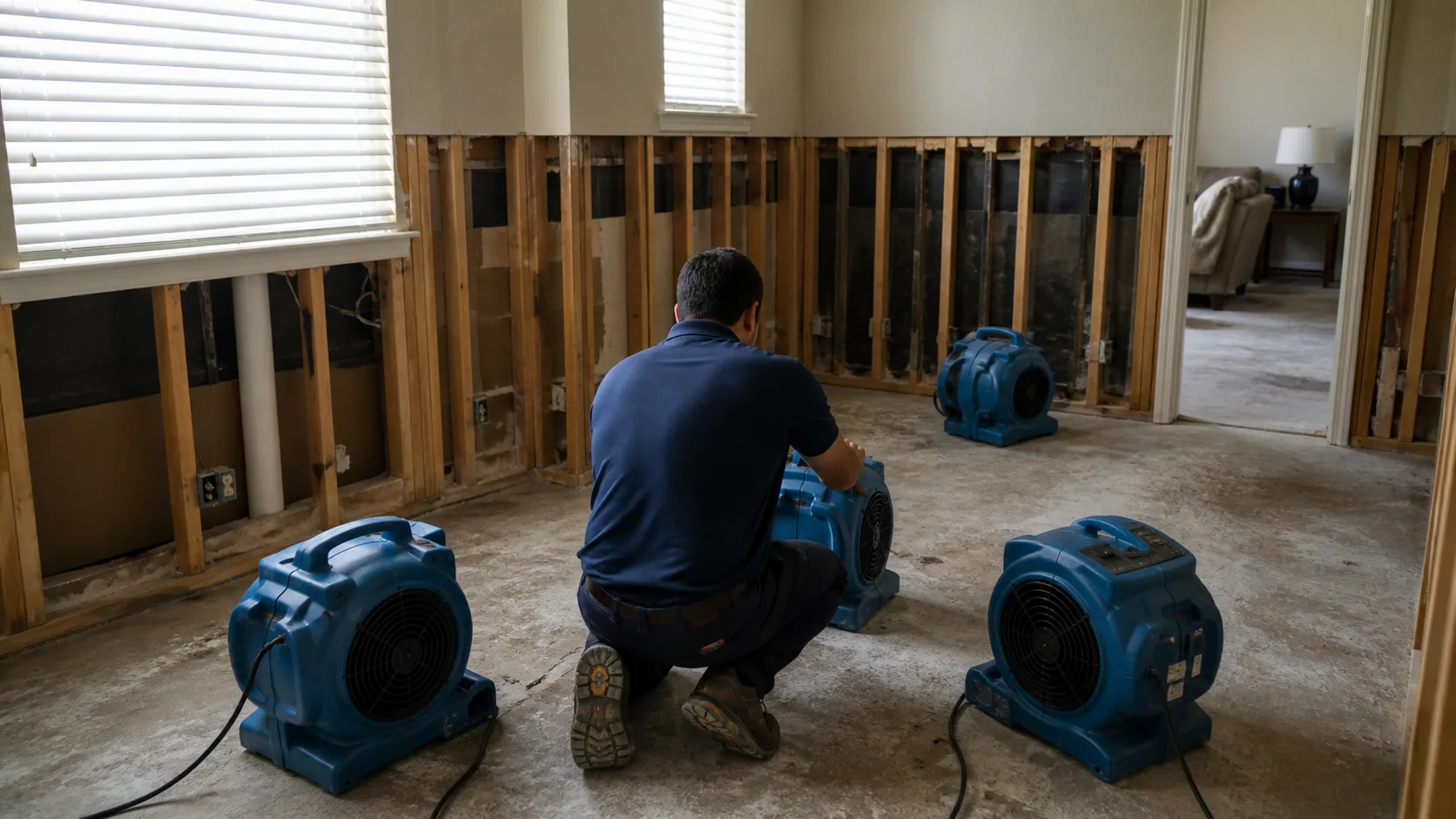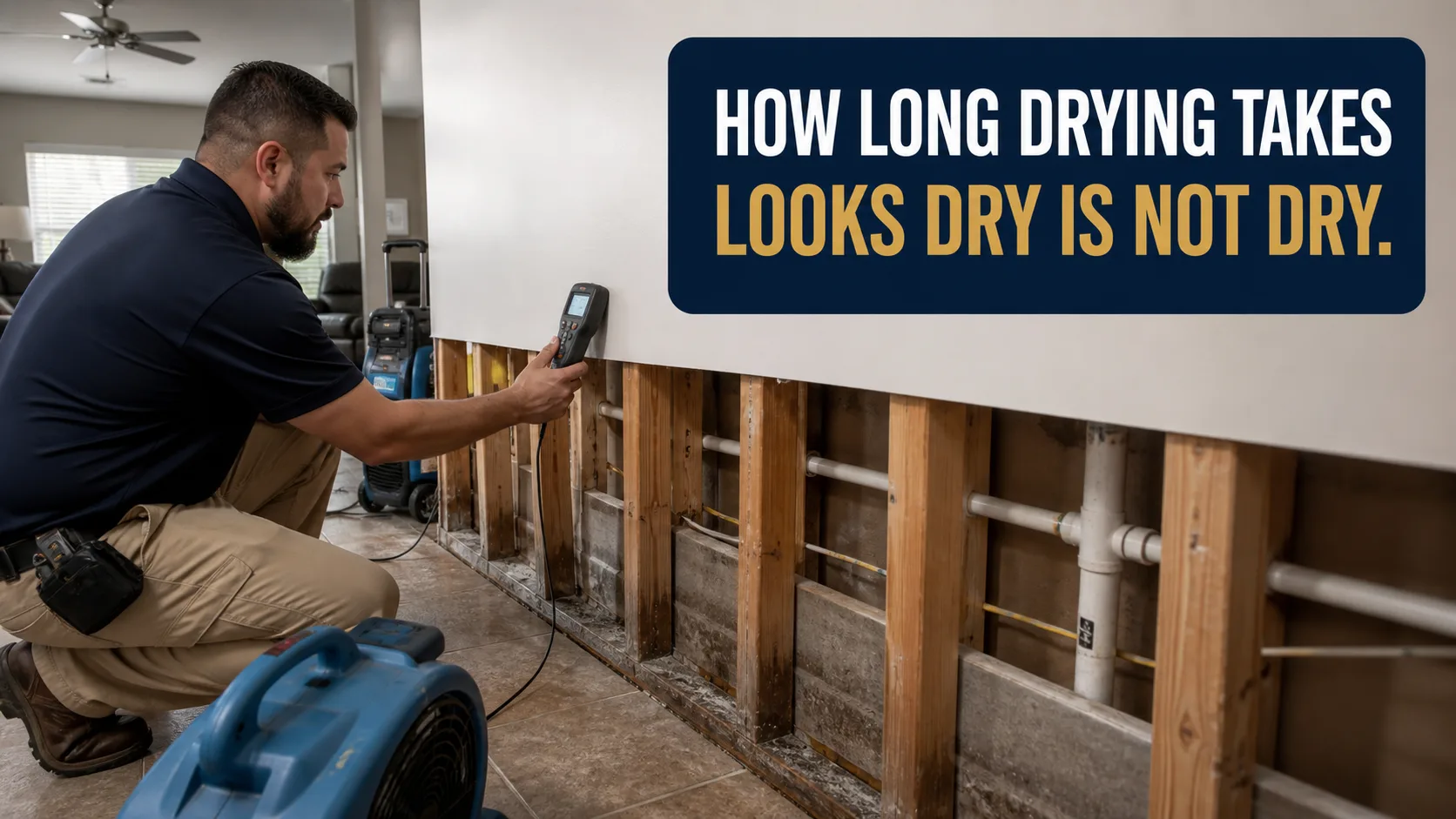
With commercial air movers and dehumidifiers running continuously, most water-damage drying takes **3 to 5 days**, longer for dense materials like hardwood, tile mortar beds, and wall cavities. The surface drying in a day is misleading — the structure behind it holds moisture much longer, and in Houston's humidity it won't dry on its own before mold starts. "Dry" is a moisture-meter reading, not a feeling. Questions about your situation? Call **(346) 271-7004**.
Why it takes days, not hours
Drying isn’t evaporation off the surface — it’s pulling water out of the inside of materials and out of the air. Three things have to happen at once: air movers sweep moisture off surfaces, a dehumidifier removes that moisture from the air, and the process repeats until the water deep in the framing and subfloor has migrated out. Skip the dehumidifier and you just relocate moisture to the next cool surface. That’s the whole reason it takes sustained days of equipment, not an afternoon of fans.
Rough timelines by material
| Material | Typical drying time* | Notes |
|---|---|---|
| Carpet & pad (clean water) | 1–3 days | Pad is often removed instead; it holds water |
| Drywall (surface wet) | 2–4 days | Wall cavity takes longer; may need to open it |
| Framing / studs | 3–5+ days | The structure’s true benchmark |
| Subfloor (plywood/OSB) | 3–7 days | Slow; sits under everything |
| Hardwood flooring | 5–14+ days | Needs specialized floor drying; monitored to moisture content |
| Tile over mortar bed | 5–10+ days | The mortar holds water long after the tile feels dry |
| Wet attic insulation | Usually removed | Won’t dry usefully in Houston humidity |
*With proper commercial equipment running continuously. Passive air-drying takes far longer or stalls entirely.
Why Houston is slower than the timelines you read online
Most drying advice is written for average conditions. On the Gulf Coast, the outdoor air is already carrying a lot of moisture, so there’s less room to pull moisture into. That slows every stage and makes dehumidification and running the AC essential rather than optional. A wall that would air-dry in a weekend up north can stay wet for a week here — long enough to start growing mold.
Warning signs the drying has stalled
Equipment running is not the same as drying happening. These are the signals that the numbers have stopped moving.
The readings are flat:
- Moisture values that were dropping a point a day and now sit still for two days
- A dehumidifier collecting noticeably less water than it did on day two with the same equipment set
- Relative humidity in the contained area that climbs overnight when the crew leaves
Something is feeding it:
- The source was never fully stopped, or a second source nobody found
- Wet insulation still in a cavity, which holds water and hands it back to the framing
- A closed cavity behind cabinets, tile, or a bathtub that no air is reaching
The equipment is wrong for the job: household box fans instead of air movers, no dehumidifier at all, or a dehumidifier fighting an open window. Air movers alone relocate moisture to the next cool surface rather than removing it from the building.
How “done” is decided
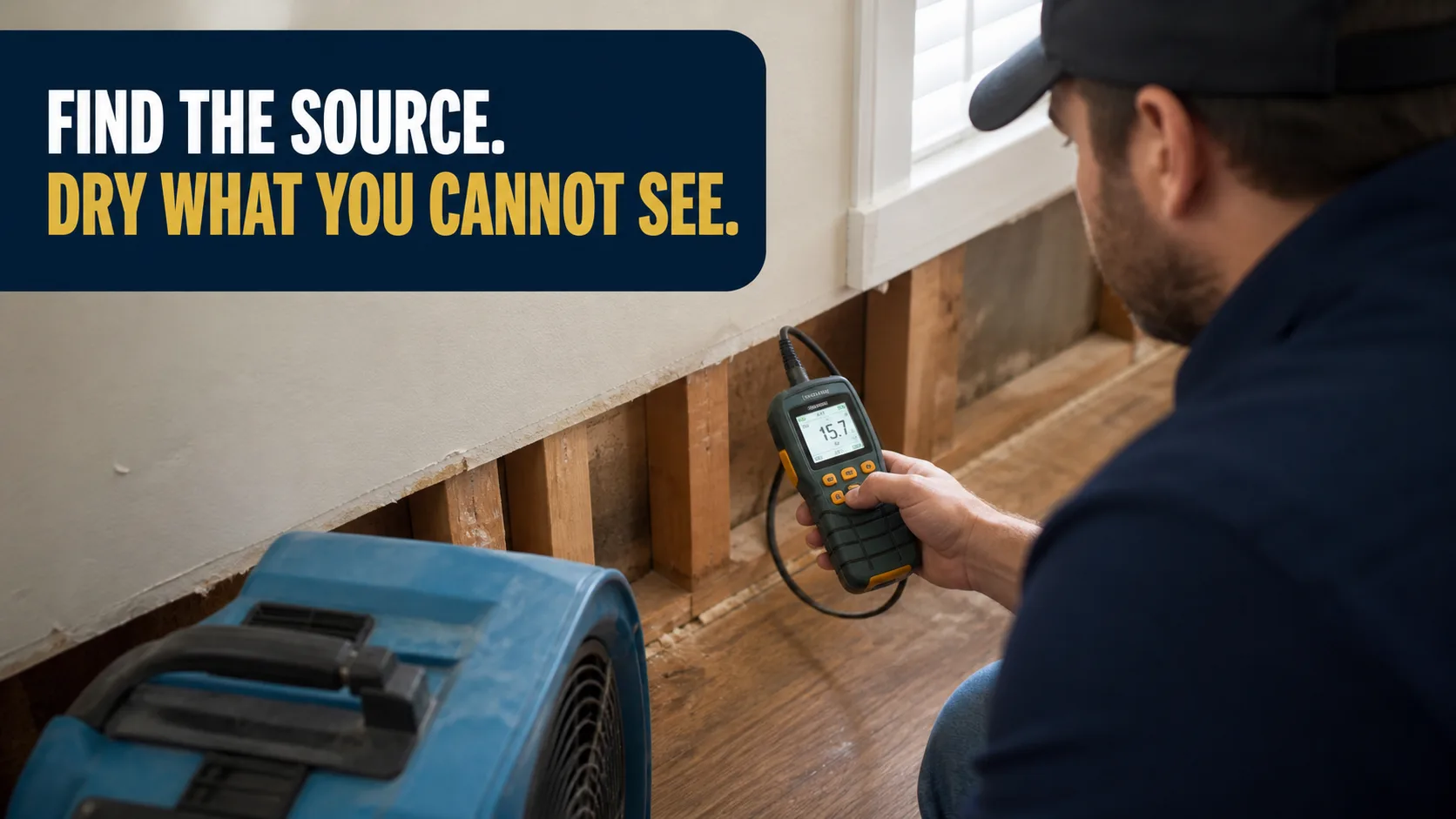
Drying isn’t finished on a calendar — it’s finished on a reading. We take moisture readings of the framing, subfloor, and drywall at the start to set the target, then daily until those materials are back to a normal dry standard. Only then does reconstruction start. Repainting or re-flooring before that trapped moisture is a musty smell and a repeat stain waiting to happen.
Why opening the windows usually makes it worse
The instinct after a leak is to open the house up. On the Gulf Coast that is usually the wrong move, and the reason is dew point rather than temperature.
Dew point is the temperature at which air has to give up its moisture. Houston outdoor air spends most of the year at a dew point in the seventies, which means it is already carrying about as much water as it can hold. Bringing that air into a wet house does not remove water — it delivers more, and it condenses on every surface cooler than the dew point, which after a loss includes the slab, the tile, and the inside of the wall cavity you are trying to dry.
The exception is a cold, dry front, which happens a handful of times a year here and rarely on the day you need it. The rest of the time, close the house, run the AC, and let a dehumidifier do the actual work.
How to check your own drying tonight
- Look at the dehumidifier’s output. Empty the tank or note the drain flow at the same time two nights running. A sharp drop with materials still reading wet means the moisture is not reaching the machine.
- Feel the bottom four inches of every wall in and around the affected room. Cool means wet, and it is the last place to dry.
- Check that the cavities are actually open. Baseboards off, insulation out, air reaching inside the wall rather than blowing across its face.
- Confirm the house is closed. Windows and exterior doors shut, AC running, containment intact.
- Count the equipment. If there are fans but no dehumidifier, nothing is leaving the building.
- Photograph the equipment layout and the daily readings with the date stamp on. A dated photo of the meter face on the framing is what an adjuster wants, and it is the record homeowners most often skip.
What the extra days cost
Drying is priced in equipment days, so the timeline and the invoice are the same conversation.
- Every additional day is another day of air movers, dehumidifiers, monitoring visits, and power. A loss that takes eight days rather than four does not cost twice as much, but it is not close to equal either.
- Equipment density. A large or high-ceilinged space needs more machines, not just more days, because drying is an air-volume problem.
- Removal versus drying. Cutting out saturated drywall and wet insulation costs money up front and takes days off the back end, and on most losses it is the cheaper of the two paths.
- Specialty systems. Hardwood mats, mortar-bed tile drying, and cavity injection each add their own equipment line.
- Delay. Every hour before extraction adds drying days, and past 24 to 48 hours it adds a mold scope on top of the drying.
The line-item structure is in what water damage mitigation costs in Houston.
What NOT to do
- Don’t close it up early. Sealing a damp wall or laying new floor over a wet subfloor traps the exact conditions mold needs.
- Don’t rely on heat alone. Warming a room without removing humidity just moves the moisture to another surface.
- Don’t call it done because it feels dry. The surface is always the first thing to dry and the last thing to tell you the truth.
Drying time is also a big driver of what a job costs — see water damage mitigation cost in Houston.
Does insurance pay for the drying equipment?
On a covered loss, yes — mitigation is normally paid as part of the claim, and most policies also require you to take reasonable steps to prevent further damage, which is exactly what drying equipment is.
What decides how completely it pays is the record. Carriers settle mitigation from daily moisture logs, equipment counts, and dated photographs, not from a summary at the end. A job that ran eight days with a documented reason for each of them settles differently than a job that ran eight days with an invoice and nothing else. Where claims come apart is covered in water damage claim denied.
The free things worth doing tonight
- Close the house and run the AC. It is the most effective free dehumidifier you own.
- Take the baseboards off the wet walls so the cavity can breathe.
- Pull carpet and pad back off the wet edge, and get the pad out entirely if it is saturated.
- Lift furniture onto blocks or foil so nothing sits in contact with a wet floor.
- Open interior doors and closets in the affected area so air reaches the still corners.
- Move contents out of the room rather than to the middle of it.
- Photograph the readings and the equipment daily with the date stamp on.
Where the rebuild contractor begins and we end
TruePoint Restoration is a mitigation and remediation contractor. We dry the structure and we stop there. We do not hang and finish new drywall, lay new flooring, install cabinets, or paint, and we do not repair the pipe, the roof, or the HVAC unit that caused the loss. We are also not a public adjuster. Those are separate trades with separate contracts, and the handoff between them is a real line rather than a soft one.
What we own is the number that everything else waits on: extraction, removal of what will not dry, equipment set correctly for the volume and the material, daily moisture readings on framing, subfloor and drywall, and a documented file that shows the material reached dry standard on a specific date. Your rebuild contractor should not start before that date, and your adjuster should not be asked to take it on trust.
Call (346) 271-7004. We work out of Pearland and serve Manvel, Friendswood, League City, Pasadena, Sugar Land and the Greater Houston area.