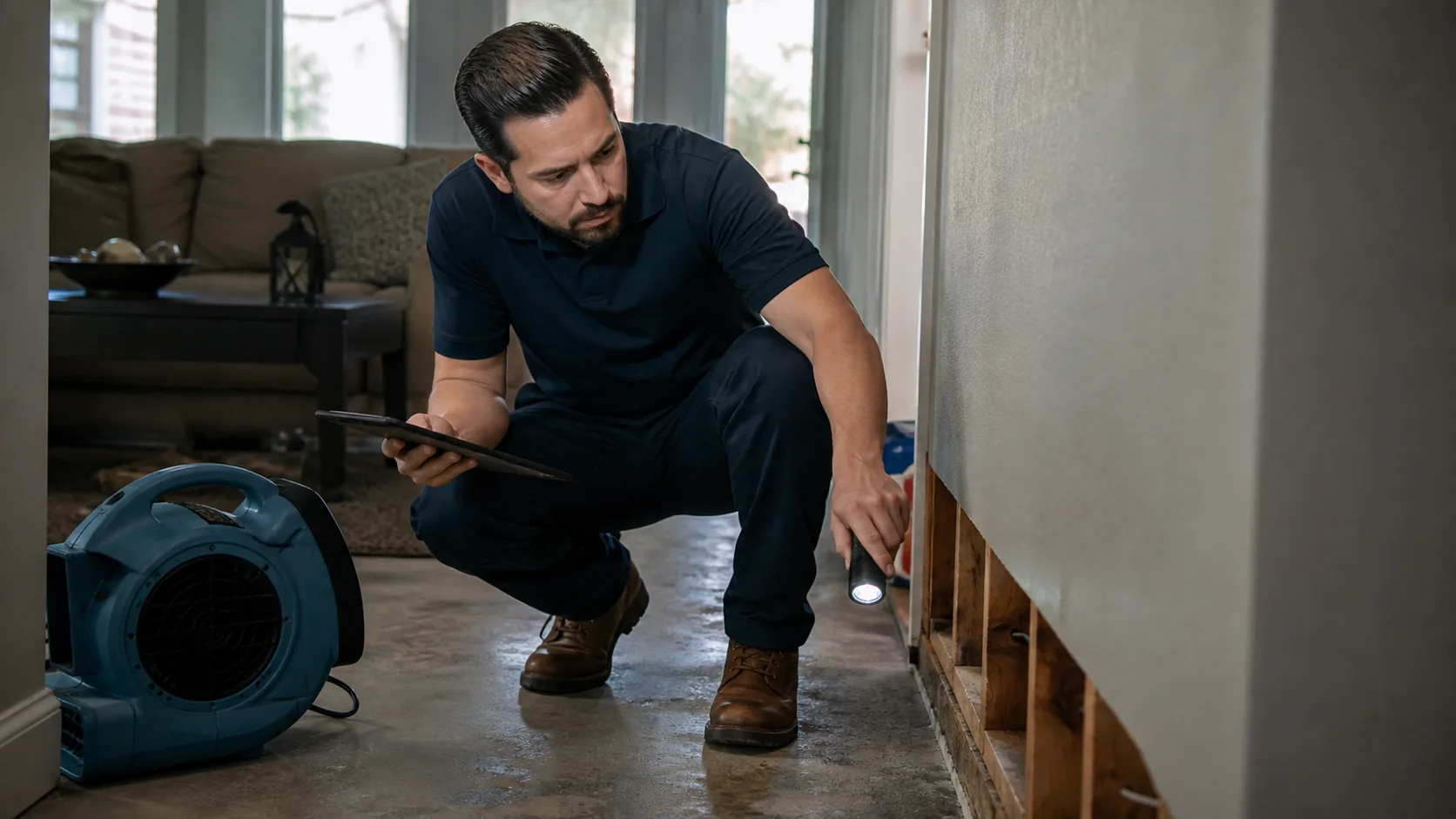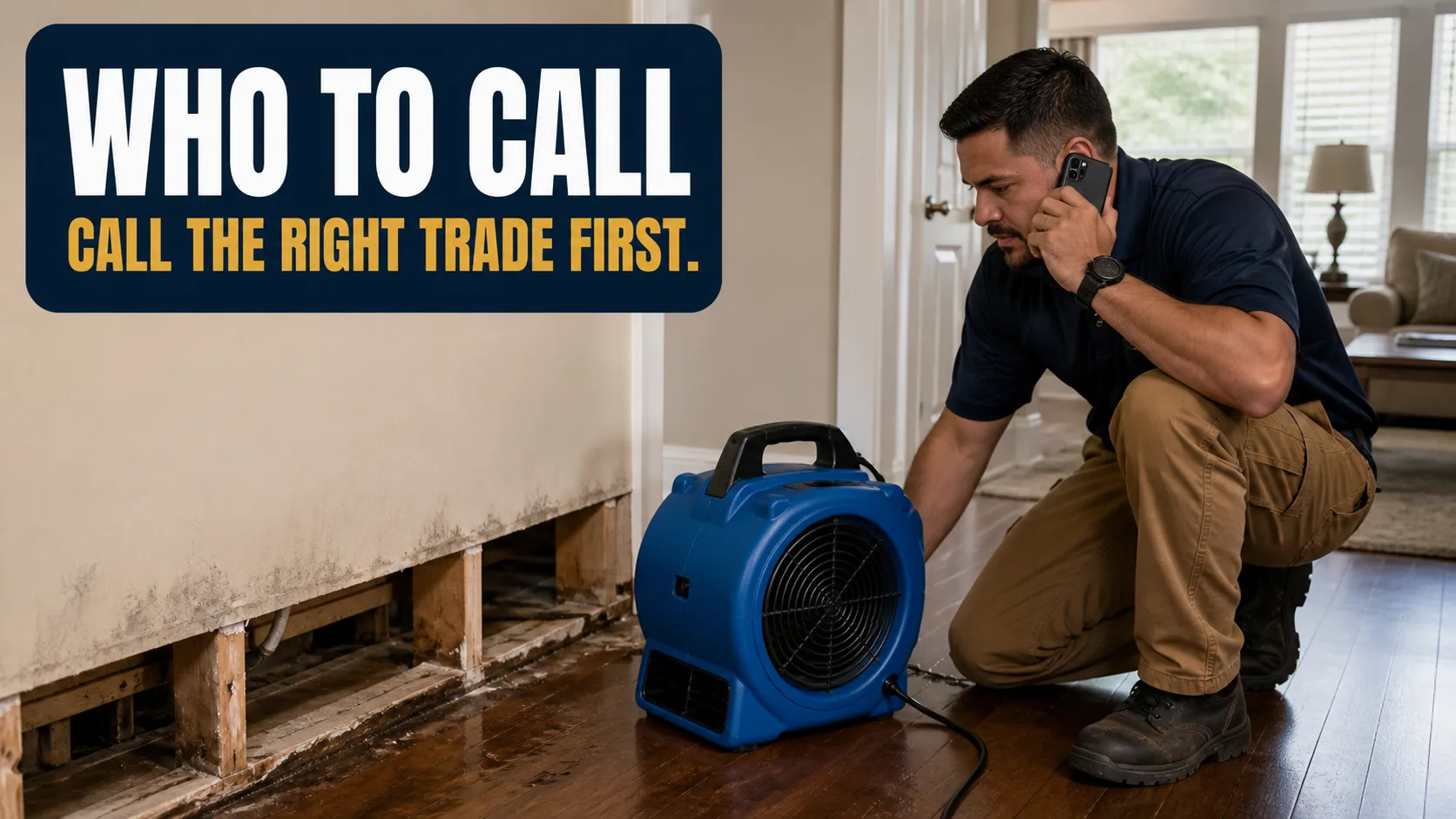
Two calls, in order: first, whoever **stops the source** — a plumber for a pipe or water heater, an HVAC tech for an AC leak, a roofer for a roof leak. Second, a **water damage mitigation company** to extract the water and dry the structure before mold starts. Open your insurance claim in parallel — don't wait on it to begin mitigating. If there's standing or spreading water, call mitigation now: **(346) 271-7004**. Every hour of delay costs drying time and risks mold.
The two jobs, and why you usually need both
Water damage involves two separate problems, and they need two different fixes:
- Stopping the water — the leak itself. Depending on the source, that’s a plumber, an HVAC tech, or a roofer.
- Dealing with the water that already escaped — extraction, structural drying, and mold prevention. That’s a mitigation company.
A plumber will fix your pipe and leave; drying the soaked wall, floor, and cavity isn’t their job. That’s the mistake that turns a small loss into a mold job. For the full breakdown of when each is needed, see plumber vs. mitigation company.
Match the call to the source
- Pipe, water heater, or under-sink leak → plumber (to stop it) + mitigation (to dry it).
- AC leaking, especially in summer → HVAC tech + mitigation. In Houston the AC is in the attic, so this usually shows as a ceiling stain.
- Worse when it rains → roofer + mitigation.
- Sewage or ground floodwater → mitigation with contamination protocols (and your plumber for a sewer-line issue).
Warning signs the water went further than the fixture
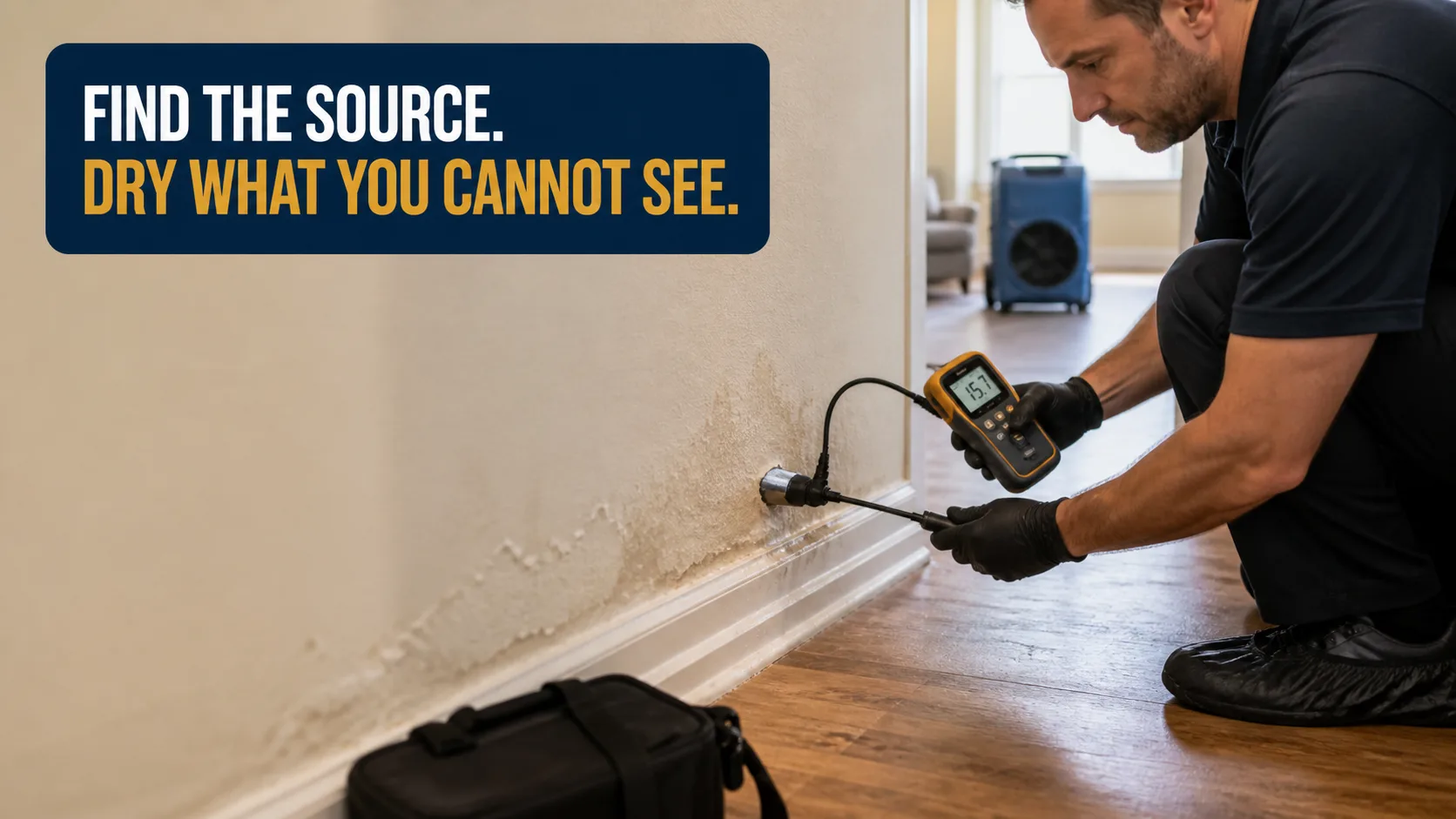
The visible wet spot is the end of the trip, not the start of it. These are the signs the water is in the structure and not just on the floor.
It is inside the wall:
- Baseboard that has darkened, swelled, or pulled a fraction away from the wall
- Paint or wallpaper bubbling in a band along the bottom of the wall
- A wet line on the drywall that sits higher tonight than it did this afternoon — wicking climbs, so a rising line means the cavity is full
It is under the floor:
- Vinyl plank lifting at a seam, or laminate edges swelling into small ridges
- Grout darker in one area, or a tile that sounds hollow when you tap it
- Carpet that feels cool and heavy underfoot two rooms away from the leak
It is already growing something: a musty smell before any visible growth, or discoloration at the bottom edge of the drywall and in the corner where two walls meet the floor. Smell arrives first because most of it happens where you cannot see.
It is an emergency, not a service call: water near an outlet, a panel, or a light fixture; a ceiling that sags or bulges; or water still arriving after you closed the fixture valve, which means the source is upstream of it.
What to check before you pick up the phone
Five minutes of this makes every call that follows shorter and cheaper.
- Shut the fixture valve, not the main, and watch for two minutes. If the water stops, the problem is that fixture and you want a plumber. If it keeps coming, shut the main.
- Read the water meter with everything off. Note the low-flow indicator, wait fifteen minutes, read it again. Movement with the whole house closed down means a supply leak — and if the meter runs while nothing indoors looks wet, suspect a slab leak.
- Test the timing. Wet only when it rains points at the roof. Wet only when the AC runs points at the condensate system in the attic. Wet regardless of either points at plumbing.
- Feel the bottom of the wall on both sides. Water crosses into the next room long before it shows on the paint.
- Smell the return-air vent. A musty smell at the return means the air handler or the duct insulation sits in the wet zone, and that changes who you call second.
- Photograph everything with the date stamp on before you move a single item — the source, the standing water, the wall, the flooring, and the contents in the path.
If the water came from a fire
Fire-damaged houses are water-damaged houses. A fire department puts hundreds of gallons through a structure in minutes, and that water goes where any other loss water goes — into cavities, under flooring, and down into the level below.
So the call list changes. The fire department releases the scene, a licensed electrician clears the affected circuits before anything is energized, and mitigation handles both the firefighting water and the soot. Leaving a fire-damaged house open to Houston humidity while you wait on an adjuster is how a fire loss becomes a mold loss on top of it — the order of operations is in what to do after a house fire.
Where insurance fits
Open the claim early, but mitigate in parallel — your policy expects you to prevent further damage, and waiting can hurt the claim. A mitigation team that documents claims properly documents the loss (source, moisture readings, photos) the way your insurer needs. That documentation is often what keeps a claim smooth.
What each of these calls costs
Rough shapes, not quotes, so you can tell which call is the expensive one.
- The plumber charges a service call plus the repair. A supply line or an angle stop is often a few hundred dollars. A slab leak, a re-route, or a sewer line is a different order of magnitude, and a camera inspection is usually billed separately.
- The HVAC tech clearing a condensate line is typically a low service-call number. Replacing a rusted-through drain pan under an attic air handler is not, because the coil usually has to come out to reach it.
- The roofer charges for an emergency tarp now and the repair later — two visits, two prices.
- Mitigation, our part, is priced on affected area, water category, how much material has to come out, and how many days of equipment the structure needs. Category is the biggest single lever: clean water gets dried, contaminated water means removal.
- The rebuild is a separate contract with a separate contractor, and it is usually the largest of the four numbers.
Insurance normally pays the mitigation and the resulting damage rather than the failed part itself. The full two-trade split is covered above, and what a denial usually turns on is in water damage claim denied.
How long each part takes
The source repair is usually hours. A plumber’s fixture repair, an HVAC drain clear, or an emergency tarp each happen in a single visit.
Drying is days. Three to five for a contained clean-water loss on hard surfaces, five to ten once a wall cavity, subfloor, or hardwood is involved, and longer when contaminated water means removal has to finish first. Houston adds time to every one of those ranges, because the outdoor air already carries moisture and there is less room to pull more into it.
Readings decide the end date, not the calendar. Dry standard is a number measured on the framing and subfloor daily, and reconstruction starts once it is met — what actually sets a drying timeline has the material-by-material version.
If you have water right now
- Stop the source if you safely can (main shut-off, AC breaker, supply valve).
- Cut power near any standing water at outlets.
- Move belongings up and photograph everything before cleanup.
- Call or text (346) 271-7004 — we’ll tell you honestly what it needs, and who else to call.
Serving Houston and the surrounding metro.
Where each trade ends and we begin
TruePoint Restoration is a mitigation and remediation company. We do not locate or repair pipes, service HVAC equipment, do roofing, do electrical work, act as your rebuild general contractor, or work as a public adjuster. When you describe your problem and it belongs to one of those trades, we say so on the phone instead of driving out and writing an estimate.
What we own is the water that already escaped and everything it touched: extraction, containment, removal of material that will not dry, structural drying with logged daily readings, mold remediation once growth has started, smoke and soot cleanup after a fire, and the documented file your adjuster works from. That file — category of loss, affected materials, daily readings, disposal records — often decides how completely a claim pays, and it is the one part a homeowner cannot reconstruct after the fact.
If you are not sure which call you need, make ours first and we will tell you straight. (346) 271-7004. We work out of Pearland and serve Manvel, Friendswood, League City, Pasadena, Sugar Land and the Greater Houston area.