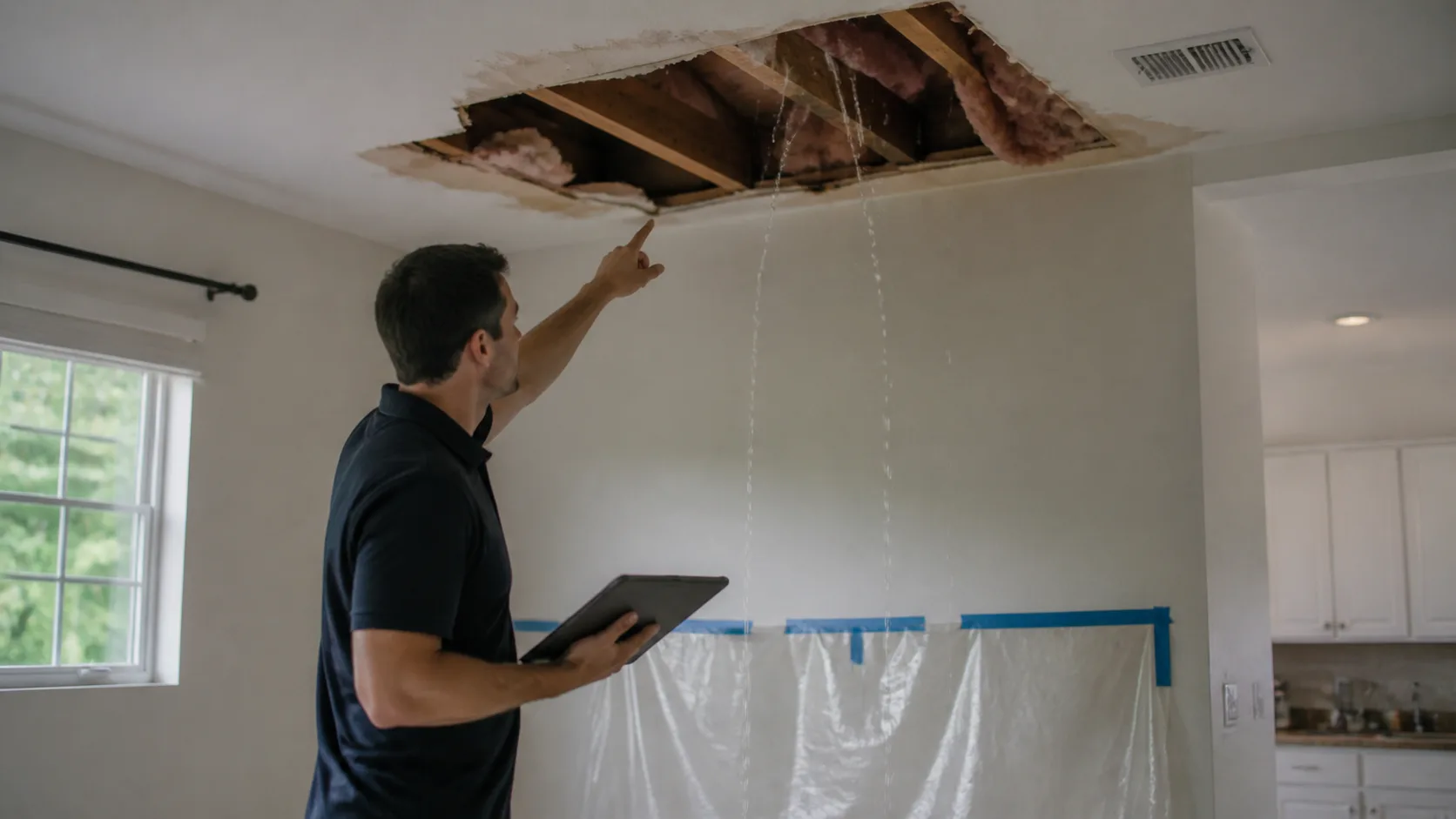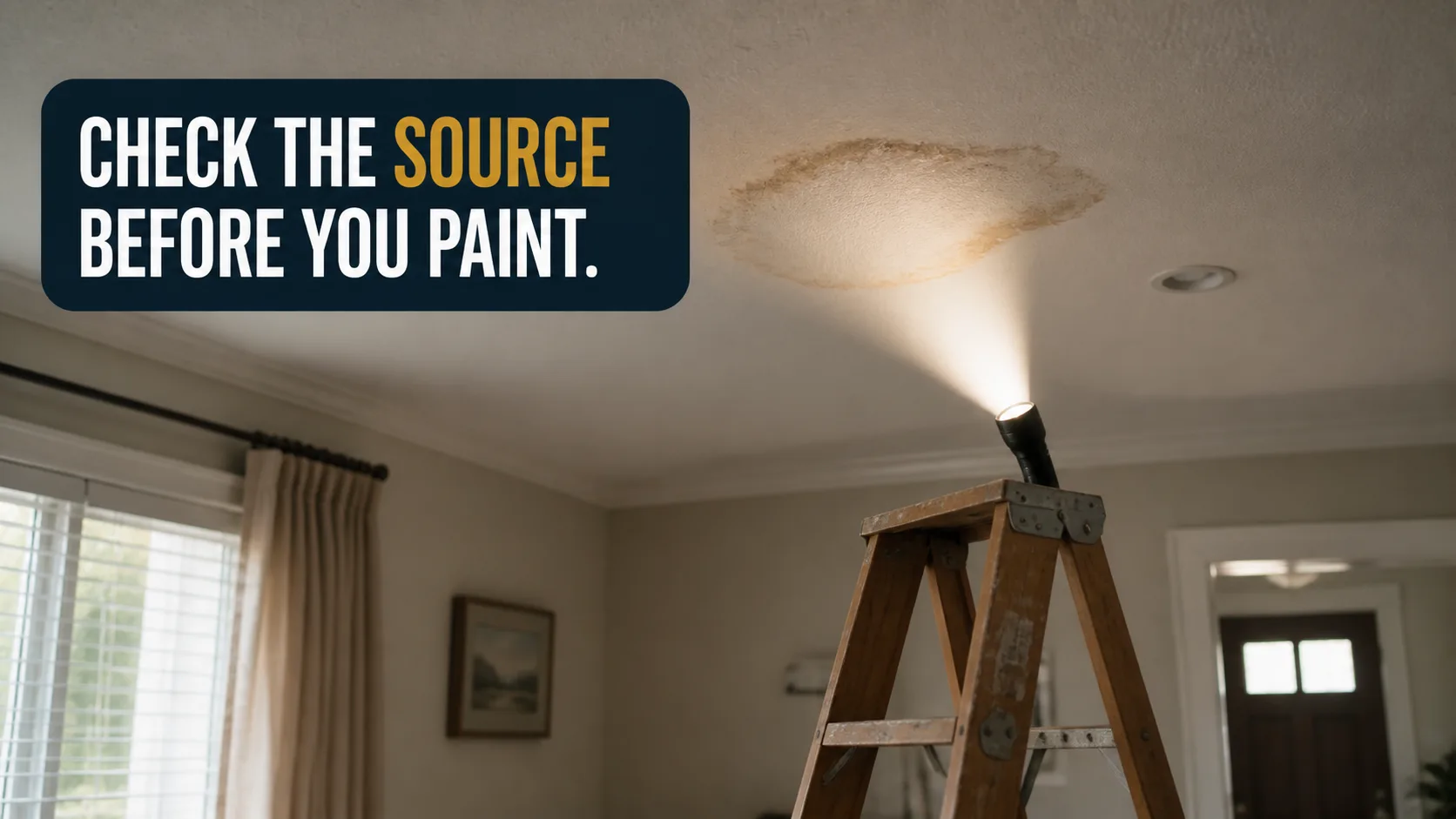
In Houston, a ceiling stain or sag almost always traces to the attic — the HVAC condensate drain or the water heater — or to a roof leak or an upstairs bathroom. First, find and stop the source (kill the AC breaker, shut the water heater's supply, or turn off the upstairs fixture). Keep people out from under any bulging area, cut power to nearby light circuits, and photograph it. Then get the cavity and attic insulation dried before you repaint. Call **(346) 271-7004** and we'll help you find the source and dry it right.
Why the ceiling, and why so often in Texas
In most of the country, the furnace and water heater sit in a basement or garage. In Houston, they live in the attic — directly above your ceilings. So when the HVAC condensate line clogs, or the water heater starts to weep, the water has one way to go: down through the ceiling drywall. Add our roof-punishing storms and the fact that many homes are single-story with a big attic footprint, and the ceiling becomes the number-one place water damage shows up.
Finding the source (the order that matters)
- Is the AC running? A wet spot near an interior wall or a hallway, especially in summer, points to the HVAC condensate drain overflowing in the attic. This is the most common Houston cause.
- Is it near the water heater? A stain under the attic platform where the water heater sits points to a tank or connector leak.
- Did it appear or worsen with rain? That’s a roof or flashing leak, not plumbing. The stain often sits away from any fixture.
- Is there a bathroom above it? An upstairs toilet, shower pan, or supply line leaks straight down into the ceiling below.
Matching the stain to the source tells you who to call first — plumber, HVAC tech, or roofer — and mitigation runs alongside to dry it.
Warning signs the ceiling is worse than the stain
Ceiling drywall holds a lot of water before it shows anything, and everything above it is out of sight.
It has been leaking a while:
- A stain with a hard brown ring around a lighter center. The ring is a tide line, and more than one ring means more than one event
- Drywall tape lifting at a seam, or nail heads dimpling through the paint
- A faint sag along one joist line, visible if you sight down the ceiling from a doorway rather than looking straight up
It is holding water right now:
- A dome or bulge, or a soft spot that gives to light finger pressure
- Water beading at a light fixture, a fan canopy, or a smoke detector
- A breaker that trips when the AC runs or when it rains
It has already grown something: a musty smell in that room, discoloration spreading outward from the stain over weeks, or an attic that smells earthy on a hot afternoon. Wet fiberglass in a Houston attic is the fastest mold substrate in the house.
It is holding more weight than it looks like. Water-loaded drywall fails all at once rather than gradually, so a soft ceiling is a room to stay out of rather than a room to inspect from below.
What to do right now
- Stop the source. Kill the AC at the breaker, shut the water heater supply valve, or turn off the upstairs fixture — whichever matches the clues above.
- Protect the area. Move furniture, put down a tarp and buckets, and keep people from under any sagging section.
- Kill power to nearby fixtures. Water and recessed lights or a ceiling fan are an electrical hazard — cut that circuit.
- Photograph everything before you touch it, for your claim.
- Get it dried. The surface drying fast doesn’t mean the attic insulation and framing above are dry. (346) 271-7004.
What you can check tonight
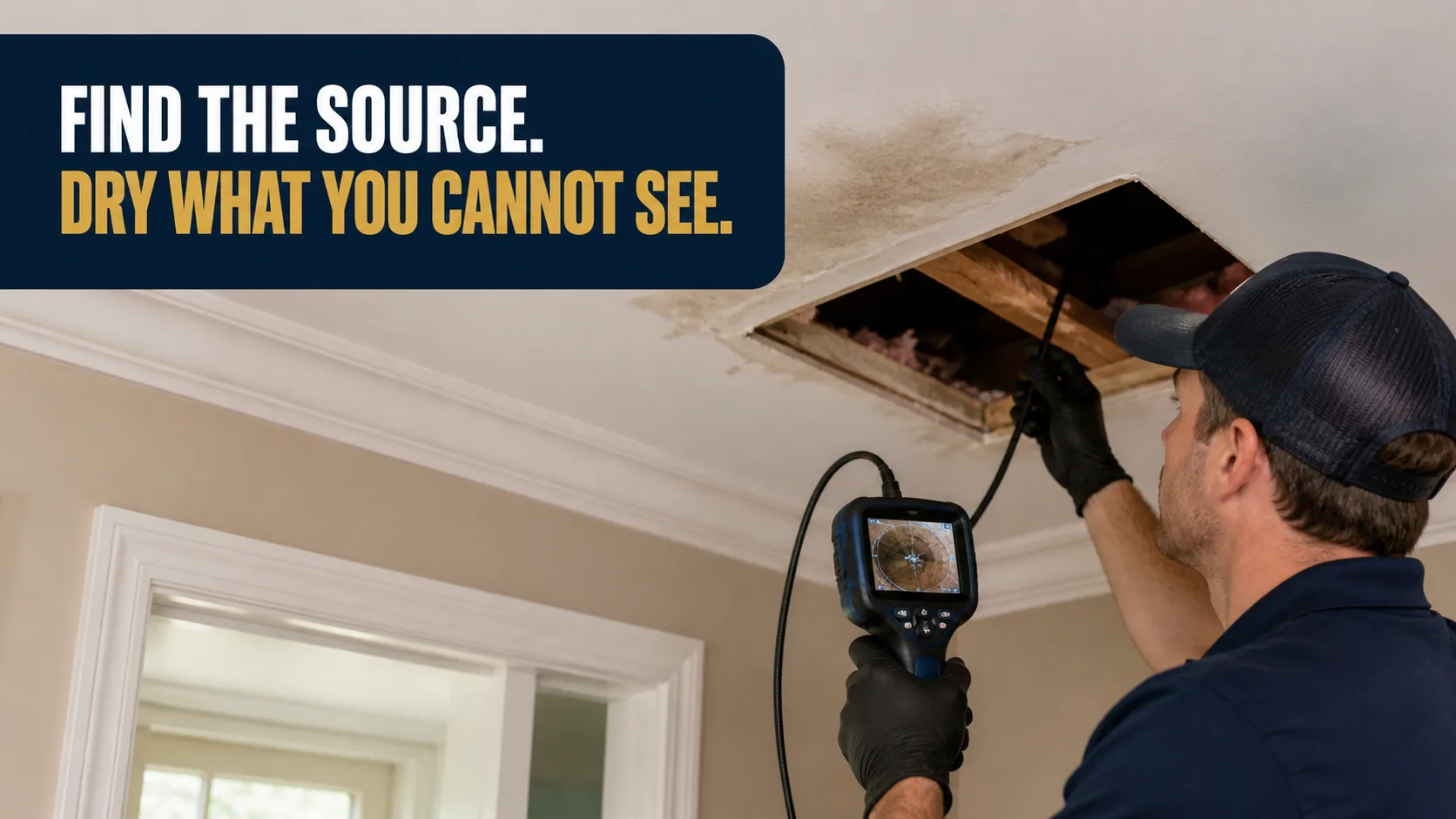
The evidence is in the attic, and you can get most of it from the hatch without walking a single joist.
- Open the attic hatch with a flashlight and look toward the area above the stain. Do not step off the decked area.
- Look at the air handler and the drain pan first. Standing water in the secondary pan, or a rusted-through primary pan, is the most common Houston cause and it is visible from a few feet away.
- Check the secondary drain line outlet outside, usually a small pipe above a window. Water dripping from it means the primary drain is blocked and the system is on its backup — the detail is in the secondary drain leak.
- Look at the insulation, not just the decking. Flattened, matted, or discolored batts in one bay while the rest is fluffy shows you where the water has been landing.
- Note the offset. Measure roughly how far the wet spot upstairs sits from the stain downstairs. Water travels along framing before it drops, and that distance is what a roofer or a plumber needs.
- Photograph everything with the date stamp on — the ceiling from below, the attic above it, the pan, the insulation, and the drip line outside.
Can it be saved, or does it come out?
- Light stain, dried fast: often sealed with a stain-blocking primer and repainted. Cosmetic.
- Soft, sagging, or bubbling: the drywall has lost integrity and water is still up there — that section comes out, the cavity and insulation dry, new drywall goes in.
- Wet attic insulation: almost always removed. Wet fiberglass loses its R-value and won’t dry usefully in Houston humidity; it just stays damp and grows mold.
What ceiling water damage costs
Two invoices from two trades, and the source repair is not ours.
- The source. An HVAC drain clear is a low service-call number. A rusted-through drain pan under an attic air handler is not, because the coil usually has to come out. A vent boot is hundreds; flashing or decking is thousands. A water heater replacement is its own number.
- The attic insulation. Wet fiberglass almost always comes out. It loses its R-value and will not dry usefully in Gulf Coast humidity, and removal is priced by area — which across a single-story Houston attic is a real line item.
- How much ceiling comes down. A light stain caught fast is primer and paint. Soft or sagging board is a cut-out, a cavity dry, and new board hung by a rebuild contractor.
- Whether the water reached the walls and floor. Ceiling water runs down inside wall cavities more often than people expect, and that changes the scope entirely.
- House age. Popcorn texture on a pre-1980s ceiling gets sampled before removal, and a positive asbestos result moves that work to a licensed abatement contractor.
How long it takes
Two to four days for a contained ceiling and attic dry-out where the insulation comes out and the framing is only surface wet. Five to ten days once water ran down inside a wall cavity or reached a subfloor. The source repair happens in parallel, usually in a single visit.
Readings decide, not the calendar. Ceiling joists, the top of the drywall, and the attic sheathing all get metered daily until they hit dry standard, and the ceiling gets closed and painted after that. Closing a ceiling on a schedule instead of a reading is a repeat stain and a musty smell a month later.
What NOT to do
- Don’t just repaint the stain. If the source isn’t fixed and the cavity isn’t dry, the stain returns — and you’ve now sealed moisture into the ceiling.
- Don’t ignore a small brown ring. It’s the first evidence of a leak that will get bigger; find the source while it’s small.
- Don’t stand under a bulging ceiling. Water-loaded drywall is heavy and fails suddenly.
Because the cause is usually in the attic, the long-term fix is upstream: keep the HVAC drain line clear and know your water heater’s age.
Does insurance cover ceiling water damage?
It depends entirely on the source and the speed. A sudden failure — a drain pan that rusted through, a supply line that let go, storm damage that opened the roof — is normally a covered loss, and the carrier pays for the resulting damage rather than for the failed part.
What gets denied is the slow version. A drip that ran for months, a roof that failed from age, or a clogged condensate line that was never maintained all read as maintenance rather than a sudden event, and a ceiling stain is unusually good evidence of how long something has been happening. That is why the dated photographs and the repair record matter more here than on almost any other loss — what claims get denied for is worth reading before you file.
The free things worth doing tonight
- Put a bucket under the air handler pan in the attic if the stain tracks with the system running.
- Relieve a bulge deliberately with a small hole at the low point, away from any fixture, into a bucket — rather than waiting for the whole section to let go.
- Look at the secondary drain outlet outside and note whether it is dripping.
- Pull the AC filter and look at it in daylight.
Where the HVAC tech and the roofer end and we begin
TruePoint Restoration is a mitigation and remediation contractor. We do not service air conditioners, clear or replace condensate lines and drain pans, replace water heaters, do roofing, do electrical work, or act as the rebuild contractor who hangs and finishes new ceiling drywall. We are also not a public adjuster. Those calls run alongside ours rather than after them, because the source has to stop while the drying starts.
What we do is everything above and around the stain: removing wet attic insulation that will not dry, opening and drying the ceiling and any wall cavity the water ran into, structural drying with logged daily readings, mold remediation if it sat long enough to start, and the documented file — source, affected materials, daily readings, disposal records — your adjuster and your rebuild contractor both work from.
If your ceiling is sagging tonight, that part is urgent regardless of who can get out this week. Call (346) 271-7004. We work out of Pearland and serve Manvel, Friendswood, League City, Pasadena, Sugar Land and the Greater Houston area.