Turn the AC off at the thermostat right now — condensate production stops when the system stops. Put a bucket under any active drip, relieve any ceiling bulge with a small hole at its center, and keep people out from under sagging drywall. Then get the wet ceiling cavity inspected the same day: in Houston humidity, soaked insulation and drywall will not dry on their own. Call or text **(346) 271-7004**.
Why this happens in Texas homes
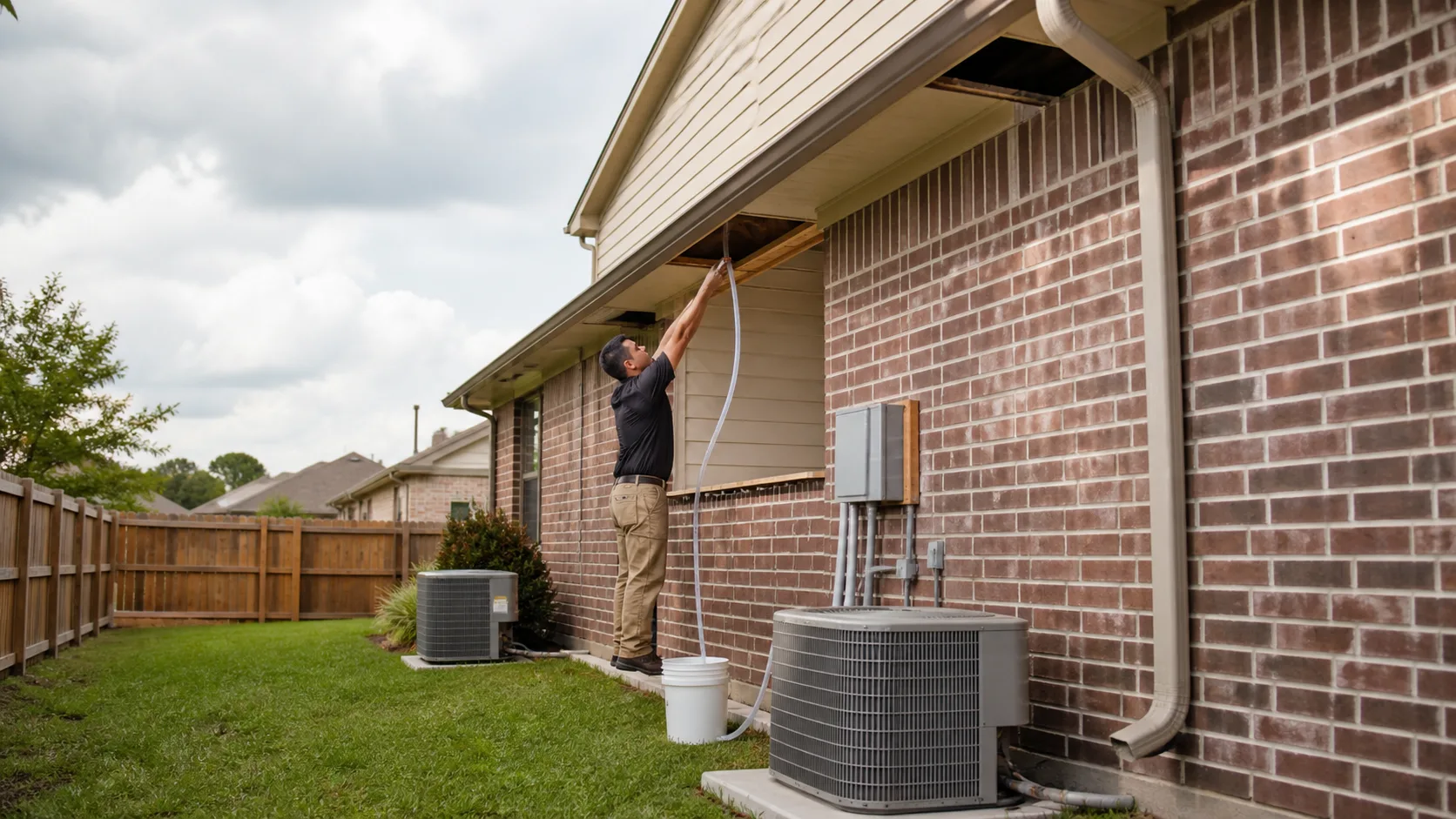
In most of the country, the air handler lives in a basement or utility closet. In Texas, it lives in the attic — directly above your living space. Under it sits a drain pan that catches the condensate the system produces, and in a Houston summer that can be gallons per day.
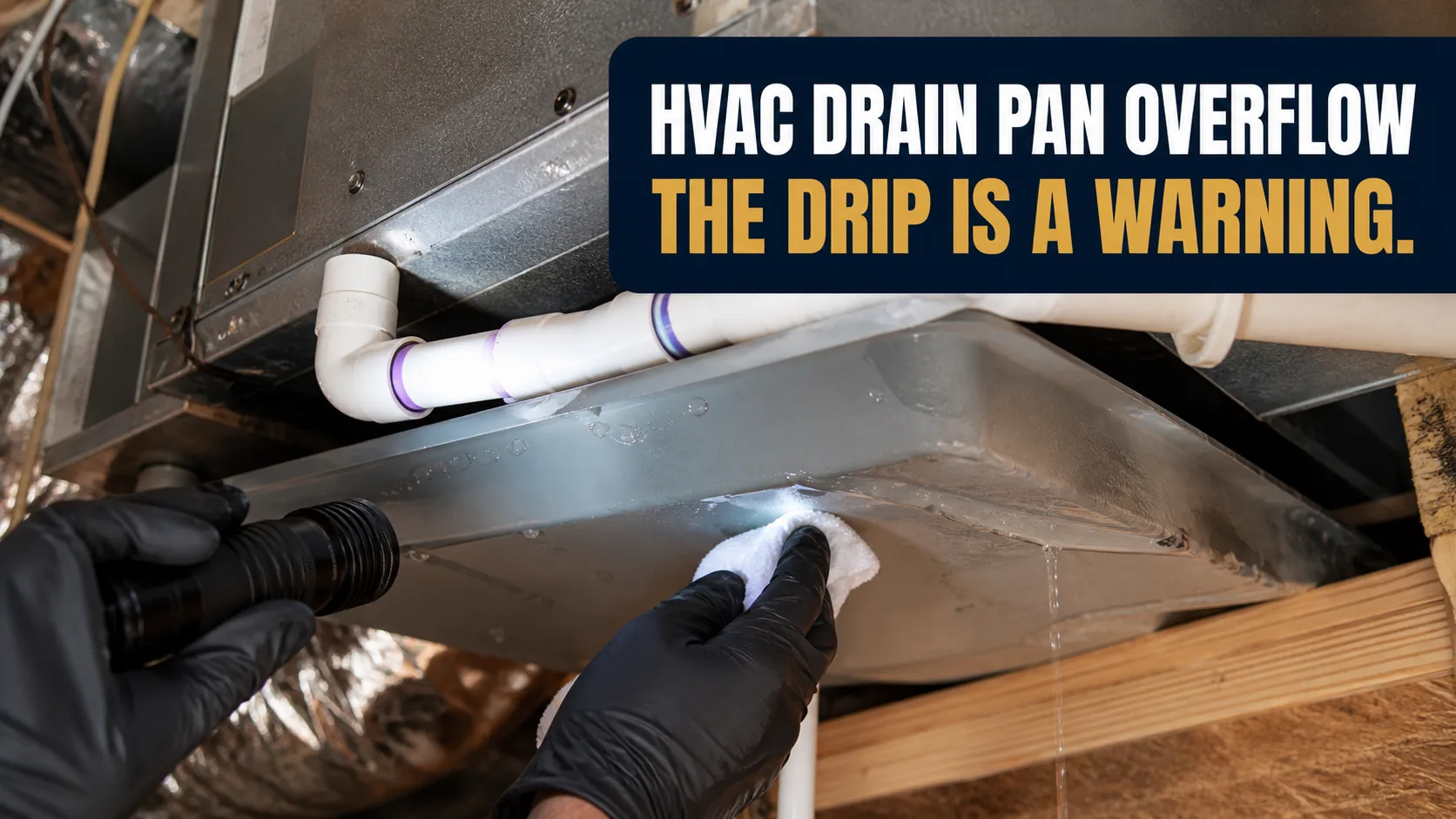
The pan drains through the primary condensate line. When that clogs (algae, biofilm — see our secondary drain guide), the pan fills. If the secondary line and float switch fail too — or were never there — the pan overflows. The only thing below it is your ceiling.
Rust matters too: metal pans corrode through after years of holding water, which produces the same result without any clog at all.
The first signs
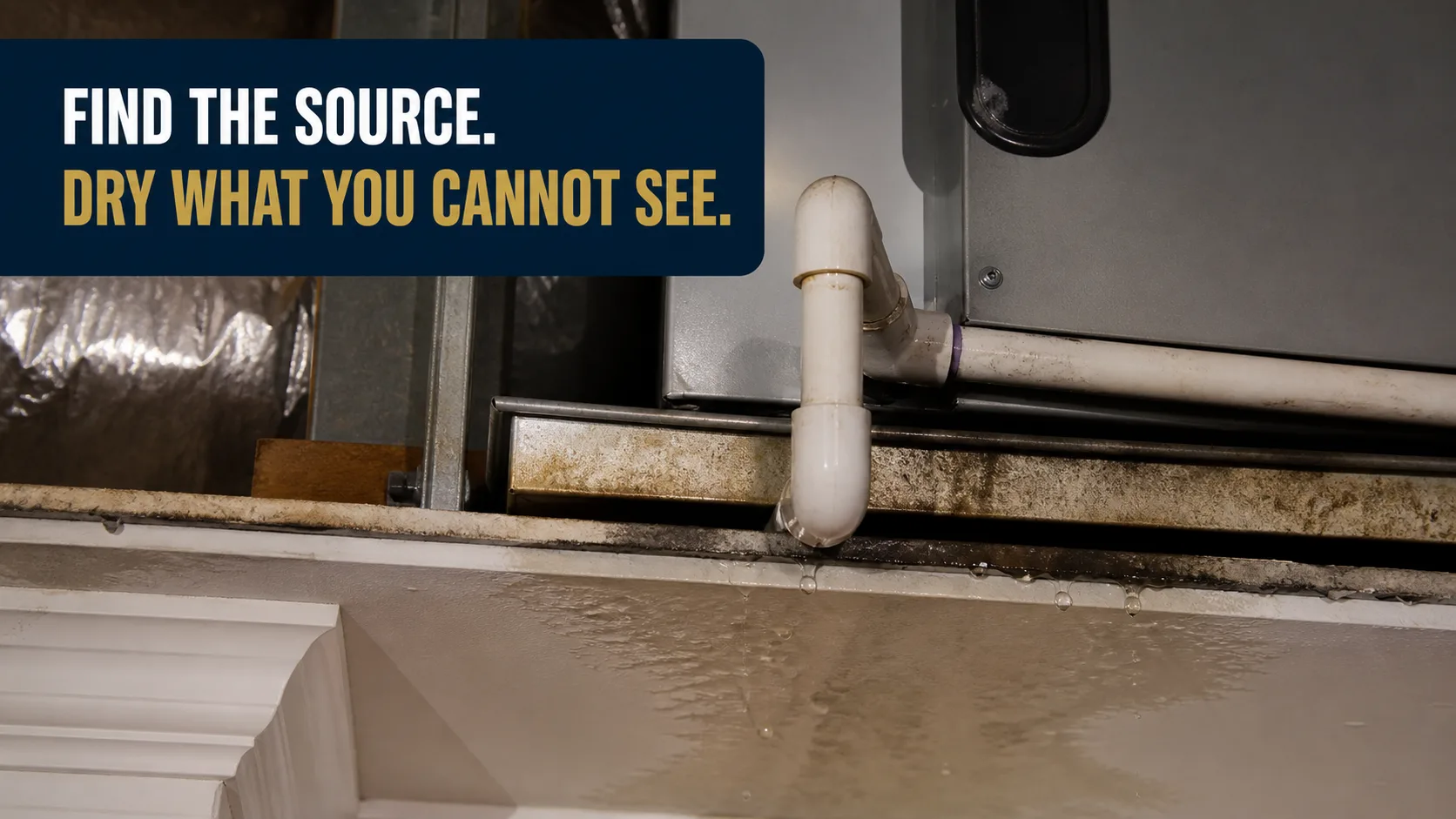
- Water stain spreading on the ceiling, usually below where the attic unit sits
- Active dripping when the system runs, slowing when it stops
- A sagging or bulging patch of ceiling
- Musty smell in the room below the unit
- In slower failures: paint bubbling or a tea-colored ring that grows over weeks
Reading the signs: how long has this been running?
It started today: active dripping that slows within minutes of the thermostat going off, a clean-edged damp patch with no color to it, water on the floor before there is any stain overhead.
It has been going for weeks:
- A tea-colored ring with a hard outer edge, and a fainter ring outside it — each ring is a wetting cycle that dried
- Paint bubbling, or a sag in the drywall’s paper facing
- A musty smell in the room below that cleaning does not touch. Wet fiberglass in a 130-degree July attic is a fermenting sponge, and the smell arrives before the stain does.
The pan itself is failing, not the line: overflow that returns weeks after a tech cleared the clog, rust staining in the drip pattern, or water appearing at the pan’s corner rather than over its lip.
What to do right now
- Thermostat off. This is the shut-off valve for condensate.
- Contain the drip — bucket, towels, plastic sheet over furniture.
- Relieve any bulge. A ceiling bulge is a water balloon. A screwdriver hole at the center drains it into your bucket on your schedule, instead of the ceiling failing on its own schedule.
- Cut power to that room at the breaker if water is near light fixtures or the fan.
- Photograph everything — the ceiling, the drips, and (if safely accessible) the pan and unit in the attic.
- Get the cavity metered the same day. The visible stain is the tip; the insulation above it is the iceberg.
What NOT to do
- Don’t run the AC “to help dry it out.” You will make more condensate and blow air through wet insulation.
- Don’t just repaint. We regularly open ceilings that were painted over twice while the insulation above stayed soaked.
- Don’t vacuum sagging drywall or push on it to “test” it.
What you can check yourself before anyone arrives
None of it costs anything, and all of it beats guessing from the floor.
- Confirm the thermostat is off, not set to fan. A running blower keeps pulling humid air across a wet coil.
- Press the ceiling gently at the edges of the stain, well away from any sag. Drywall that gives is saturated; drywall that feels normal can still be wet on its top face, which is why meters exist.
- Look at the stain from a low angle with a flashlight. Faint outer rings that vanish under direct light are older wetting cycles.
- If the attic is safe, look in the pan. Standing water means the clog is still there. Rust rings mean it has been full before.
- Check the rooms either side. Condensate follows framing, so wall tops next door are worth a hand.
- Photograph all of it with the date stamp on before anything is cleaned, opened, or repaired.
How far did the water actually go?
This is the question that decides whether you have a $500 problem or a $15,000 problem, and you cannot answer it by looking. Attic condensate follows framing. We routinely find:
- Wet insulation two and three joist bays away from the visible stain
- Water tracked down inside wall cavities below the ceiling
- Moisture readings at “saturated” in ceilings that looked merely shadowed
A proper inspection maps the moisture with meters and thermal imaging, then dries exactly what is wet — no more, no less — with documentation your insurer accepts.
What does it cost to dry a ceiling after a pan overflow?
Two numbers from two trades, and the HVAC repair is the smaller one. The drying is priced by what the water reached.
- How many joist bays got wet. The stain marks where water pooled, not where it traveled, and readings two or three bays out from a dinner-plate stain are routine.
- Whether the insulation comes out. Soaked blown-in cellulose or fiberglass is bagged and replaced rather than dried, and that removal plus reinstall is often the largest line on the invoice.
- Whether the drywall comes down. Damp but sound ceiling drywall dries in place; sagging or crumbling drywall gets cut out, and that is a meter decision.
- How far it tracked down the walls, which adds a second dry-out to the same job.
- Whether growth started. Wet insulation on drywall past a couple of days in this climate is where mold begins.
A single-room ceiling dry-out with the wet insulation removed commonly lands between the high hundreds and low thousands. Multiple rooms, drywall removal, or growth in the cavity push it into the several thousands — the structure behind those numbers is in what mitigation costs in Houston.
How long does the drying take?
Three to five days for a single room once the wet insulation is out and air is moving through the cavity. Longer when water tracked into wall cavities, when a floor sits above the ceiling, or when several bays are wet.
Readings decide the end date, not the calendar. Framing, the top face of the drywall, and any wall bottoms below have to hit dry standard before the cavity is closed and anything is painted — the same rule that governs ceiling water damage generally.
Does insurance cover an AC drain pan overflow?
The split is consistent. The resulting damage — ceiling, insulation, flooring — is commonly covered as sudden and accidental discharge. The cause is not: clearing the clog, replacing a rusted pan, and adding a float switch are maintenance and come out of your pocket.
What complicates these claims is evidence the pan had been overflowing slowly for months. Layered staining and rust rings read as a long-running condition rather than a sudden one, so the discovery date, dated photos, and a moisture map carry more weight than anything said on a call. More on the coverage side: does insurance cover water damage.
Who to call, in what order
- HVAC tech — clear the drain, verify or install float switches, check the pan for rust-through. The overflow will repeat until the cause is fixed.
- Mitigation (us) — dry the ceiling cavity, verify with readings, document the loss. Same day as discovery, ideally.
If water is actively coming through, call or text (346) 271-7004.
The free things worth doing tonight
- Thermostat off, not set to fan.
- Bucket under the drip, plastic sheet over anything below it.
- Relieve any bulge with a small screwdriver hole at its center, so it drains on your schedule rather than the ceiling’s.
- Kill the breaker for that room if water is near a light fixture or a ceiling fan.
- Photograph every affected room with the date stamp on, the attic pan included if you can reach it safely.
- Move furniture and rugs out from under the wet area.
- Keep the windows shut. Houston outdoor air sits at a dew point in the 70s through most of the cooling season, so opening up adds moisture rather than removing it.
Prevention
Two float switches (primary line and pan), a 90-day vinegar flush during cooling season, and an annual pan inspection would prevent nearly every one of these losses. The full routine: HVAC drain line maintenance for Houston homes.
Where the HVAC tech ends and we begin
TruePoint Restoration is not an HVAC company. We do not clear condensate lines, replace pans, install float switches, or service equipment, and we say so on the phone rather than after the estimate. The overflow repeats until an HVAC tech fixes the cause, and that is the call that stops the water.
What we do is everything the water reached: mapping the wet area with meters and thermal imaging so the scope matches the real footprint rather than the visible stain, removing soaked insulation and drywall that cannot be saved, drying the cavity and any wall bottoms with logged daily readings, and handing you a documented file your adjuster can work from. We are not the rebuild contractor either — texture and paint belong to a third trade, and who to call for water damage sets out the order.
If water is coming through a ceiling right now, send photos to (346) 271-7004. We serve Pearland, Manvel, Friendswood, League City and the Greater Houston area.