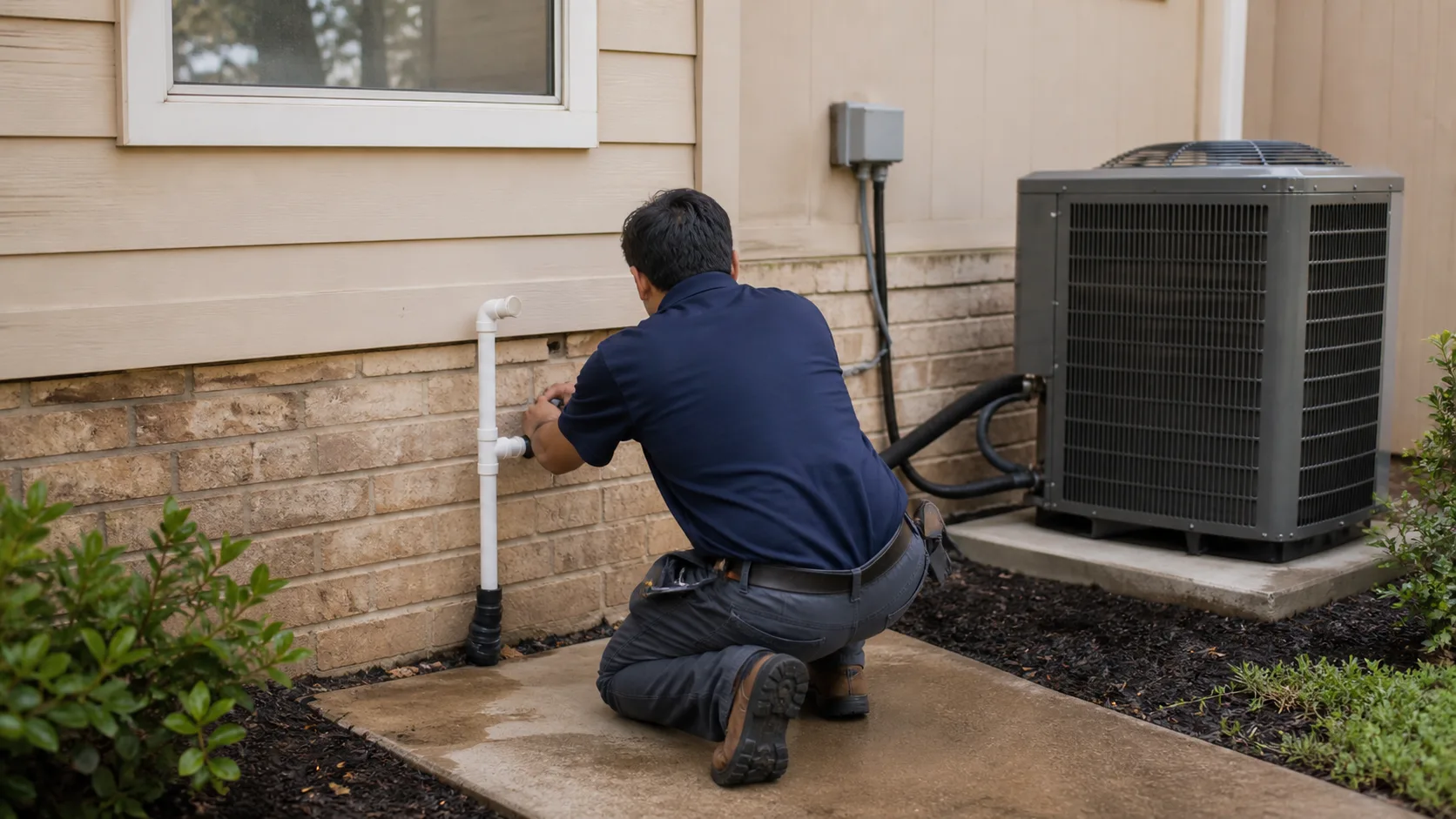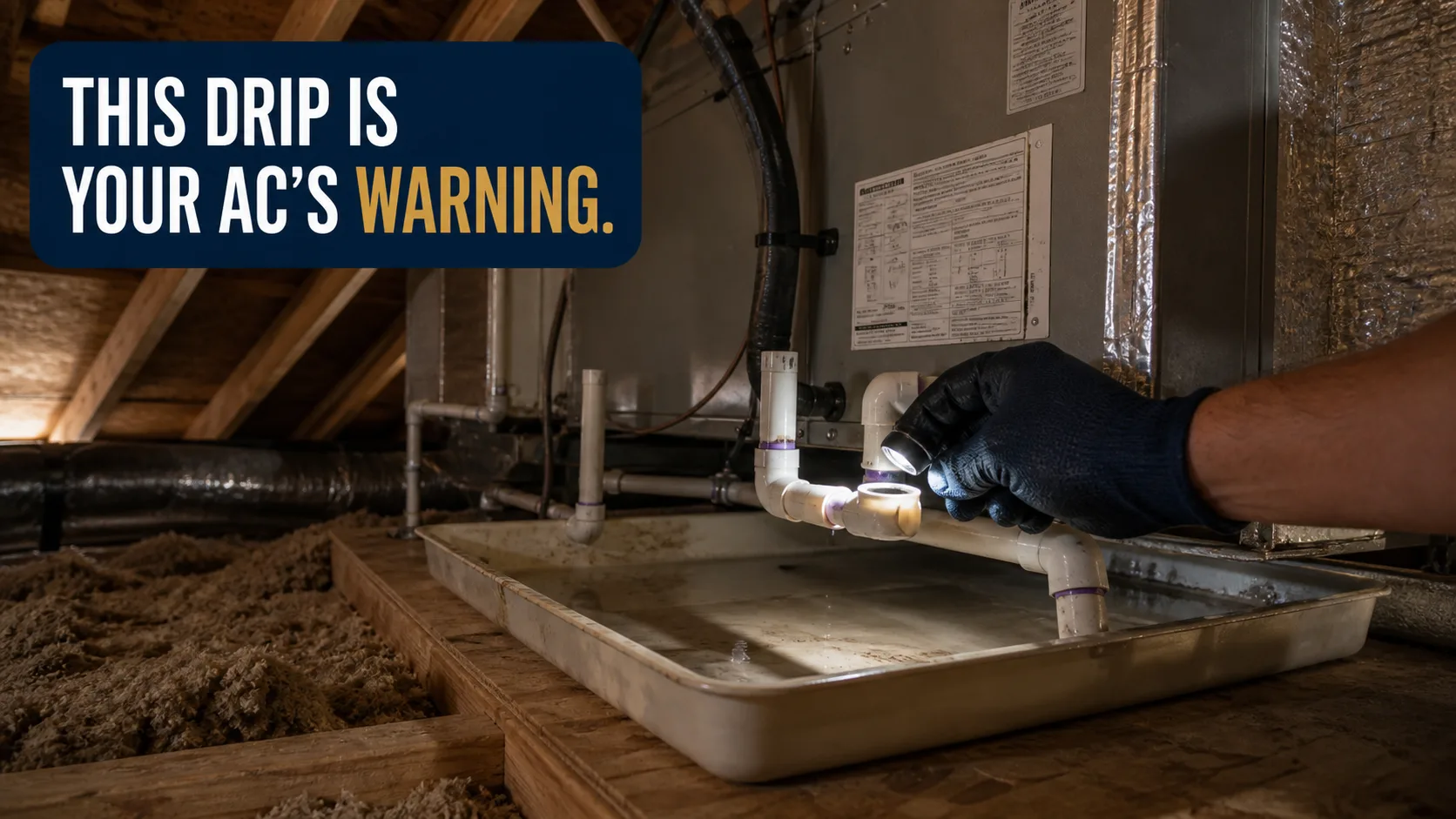
Water dripping from that small pipe over your window or eave means your AC's primary condensate drain is clogged and the emergency backup line is now carrying the water. The system still works — but you are one clog away from condensate pouring into your ceiling. Turn the AC off, clear the primary line (or have it cleared) within days, and check the ceiling below the unit for any staining.
Why it happens
Your air conditioner does two jobs: it cools air and it wrings moisture out of it. In Houston humidity, a running system produces gallons of condensate a day. All of it drains through a narrow PVC line — the primary drain — that runs from the drain pan under your attic air handler to a sink drain or outside.
That line is dark, warm, and wet all summer. Algae loves it. Biofilm builds until, one day, the line blocks. When it does, condensate backs up and spills into a secondary drain line — a separate pipe that installers deliberately route somewhere you will notice: over a window, above the front door, out an eave.
The drip is not the malfunction. The drip is the alarm.
The first signs homeowners notice
- Steady dripping from a small pipe high on an exterior wall, usually over a window
- The drip appears only when the AC is running
- Sometimes: a faint water stain forming on the ceiling near the unit’s location
- Sometimes: the AC shutting itself off, if a float switch tripped
Warning signs the primary line has been blocked a while
The blockage is recent: the drip started this week, it runs only while the system runs, and the wall or trim under the pipe is still clean.
It has been going a season:
- A green or black stain running down the siding, brick, or window trim under the pipe
- A dead or permanently soggy patch of soil directly under the drip point
- Wood trim at the drip point swelling, or paint lifting along its bottom edge
The pan has already overflowed at least once:
- Any discoloration on the ceiling below the air handler, however faint
- A musty smell in the room below that cleaning does not remove
- The system shutting itself off intermittently, which is a float switch doing its job
That last group changes the job. A dripping line over a dry ceiling is an HVAC service call. A dripping line over a stained ceiling is active water damage in the ceiling cavity, on a different clock.
What to do right now
- Note it, don’t ignore it. The secondary line has no backup. When it clogs — and it is fed by the same algae-friendly conditions — the next stop is your ceiling.
- Turn the system off when you can tolerate it, especially overnight, to slow the flow while you arrange the fix.
- Clear the primary line. DIY: find the capped cleanout tee near the indoor unit, pour in a cup of white vinegar, and/or pull the clog through with a wet/dry vacuum sealed against the line’s outdoor termination. Or have an HVAC tech do it — it is a quick, inexpensive service call.
- Inspect the ceiling below the unit with a flashlight held at a low angle. Any discoloration, however faint, means water already escaped the pan at some point — and that is a moisture inspection, not a paint job.
What NOT to do
- Don’t paint over a ceiling stain without confirming the material above is dry. In our humidity, wet drywall and insulation stay wet.
- Don’t pour bleach into the line while the system runs — vinegar is safer for the coil and pan; save stronger treatment for a serviced, switched-off system.
- Don’t assume the float switch will save you. Many systems have one; not all work; some homes don’t have one at all.
What you can check yourself tonight
Fifteen minutes and a flashlight, and it decides whether you need one trade or two.
- Confirm the drip stops when the system stops. Water that keeps running with the thermostat off is not condensate — that is a plumbing leak and a different call.
- Look at the ceiling under the air handler with the light held at a low angle rather than straight on. A dried stain shows as a faint ring that vanishes under direct light.
- Press that area with a fingertip. Drywall that went through a wetting cycle often feels softer or slightly bowed even when it looks fine.
- Smell the room below after an hour with the door shut. Enclosed air concentrates odor.
- If the attic is safe, look in the pan. Standing water means the primary is blocked now; rust rings mean it has been full before.
- Photograph everything with the date stamp on, ceiling included, and write down today’s date.
When this becomes an emergency
The moment water shows on the ceiling, this stops being an HVAC maintenance item and becomes active water damage. Wet insulation holds water like a sponge directly on top of your drywall. Call or text a photo to (346) 271-7004 — we will tell you whether the ceiling needs professional drying or just monitoring.
Who to call: HVAC tech, or mitigation?
- Dripping secondary line, dry ceiling: HVAC tech (or DIY the line clearing). No mitigation needed.
- Any ceiling staining or dampness: both. The HVAC tech stops the source; mitigation dries the ceiling cavity and documents it for insurance before mold starts.
What does this cost, at each stage?
Three stages, three very different numbers, and the gap between them is the whole argument for acting this week.
- Clearing the primary line. An HVAC service call in the Houston area typically runs $150 to $300, more if the line is cracked or kinked and has to be re-run.
- Adding what should have been there. A float switch and a properly routed secondary line are a few hundred dollars of maintenance, not an insured loss.
- Drying a ceiling after the pan overflows. A single-room dry-out with wet insulation removed commonly lands between the high hundreds and low thousands, and climbs into the several thousands once drywall comes out, water tracks into a wall cavity, or growth has started.
What moves that third number is not the volume of water but how many joist bays got wet, whether the soaked insulation has to be bagged and replaced, and whether the drywall dries in place or comes out. The pricing structure is in what mitigation costs in Houston.
How long does each part take?
Clearing a blocked primary line is one visit, usually under an hour. If the drip stops and the ceiling meters dry, that is the whole job.
If the ceiling did get wet, plan on three to five days of equipment for a single room. Readings decide the end date, not the calendar — framing, the top face of the drywall, and any wall bottoms have to hit dry standard before anything is closed and painted. What sets a drying timeline comes down to how much material got wet, how deep, and how fast equipment arrived.
Does insurance cover this?
The pattern explains why the timing of your call matters. A sudden overflow that damages the ceiling is commonly covered as sudden and accidental discharge. Long-term seepage from a line that dripped for months is the textbook maintenance denial. And the cause — the clog, the rusted pan, the missing float switch — comes out of your pocket either way.
So a secondary line dripping today, acted on today, protects the ceiling and the coverage in one move. If the ceiling is already stained, the discovery date, dated photos, and a moisture map are what keep the loss on the covered side. More: does insurance cover water damage.
The free things worth doing tonight
- Turn the system off overnight if you can tolerate it. No cooling, no condensate, no more water into a line that is already backing up.
- Put a marked container under the drip so you can see how much actually comes out in an hour.
- Look at the ceiling under the air handler with a flashlight at a low angle, and touch it.
- Photograph the drip, the ceiling, and any stained siding with the date stamp on.
- Pour a cup of white vinegar down the cleanout tee near the indoor unit, system off.
- Do not paint the ceiling, and do not pour bleach into the line.
Prevention: the 90-day rule
In Houston’s cooling season, the drain line needs attention every 90 days — a cup of vinegar down the cleanout takes two minutes. The full routine, including what your HVAC tech should check annually, is in our guide: HVAC drain line maintenance.
Where the HVAC tech ends and we begin
TruePoint Restoration is not an HVAC company. We do not clear condensate lines, replace pans, install float switches, or service equipment, and we say that on the phone rather than after the estimate. If your ceiling is dry, the HVAC tech is the only call you need, and we will tell you so.
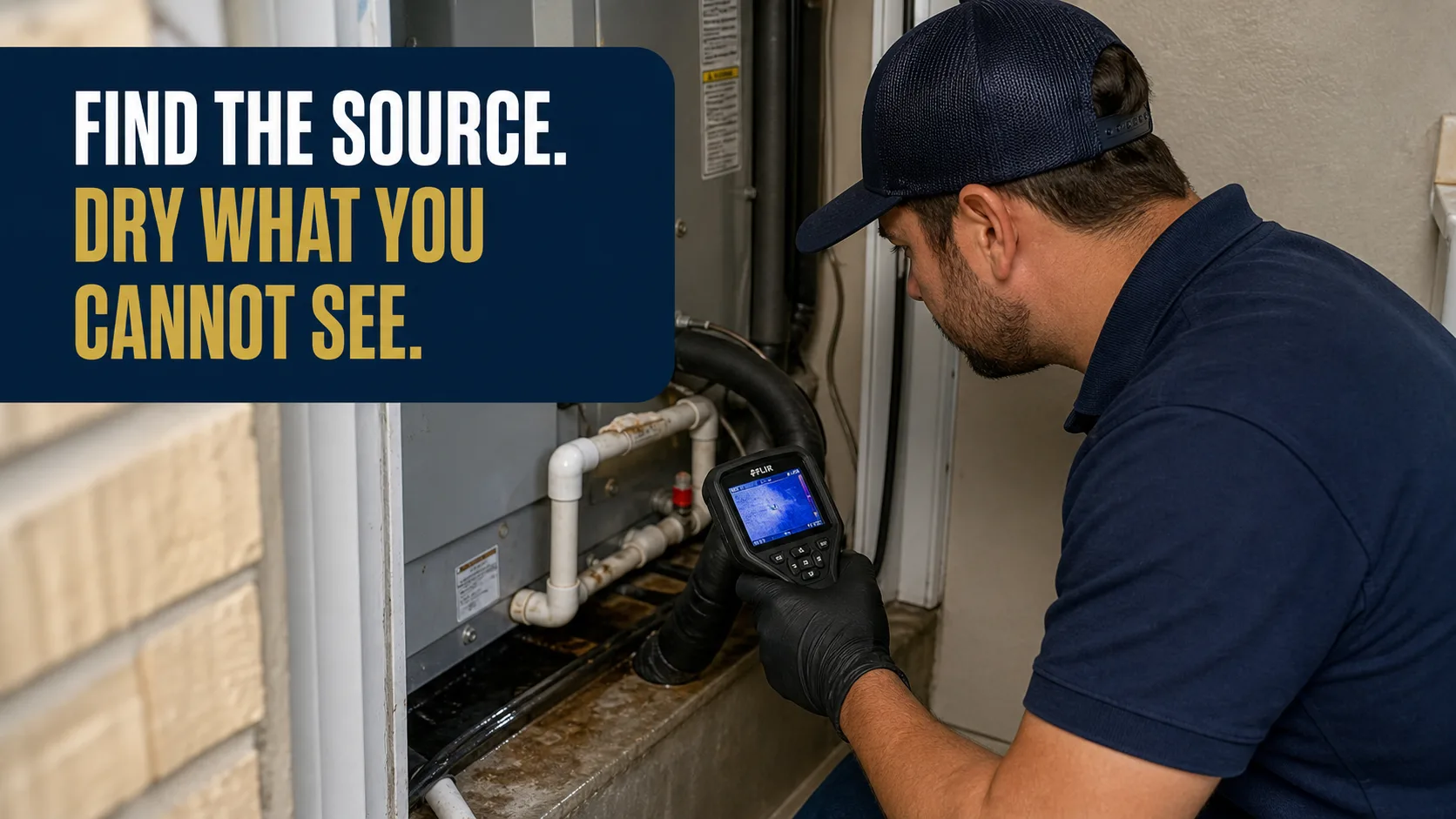
What we do starts the moment water gets past the pan: mapping the wet area with meters and thermal imaging so the scope matches the real footprint rather than the visible stain, removing soaked insulation and drywall that cannot be saved, drying the cavity with logged daily readings, and handing you a documented file your adjuster can work from. The rebuild — texture, paint, new ceiling — is a third trade again, and who to call for water damage sets out the order.
Send a photo of the drip and of the ceiling under your air handler to (346) 271-7004 and we will tell you which trade you actually need. We serve Pearland, Manvel, Friendswood, League City and the Greater Houston area.