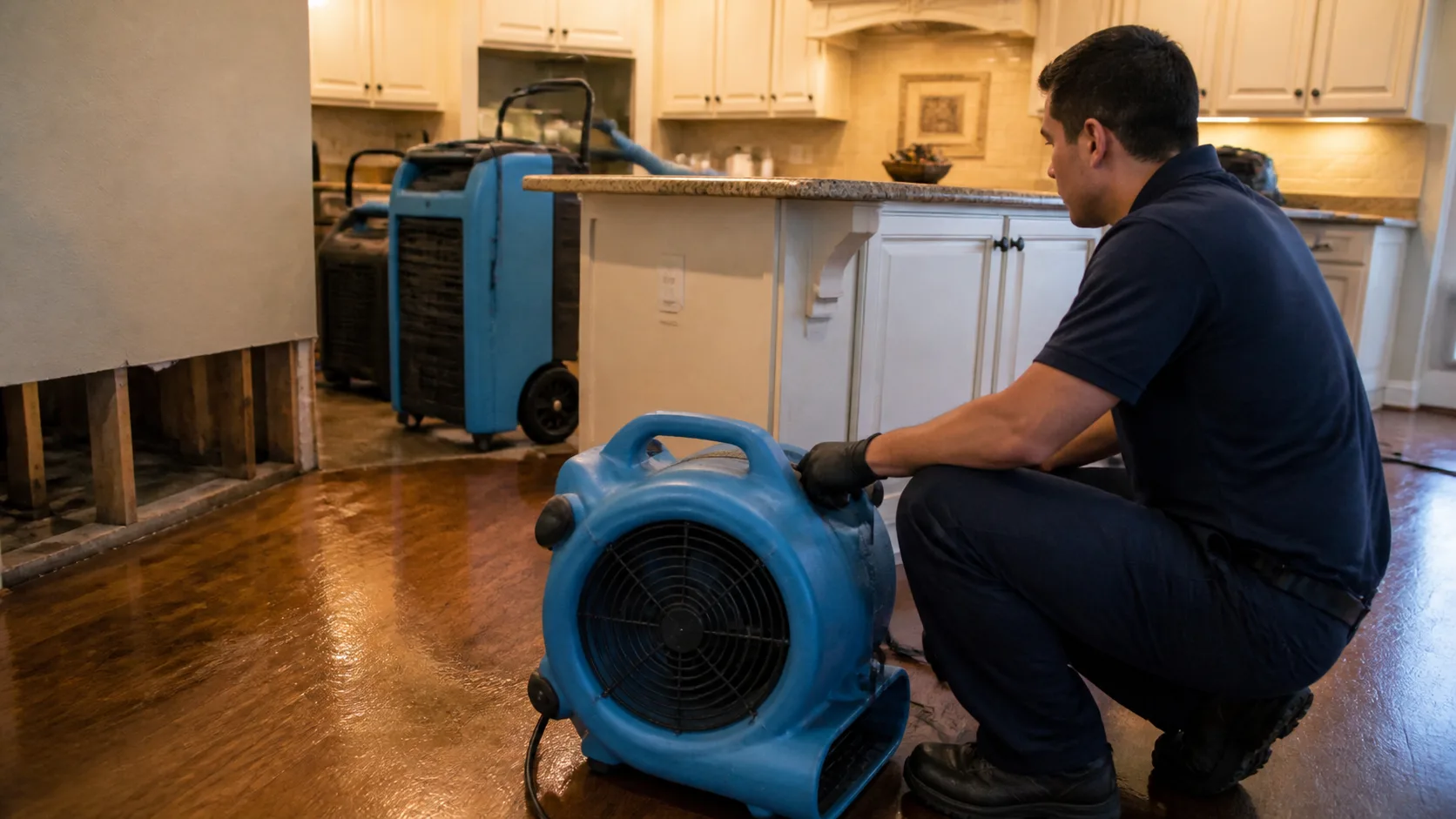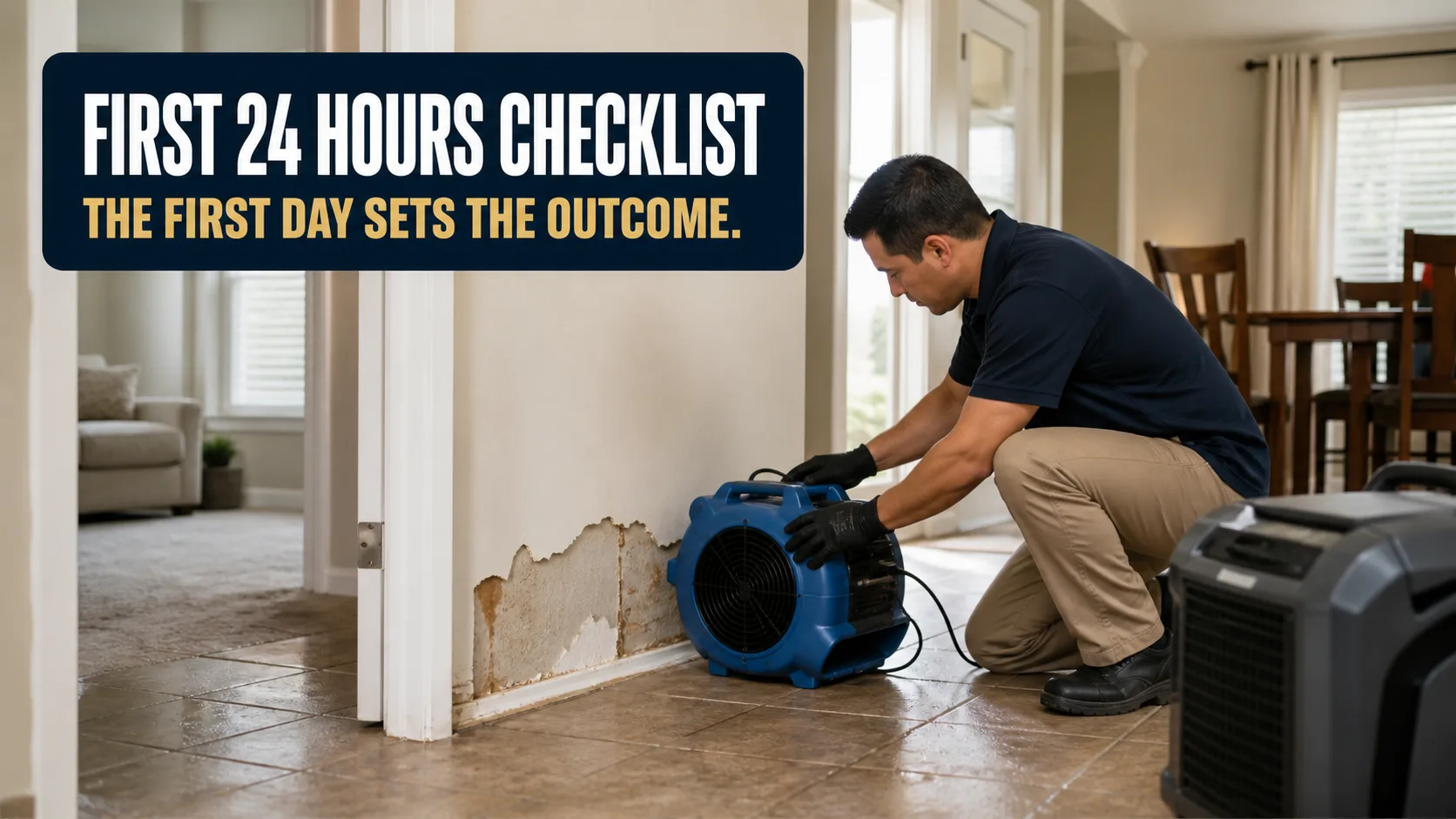
In order: stop the water, make the area electrically safe, photograph everything before touching anything, move what can be saved, extract standing water, get professional drying started the same day, and report the claim once the response is moving. The two clocks running against you: mold begins in wet materials within 24–48 hours in Houston humidity, and your claim is being decided by the evidence you keep — or destroy — today.
Hour zero: stop the water
- Fixture or appliance source → its own valve (behind the toilet, under the sink, behind the washer, on the water heater’s cold inlet)
- Unknown source or in-wall line → house main, at the meter or where the line enters the house
- AC condensate → thermostat off; the system is the pump
- Water rising from drains → stop using all water in the house; that is a sewer backup and it has its own rules
Seized valve? Don’t wrestle it mid-flood — go to the main. (And afterward, replace that valve; a shut-off that can’t shut off already failed.)
Hour zero, part two: make it safe
Breakers off for any room where water touches outlets, fixtures, or appliances — without standing in water to reach the panel. Sagging ceiling? Clear the room below; relieve a bulge with a small hole at its center, into a bucket, on your terms. Sewage involved? People and pets out entirely.
The golden hour: document before you clean
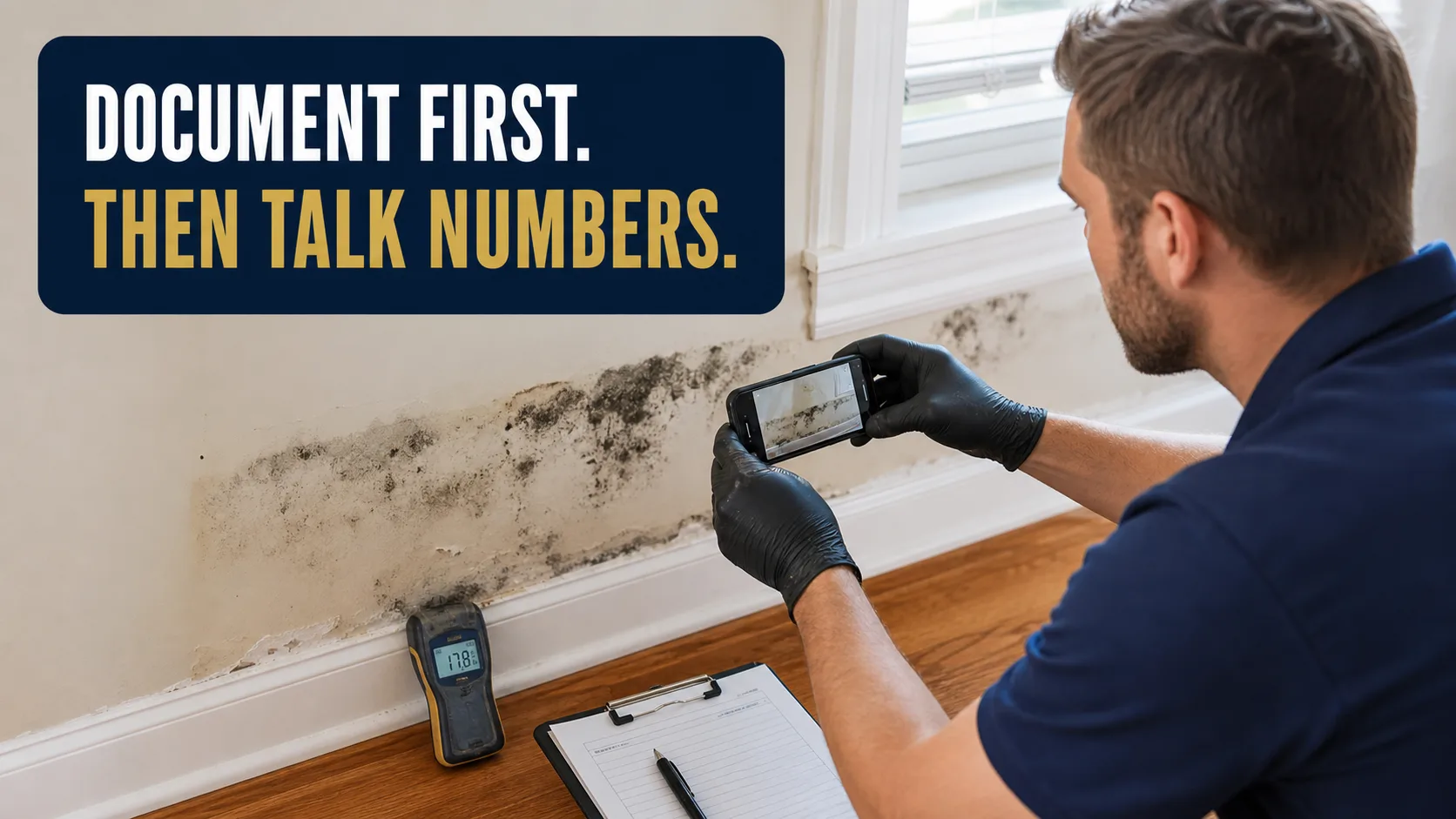
This is the step the claims veteran in us insists on, because months from now the entire claim rests on it:
- The source, as found. The burst hose still on the machine, the crusted connector, the failed line. Wide shot and close-up.
- Every affected room — standing water, the waterline on walls and furniture legs, the spread pattern.
- The clock: note discovery time and take a video walking the whole loss narrating what you see. Two minutes of phone video outranks an hour of memory at claim time.
- Data plates and serials of any failed appliance — the warranty status of the failed part can bring your deductible back.
- Keep the failed part. The hose, the connector, the line. Bag it, label it, do not let it leave in the cleanup.
Then — and only then — clean.
Hours 1–4: move, extract, protect
- Furniture, rugs, electronics out of the wet zone; foil or blocks under legs that can’t move
- Extract standing water: wet/dry vac (clean water only), mop, squeegee toward drains
- Lift curtains and bed skirts; pull anything absorbent off wet floors
- Prop open cabinet doors in wet kitchens and baths; empty the sink cabinets
- Do not run the HVAC through wet rooms, and no fans if sewage is involved — airflow spreads contamination
Same day: start real drying
Here is the honest line between what you can finish and what you can’t: household fans dry surfaces; they cannot dry structures. Wall cavities, wet insulation, flooring underlayment, the subfloor — the water in those layers is beyond any box fan, and in our humidity it stays put for weeks, feeding mold on schedule.
Professional mitigation the same day means extraction, commercial dehumidification, and — the part that protects you twice — daily moisture logs until materials verifiably hit dry standard. That log is also the spine of your insurance file. Call or text (346) 271-7004; a photo gets you an honest assessment of whether the loss needs us at all.
Same day: report the claim
With the emergency handled and evidence secured, call your insurer (or agent). Have ready: discovery time, source, what you’ve done so far, and your photo set. Two phrasing notes:
- Describe the event factually — “the supply line failed suddenly; I found it at 7 a.m. and shut off the main” — and resist speculating about how long something might have been leaking. Guesses become policy language.
- Ask what your policy’s ALE (additional living expense) covers if rooms are unusable, and whether your policy carries sewer backup coverage if that is the loss type.
A worked example: what the first cheque covers
Numbers invented to show the arithmetic. Nothing below is a quote, and your declarations page is the only document that governs your claim.
A toilet supply line fails at 6 a.m. and is shut off by 7. Water crosses a bathroom, a hallway, and into one bedroom. The documented scope comes to $7,600 — mitigation, removals, flooring, baseboard, drywall, paint. The policy is replacement cost on the dwelling with a $2,000 deductible, and the flooring carried real age.
| Line | Amount |
|---|---|
| Approved scope | $7,600 |
| Depreciation withheld, recoverable on completion | -$2,100 |
| Deductible | -$2,000 |
| First payment | $3,500 |
| Released once the work is finished and invoiced | $2,100 |
| Total received | $5,700 |
The envelope holds less than half the job. Under a replacement cost policy that is normally the contract working as written — the withheld portion is released on final invoices itemised against the approved scope, proof of payment, and photographs of the finished work. On an actual cash value settlement it never comes back at all. The mechanic is in actual cash value vs replacement cost.
Two notes. The deductible comes off once against the claim, not once per contractor. And a scope of $1,600 against a $2,000 deductible is not a claim — which is why the metered extent is worth having before you decide to file.
The Texas timeline after you report
Texas claim-handling rules set general windows, not guarantees. An insurer normally has about 15 days from notice to acknowledge the claim, begin its investigation, and request the items it needs, then about 15 business days after receiving everything requested to accept or reject the claim in writing, with a limited extension where it explains the delay in writing. Payment follows shortly after acceptance. Those periods can shift after a declared catastrophe, and the current requirements come from the Texas Department of Insurance.
One caveat that matters more than the numbers: the clocks generally start at notice, and they pause on you whenever the carrier is waiting for a document. Sending a complete set early is the whole difference between a file that moves and one that sits.
Nothing on that calendar is a reason to slow the drying. The 24-to-48-hour mold clock does not pause for an adjuster, and how long the structure actually takes to dry is set by materials, not by scheduling.
Hours 4–24: the follow-through
- Meter, don’t guess. Every “it looks dry” surface adjacent to the loss gets a moisture reading — floor perimeters, baseboards, the rooms behind shared walls, ceilings below.
- Inventory damaged belongings as you find them: photo, description, rough value. A running list beats a heroic weekend reconstruction.
- Save every receipt — mitigation, fans, tarps, even the wet/dry vac. Reasonable emergency costs are commonly reimbursable.
- Don’t authorize permanent repairs yet. Mitigation (drying, protecting) now; rebuilding after the adjuster has seen the loss or approved scope. The order matters.
- Check on the drying daily. Equipment running is not the goal; readings falling is. Whoever you hired should show you numbers moving toward dry standard, every day, until they arrive.
If the water came in with a fire
Firefighting water is usually handled under the fire claim rather than as a separate water loss, and the first 24 hours look different. The scene has to be released before anyone works in it. The house is warm, closed up, and soaked, so the mold clock starts the day the fire goes out. Soot is acidic and starts etching chrome within a day, which is why nothing gets wiped with a wet rag before it is documented.
The claim also splits into more parts. Structure and contents sit under separate coverages with separate limits, and additional living expenses reimburse the increase in your costs while the home is unlivable, against receipts. Start the receipt folder the first night — what a fire claim file needs is a longer list than the water version.
The mistakes that cost the most
- Waiting “to see if it dries out” — Houston’s humidity has already voted on this
- Cleaning up before photographing
- Throwing away the failed part
- Painting over stains instead of metering them
- Letting anyone close up walls or floors that never got a dry reading
The 24-hour checklist, free
Print it, or keep it where you will find it at 3 a.m.
- Water stopped — fixture valve, or the house main
- Power off to any room where water reached outlets or appliances
- People and pets out if sewage is involved
- Photos and video before anything is cleaned, date stamp on
- Discovery time written down
- Failed part bagged, labelled with the date, and shelved
- Data plate and serial photographed
- Standing water extracted, absorbent items lifted off wet floors
- Mitigation called the same day
- Loss reported, with discovery time, source, and what you did
- Declarations page found — deductible, settlement basis, sub-limits, water backup endorsement
- Receipt folder started
- Nothing removed thrown away, nothing permanent repaired yet
- Readings checked daily until every material hits dry standard
Where we fit
TruePoint Restoration is a mitigation and mold remediation company. We are not plumbers, not a rebuild contractor, and not a public adjuster or claims representative — Texas keeps that last role separate from the firm doing the work, and a public adjuster generally may not hold a financial interest in the repairs. We do not negotiate settlements, argue coverage, or interpret your policy.
What we do in the first 24 hours is the part that decides the next three weeks: metering every wet material, extracting, removing only what cannot be saved, drying with daily logged readings, and building a file — moisture map, photographs, source of loss, final readings — that an adjuster can read without translation.
If a claim is genuinely disputed, a Texas-licensed public adjuster, an attorney, or the Texas Department of Insurance is who takes it up. If there is water in your house right now, call or text (346) 271-7004. We serve Pearland, Manvel, Friendswood, League City and the Greater Houston area.