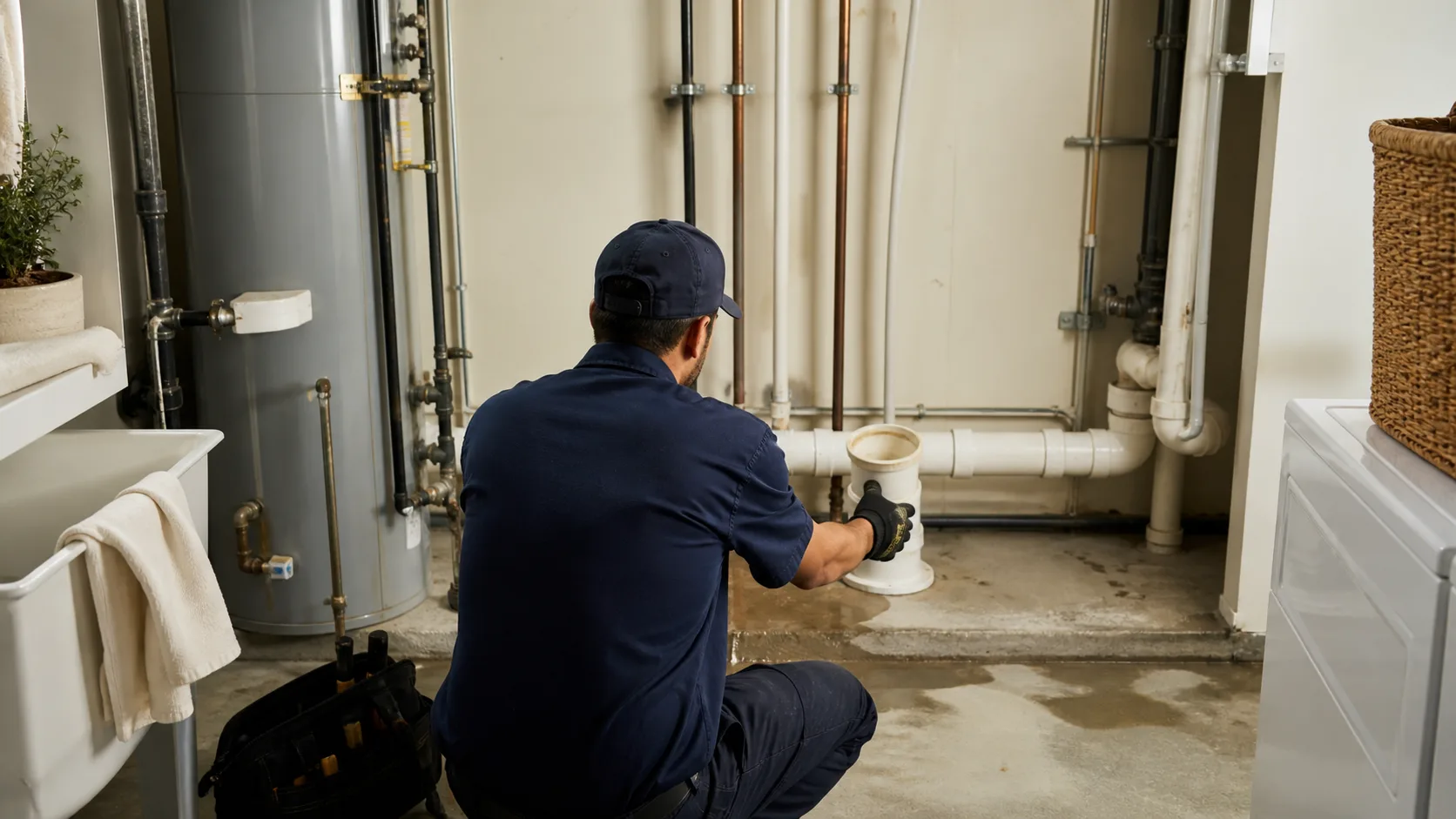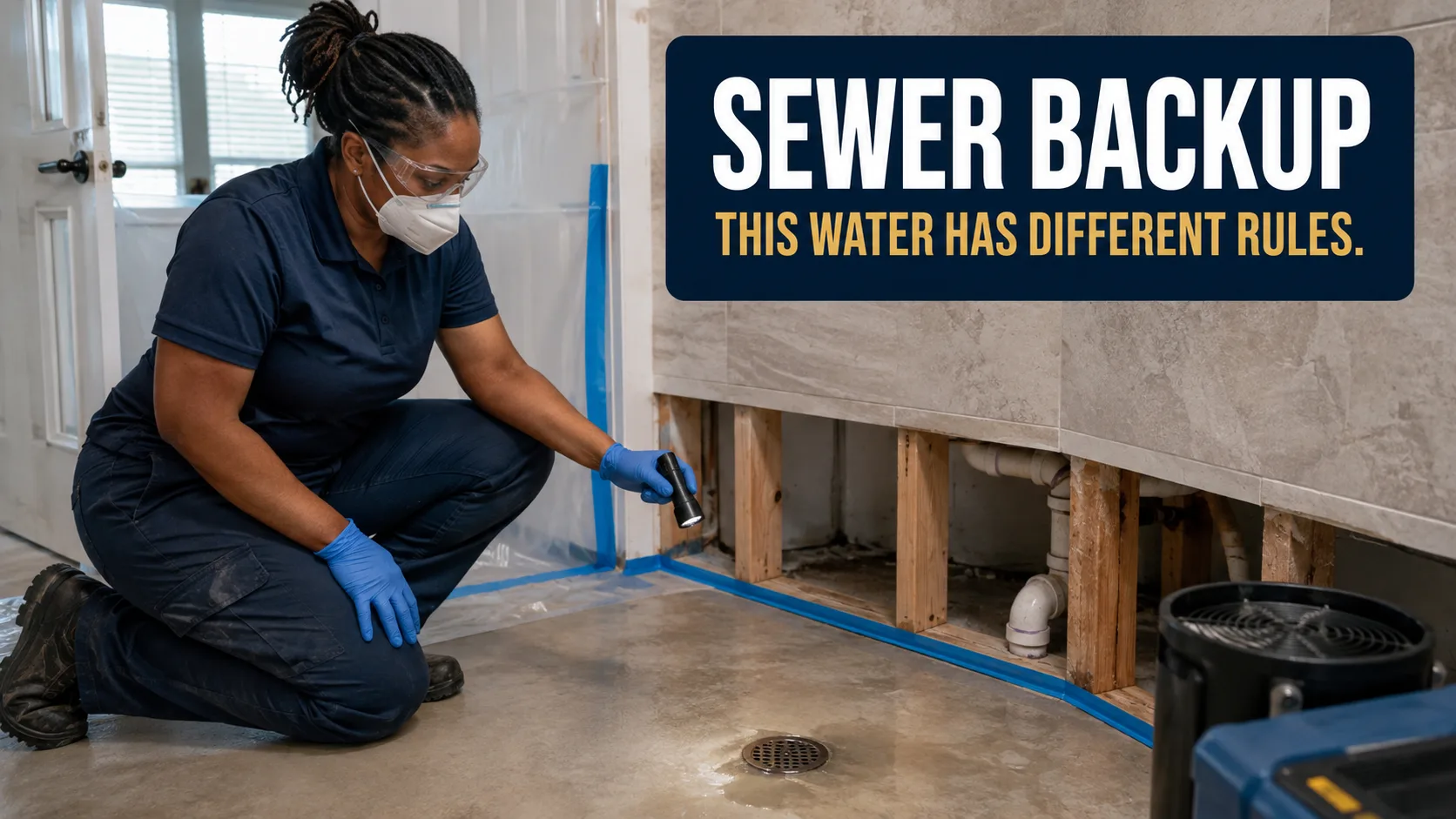
Stop using all water in the house immediately — every flush and drain feeds the backup. Keep people and pets out of affected rooms, turn off HVAC if vents or returns are near the sewage, and photograph from the doorway. Do not attempt cleanup beyond containment: sewage is Category 3 contaminated water, and porous materials it touches generally must be removed, not cleaned. Call **(346) 271-7004** — this is the one loss where professional handling is not optional.
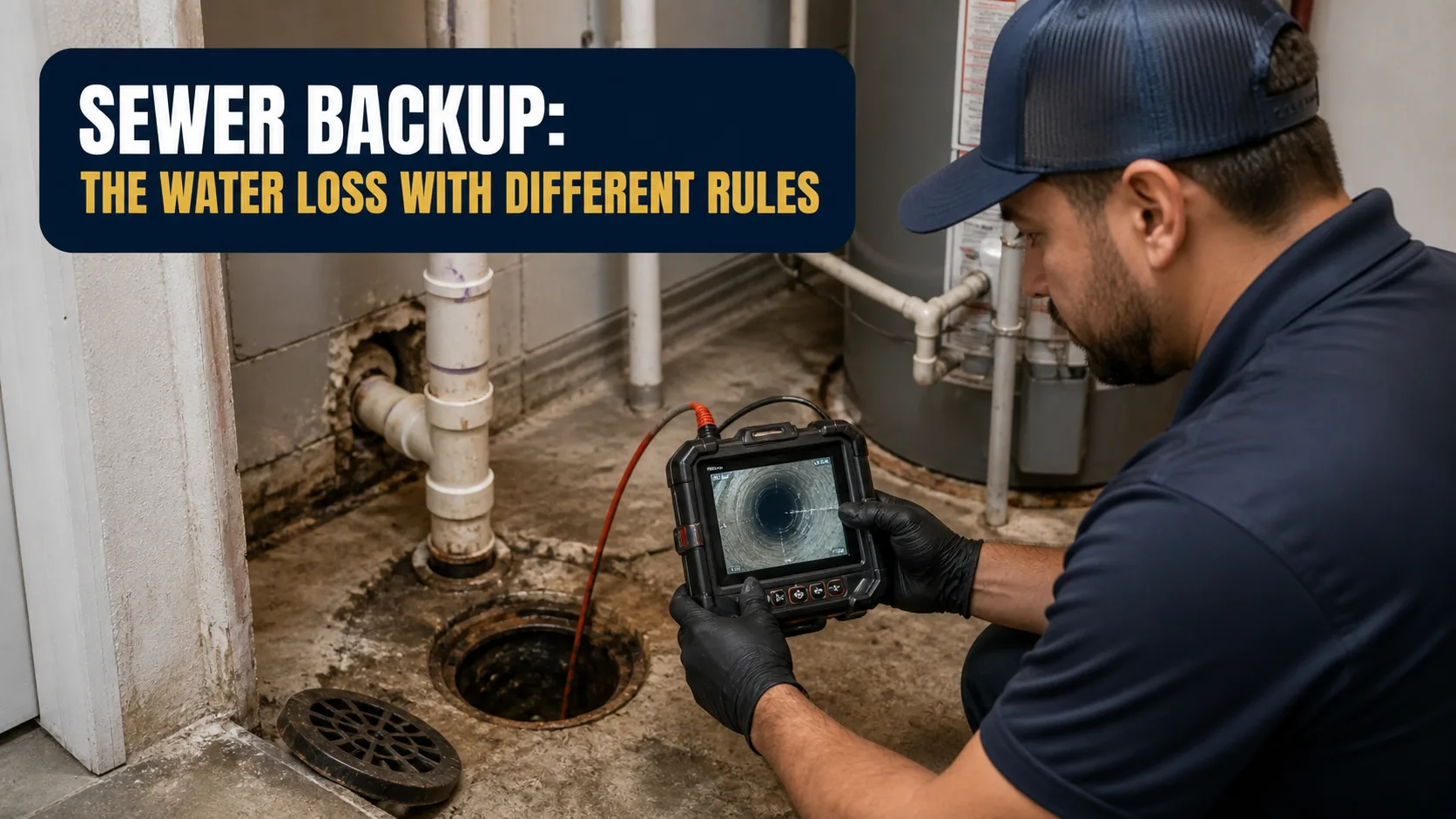
Why sewage comes back up
Every drain in your house — toilets, tubs, sinks, washer — feeds one main sewer line to the street. When that line blocks, wastewater has nowhere to go. Add more water from anywhere in the house and it rises until it finds the lowest exit: a shower drain, a tub, a first-floor toilet.
Common causes in Houston:
- Tree roots infiltrating older clay or cast-iron laterals
- Grease narrowing the line over years
- Line bellies or collapses — Houston’s expansive clay soils shift, and buried pipes shift with them
- City main surcharges during heavy rain, pushing flow back toward homes
Why this is not like other water damage
Water damage pros classify water by contamination: Category 1 (clean supply water), Category 2 (gray — dishwasher, washer discharge), Category 3 (black — sewage). Category 3 changes everything:
- It is a biohazard, whatever it looks like. Clear sewage is still sewage.
- Porous materials cannot be saved. Carpet, pad, upholstered furniture, and drywall that absorbed sewage are removed, not dried. Surface cleaning does not reach contamination absorbed into the material.
- Cleanup method matters as much as speed. Wrong handling aerosolizes contamination and spreads it to clean rooms.
- Disinfection is verified, not assumed — cleaned surfaces get treated with antimicrobials, and the drying that follows is documented like any other loss.
Warning signs before the backup reaches the floor
A main line rarely blocks all at once. It narrows, and the house complains for weeks first.
The line is narrowing:
- Several fixtures draining slowly at the same time, rather than one bad sink
- A toilet whose level rises when the washer drains, or a tub that gurgles when a toilet flushes — one drain venting through another means the shared line is restricted
- Gurgling from a floor drain or shower when nothing near it is running
The blockage is close to complete:
- Water backing up at the lowest opening in the house — a first-floor tub, shower, or floor drain
- A sewer smell in the lowest bathroom that comes and goes
- The cleanout in the yard weeping or standing full
It has happened before and will again: repeat backups in the same fixture, a lateral over thirty years old, or mature trees within twenty feet of the line. Roots find clay and cast-iron joints, and Houston’s expansive clay pulls those joints apart a little every dry season.
What to do right now
- Stop all water use. No flushing, no sinks, no laundry — anything that goes down any drain comes up at the backup point.
- Evacuate the affected rooms. Children and pets out entirely.
- HVAC off if any vent, return, or duct is in or near the affected area.
- Photograph from the doorway. Do not wade in for a better angle.
- Block the spread if you can do it without contact — towels rolled at doorways (they will be discarded).
- Call a plumber (for the line) and mitigation (for the contamination) — in parallel. The line must be cleared or the backup repeats; the cleanup must start fast. (346) 271-7004.
What you can safely check from the doorway
Do not wade in and do not touch it. Everything below can be done without contact.
- Stop all water use first. Every flush and drain cycle feeds the backup.
- Establish whether it is one fixture or the whole house. Water rising in a single sink with everything else draining normally is a branch blockage. Water at the lowest openings while several fixtures back up is the main line, and that is a different call.
- Find your sewer cleanout in the yard or against the house — a capped pipe, usually white or black. Do not open it, but know where it is, because it is the first thing a plumber asks for.
- Note whether it started during or after heavy rain. A backup that tracks the weather points at a city main surcharging rather than your own lateral, and that changes who you notify.
- Turn the HVAC off if any supply, return, or duct opening is in or near the affected area.
- Photograph from the doorway with the date stamp on — the water line on the wall, the fixtures it came up through, the contents in the room.
What NOT to do
- Don’t use a household wet/dry vac. It exhausts aerosolized sewage into the air and the vacuum is contaminated afterward.
- Don’t sprinkle bleach on carpet and hope. Disinfectant on top of a contaminated porous material does not decontaminate its depth.
- Don’t run fans. Airflow before containment spreads contamination to clean areas.
- Don’t handle materials barehanded, and keep any cut or broken skin far away from all of it.
The insurance trap: check your policy today
Here is the part that surprises homeowners at the worst possible moment: standard homeowners policies often exclude sewer backup. Coverage usually comes as an optional endorsement (“water backup and sump discharge” or similar) that costs relatively little but must be added before the loss.
Two minutes today: find your declarations page, look for sewer/water backup coverage. If it is not there, call your agent. This single check is the highest-value action in this entire guide. More on coverage: Does insurance cover water damage?
What does sewage cleanup cost, and what drives it?
There is no flat rate, and removal drives the number rather than drying time.
- How far it spread. One bathroom floor is a contained job. Sewage that crossed a threshold into carpeted living space is a different scope entirely.
- How much porous material is in the path. Carpet and pad, upholstery, baseboards, cabinet kicks and the bottom of drywall come out — they are not cleaned. That removal is the largest line on most of these invoices.
- Whether the HVAC is involved. A return or duct opening in the affected zone puts decontamination of the system into scope.
- What is under the flooring. Slab-on-grade construction covers most of the Houston area, so contaminated water spreads sideways across the slab and the flooring usually has to come up to reach and treat it.
- How long it sat, because absorbed contamination is a removal line and growth follows on the usual clock.
A contained single-bathroom job commonly runs a few thousand dollars. Losses that reached carpeted living areas, the ductwork, or several rooms run well into five figures — the pricing structure is in what mitigation costs in Houston.
How long does it take?
Three to five days for a contained single-bathroom backup: containment, removal of contaminated porous material, cleaning and antimicrobial treatment, then documented drying. Losses that crossed into living areas or ductwork run one to three weeks, because removal and access add scope before drying even starts.
Readings decide the end date, not the calendar — and on this loss type, so does the removal record. Smell is not a clearance test. Odor drops off as soon as the bulk material is out, while contamination absorbed into a subfloor or bottom plate stays exactly where it is. What sets a drying timeline applies here on top of the decontamination work.
What professional sewage cleanup looks like
- Containment of the affected zone
- Removal of contaminated porous materials, bagged at the source
- Extraction, cleaning, and antimicrobial treatment of salvageable surfaces
- Structural drying with daily moisture logs
- Full documentation: category of loss, affected materials, disposal records — the file your adjuster and any future buyer’s inspector will want to see
The free things worth doing tonight
- Stop all water use and tell everyone in the house why. It is the highest-value action available to you.
- Keep children and pets out of the affected rooms entirely, doors closed.
- Turn the HVAC off if any vent, return, or duct is in or near the area.
- Photograph from the doorway with the date stamp on — the water line, the fixtures, the contents.
- Roll towels at doorways to slow the spread, and accept that those towels are going in the trash.
- Find your declarations page and look for water backup coverage. Two minutes, tonight, and it decides how the next two weeks go.
- Report it in writing to your carrier, and to the city too if the backup followed heavy rain.
- Do not run fans, do not use a shop vac, and do not pour bleach on anything.
Prevention
- Annual camera inspection of the lateral if your home is 30+ years old or has mature trees
- No grease down drains, ever — it does not rinse away, it accumulates
- Consider a backwater valve if your home has a history of city-main surcharges
- Know where your sewer cleanout is before you need it — your plumber will thank you
Where the plumber ends and we begin
TruePoint Restoration is not a plumbing company. We do not clear main lines, run a camera down your lateral, cut roots, or replace collapsed pipe, and we say that on the phone rather than after the estimate. Until a plumber clears the blockage the backup repeats, so that call and ours run in parallel rather than in sequence — the two trades are not interchangeable, and neither is the rebuild contractor who puts flooring and cabinets back afterward.
What we do is the contamination: containing the zone so cleaning does not carry it into rooms that are still clean, removing and bagging porous material at the source, treating what can be saved, drying the structure with logged daily readings, and handing you a documented file — category of loss, materials removed, disposal records, final readings — that your adjuster works from now and a buyer’s inspector may ask for years later.
This is the one loss where handling it yourself reliably costs more than calling. If sewage is in your house, call (346) 271-7004. We serve Pearland, Manvel, Friendswood, League City and the Greater Houston area.