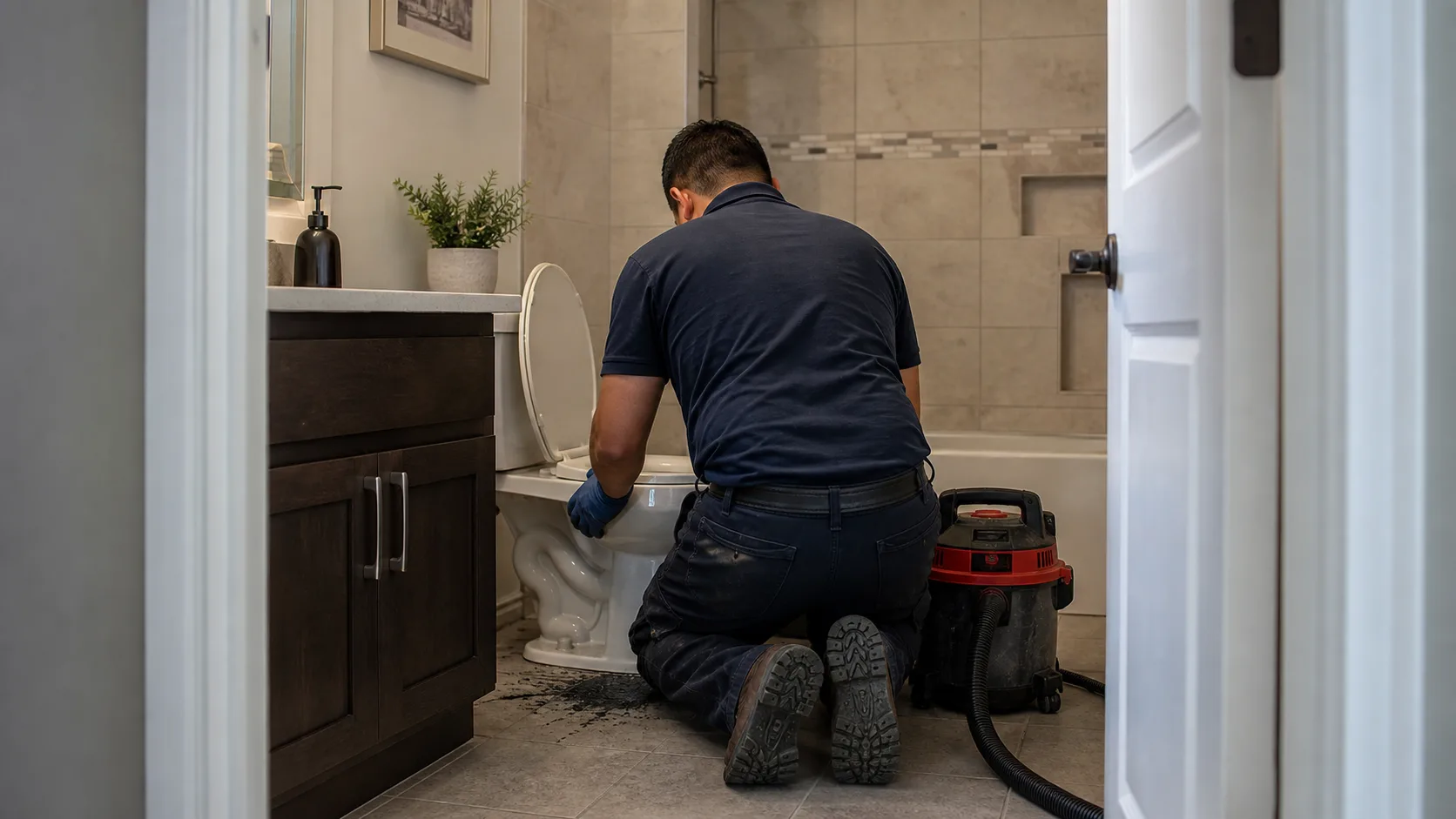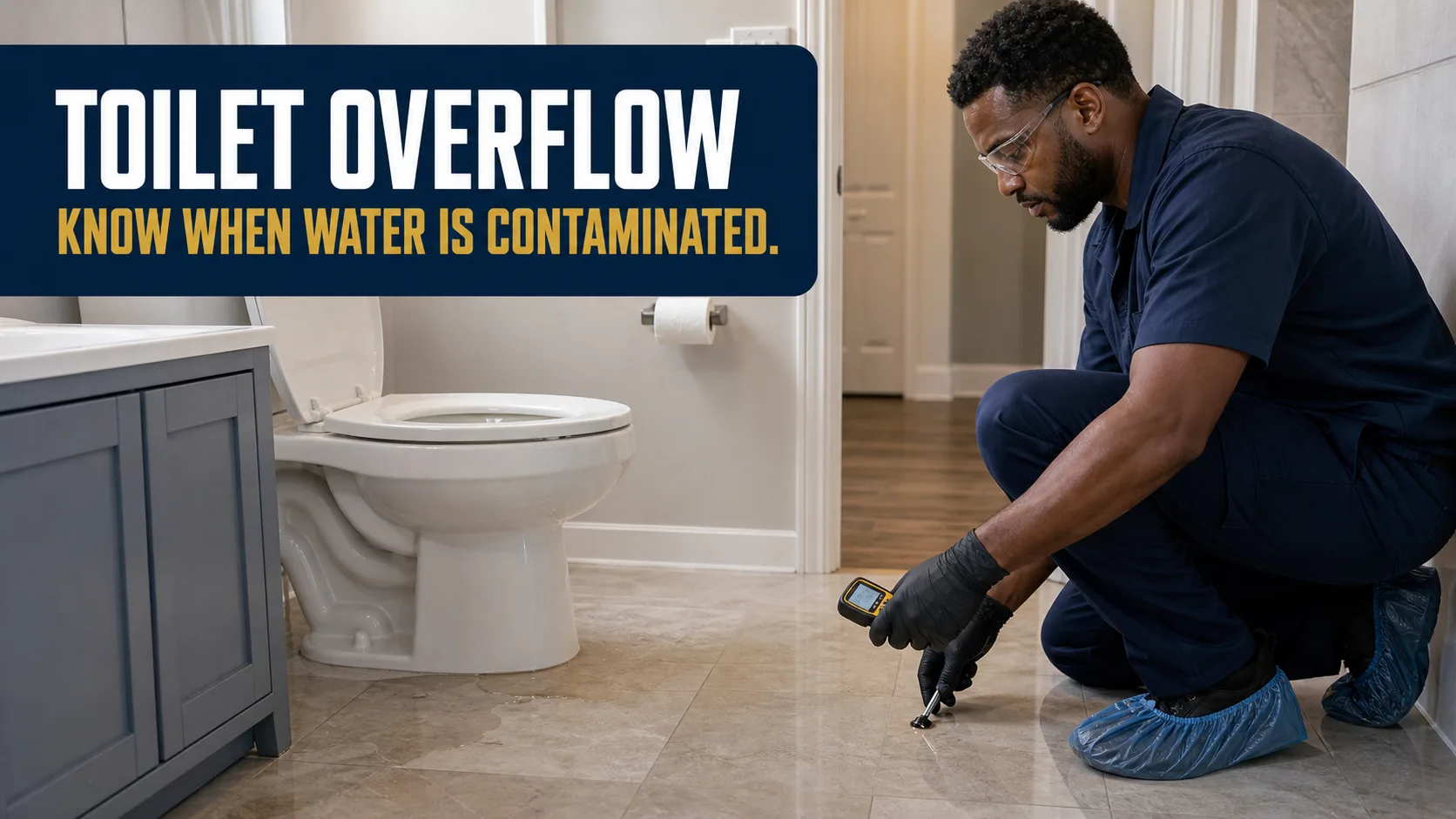
Stop the water first: close the supply valve behind the toilet, or open the tank and push the flapper closed. Then answer the question that decides everything else — was there waste in the bowl? Clean water: contain it, dry fast, watch the floor edges. Waste involved: treat it as a contamination event and keep people out. Either way, if water ran along baseboards or reached a ceiling below, it needs a moisture reading — bathroom floors leak into the structure at every edge.
Stopping it (the 15-second version)
- Supply valve behind the toilet, clockwise until snug.
- Can’t reach it or it’s seized? Tank lid off, push the flapper down over the hole at the tank bottom — the flood stops instantly — then lift the float to stop the refill.
- Do not flush again. Every “test flush” on a blocked drain is another tank of water on your floor.
The question that decides the cleanup
Water professionals grade water by contamination, and a toilet can produce two very different grades:
- Clean-ish (Category 2): fresh bowl water from a clog with nothing in it. Mop it, disinfect surfaces, dry fast.
- Contaminated (Category 3): any overflow with waste involved. This is a small sewage event, and sewage rules apply: porous materials that absorbed it (carpet, rugs, drywall, baseboard) generally cannot be surface-cleaned back to safe — they get professionally handled or removed. Keep kids and pets out.
If you are not sure which you have, treat it as contaminated. The downside of overcaution is a few dollars of disinfectant; the downside of undercaution is a bathroom that smells wrong forever and a family exposed to bacteria.
Where the water really goes
Here is what opening up bathroom floors teaches you: the puddle you mop is the smallest part of an overflow. Bathrooms are full of edges — the toilet base, the tub skirt, the baseboards, the door threshold — and every edge is a drain into the structure:
- Under tile and vinyl, into the subfloor
- Behind baseboards, into the bottom plate of the walls
- Around the toilet flange, into the ceiling below (upstairs bathrooms)
The bathroom looks dry by dinner. The subfloor under it stays wet for weeks in our humidity — and that is the mold timeline starting, out of sight.
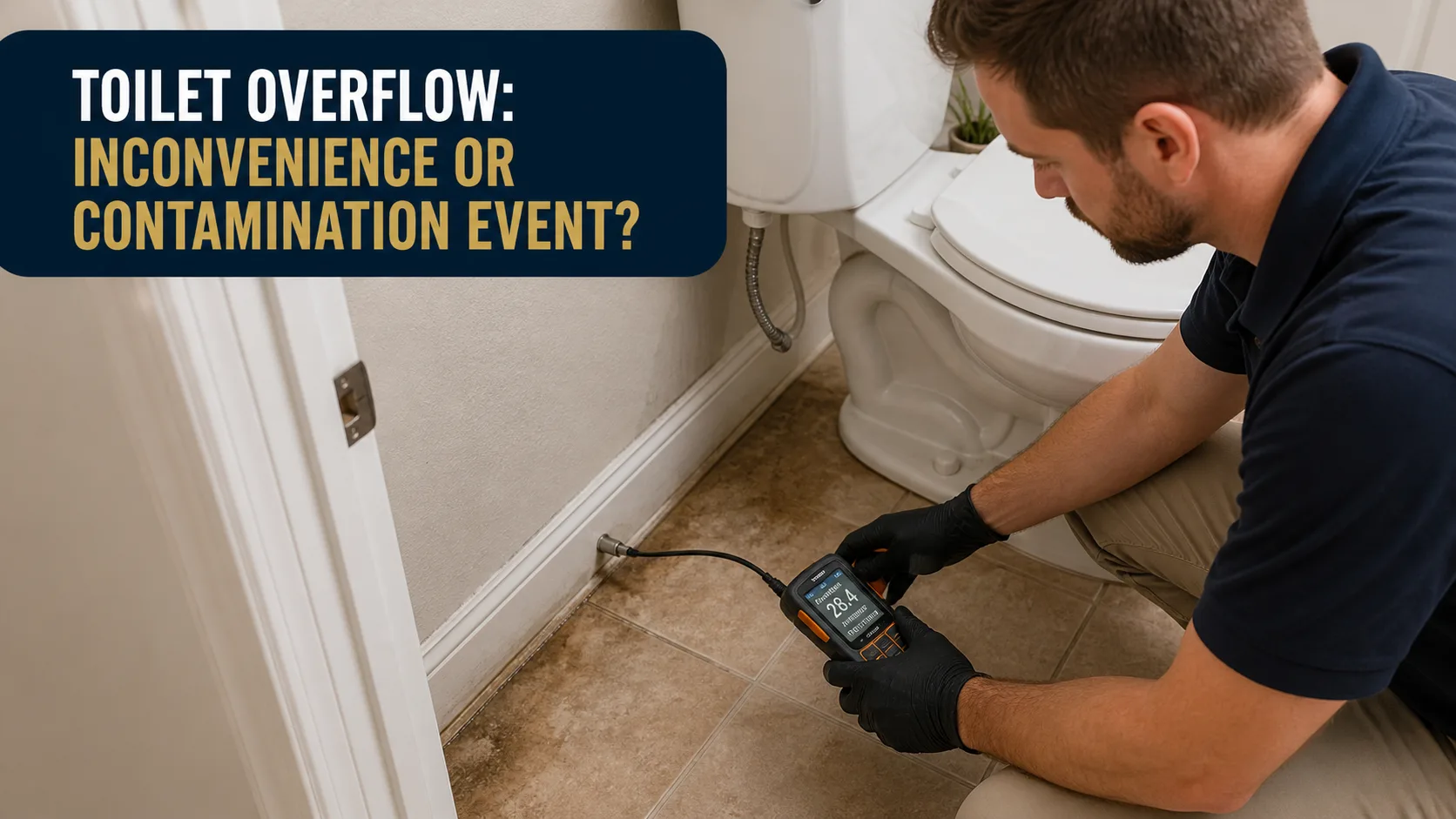
The rule of thumb: more than a mop bucket’s worth on the floor, or any sign of water at the baseboards or the ceiling below → get the edges metered. Ten minutes with a moisture meter answers what no amount of looking can. Text a photo to (346) 271-7004 and we will tell you honestly whether it needs a visit.
What to do after the water stops
- Photograph the overflow and the water’s reach before cleanup.
- Contain and remove the standing water — towels, mop, wet/dry vac (clean water only).
- Disinfect hard surfaces.
- Pull the bath mat, and lift anything absorbent off the floor.
- Check the perimeter: baseboards, the toilet base, the room below if upstairs. Anything damp or discolored goes on the watch list — or better, gets metered now.
- Fix the cause. A one-off clog is a plunger’s job. A repeat performance means the blockage is deeper in the line — see below.
When it’s not really a “toilet problem”
A toilet that overflows repeatedly, gurgles, or backs up alongside another fixture is not clogged — it is the lowest opening on a blocking sewer line, and it is warning you. That escalates to a different guide: Sewer backup. Stop using water in the house and get the main line cleared before the warning becomes the event.
The warnings a drain gives before it overflows
An overflow is rarely the first message the line sent. It is the last one.
The bowl is reporting a restriction: water rising higher than normal before it drains, a bowl that empties in two stages, or a gurgle when you run the sink. That is a plunger and maybe an auger.
The blockage is downstream: a tub that fills when the toilet flushes, two toilets misbehaving in the same week, or a smell at the cleanout in the yard. That is a main line, and it stops water use in the house until it is cleared.
The floor is already involved: caulk at the base darkening and never fully drying, baseboard paint blistering along the bottom inch behind the bowl, or a stain on the ceiling below. Water left the room some time ago, often past a failed wax ring rather than over the rim.
What to check yourself tonight
The water you mopped and the damage you have are two different measurements. Twenty minutes, no cost.
- Run a dry hand along every baseboard, behind the toilet and under the vanity toe kick included, with the bath mat and anything else absorbent out of the room. You are feeling for cool and damp, not wet.
- Press the flooring at the door threshold. Vinyl or laminate that flexes or clicks underfoot has water beneath it.
- Put your face near the vanity cabinet floor. Enclosed air concentrates odor, and a musty note there is a reading you can take with your nose.
- Check the room below with a flashlight held flat against the ceiling. Raking light shows a stain and a sag that straight-on light hides.
- Photograph all of it with the date stamp on, including what looks fine. A dated photo from the night it happened outweighs any description written a month later.
Anything damp, soft, or musty on that list is a meter question, not another towel.
What does overflow cleanup cost?
Nobody prices this off a phone call. What is honest is naming the variables that move it.
- Clean or contaminated. Category 2 bowl water is cleaned and dried. Waste-bearing Category 3 water means containment, antimicrobial treatment, and removal of porous material that absorbed it — a different scope, not a larger version of the same one.
- How far it traveled. One tile bathroom is one room. Water that crossed the threshold into carpet is two, and a wet ceiling below adds a cavity plus insulation that is bagged rather than dried.
- How long it sat. Extracted in the first hours, it is a dry-out. Found a week later, it is a dry-out plus removals.
- How high the drywall wicked. Roughly 12 inches above the waterline, so the cut lands between 12 and 24 inches — set by readings, never by a rule of thumb.
Working range: a single bathroom handled the same day commonly runs $1,500 to $4,000, and climbs from there with a carpeted room or a ceiling below. Most Texas deductibles sit under that figure, which is the practical argument for filing — wider breakdown in water damage mitigation cost in Houston.
How long does the drying take?
A same-day clean-water overflow held to one bathroom is usually two to three days on equipment. A contaminated overflow with material removal runs three to five. A ceiling cavity or a carpeted room runs longer, because wet insulation comes out rather than dries.
Readings decide the end date, not the calendar. Wet material is metered against unaffected material of the same type, logged daily, and equipment leaves when the numbers match — what really sets the timeline is how much got wet and how deep, never how big the puddle looked.
Insurance notes
- A sudden overflow with resulting damage: commonly covered.
- The toilet’s repair itself: usually on you.
- Overflow caused by a municipal or main-line backup: falls under sewer backup coverage, which many Texas policies only include as an optional endorsement — check yours today.
- As always: photos before cleanup, and a documented dry-out if structure got wet.
The free things worth doing tonight
- Find the shut-off valve behind every toilet and confirm each one turns. A valve that will not close is a failure that has not been billed yet.
- Find your main shut-off — garage, utility closet, or the meter box near the curb — and confirm that turns too.
- Close the toilet supply valves before any trip longer than a weekend. Ten seconds each.
Where the plumber ends and we begin
TruePoint Restoration is not a plumbing company. We do not clear drains, auger main lines, pull toilets, or run a camera down your sewer — call a plumber for the cause, and call them first, because nothing we do holds while the line still blocks. We are not the rebuild contractor either.
What we do is the part between the two: metering what got wet, cleaning a contaminated overflow to a standard a wipe-down cannot reach, removing porous material that cannot be brought back to safe, drying the subfloor and wall bases with logged daily readings, and handing you a documented file your adjuster can work from. The split is worth understanding before you dial — plumber versus mitigation company.
Send photos to (346) 271-7004. Sometimes the honest answer is that a fan and an open door will do it, and we would rather say that than sell you equipment days you do not need. We serve Pearland, Manvel, Friendswood, League City and the Greater Houston area.