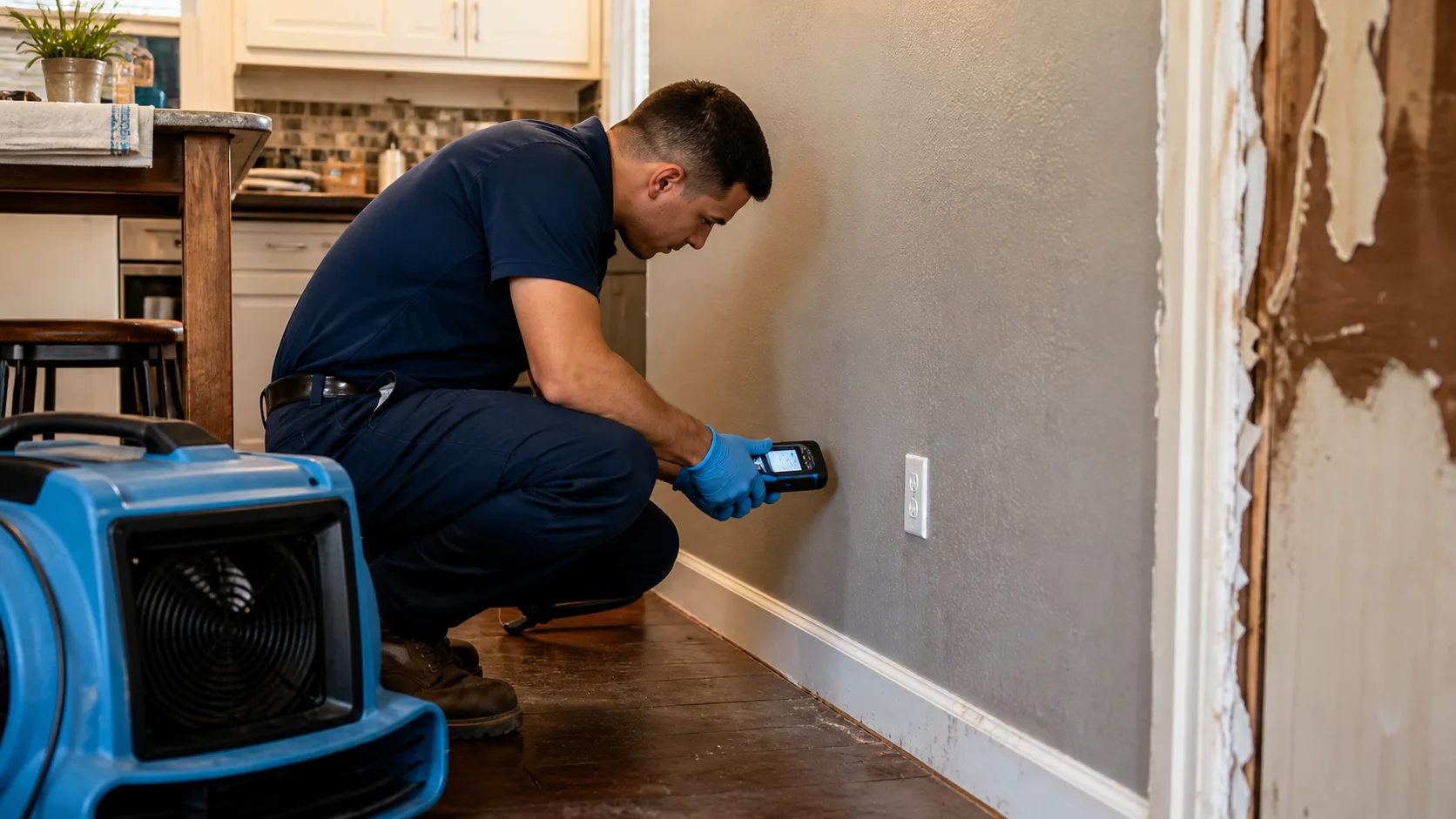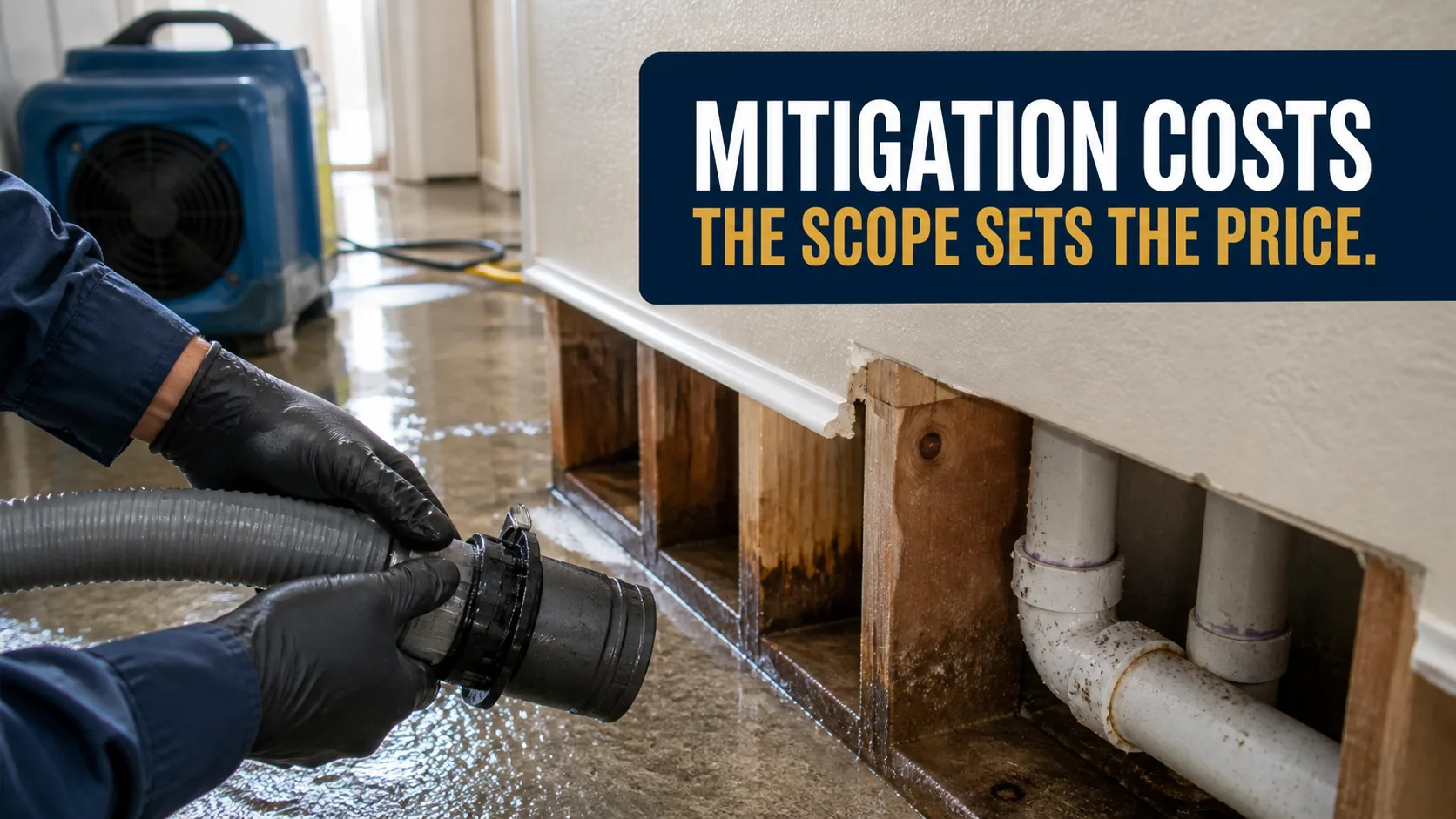
Mitigation cost is a measurement, not a mystery: it scales with how much material got wet, how deeply, for how long, and whether the water was clean or contaminated. Small single-room dry-outs run in the hundreds to low thousands; multi-room and contaminated losses run higher. For covered losses, insurance pays above your deductible — mitigation is the work your policy requires. Two honest rules: the number should come after moisture readings and before work begins, and speed is the biggest cost control you have.
The five dials that set the price
1. Wet square footage — including the hidden kind. Not the puddle: the full metered extent across floors, walls, cavities, and ceilings. This is why two “identical-looking” losses price differently, and why estimates without moisture mapping are guesses wearing a letterhead.
2. Saturation depth. Surface-wet tile is extraction and airflow. Soaked drywall, insulation, and underlayment are equipment-days — or removal. Materials have drying curves; wetter and longer-wet means more of both.
3. Water category. Clean supply water can often be dried in place. Gray water needs cleaning plus drying. Sewage forces removal of porous materials regardless of drying math — category is a cost multiplier all by itself.
4. Time-to-response. The dial you control. Hours-old water sits on surfaces; days-old water lives in materials, and materials that pass the 24–48 hour mark in Houston humidity start growing mold — converting drying line-items into removal-and-remediation line-items at several times the cost.
5. What’s in the way. Drying under cabinets, hardwood salvage attempts, built-ins, two-story losses — access and salvage complexity add equipment and labor.
What a legitimate estimate looks like
You should be able to see the measurement inside the number:
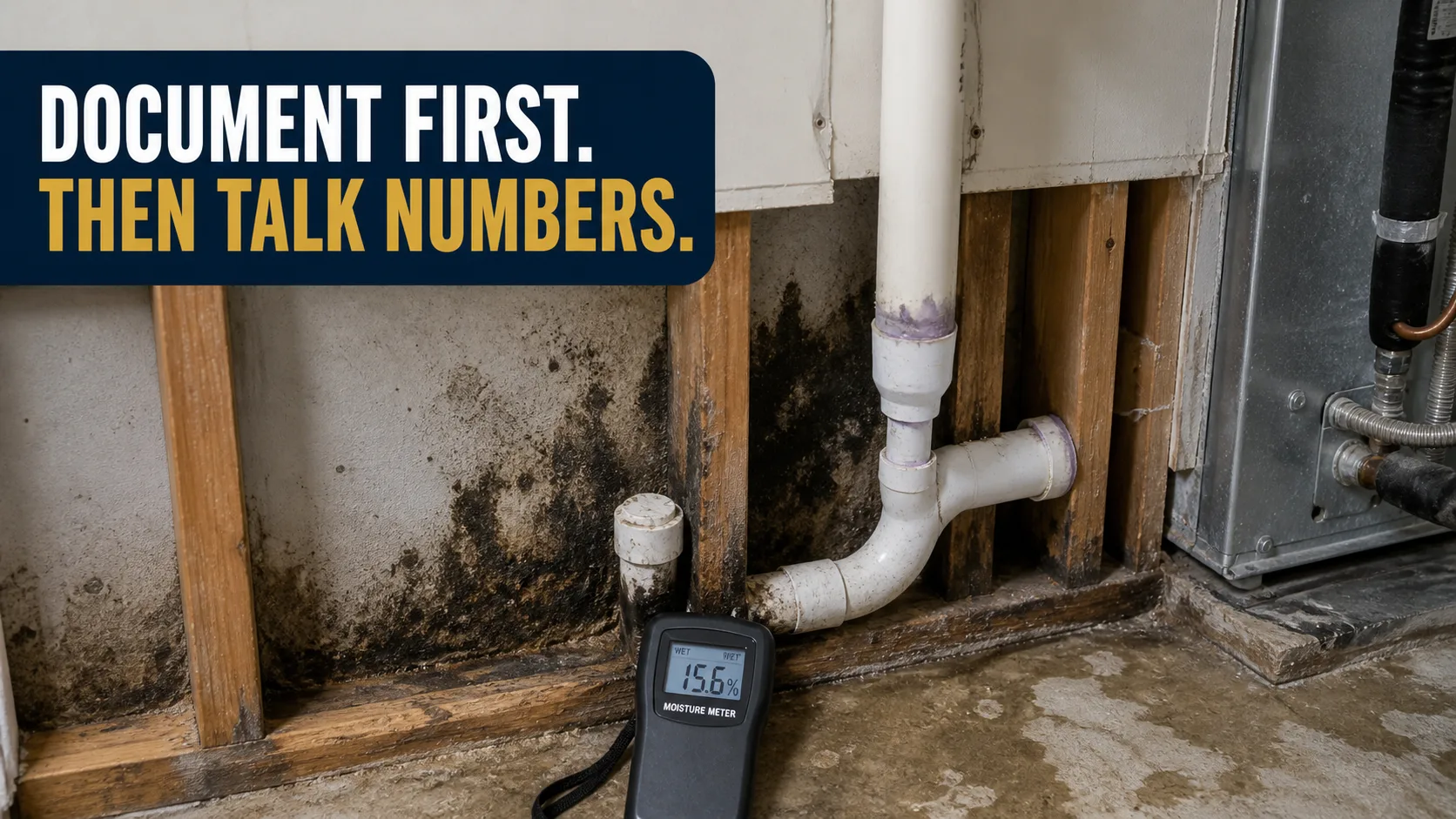
- Moisture map first — which rooms, which materials, what readings
- Line items, not lump sums: extraction, removals (what and why), equipment count and rental days, antimicrobial treatment where category calls for it, monitoring visits
- Written in Xactimate line items (the insurers’ own pricing system) so the adjuster can approve it without a translation fight
- The exit criteria stated: drying continues until materials hit dry standard, verified by daily logged readings — that log is also what closes your claim
- The number before the work. Emergencies compress timelines; they do not excuse open-ended pricing.
Red flags: estimates produced without meters, “we’ll sort it out with your insurance” instead of a scope, pressure to sign rebuild work before dry readings exist, and bids that undercut everyone by skipping the cavities — the cheapest bid on paper is routinely the most expensive one by spring.
What insurance pays (and the deductible math)
For covered sudden-and-accidental losses, mitigation is core claim spend — policies require you to prevent further damage, and this is that. You pay your deductible; covered costs above it are the carrier’s.
Two practical corollaries:
- Below or near your deductible? Might not be a claim at all — a $900 dry-out against a $2,500 deductible is a checkbook decision, and a good mitigation company will tell you so instead of inflating scope to “make it worth filing.”
- Well above it? File with confidence and let the documentation do the arguing. And if a warrantied part caused the loss, your deductible itself may come back through subrogation — keep the part.
A worked example: a kitchen supply line
Numbers invented to show how a mitigation estimate turns into a payment. Nothing below is a quote or a market rate.
A supply line under a kitchen sink fails on a Saturday and runs for about four hours. Water crosses the kitchen, under the island, into the dining room, and eighteen inches up the shared wall. Assume a $2,000 deductible on a replacement cost policy.
| Line | Amount |
|---|---|
| Emergency extraction and initial moisture mapping | $650 |
| Cabinet kick and toe-board removal for access | $480 |
| Removal of wet drywall and insulation, two walls | $920 |
| Equipment — 6 air movers and 2 dehumidifiers, 5 days | $2,150 |
| Antimicrobial treatment and daily monitoring visits | $700 |
| Mitigation total | $4,900 |
| Reconstruction, separate scope and contractor | $6,300 |
| Claim scope | $11,200 |
Two things about that table. Equipment is the largest single line and it bills per unit per day, which is why response time and correct equipment sizing move the number more than anything a salesperson says. And mitigation is only 44 percent of the claim — the rebuild is the bigger half, and it arrives on a separate invoice from a separate company.
Then the settlement basis applies. On a replacement cost policy the carrier commonly withholds depreciation on the aged materials and releases it after the work is finished and invoiced, so a first cheque of roughly $6,000 against an $11,200 scope is normal rather than a shortfall. On an actual cash value settlement the withheld portion never returns. The whole mechanic is in actual cash value vs replacement cost.
Change one variable — nobody home until Monday — and a mold remediation scope appears against a separate sub-limit, and the cabinets stop being salvageable. The 48 hours cost more than every other line combined.
The false economies (the ways people pay twice)
- “Fans for a week” instead of metered drying — surface dry, cavity wet, mold in six weeks; now it’s remediation plus the original job
- Skipping mitigation to “save the deductible” on a real loss — the growth of the damage eats the savings, and delayed response weakens the claim itself
- Taking the no-meter low bid — you paid for a fraction of the job at a fraction of the price, which is not a discount
- Rebuilding over unverified structure — new flooring atop a damp slab or fresh paint on a wet ceiling is prepaying to do it twice
- Waiting for the adjuster before drying — the policy expects mitigation first; the delay costs materially and reads as neglect
What to do in order
- Stop the water, at the fixture valve or the house main.
- Photograph and film before anyone cleans, with the date stamp on.
- Get the extent metered before you decide to file. A loss below the deductible is not a claim, and you cannot judge extent by looking at a stain.
- Ask for the scope and the number in writing before work starts.
- Keep the failed part, bagged and labelled with the date.
- Report the loss with the discovery time, the source, and what you did.
- Watch the readings daily, not the equipment. Running fans is not progress; falling numbers are.
- Book the rebuild after dry standard, never alongside it.
What to document so the estimate holds up
An estimate is only as strong as the measurements behind it, and a carrier reviews the measurements.
- Moisture readings at discovery, room by room and material by material. This is the extent the whole price is built on.
- Daily logs showing readings falling toward dry standard, with the date each piece of equipment went in and came out.
- Equipment count and placement, because the invoice bills per unit per day and the log is what justifies it.
- Photographs of every removal and the reason for it — wet insulation, delaminated pad, swollen baseboard.
- The failed part and its data plate, which establish a sudden cause and may bring the deductible back through subrogation.
- A final reading at dry standard on every affected material. That is the document that closes the mitigation file and lets the rebuild start.
An estimate produced without meters is a guess wearing a letterhead, and it is the kind that gets reduced on review.
Two clocks, and only one is yours
The drying clock is physical. Extraction is hours. Structural drying is three to five days on a contained loss, longer where hardwood, plaster, or a slab is involved — what sets a drying timeline is materials, not scheduling. The mold clock runs at 24 to 48 hours in Gulf Coast humidity, and every hour past it converts drying line items into removal and remediation line items.
The claim clock is procedural. Texas rules generally give an insurer about 15 days from notice to acknowledge the claim, begin investigating, and request what it needs, then about 15 business days after receiving everything requested to accept or reject in writing, with a limited extension explained in writing. Those windows can shift after a declared catastrophe, and the current requirements come from the Texas Department of Insurance.
Nothing on the second clock justifies pausing the first.
Get a real number
Photos cost nothing: text them to (346) 271-7004 with your neighborhood. Small loss, we’ll tell you how to handle it yourself. Real loss, we’ll meter it, put the scope and number in front of you before work starts, and document everything your claim will need. That’s the whole pitch.
Do this tonight, free
- Find your declarations page and write down the deductible and the settlement basis.
- Check for a water backup endorsement, and for separate windstorm or flood policies with their own deductibles.
- Confirm your main shut-off turns, and show someone else where it is.
- Photograph the laundry connections, both water heater fittings, and under every sink while they are dry.
- Save a number you would call at 2 a.m. so the decision is not made under pressure.
Where the estimate ends and we begin
TruePoint Restoration is a mitigation and mold remediation company. We are not a rebuild contractor and not a public adjuster — Texas keeps that second role separate from the firm doing the work, and a public adjuster generally may not hold a financial interest in the repairs. We do not negotiate your settlement, interpret your policy, or tell you what is covered.
What we price and perform is the mitigation: metering the extent, extracting, removing only what cannot be saved, drying to dry standard with daily logged readings, and producing a scope written in the line items a carrier’s estimating software reads directly. If the honest answer is that your loss is under the deductible and does not need us, we will say so.
Where a claim is genuinely disputed, a Texas-licensed public adjuster, an attorney, or the Texas Department of Insurance is the right call. For a real number instead of a range, text photos to (346) 271-7004. We serve Pearland, Manvel, Friendswood, League City and the Greater Houston area.