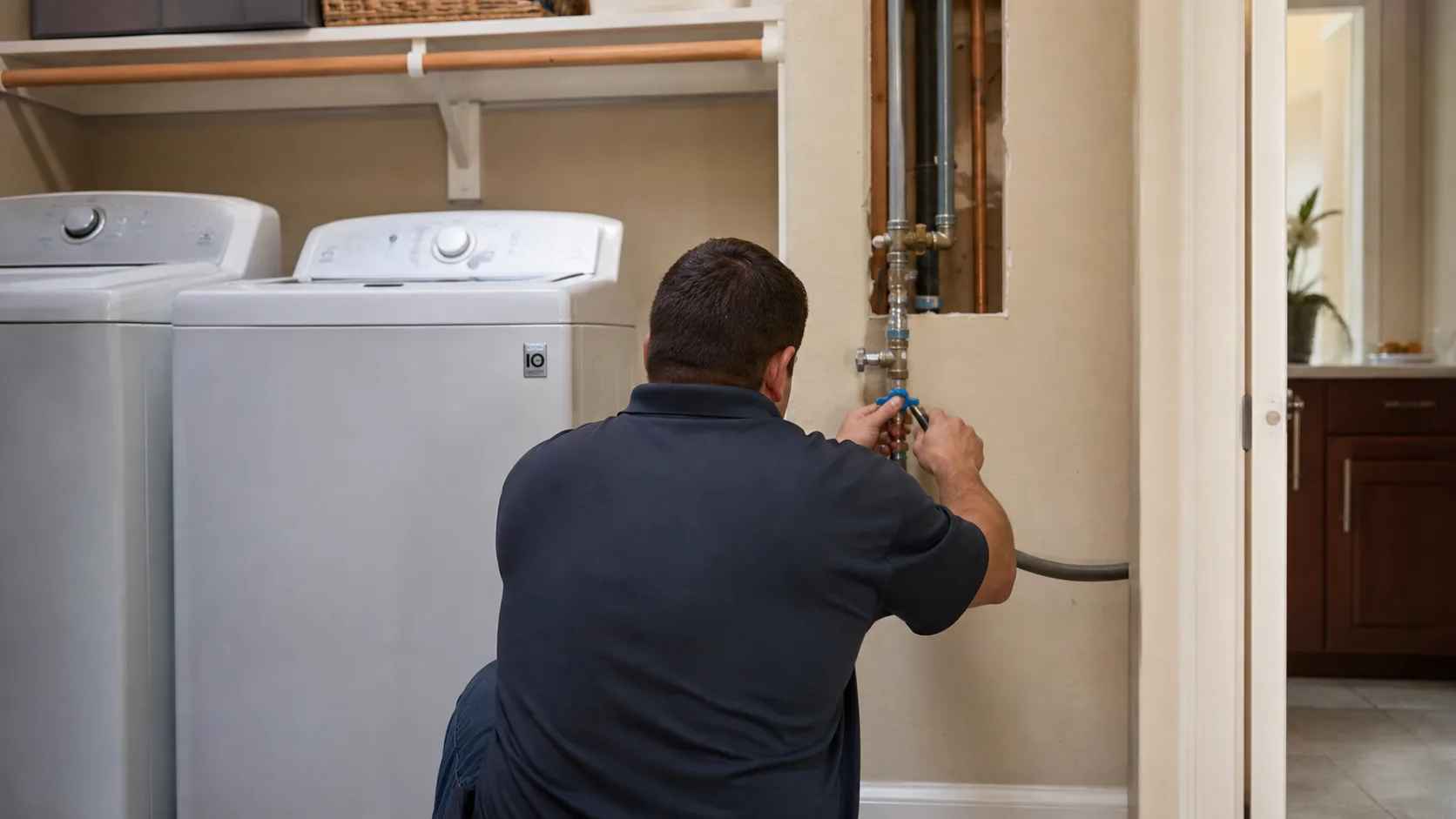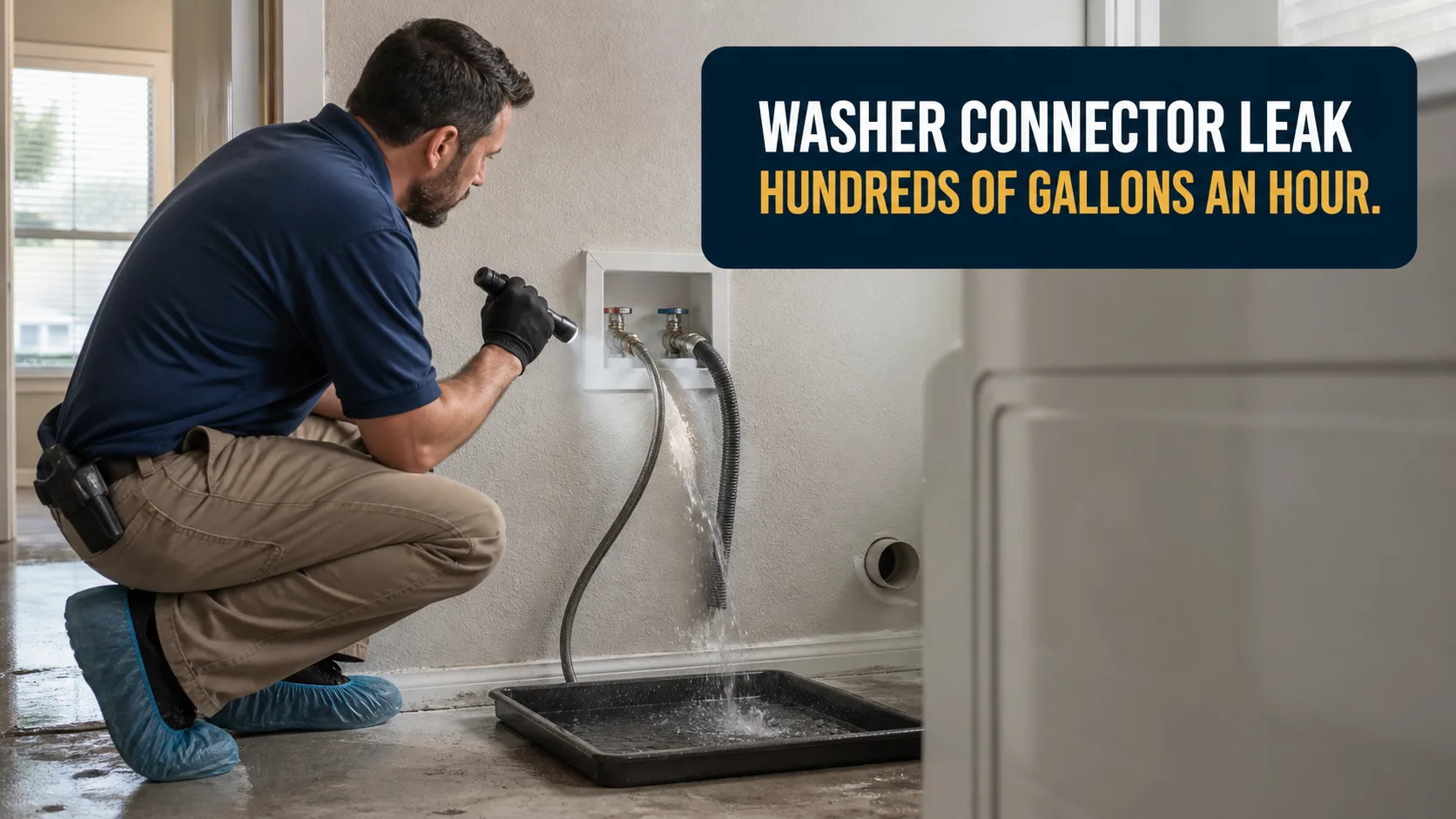
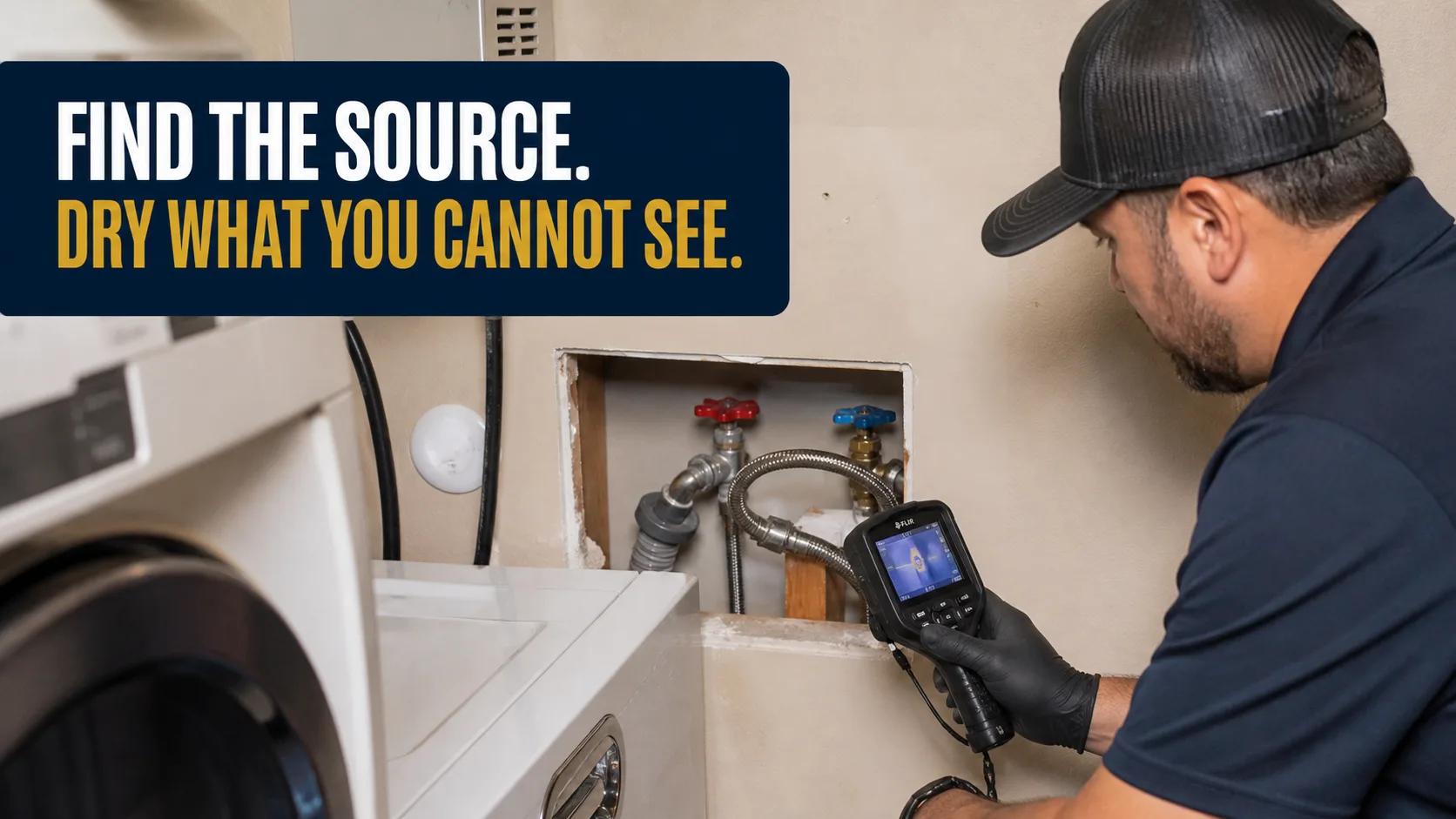
Shut off the two valves behind the washer (or the house main if they are seized), kill power to the area if water reached outlets, and start extracting immediately — a burst supply hose runs at full line pressure and typically floods well beyond the laundry room. Photograph everything including the failed hose itself, and keep the hose: its age and warranty status matter for your claim. Then get the floor perimeter metered — this failure is famous for water you cannot see.
Why this failure is different
Most leaks drip. This one pours. A washing machine supply hose carries full household water pressure 24 hours a day, whether the machine is running or not. When the rubber fails, you get an open line discharging hundreds of gallons per hour — and if it happens while you are at work or asleep, it runs for hours.
That is why washer hose failures sit at the top of insurance-industry loss data year after year: not the most common failure, but among the most destructive per event.
Why hoses burst on a schedule
Rubber hoses age from the inside: heat, chlorinated water, and constant pressure make the liner brittle, then it cracks. The outside can look perfect the day it lets go.
Which is why the replacement rule is a calendar rule, not an inspection rule:
- Rubber hoses: replace every 5 years, or at the hose’s warranty expiry if sooner
- Braided stainless: better burst resistance; still replace on schedule
- The warranty principle: a 4-year warranty is the manufacturer’s own service-life estimate. Running a hose into year 8 means running four years past what its maker would put in writing. Full logic: appliance connector warranty windows.
What to do right now
- Valves off — both, behind the machine. Seized? House main off.
- Power off to the laundry area at the breaker if water is near outlets or the machines’ plugs.
- Extract fast. Wet/dry vac, towels, squeegee toward a drain if there is one. Every gallon out now is drying time saved.
- Photograph: the standing water, its full reach, the failed hose still attached if safe.
- Keep the hose. Do not toss it in the cleanup. If it failed inside its warranty period, it is evidence your insurer can use to recover from the manufacturer — which can return your deductible.
- Meter the perimeter. See below. (346) 271-7004 — text photos, get an honest answer.
Where the water hides after this one
High-volume releases behave differently from drips. In the minutes the hose ran, water moved:
- Under the walls — laundry rooms are rarely sealed at the plates; water crosses into the hallway, the closet on the other side, the garage
- Under laminate and wood flooring — floating floors trap a lake beneath them and look fine on top
- Into the wall bottoms — drywall wicks upward from the base; by day three the moisture line is at 6 inches and invisible under paint
A hallway that “feels dry” the next morning routinely meters wet at the baseboards. In Gulf Coast humidity that water is not going anywhere on its own — except into mold. After any burst-hose event, the surrounding rooms deserve fifteen minutes with a moisture meter.
The warning signs on a hose that has not burst yet
Rubber fails from the inside, so the outside is a poor witness. Read it anyway — when it does show something, the hose is nearly done.
On the hose body: a bulge or soft spot anywhere along it, surface cracking near either end where the hose bends, or rubber that has gone hard and shiny.
At the fittings: white or green mineral crust at a coupling nut. That is dried mineral left by water escaping and evaporating, which means the joint has already started leaking.
Behind the machine: a damp patch on the floor that keeps coming back, rust on the back panel, or drywall softened along its bottom edge.
At the valves: a handle that will not turn. Every prevention step on this page depends on those valves closing.
On the calendar: nothing visible, and an install date nobody remembers. That is the usual condition of a hose about to fail.
Check your own hoses tonight
Fifteen minutes, a flashlight, and a phone.
- Pull the washer forward far enough to get a hand and a light behind it.
- Run a dry hand along both hoses, end to end, squeezing gently. You are feeling for a soft spot, a bulge, or a section gone hard.
- Look at all four fittings — two at the wall, two at the machine — for crust and for damp.
- Close both valves and open them again. If either fights you, that valve gets replaced before anything else on this list.
- Check the wall and floor behind the machine for drywall softness at the bottom edge, a stained baseboard, or a buckled flooring seam.
- Photograph the hoses, the fittings, and any install date written on them, with the date stamp on. Dated proof that you inspect and replace hoses is what quietly wins a maintenance argument in a claim.
Finding nothing is a good outcome and it still tells you something. Write today’s date on both hoses with a paint marker and you have started the clock that matters.
What NOT to do
- Don’t trust the surface. Tile tops dry fast; the mortar bed and subfloor under them do not.
- Don’t put the machines back and resume laundry until the valves, floor, and walls check out.
- Don’t discard the failed hose before the claim settles.
What does the cleanup cost?
The failed part costs $15. What follows is set by how long the line ran and where the water went.
- Run time. A hose that let go at 2 a.m. put hundreds of gallons through the house. Caught in ten minutes, it did not.
- How many rooms. Laundry rooms are rarely sealed at the bottom plate, so the hallway, the closet behind the wall, and the garage are commonly in scope whether or not they look wet.
- What the flooring is. Carpet and pad over a slab dry quickly. A floating laminate floor traps a lake underneath and usually comes up.
- Whether it went down. An upstairs laundry room adds a ceiling cavity and insulation that is bagged rather than dried.
Working range: a multi-room clean-water loss with extraction, several days of equipment, and some flooring removal commonly runs $3,000 to $10,000, and a release that ran overnight and came through a ceiling runs well above that. Typical Texas deductibles sit at $1,000 to $2,500, so this loss is nearly always worth filing — and Texas carriers must acknowledge a claim within 15 days, with mitigation expected to start before an adjuster walks the house.
How long does the drying take?
Three to five days for a clean-water loss caught quickly with equipment on site the same day. A week or more when water sat overnight, got under floating floors, or reached several wall cavities. Volume is not what sets the timeline — what got wet and how deeply does.
Readings decide the end date, not the calendar. Every wet material is metered against unaffected material of the same type and logged daily, and equipment leaves when the numbers match. Never unplug it overnight to save electricity: interrupted drying lets material re-absorb moisture and restarts the clock. What actually sets a drying timeline is depth and material, not square footage.
Prevention: the best $15 in home ownership
- Replace both hoses with braided stainless, longest warranty you can find, this week if yours are rubber or of unknown age.
- Write the install date on the hose with a paint marker.
- Exercise the shut-off valves twice a year so they close when it counts.
- Going out of town? Close the washer valves. It costs three seconds.
- Consider a washer pan with a drain and/or a leak sensor that shuts the valves automatically — cheap compared to what you are reading this page about.
Full schedule and product guidance: washer hose replacement schedule.
Where the plumber ends and we begin
TruePoint Restoration is not a plumbing company and we do not service appliances. We do not replace hoses, swap seized shut-off valves, plumb in a washer pan, or repair the machine — and we are not the contractor who lays your flooring back. Call a plumber for the valves and the pan, and buy the hoses yourself.
What we do is everything the water reached: metering the laundry room perimeter and every room on the other side of those walls, pulling out flooring and material that cannot be brought back, drying wall cavities and subfloor with logged daily readings, and handing you a documented file your adjuster can work from.
Text photos to (346) 271-7004 — the standing water, the failed hose, and the rooms next door. We serve Pearland, Manvel, Friendswood, League City and the Greater Houston area.