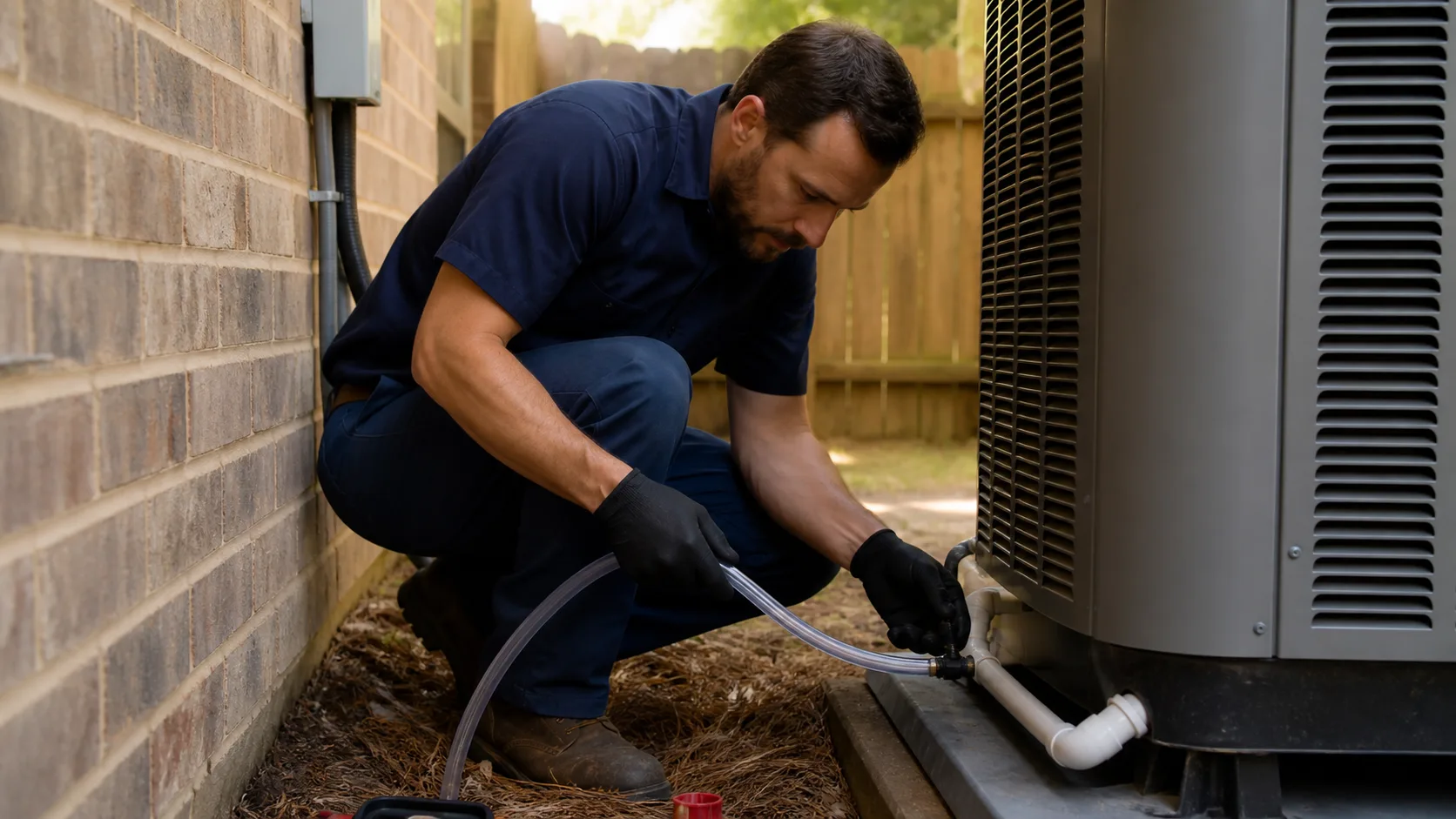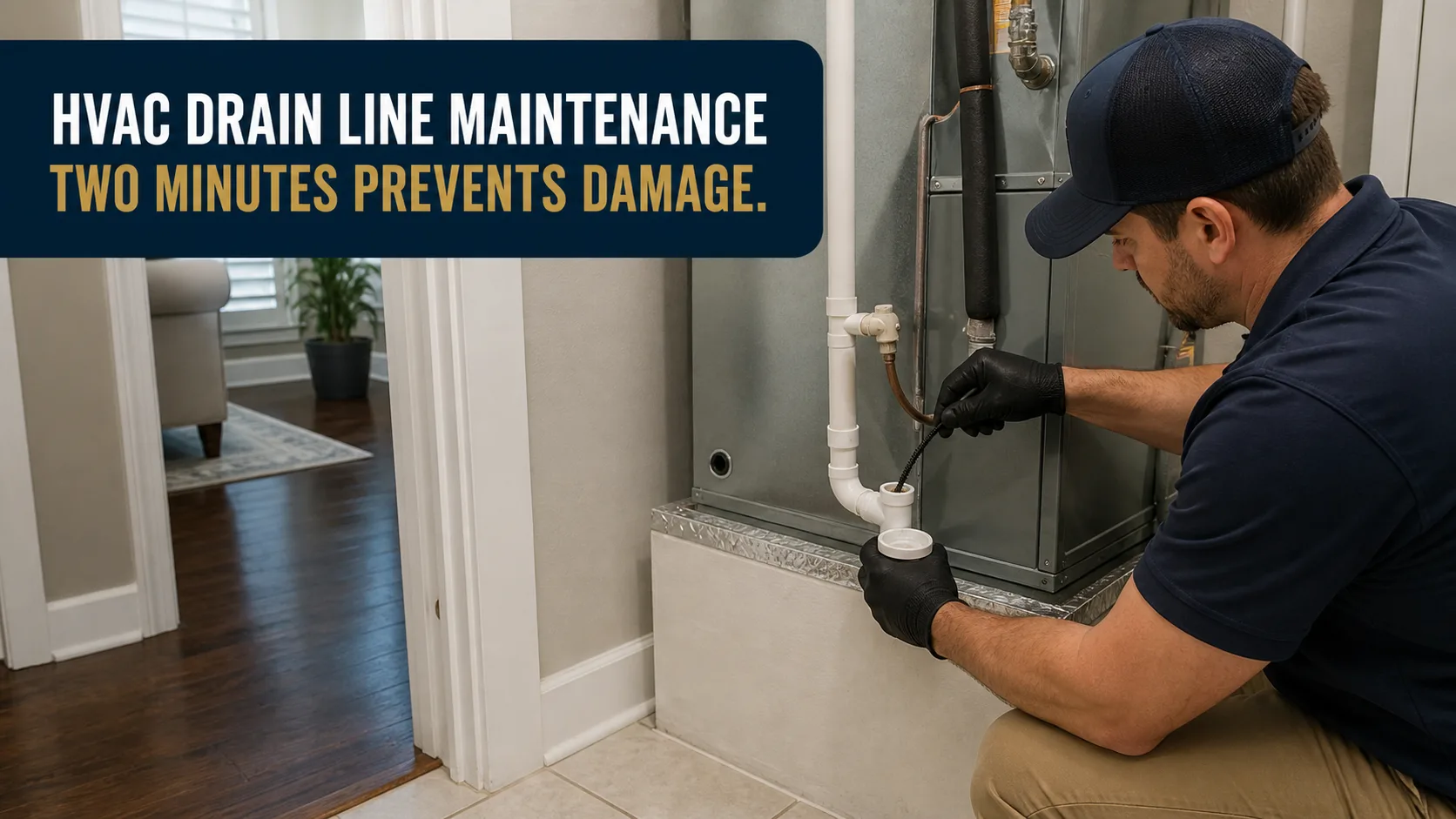
Every 90 days during cooling season, pour a cup of plain white vinegar into the condensate line's cleanout tee near your indoor unit. Once a year, have your HVAC tech clear the line completely, inspect the drain pan for rust, and test both float switches (add them if missing). This routine costs almost nothing and prevents the single most common summer water loss in Texas homes: the attic AC overflowing through the ceiling.
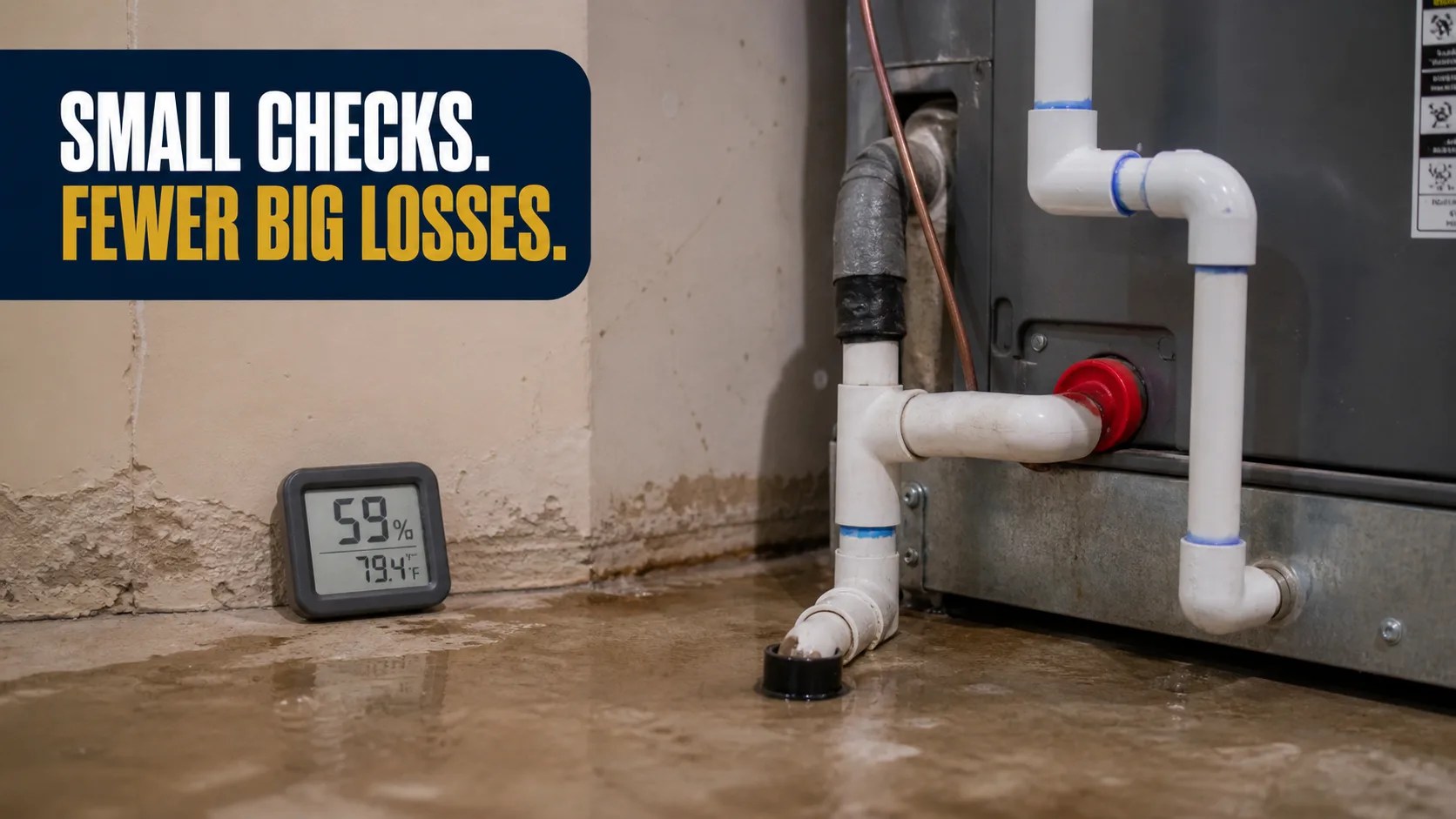
Why Houston runs on a 90-day clock
An air conditioner in a Houston summer is a dehumidifier with a cooling habit — it pulls gallons of water a day out of the air, and every drop leaves through one narrow PVC drain line. That line is dark, warm, and wet from March to November: ideal algae habitat. The biofilm thickens until the line chokes.
Standard maintenance advice says “clean it annually.” That advice was written for climates where the AC runs four months a year. Ours runs eight or nine — so the line earns attention every 90 days, and the math of the routine is absurd in your favor: a cup of vinegar versus a ceiling.
The 90-day flush (the part you do)
- Find the cleanout tee — a capped vertical fitting on the white PVC line near the indoor unit (attic, in most Houston homes).
- Uncap it and pour in about one cup of plain white vinegar. Recap.
- That’s the routine. The vinegar sits in the trap and line, dissolving biofilm before it becomes a clog.
- While you’re up there — thirty extra seconds: glance at the emergency pan under the unit. It should be bone dry. Water, rust rings, or crust in that pan is the early chapter of the overflow story.
No cleanout tee on your line? Put “add a condensate cleanout” on the next service visit — it is a trivial add that makes the next decade of maintenance a two-minute chore.
Set the reminder now: phone calendar, every 90 days, “vinegar down the AC line.” The whole system fails at the remembering step, never the pouring step.
The annual service (the part your tech does)
Once a year — spring, before the load hits (the pre-summer checklist) — the condensate side should get professional attention. Ask for these by name, because “tuned up the system” does not guarantee any of them:
- Clear the primary line end to end — vacuum or nitrogen purge, not just a pour
- Inspect the drain pan — metal pans rust through; plastic pans crack. A pan at end-of-life is an overflow with a date on it
- Test the float switches — trip them manually, confirm the system shuts down
- Confirm the secondary line is open and still terminates somewhere visible
- Check the trap and slope of the drain line — sagging line sections collect sludge
What the routine costs against what the ceiling costs
A gallon of white vinegar is a few dollars and covers a full year of flushes. A pair of float switches fitted during a scheduled visit is usually under $150. Adding a cleanout tee, if your line has none, is a small line on an existing ticket. The annual professional clearing sits inside a tune-up that generally runs $80 to $200. Call the whole program $250 to $400 a year, most of it a visit you were buying anyway.
The failure is not on the same scale. An attic pan that overflows soaks insulation across a wide area, then drywall, then whatever is in the room below. Mitigation alone — containment, extraction, structural drying with daily readings — typically lands in the low-to-mid four figures, and rebuild follows: ceiling drywall, texture, paint, insulation. If the water sat through a Houston August first, add remediation on top.
A cup of vinegar every ninety days against a four-figure minimum. That is the argument.
Check it yourself: the ten-minute attic look
Do this at the same time you pour the vinegar, so it is one trip instead of two.
- Look in the emergency pan. It should be bone dry. Standing water means the primary line has already failed and the pan is doing a job it was never meant to do full time.
- Look for rust rings or mineral crust in the pan. Those are the fingerprints of past overflows, and they date the problem for you.
- Press the pan floor gently at the low corner. Flexing metal, flaking rust or a hairline crack in a plastic pan means the pan is on its last season.
- Lift each float switch by hand and confirm the system actually shuts down. A float switch that does not kill the unit is decoration.
- Follow the drain line with your eyes. Sags between supports collect sludge at the low point and clog there first.
- Check the duct and suction line insulation near the unit. Torn wrap in a 130°F attic sweats and drips all summer, and it reads exactly like a leak.
- Go outside and find the secondary line. Confirm the end is open — not painted shut, not crushed, no wasp nest.
- Photograph the pan and the line with the date stamp on, then write the date on the cleanout cap with a paint marker. Next quarter you will know whether you actually did this.
What wears out, and when it tells you
Nothing in the condensate chain fails loudly. The parts have service lives and the symptoms are specific.
- Drain line: vinegar every 90 days, cleared end to end once a year. The tell is a drip from the secondary line outside — the last free warning you get.
- Emergency pan: inspect annually, roughly 15 to 20 years of life. The tell is rust rings, then a rust-through.
- Float switches: trip-test annually. There is no tell, which is the problem — a dead switch is invisible until the pan fills.
- Condensate pump, where fitted: test annually, typically 3 to 5 years. The tell is a pan filling while the system keeps cooling.
- Air handler: 12 to 15 years in this climate, after which every item above happens at once.
And the symptom that means stop reading and act: a stain on the ceiling below the unit. A flashlight held flat against the ceiling shows discoloration that overhead lamps hide.
Float switches: the $20 insurance policy
If your air handler is in the attic, float switches are not optional equipment — they are the only thing standing between “the AC quit, annoying” and “the ceiling is coming down.” You want two:
- Primary line switch (inline): cuts the system when the primary drain backs up
- Pan switch: cuts the system when water reaches the emergency pan — the last line of defense
Both installed, both tested annually. If your system has neither, that is the first phone call this guide should generate.
The failure timeline (what skipping this buys)
Month 1–6 of a neglected line: biofilm builds silently. Then the primary clogs — no symptom yet, the secondary line takes over. The drip over the window starts: this is the last free warning. Weeks later the secondary clogs the same way, the pan fills, and the pan either overflows or rust-throughs. Then it is drywall, insulation, and a mitigation job — in the middle of a Houston August, when every HVAC company is booked two weeks out.
Every step of that timeline is interruptible with a cup of vinegar.
The insurance line runs straight through this page
Carriers sort AC water losses by speed, not by volume.
A pan that overflows and drops a ceiling in an afternoon is a sudden and accidental discharge, and it is generally covered. A drain line that seeped into a wall cavity for four months is gradual damage, excluded on almost every homeowners form in Texas. Same equipment, same water, opposite outcome — and the thing that decides which one you had is how long it ran before anyone looked.
That makes the maintenance record part of the coverage. Keep the tune-up invoices. Photograph the pan each quarter with the date stamp on. Write flush dates on the cleanout cap. If a claim ever turns on when the leak started, those are the only documents that answer it. The coverage picture is in does insurance cover water damage, and what happens when the answer comes back wrong is in water damage claim denied.
The Houston calendar for a condensate line
- March. First flush of the year, as the system starts working again.
- April. The professional visit and the full pre-summer checklist.
- June. Second flush, in the heart of the load.
- September. Third flush, while the system is still pulling gallons a day out of the air.
- December. Fourth flush, before the line sits damp and idle through winter — which is exactly when the biofilm that clogs it in June gets established.
- First of every month, June through September. Ninety seconds: secondary line dripping? Ceiling below staining?
While you are up there: the attic fire check
The air handler is not the only thing in that attic worth two minutes, and the other risks are the ones nobody looks at until they are a fire.
- The furnace side. If the same cabinet houses a gas furnace, keep the area around it clear of stored boxes and stray insulation batts. Look at the flue where it passes through the roof — a disconnected or rusted-through section is a carbon monoxide problem before it is anything else, and it is an HVAC contractor’s repair.
- Junction boxes and old wiring. Every splice in an attic belongs inside a covered box. Loose wire nuts hanging in the insulation, cloth-insulated conductors, or original 1960s and 70s branch wiring — common in southeast Houston stock — go to a licensed electrician. See electrical fire damage.
- Recessed can lights. Older non-IC-rated cans are not rated for insulation contact. Keep insulation pulled back unless the fixture is marked IC.
- Storage. Nothing flammable — paint, solvents, fuel — belongs in a 130°F attic.
Do not work on gas connections, flues or wiring yourself. Look, photograph, and hand the photos to the right trade.
If you’re reading this too late
Water already at the pan, dripping from the secondary, or marking the ceiling? The maintenance chapter is over — start here instead: secondary drain leak or pan overflow. Ceiling staining means the cavity above it needs a moisture reading before it becomes a mold question: (346) 271-7004, photo first, straight answer back.
Where we fit, and where we don’t
TruePoint Restoration does not service air conditioners. We do not clear condensate lines, fit float switches, replace pans, repair flues or charge refrigerant — every item on the annual list above belongs to a licensed HVAC contractor. We do not do electrical work and we do not rebuild ceilings.
What we do is the water once it is in the structure: extraction, containment, structural drying with logged daily moisture readings, mold remediation when it sat, and smoke and soot cleanup on the fire side. We work out of Pearland and cover Manvel, Friendswood, League City, Pasadena and the Greater Houston area. (346) 271-7004.