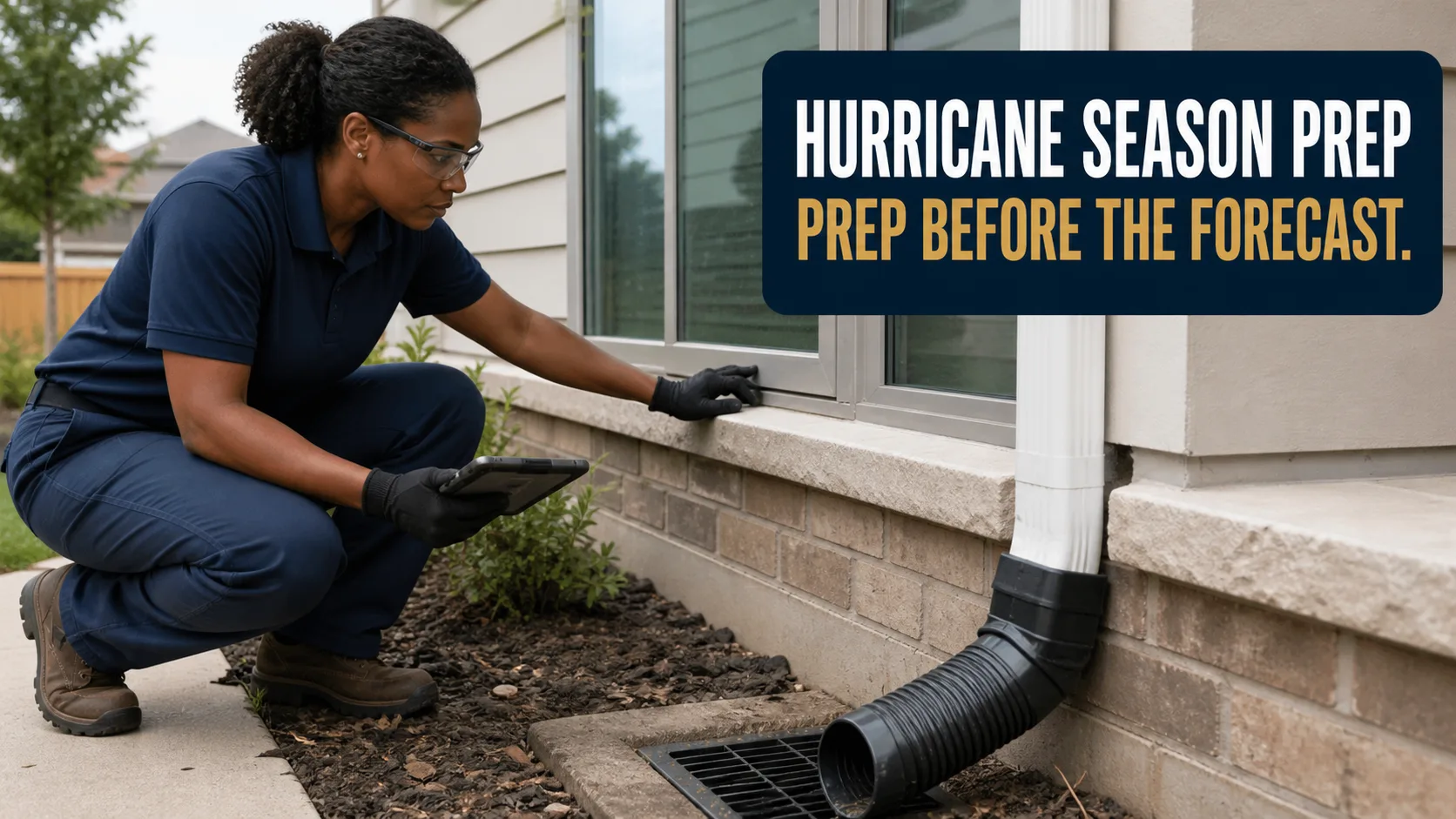
Hurricane season runs **June through November** (peak Aug–Oct). Prepare *before* a storm is named: clear gutters and yard drains, trim trees off the roof, repair loose shingles and flashing, and know where your water main shut-off is. Just as important, confirm your coverage — **wind-driven rain** through a storm-damaged roof is usually homeowners, but **flooding from outside** needs a separate flood policy that often has a waiting period. If a storm does get water in, call **(346) 271-7004** fast; mold starts within 24–48 hours here.

The two water threats, and why they’re covered differently
A hurricane threatens your home with water two ways, and your insurance treats them very differently:
- Wind and roof intrusion — wind lifts shingles and cracks flashing; rain then pours into the attic and ceilings. Wind-driven rain through storm-damaged roofing is commonly covered by homeowners.
- Flooding from outside — storm surge and rising water from overwhelmed bayous and streets. This is excluded from homeowners and covered only by a separate flood policy.
Confirm both before the season. And note: flood policies frequently have a waiting period before they take effect, so buying one as a storm approaches usually won’t help for that storm. Details on the coverage line: does insurance cover water damage.
The 30-day waiting period is the whole game
An NFIP flood policy takes effect 30 days after you buy it. Read that sentence again in September, with the cone pointed at Galveston Bay and every neighbor asking the same question, and it means exactly what it says — you are not getting covered for this storm.
The exceptions are narrow — a policy written at a loan closing, a handful of map changes — and none of them help a homeowner who woke up worried. Private flood carriers usually carry a waiting period of their own.
So the date that matters is not June 1. It is the end of April. Buy then and the policy is in force when the season opens.
Then read the flood policy you already have. Check the building limit, the contents limit, and whether contents are covered at all — NFIP writes those as separate coverages, and homeowners find out at the worst hour that the building was insured and the furniture was not.
Before-the-season checklist
- Clear gutters, downspouts, and yard/area drains so water moves away from the house.
- Trim trees away from the roof; remove dead limbs that become projectiles.
- Inspect and repair the roof — shingles, flashing, and vent boots are the common failure points.
- Know your water main shut-off and make sure it turns.
- Photograph your home’s condition now — a dated “before” record helps any future claim.
- Confirm homeowners and flood coverage. Don’t assume; read the policy.
The Houston calendar, month by month
The season runs June 1 through November 30, and the risk inside it is not flat — peak activity is August and September. That gives the year a usable shape.
- February–March. Book the roof inspection and the AC tune-up while those companies still answer the phone.
- April. Buy or renew flood coverage. Photograph the house inside and out.
- May. Clear gutters, downspouts and yard drains. Trim limbs off the roof. Run the generator under load for fifteen minutes.
- June–July. Fix whatever the spring check flagged. Watch the tropics.
- August–September. The peak. Yard clear, fuel fresh, phone charged.
- October–November. Late-season storms still land here. Do not stand down early.
- December–February. Freeze season, using the same shutoff valve you located in May — the freeze checklist picks up where this one stops.
Check it yourself: the pre-June walk
Two hours on a Saturday, with no ladder work you are not comfortable doing.
- Walk the perimeter and watch the ground. Soil should fall away from the foundation everywhere. Note any spot where mulch or dirt has built up against the slab.
- Put a hose in every downspout. Water should come out the far end of the extension. A blocked downspout dumps a roof’s worth of rain at one corner.
- Pour a bucket into each yard drain. It should disappear. Standing water means the line is silted and needs rodding before the season.
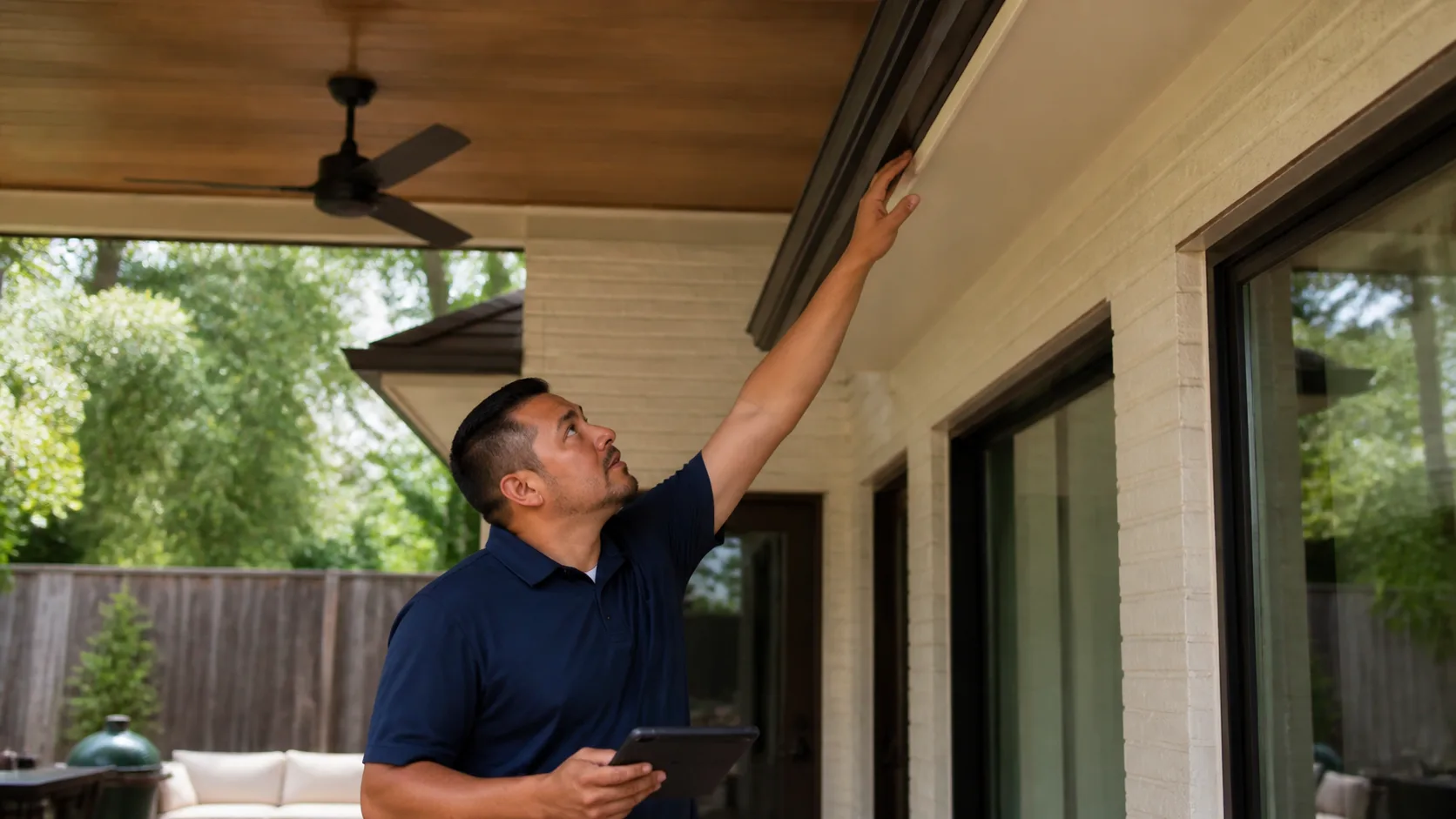
- Look at the roof from the ground with binoculars — lifted shingles, bare granules, cracked boots around vent pipes, rusted flashing at the chimney. Do not get on the roof. Anything you can see from below goes to a licensed roofer.
- Open and close the main water shutoff. A gate valve that has not turned in fifteen years often will not close on the night it matters.
- Photograph every room and every exterior wall with the date stamp on, then email the album out of the house. A dated “before” record ends the pre-existing-damage argument in about thirty seconds.
That last step is the one homeowners skip and the one adjusters ask about.
When a storm is actually coming
- Bring in or secure loose outdoor items.
- Clear the yard drains one more time.
- Service the generator and charge devices.
- Move valuables and documents up off the floor.
Generators, grills, and the fires that follow the storm
Water is not the only thing that damages houses after a hurricane. The days after a Gulf Coast storm produce a predictable run of fires, and they come from the same three places every time.
Generators. Outside only, at least twenty feet from the house, exhaust pointed away from windows, doors and the AC return. Never in a garage, not with the door open, not under a carport. Refuel with the engine off and cool — gasoline hitting a hot exhaust manifold is how these start.
Extension cords. Heavy outdoor-rated cord, sized for the load, run in one length with no daisy-chaining, never under a rug. An undersized cord carrying a refrigerator and a window unit heats along its whole length.
Open flame. Battery lanterns, not candles. Charcoal and propane grills stay outside and ten feet off the house, never under a covered patio or an eave.
Check the date on every smoke alarm before the season starts. They expire ten years from the manufacture date printed on the back, and you replace the whole unit rather than the battery. Carbon monoxide alarms run five to seven years, and after a storm they earn their keep — a generator running too close to the house is the exact scenario they exist for. If a fire does happen, the first steps are here.
After the storm
If water gets in, treat storm floodwater as contaminated, document everything before you remove anything, and call for professional extraction and drying immediately. The full after-storm playbook is here: hurricane & storm flooding in Houston.
What the prep costs against what the water costs
The arithmetic here is not close.
- Gutter and downspout clearing: a Saturday, or a couple of hundred dollars hired out.
- Trimming limbs off the roofline: a few hundred to a low four figures, depending on the tree.
- Repairing lifted shingles and cracked vent boots: usually hundreds, on the day you catch them.
- A flood policy outside a high-risk zone: a few hundred dollars a year.
- A dated photo album of the house: free.
Against that, a storm that gets water inside a Houston house means extraction, structural drying, and usually removal of soaked drywall and insulation — a five-figure event on the mitigation side alone, before anyone rebuilds anything. The drying timeline is the part homeowners underestimate most, because a wet wall cavity in Gulf Coast humidity does not dry on its own schedule.
Whether your carrier cares that you did the maintenance
They do, and it shows up as the denial you never receive rather than as a discount. Every homeowners policy asks you to maintain the property, and a roof that failed because shingles had been lifting for two seasons is the carrier’s favorite argument. The answer is a dated record — the roofer’s invoice, the April photographs, the gutter receipt. That is the line between a covered sudden loss and a gradual-damage exclusion, and the exclusion is where storm claims go to die.
Ask your agent two questions before June. Does the policy carry a separate windstorm or named-storm deductible, and is it a percentage of the dwelling limit rather than a flat figure? On the Texas coast it usually is, and a percentage on a large storm is a bigger number than homeowners expect. Second, does it pay replacement cost or actual cash value on the roof? Many Texas policies have moved roofs to actual cash value.
The bottom line
Hurricane water damage is one of the few disasters you can meaningfully prepare for. An afternoon of maintenance and one honest look at your coverage — done before the season, not during a warning — is what separates a manageable loss from a catastrophic one.
Where we fit, and where we don’t
TruePoint Restoration is a mitigation company. We extract water, dry structures with logged daily moisture readings, remediate mold, and clean smoke and soot. We do not put on roofs, repair plumbing, service HVAC systems, do electrical work, or rebuild what has to come out. Before a storm the trades you want are a licensed roofer, a licensed plumber and an HVAC contractor — and for a limb over the roof, an insured arborist rather than a ladder and a chainsaw.
After the storm we handle the inside. If water is already in your house, call (346) 271-7004. We work out of Pearland and cover Manvel, Friendswood, League City, Pasadena and the Greater Houston area.