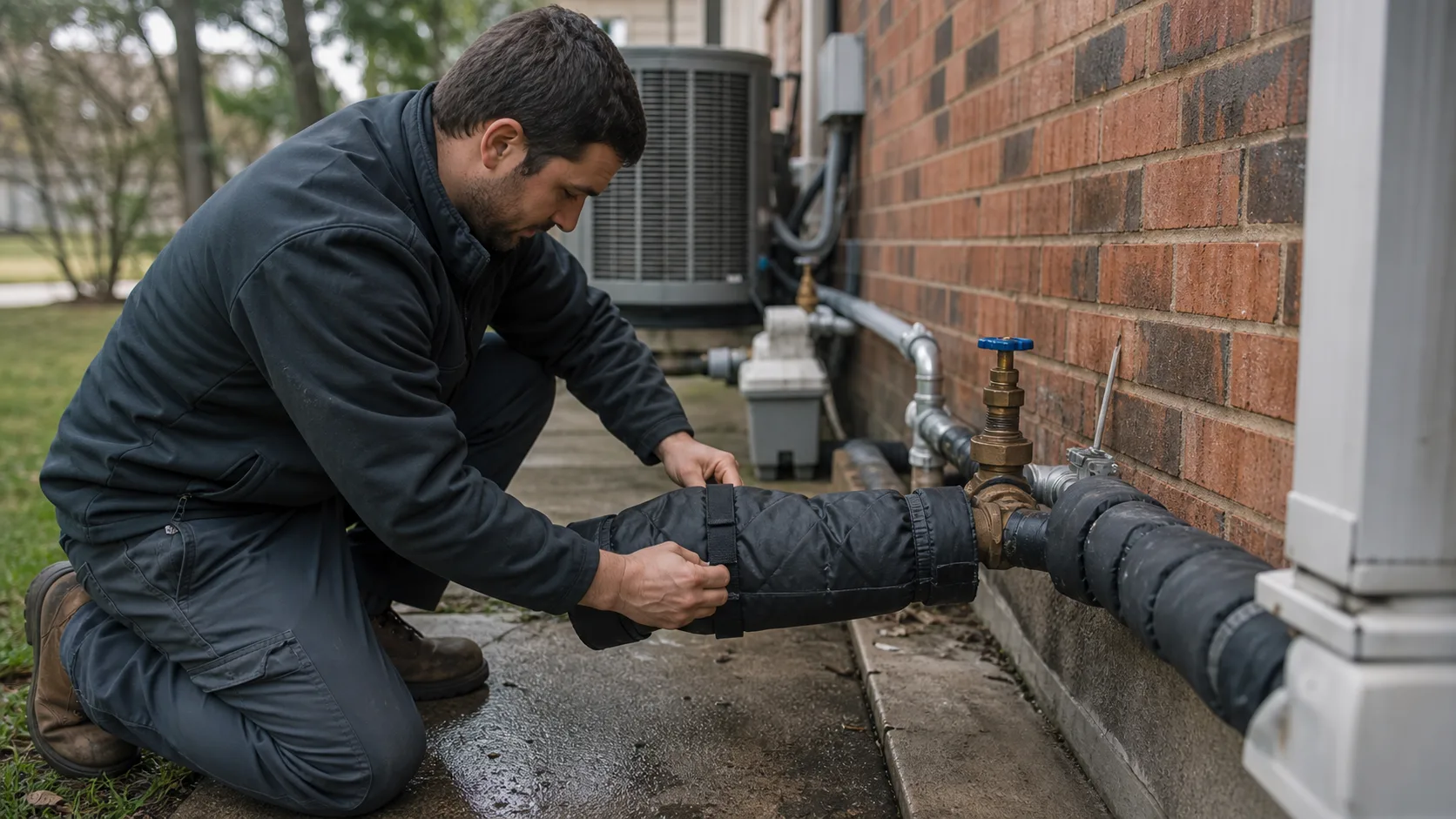
Texas homes route water lines through uninsulated attics, exterior walls, and garages, so Houston pipes freeze in conditions a northern home would ignore. Start protecting them when a **hard freeze below ~20°F** is forecast: **drip your faucets**, open cabinet doors under exterior-wall sinks, disconnect and drain hoses, insulate exposed pipes, and **keep the heat on even if you leave**. Know where your main shut-off is. If one bursts anyway, shut the main and call **(346) 271-7004** — a burst runs at full pressure until it's stopped.
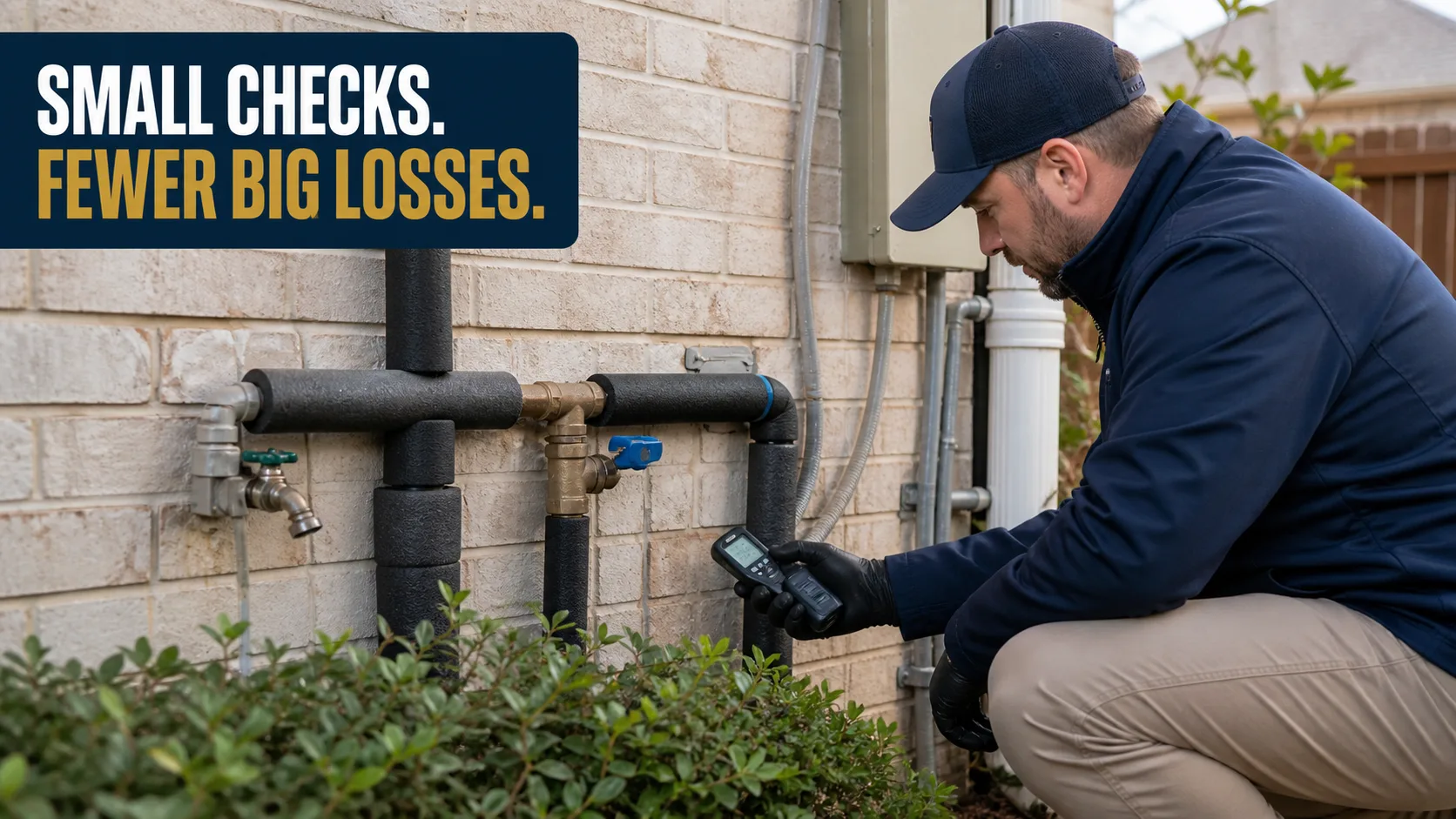
Why Houston pipes are so vulnerable
Winter Storm Uri in February 2021 burst pipes across the entire region at once — not because Texas got colder than the north, but because Texas homes aren’t built for cold. Water lines here run through uninsulated attics, exterior walls, and garages that building practice in cold states would never allow. Water expands about 9% when it freezes; in a closed pipe, that pressure builds until the pipe splits — and when it thaws, it pours. Prevention is far cheaper than the aftermath.
Before the freeze
- Drip your faucets — especially those on exterior walls and farthest from the water main. Moving water resists freezing.
- Open cabinet doors under sinks on exterior walls so heated air reaches the pipes.
- Disconnect and drain outdoor hoses; cover spigots with insulated covers.
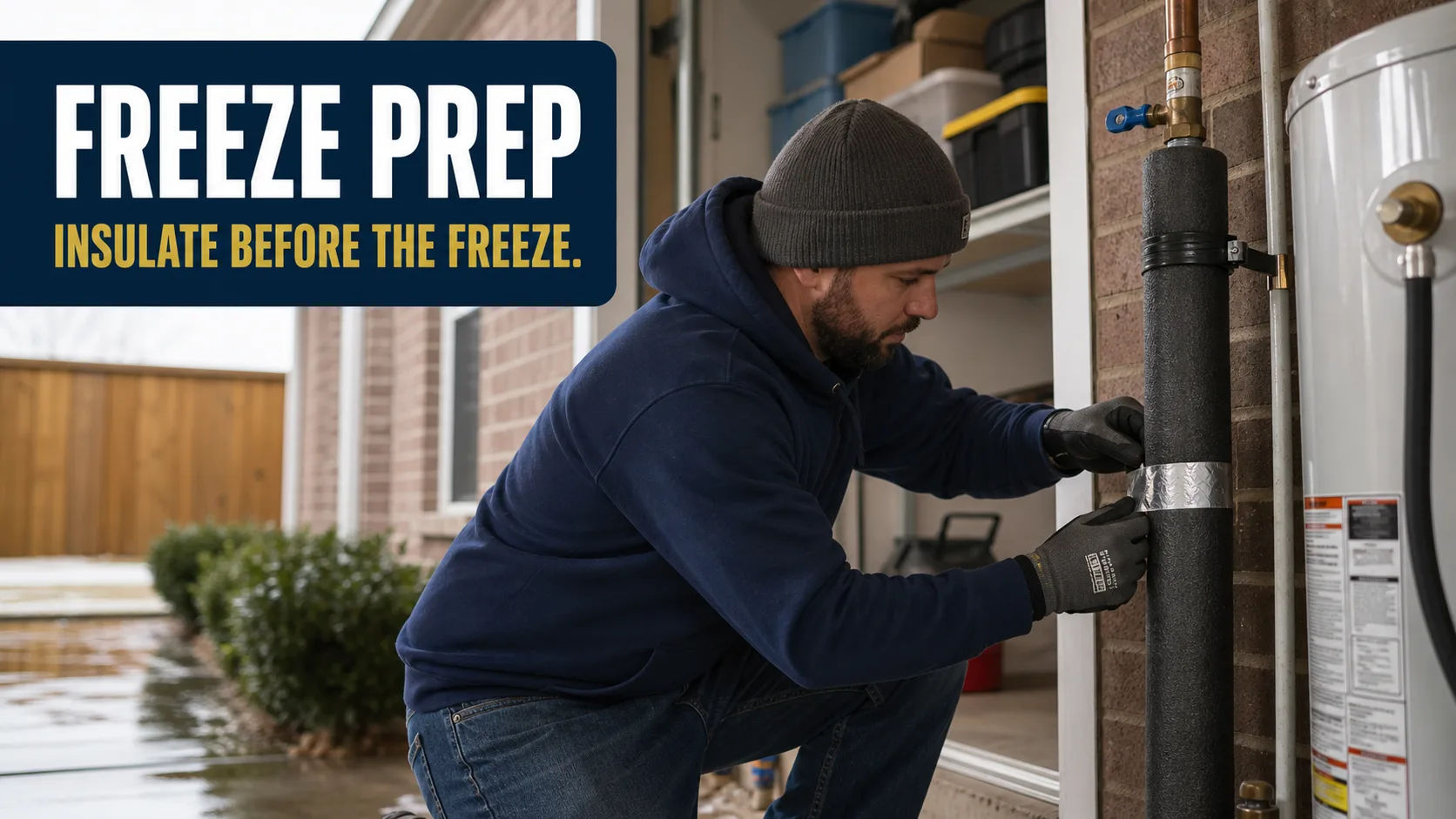
- Insulate exposed pipes in the attic and garage with foam sleeves.
- Keep the house heated — even when you’re away. Unheated homes are where the worst bursts happen (and where insurers ask questions).
- Find your main shut-off and confirm it turns.
The irrigation backflow preventer breaks first
Across Pearland, Friendswood, Sugar Land and Manvel, the most common casualty of a hard freeze is not a pipe in the attic. It is the backflow preventer on the sprinkler system — the brass assembly standing above ground against an exterior wall or out in the yard.
The reason is mechanical. That brass body holds standing water even when the system is off, it sits fully exposed, and brass has no give in it. The water freezes, expands, and splits the casting. Then the thaw arrives and the assembly runs at full main pressure into your flower bed, your foundation, or your garage wall — often for hours, because nothing inside the house misbehaves.
Handle it in one visit each November: close the irrigation isolation valve, open the two test cocks with a flathead so the brass body drains, wrap the assembly in an insulated cover without sealing the vent openings, and set the controller to off rather than to a rain delay. A system that runs during a freeze sheets your driveway and the street in ice.
If the assembly has already split, an irrigation contractor or a licensed plumber replaces it. That is not our work and it is not a homeowner repair — backflow assemblies are tested, certified equipment in most jurisdictions.
Check it yourself: the November hour
Do this once a year, before the first cold front, and the freeze forecast stops being an emergency.
- Turn the main shutoff fully closed, then open. A gate valve that has not moved in a decade often will not close when you need it, and replacing it now costs a fraction of what discovering it costs.
- Walk the attic with a flashlight and photograph every water line you can see. Those are the runs that need sleeves, and the photos tell you where to go in the dark.
- Sleeve every exposed run in the attic and garage — foam insulation, taped at the seams, no bare gaps at elbows. Elbows are where they split.
- Disconnect every hose, drain it, fit an insulated cover on each bib, and winterize the irrigation assembly using the steps above.
- Check the water heater’s pan and connectors while you are up there — a freeze finds the weakest fitting, and connector age decides which one that is.
- Photograph the finished work with the date stamp on, then write the year on the foam with a paint marker. Next November you will know whether you did this or only meant to.
If a pipe freezes but hasn’t burst
- Open the faucet it feeds so melting water can escape.
- Warm the frozen section gently — hair dryer or space heater, starting near the faucet end. Never an open flame.
- Can’t reach it, or it’s in a wall? Shut the main and call a plumber before it splits.
Space heaters and the winter fire spike
A hard freeze in Houston produces two kinds of loss, and the second gets almost no attention here. When the furnace cannot hold the house, people pull out cheap portable heaters and run them in ways the manual forbids. That is the seasonal jump in house fires, and it lands in the same 48 hours as the burst pipes.
The rules are short and not negotiable:
- Three feet of clear space on every side. Not near bedding, curtains, upholstery, or a stack of laundry.
- Straight into a wall outlet. No extension cord, no power strip, no adapter. A 1,500-watt heater on a light-duty cord heats the cord, not just the room.
- Buy one with a tip-over shutoff and an overheat cutout, and test the tip-over switch when you unbox it.
- Off when you sleep, off when you leave the room. Overnight bedroom use is the most common fatal pattern.
- Never a gas range or an oven for heat. That is a carbon monoxide event, not a heating strategy.
Freeze week is also the week to check the alarms. Smoke alarms expire ten years from the manufacture date printed on the back — you replace the unit, not the battery — and carbon monoxide alarms run five to seven years. If a fireplace is part of your cold-weather plan, have the chimney swept by a certified sweep before you light it. What follows a fire is on electrical fire damage and what to do after a house fire.
If it bursts
Shut off the water at the main immediately, cut power near any standing water, and start extraction — then call for drying. The full first-hour steps are here: a pipe just burst: what to do, and the Houston-specific freeze details are in frozen pipes in Houston.
What the prep costs against what a burst costs
Foam pipe sleeves run a few dollars per six-foot length, and insulated bib covers a few dollars each. Wrapping every exposed run in a typical Houston attic is usually under $100 in materials and one afternoon. A plumber doing the same work properly — attic runs, hose bibs, water heater lines, irrigation assembly — generally runs a few hundred dollars.
Now the other side. One half-inch supply line that splits in the attic and runs for three hours puts hundreds of gallons through insulation, ceilings and flooring. Between mitigation, rebuild and your deductible, those losses commonly land between $8,000 and $25,000 — and during a regional freeze the timeline stretches, because every plumber and every drying crew is booked at once. In February 2021 the wait for either trade ran into weeks.
The asymmetry is roughly a hundred to one, and the work lasts for years.
The Houston freeze calendar
Freezes here are rare, short, and regionally simultaneous — which is exactly why they do so much damage. Every failure happens in the same 48 hours, so every phone rings at once.
- November. The one-hour walk above. Sleeve the attic runs, winterize the irrigation, cover the bibs, exercise the main.
- December through February. The window. Act on the forecast, not the thermometer.
- The night itself. Drip the taps on the north and exterior walls. Open the cabinet doors beneath those sinks. Keep the heat at 55°F or higher even if you leave.
- The thaw, 24 to 72 hours later. Stay home for it. The ice plug seals the split while everything is frozen, so most bursts only start running after temperatures climb back above 32°F. Walk the attic, check ceilings for stains or sagging, and listen for running water with every fixture closed.
- March. Reopen the irrigation, close the test cocks, and run one zone at a time watching for geysers.
The coverage note
A burst frozen pipe is generally a covered sudden loss in Texas if you kept the home heated. A vacant, unheated house is the scenario insurers push back on. So during a freeze, leaving some heat on isn’t just comfort — it’s what keeps your claim clean. More: does insurance cover water damage.
Carriers do care that you did the maintenance, and they show it procedurally rather than financially. A dated photograph of sleeved attic lines, a receipt for the plumber who winterized the irrigation, and a thermostat you can show was running — those turn “sudden and accidental” from an argument into a fact. The counter-argument, when there is one, is gradual damage or poor maintenance, and documentation is the only thing that answers it. Keep the split section of pipe as well; a part that failed inside its warranty becomes a subrogation target, and your deductible can come back with it.
Where we fit, and where we don’t
TruePoint Restoration does not repair pipes. We do not thaw lines, cut and solder, replace backflow preventers, or service furnaces — those belong to a licensed plumber, an irrigation contractor and an HVAC contractor, and during a freeze week you want to be in all three queues early. Anything involving a gas appliance, an electrical panel, or standing water near a live circuit stops being a homeowner job entirely.
What we handle is what came out of the pipe: extraction, structural drying with daily logged moisture readings, mold remediation when the water sat, and smoke and soot cleanup when a heater or a flue was the cause instead. If a line has already let go, shut the main yourself first — that is faster than any phone call — then call (346) 271-7004. We work out of Pearland and cover Manvel, Friendswood, League City, Pasadena and the Greater Houston area.