Restoration · August 15, 2026

Frozen Pipes in Houston: A Bigger Risk Here Than People Think

Why Houston pipes freeze and burst more easily than up north, at what temperature Texas pipes freeze, what to do when one bursts, and whether insurance covers it. Post-Winter-Storm-Uri guide.

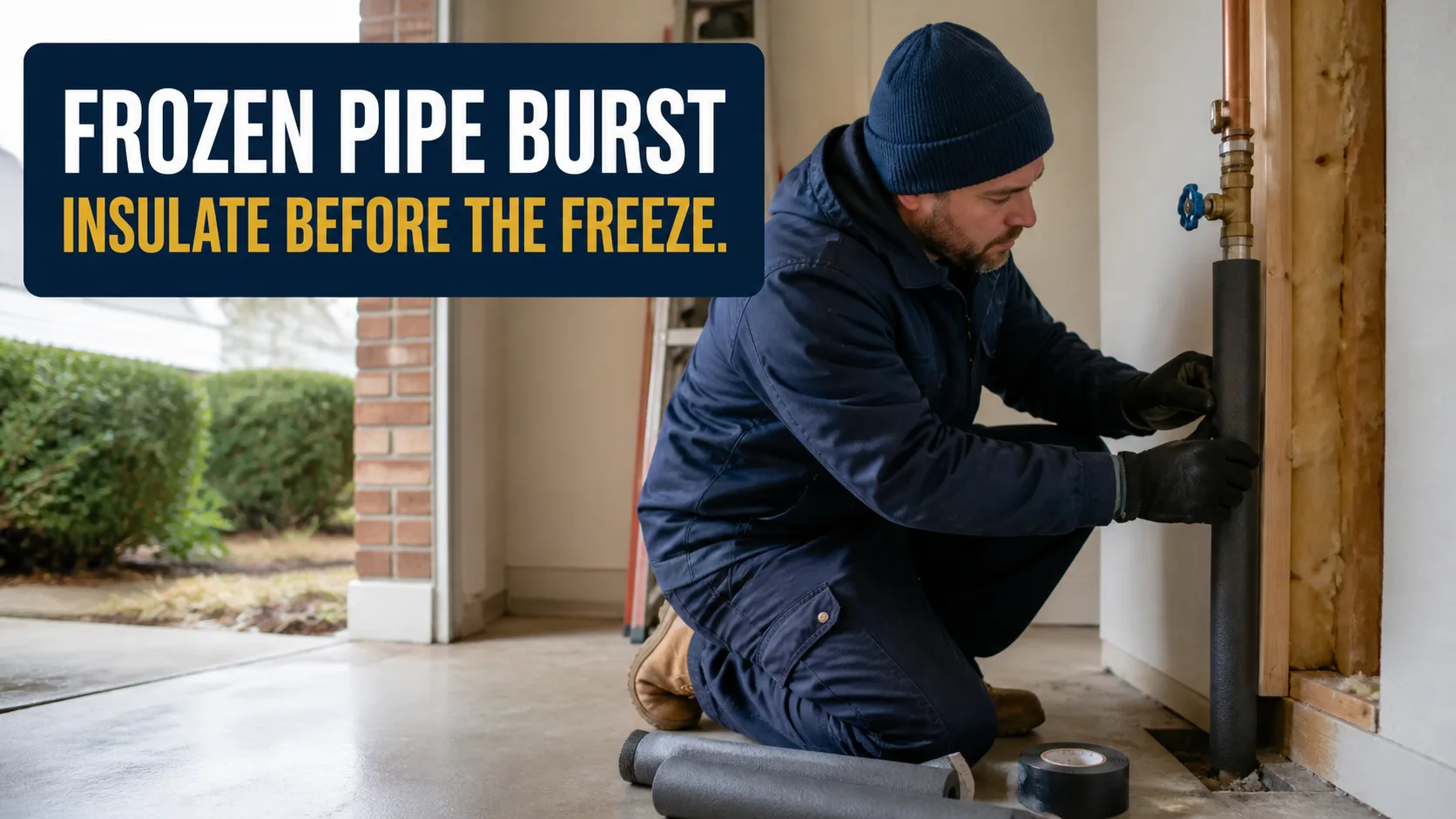
A technician wearing a blue jacket and beanie kneels to insulate a copper pipe in a garage, with a roll of black tape and pipe insulation on the concrete floor. Caption on image: FROZEN PIPE BURST INSULATE BEFORE THE FREEZE.
The short answer

Houston pipes freeze more easily than northern ones not because it gets colder, but because Texas homes aren't built for cold — water lines run through uninsulated attics and exterior walls. Pipes are at risk below about **20°F**. If one bursts, shut off the water at the main immediately, cut power near any standing water, open faucets to relieve pressure, and start extraction. Insurance generally covers it if you kept the home heated. Call **(346) 271-7004** for drying before mold starts.
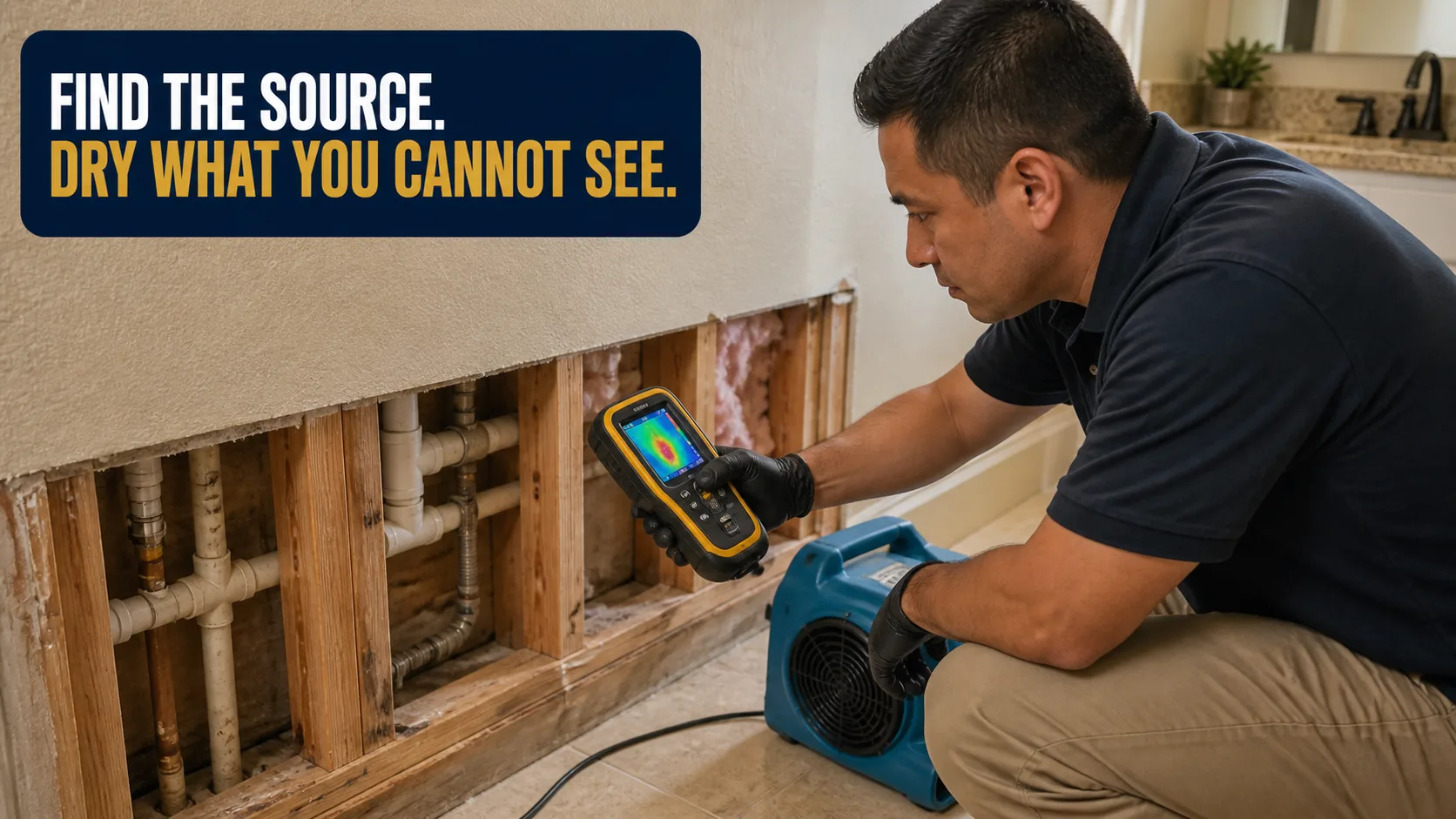
A technician wearing black gloves uses a thermal imaging camera to inspect exposed pipes and insulation in a wall, with a blue air mover on the floor. Caption on image: FIND THE SOURCE. DRY WHAT YOU CANNOT SEE.

Why a Houston freeze is so destructive

In February 2021, Winter Storm Uri froze and burst pipes across the entire Texas region at the same time — and it wasn’t because Texas got colder than Minnesota. It’s that Texas homes are engineered for 100°F summers, not hard freezes. Water lines here are commonly run through uninsulated attics, exterior walls, and unconditioned garages — placements that building practice in cold states would never allow. So a freeze that a northern home shrugs off can burst pipes all over a Houston neighborhood in a single night.

Water expands about 9% when it freezes. In a closed pipe, that expansion has nowhere to go, so pressure builds until the pipe splits — and then, when it thaws, it pours.

Before a freeze: protect the pipes

  • Drip your faucets. Moving water is far harder to freeze; a slow trickle on the coldest lines helps.
  • Open cabinet doors under sinks on exterior walls so heated room air reaches the pipes.
  • Disconnect and drain outdoor hoses, and cover exterior spigots with insulated covers.
  • Insulate exposed pipes in the attic and garage with foam sleeves.
  • Keep the heat on — even if you leave town. A cold, unheated house is where the worst bursts happen (and where insurers ask questions).
  • Find your main shut-off now so you can stop a burst in seconds, not minutes.

Warning signs during and after a freeze

The dangerous part of a Texas freeze is not the night it happens. It is the thaw, and the week after.

A line is frozen right now:

  • One fixture down to a trickle while the rest of the house runs normally
  • Frost or condensation on an exposed pipe run in the garage or under a sink
  • A toilet that will not refill, or a washer that fills on one side only

A line already split and you have not seen it yet:

  • Water pressure that came back weaker than it was
  • A hissing or running sound in a wall or ceiling with every tap closed
  • The water meter still counting with the whole house shut down
  • A ceiling stain that appears a day or two after the thaw, because the split is in an attic run over the garage

The freeze created a second hazard: space heaters, extension cords, and generators all running at once on circuits never sized for continuous load. A hot-plastic or fishy smell with no visible source is heated wire insulation, and that is an electrical fire starting rather than a nuisance.

If a pipe freezes but hasn’t burst yet

  1. Open the faucet it feeds so melting water has somewhere to go.
  2. Warm the frozen section gently — hair dryer or space heater, starting near the faucet end. Never an open flame.
  3. Can’t reach it, or it’s in a wall? Shut the main and call a plumber before it splits.

If it bursts

  1. Main water off — first, always.
  2. Power off near any standing water at outlets.
  3. Relieve pressure by opening faucets.
  4. Extract and lift belongings; photograph everything for the claim.
  5. Call for drying. A burst runs at full pressure and spreads fast — here’s the full first-hour burst-pipe checklist. (346) 271-7004.

What to check when the water comes back on

Do this before you leave the house on the first normal day, because most freeze losses are found late.

  1. Turn the main on slowly and stand at the meter. Watch the low-flow indicator with every fixture closed. Movement means a split somewhere.
  2. Walk every fixture in turn — every faucet, every toilet, the washer, the outside spigots. Pressure that comes back weak at one point is a clue, not a coincidence.
  3. Open the attic hatch and look at the plumbing runs, especially anything over the garage or a hallway. Attic lines are the first to freeze here and the last to be inspected.
  4. Check the water heater pan and the washer box. Both catch what a split above them drops.
  5. Listen with the house silent. A running sound with everything closed is water leaving the system.
  6. Photograph anything wet with the date stamp on, including the meter reading, before you clean or move anything.

What a burst-pipe dry-out costs

Two invoices again — the plumber’s repair and the mitigation — and only the second one is ours.

  • How long it ran. A split that let go while you were asleep or out of town is the whole difference between a room and a floor plan. Volume, not pressure, is the cost driver.
  • Where it ran. An attic split soaks insulation, ceilings, and everything below. A wall split soaks the cavity, the plate, and the flooring on both sides.
  • What has to come out. Wet attic insulation, saturated drywall, and carpet pad are removed rather than dried. Framing and subfloor are dried in place.
  • Equipment days, which Gulf Coast humidity adds to.
  • Regional demand. After a statewide freeze every plumber and every mitigation crew in Texas is booked the same week, and that is a real schedule cost even when it is not a line item.

The residential pricing structure is in what mitigation costs in Houston.

How long it takes

Three to five days for a contained clean-water dry-out caught the same day. Five to ten once a ceiling, an attic, or a wall cavity is involved and the insulation has to come out. Longer again after a regional freeze, because the plumbing repair has to happen before the drying finishes and the plumber may be days out.

Readings decide, not the calendar. Framing, subfloor and the bottom of the drywall get metered daily until they reach dry standard. A pipe repair is not the end of the loss — what actually sets a drying timeline is the water that is already in the structure.

The insurance angle

A burst frozen pipe is generally a covered sudden loss in Texas — as long as you took reasonable care to keep the home heated. The scenario insurers push back on is a vacant or unheated house, which can be treated as a maintenance failure. So during a freeze, leaving some heat on isn’t just about comfort; it’s what keeps your claim clean. More on coverage: does insurance cover water damage.

The free things worth doing tonight

  1. Find the main shut-off and turn it once, both directions, so you know it moves before you need it to.
  2. Put a meter key or a wrench with it, in a place everyone in the house knows.
  3. Photograph your thermostat set point during a freeze. A dated photo showing the heat on is the cheapest answer to the question a carrier asks about an unheated house.
  4. Keep space heaters off extension cords, one per circuit, nothing on a power strip.
  5. Read the freeze preparation list in Texas freeze pipe prevention before the next front, not during it.

Where the plumber ends and we begin

TruePoint Restoration is not a plumbing company. We do not thaw pipes, locate splits, cut and solder, re-pipe an attic, or pull plumbing permits, and we are not a public adjuster. On a freeze loss those calls run in parallel with ours rather than in sequence — the plumber stops the water, and the water already in your ceiling starts growing things on its own schedule.

Our part is everything the water touched: extraction, removal of wet attic insulation and saturated drywall, opening and drying wall and ceiling cavities, structural drying with logged daily readings, mold remediation if it sat long enough to start, and a documented file — source, affected materials, daily readings, disposal records — that your adjuster works from. After a regional freeze that file matters more than usual, because carriers process thousands of near-identical claims and the well-documented ones move first.

Call (346) 271-7004. We work out of Pearland and serve Manvel, Friendswood, League City, Pasadena, Sugar Land and the Greater Houston area.
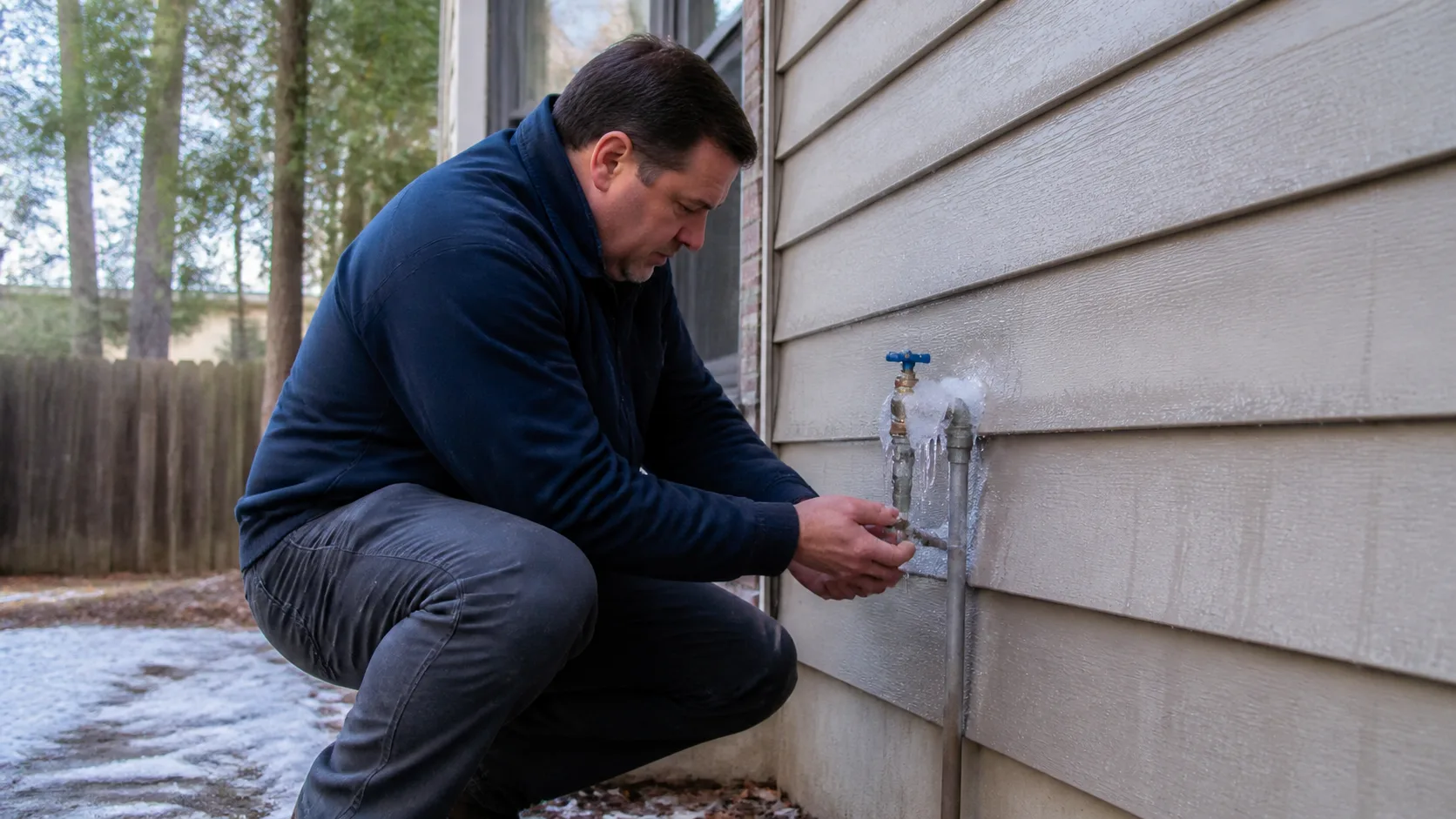
A homeowner crouches down, inspecting a frozen outdoor water spigot and pipes on the side of a house, with ice visible on the fixtures and ground.
Questions, answered

Frozen Pipe Questions

At what temperature do pipes freeze in Texas?
Pipes are generally at risk once the temperature drops below about 20°F (-6°C), and sooner for pipes in unprotected spots like attics, exterior walls, and unheated garages. In Texas the danger is less about how cold it gets and more about how unprepared homes are — pipes are often run through uninsulated attics and exterior walls that would never be allowed in colder states.
Why do pipes freeze so easily in Texas?
Because Texas homes are built for heat, not cold. Water lines are frequently routed through uninsulated attics, exterior walls, and unconditioned spaces, and homeowners aren't used to protecting them. So when a hard freeze hits — like Winter Storm Uri in February 2021 — pipes that would be safely insulated up north freeze, expand, and burst all over the region at once.
Does homeowners insurance cover a frozen pipe burst?
Usually yes, if you took reasonable steps to keep the home heated. Most Texas policies cover sudden water damage from a burst frozen pipe. The main exception is if the home was left unheated — for example, a vacant house with the heat off — which insurers may treat as a failure to maintain. Keeping some heat on during a freeze protects both your pipes and your claim.
How do I keep my pipes from freezing in Houston?
Before a freeze: let faucets drip (moving water resists freezing), open cabinet doors under sinks on exterior walls to let warm air in, disconnect and drain outdoor hoses and cover spigots, insulate exposed pipes in the attic and garage, and keep the house heated even if you leave. Know where your main shut-off is so you can act fast if one does burst.
What do I do if a frozen pipe bursts?
Shut off the water at the main valve immediately, then cut power to any area with standing water near outlets, open faucets to relieve pressure, and start extracting water and moving belongings up. Photograph everything for your claim. Then call for professional extraction and drying — a burst releases water at full pressure and the damage spreads fast.
How do I thaw a frozen pipe before it bursts?
If a pipe is frozen but hasn't burst, open the faucet it feeds and gently warm the frozen section with a hair dryer or space heater kept away from water — never an open flame. Start warming near the faucet end so melting water can escape. If you can't reach the frozen section or it's inside a wall, shut off the main and call a plumber before it bursts.
Should I drip my faucets during a freeze in Houston?
Yes. Moving water freezes slower than still water. Turn on the coldest faucets—usually ones on exterior walls or the top floor—to a slow drip. It costs pennies in water and can save thousands in damage. Keep dripping until temperatures climb back above freezing.
Can I use a heat gun or space heater to thaw a frozen pipe?
A space heater or hair dryer works. Never use a torch or open flame—it can rupture the pipe, scald you, or start a fire. Start warming near the faucet end and work back toward the frozen section. If you can't reach it or it's in a wall, stop and call a plumber.
Which pipes freeze first in a Houston house?
The ones in the attic, and it is not close. Texas homes run water lines through unconditioned attics and exterior walls, and an attic reaches ambient outdoor temperature within a couple of hours once the sun goes down. After that: hose bibs and anything outside, lines in an unheated garage, and pipes under sinks on an exterior wall. During a hard freeze, open the attic access hatch and the cabinet doors under exterior-wall sinks so house heat can reach those runs — it is free and it works.
What outside the house freezes and floods people every winter?
The irrigation backflow preventer, above everything else. That brass assembly standing up out of the ground near the street holds water, sits fully exposed, splits its bonnet in a hard freeze, and then runs at full main pressure the next time the system comes on. After that: hose bibs with the hose still attached, pool equipment and pump housings, tankless water heaters mounted on an exterior wall, and outdoor kitchen lines. Shut off and drain the irrigation system, disconnect hoses, and insulate the backflow before the first freeze warning — in Pearland and Friendswood these account for a real share of post-freeze water calls.
Should I turn the water off and drain the house if I leave town during a freeze?
If the house will sit empty for more than a day or two during a freeze, yes. Shut the main, then open the highest and lowest faucets in the house and let them run until they stop, so there is no standing water sitting in the lines. Leave the heat on at 55 degrees anyway, because draining does nothing for the traps or the water heater. Switching the heat off entirely is also the single thing most likely to get a frozen-pipe claim questioned.
What do I do if the power goes out during a hard freeze?
Watch the indoor temperature, not the clock. Once the inside of the house is heading toward the low forties with no heat coming back, shut the water off at the main and open the faucets to drain the lines — an empty pipe cannot burst. Close interior doors to concentrate what heat is left, cover windows, and keep the attic hatch open only while the house is still warm enough for it to help. Winter Storm Uri did most of its damage in the hours after the heat stopped, not during the coldest reading.
Is it safe to use space heaters to keep pipes from freezing?
With hard rules, yes — and they are worth taking seriously, because portable heaters cause a large share of home heating fires every winter. Plug the heater straight into a wall outlet, never an extension cord or a power strip. Keep three feet of clearance on every side from bedding, curtains, laundry and furniture. Never leave one running in an empty room or overnight, and never aim one at a frozen pipe inside a closed cabinet and walk away. A frozen pipe is a repair; a house fire is a rebuild.
How do I get in line for help after a region-wide freeze?
Call early and give exact information, because after a regional freeze every mitigation and plumbing company in Greater Houston is triaging hundreds of calls at once. Have your address, the time the water was shut off, which rooms are affected and photos ready before you dial. Meanwhile, protect your own claim: photograph the thermostat showing the house was heated, keep receipts for pipe insulation, heaters and hotel nights, and extract standing water yourself where it is safe to do so. Policies expect you to take reasonable steps to prevent further damage, and after Uri that is where a lot of the arguments landed.
Water or fire damage right now?

Talk to someone who documents it properly.

Certified water and fire damage mitigation across Pearland, Manvel, Friendswood and the Greater Houston area. Text a photo of what you are seeing and we will tell you whether it needs professional drying.

Call or text (346) 271-7004