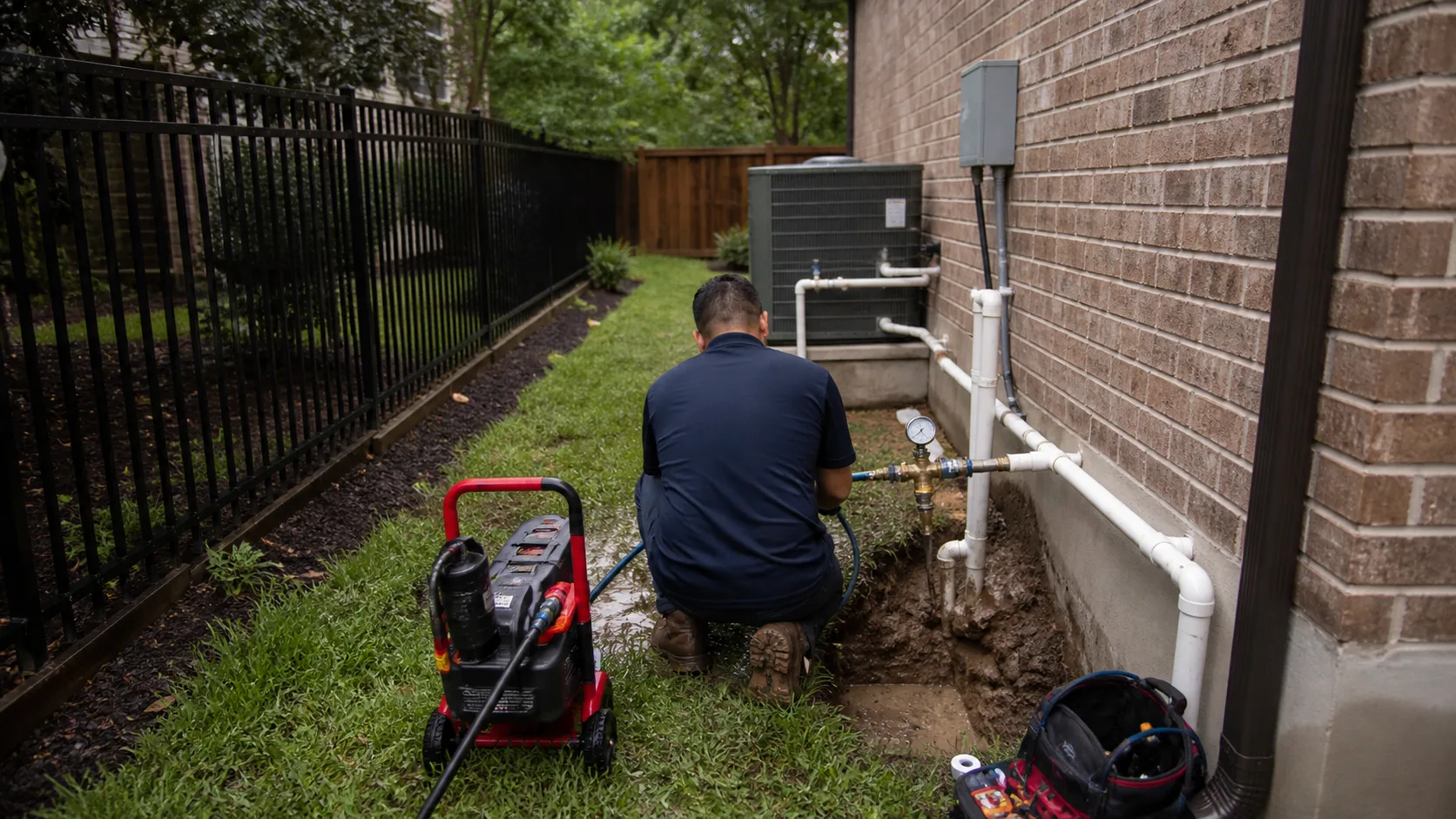
If you suspect a supply line leak — damp drywall, warm floor spot, phantom water sounds, a spiking bill — shut off the water main and check the meter's leak dial with everything off. Movement means a pressurized leak running around the clock. Leave the main off except when you need water, get a plumber with leak-detection equipment to locate it, and plan on metered drying of the cavity or slab-adjacent materials once the line is fixed. The repair is step one; the drying is what protects the house.
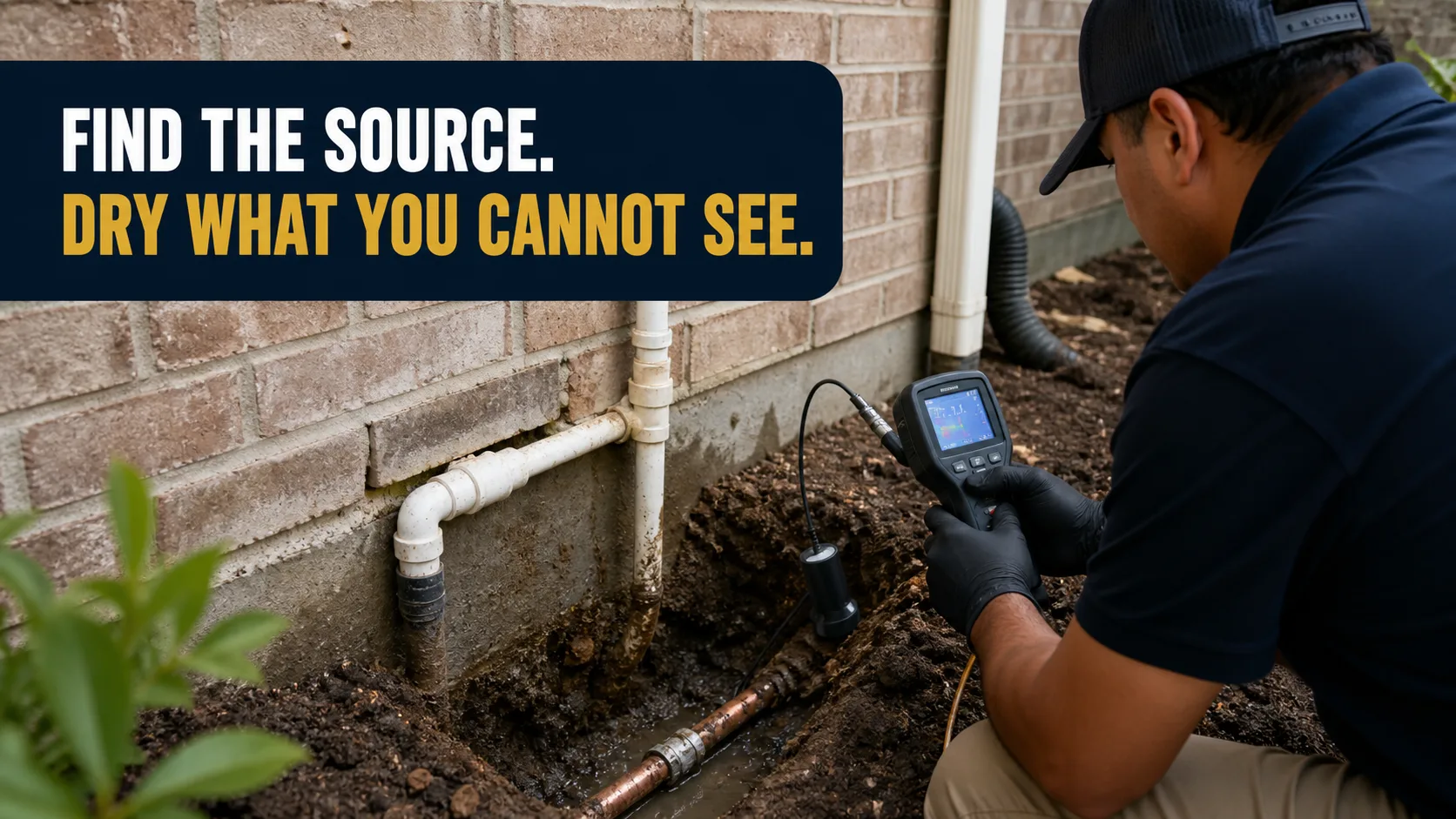
Why supply line leaks are the expensive ones
Drains only carry water when you use a fixture. Supply lines carry pressure all day, every day. A pinhole in a supply line delivers water continuously — into the wall cavity, under the slab, above the ceiling — for however long it takes someone to notice. And because the pipe is buried in the structure, “noticing” usually means the damage has already surfaced.
Houston adds its own aggravators: slab-on-grade foundations with supply lines in or under the concrete, expansive clay soil that flexes those slabs seasonally, and humidity that keeps everything the leak touched wet.
The warning signs, by location
In a wall:
- Damp, soft, or discolored drywall; bubbling paint or texture
- Baseboard swelling or pulling off
- Musty smell localized to one wall or room
- Hiss or trickle sound with all water off
Under the slab:
- A warm spot on the floor (hot-side slab leak — the classic)
- Flooring failing in one area: tile grout darkening, wood cupping, vinyl lifting
- Moisture at the slab edge outside, or between slab and baseboards inside
- Water heater running more than usual (hot-side leak drains it)
Anywhere:
- Water bill jump without a lifestyle change
- Meter leak-dial movement with the house shut down — the single most decisive test you can run yourself
What to do right now
- Shut off the main — at the house shut-off or the meter. This converts an active leak into a scheduling problem.
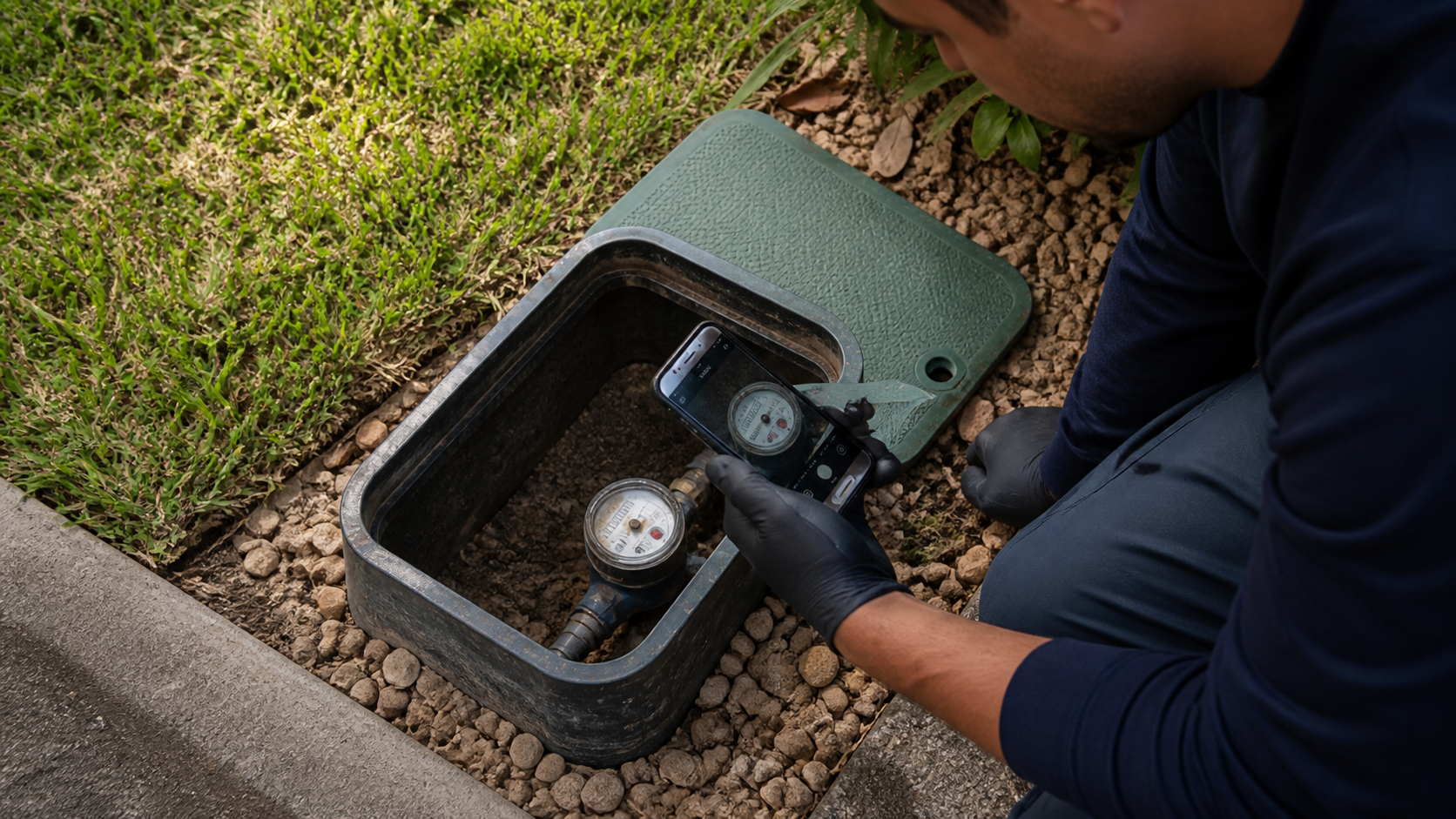
- Run the meter test: everything off, watch the leak indicator. Document the result (a phone video of the moving dial is perfect claim evidence).
- Photograph every symptom: stains, swollen materials, the warm spot (a cheap IR thermometer reading makes it objective).
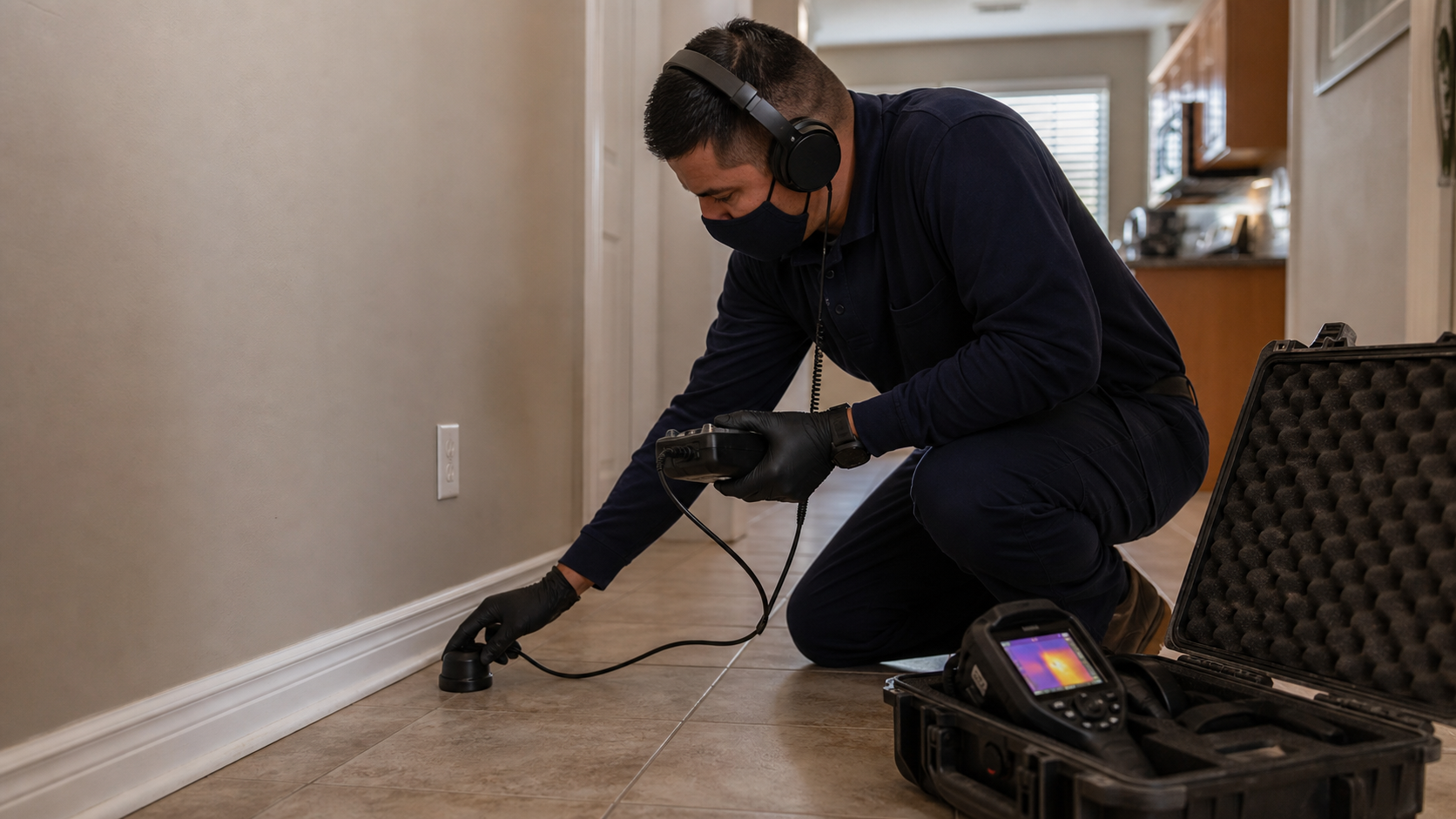
- Call a plumber with detection equipment — acoustic, pressure, and thermal tools find the leak without exploratory demolition.
- Plan the drying alongside the repair. The plumber fixes the pipe; the wet cavity, insulation, and flooring are a separate job with its own documentation. (346) 271-7004 — we coordinate with your plumber routinely.
The meter test, step by step
Free, fifteen minutes, and it turns a suspicion into evidence.
- Shut every fixture and appliance down — icemakers, irrigation, humidifiers, the lot. Anything drawing water invalidates the test.
- Find the meter and watch the low-flow indicator for fifteen minutes. It is a small triangle, star, or dial that spins on flows too small to move the main numbers. Movement with the house shut down means water is leaving your system somewhere.
- Narrow it to hot or cold. Close the shut-off valve on top of the water heater and watch again. If the movement stops, the leak is on the hot side — where most slab leaks live. If it keeps going, it is the cold side or something upstream of the heater.
- Walk the floors barefoot in the morning, before the house warms up, feeling for one patch warmer than the rest. Tile shows it best.
- Video the moving dial with the date stamp on. It confirms the problem, and it is dated evidence later.
What NOT to do
- Don’t leave the main on “because the drip is small.” Pressurized means continuous.
- Don’t close the wall the day the pipe is fixed. A cavity that metered wet on Monday is still wet on Friday without equipment — closed walls do not dry in Gulf Coast humidity.
- Don’t accept “we fixed the pipe, you’re all set” as the final word on moisture. Two different trades, two different questions.
What does a hidden line leak cost?
Two invoices, from two trades. Detection and the pipe repair belong to a plumber — a few hundred dollars for detection alone, low thousands for a spot repair, more for a reroute or repipe. Slab leak repair options and what each costs are broken out separately, because that choice is a plumbing decision rather than ours.
The drying is the second number, and these variables move it.
- How long the line ran before discovery. A pressurized leak delivers water every hour of every day. A week is a dry-out; six months is a dry-out plus removals plus, often, remediation.
- How much material comes out rather than dries. The single biggest lever on the invoice.
- Where it sits. An open bedroom wall is straightforward. Under a kitchen island or behind a wall of cabinets is not.
- Flooring type. Tile and engineered wood over a wet slab often cannot be reinstalled, and that is a finish cost rather than a plumbing one.
- Whether growth started. Material wet past a couple of days in this climate is where mold begins.
One wet wall with a few days of equipment usually runs several hundred to a couple of thousand dollars. Multiple rooms, wet flooring, or cabinets coming out push it into the several thousands.
How long does the drying take?
Three to five days for a single wet wall or one room, once the cavity is open and equipment is running. Longer when flooring or cabinets are involved, and longer again with a slab in the picture — concrete gives up moisture slowly, so slab-adjacent wood is usually the last material to reach dry standard.
Readings decide the end date, not the calendar. Framing, insulation, drywall and flooring all have to meter at dry standard before the wall is closed, and the daily log is what proves it. What sets a drying timeline is how much material got wet, how deeply, and how fast equipment arrived.
Does insurance cover a hidden water line leak?
Most Texas policies cover the resulting water damage from a sudden failure, and many cover the access cost — opening and repatching a wall or slab to reach the pipe — while excluding the pipe repair itself as a maintenance item. Slab language in particular varies meaningfully between carriers, so read your own declarations page rather than any general rule, this one included.
What decides how completely a claim pays is usually the record rather than the argument. Sudden failures are treated very differently from leaks that clearly ran for months, so the discovery date, the meter video, dated photos, and a mitigation file with daily readings do more work than a phone call. Report it promptly — a late report on a long-running leak is the easiest denial an adjuster ever writes. More: does insurance cover water damage.
The slab leak decision: repair, reroute, or repipe
Once located, slab leaks offer three paths — and the right one depends on the house’s age and pipe material:
- Spot repair (open the slab at the leak): makes sense for an isolated failure in otherwise healthy pipe
- Reroute (abandon the buried section, run a new line overhead): often preferred — no slab demolition, and it retires the risk of that line
- Repipe (replace the supply system): the answer when this is the second or third leak; recurring slab leaks in aging pipe are a pattern, not bad luck
Ask your plumber which pattern your home fits. And loop your insurer in early — access costs and resulting damage are commonly covered even where the pipe repair is not. Details: what mitigation costs and what insurance pays.
After the repair: verify dry, then close
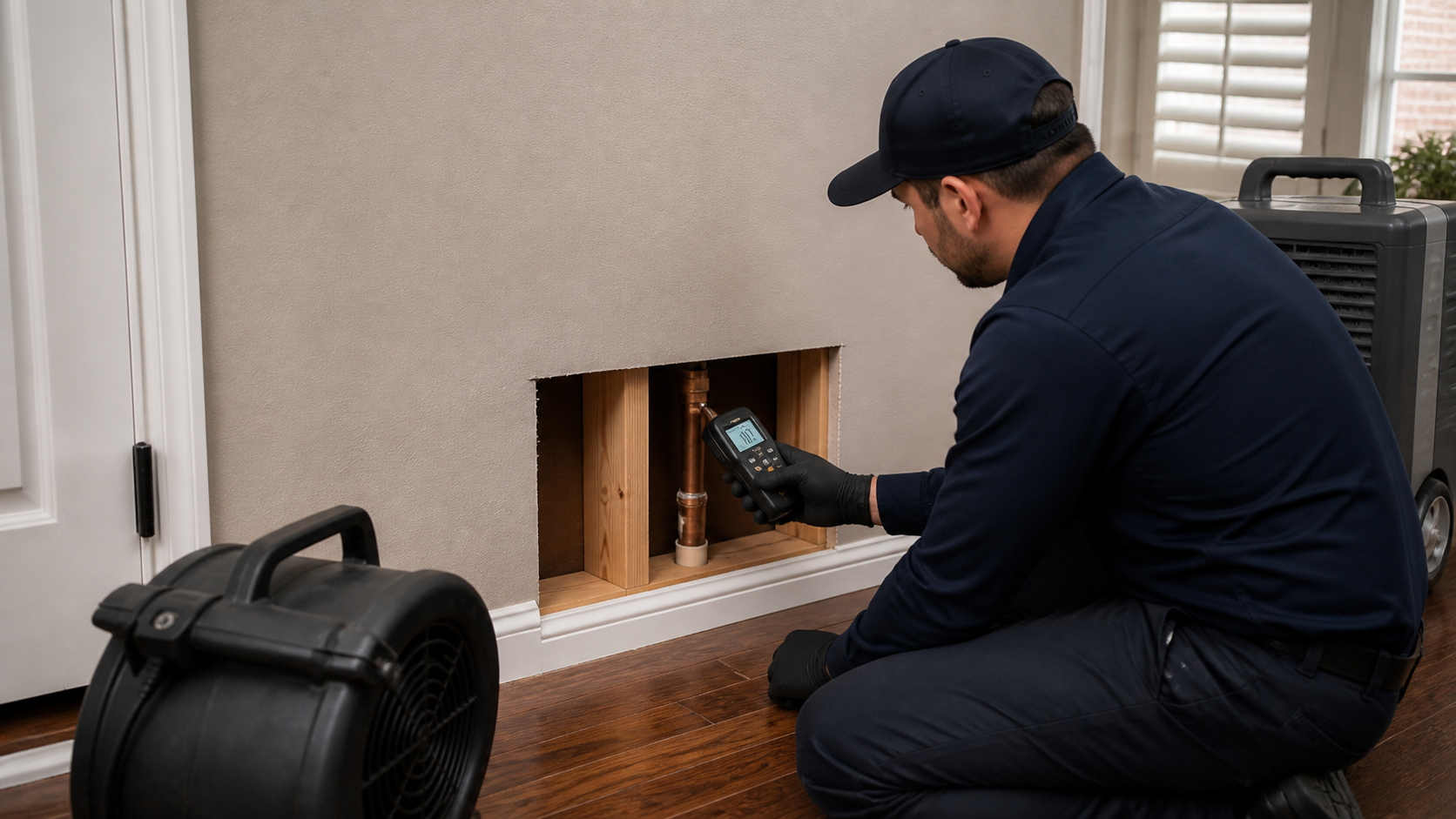
The finish line is a moisture reading at dry standard on every affected material — cavity framing, insulation replaced where soaked, slab-adjacent flooring evaluated honestly. That documentation also closes out your claim cleanly. It is a few days of equipment and daily readings; skipping it is how a fixed pipe turns into a mold remediation next spring.
The free things worth doing tonight
- Shut the main off and leave it off, turning it on only when you need water. That habit converts a leak running 24 hours a day into one running ninety minutes.
- Run the meter test and video the dial. Write down the date.
- Photograph every symptom with the date stamp on — stains, swollen baseboards, cupped flooring, the warm spot.
- Move furniture and rugs off any damp flooring.
- Pull loose baseboard away where it has already released, so air can reach behind it.
- Pull twelve months of water bills and find the month the number stepped up. A supply leak shows as a step change, not a spike.
- Do not close a wall, lay flooring, or repaint until something with a meter has read it.
Where the plumber ends and we begin
TruePoint Restoration is not a plumbing company. We do not locate leaks, cut into pipe, reroute lines, or repipe houses, and we say that on the phone rather than after the estimate. Detection and repair are a licensed plumber’s work with equipment we do not carry — the two trades are not interchangeable, and the sequence is find, fix, dry, document.
Our half is the third and fourth steps: metering what got wet, deciding which drywall dries in place and which comes out, pulling saturated insulation and flooring, drying framing and slab with logged daily readings, and handing you a documented file your adjuster can work from. Closing the wall and painting it is a third trade again.
If your plumber has finished and nobody has told you whether the structure is dry, send photos to (346) 271-7004. We serve Pearland, Manvel, Friendswood, League City and the Greater Houston area.