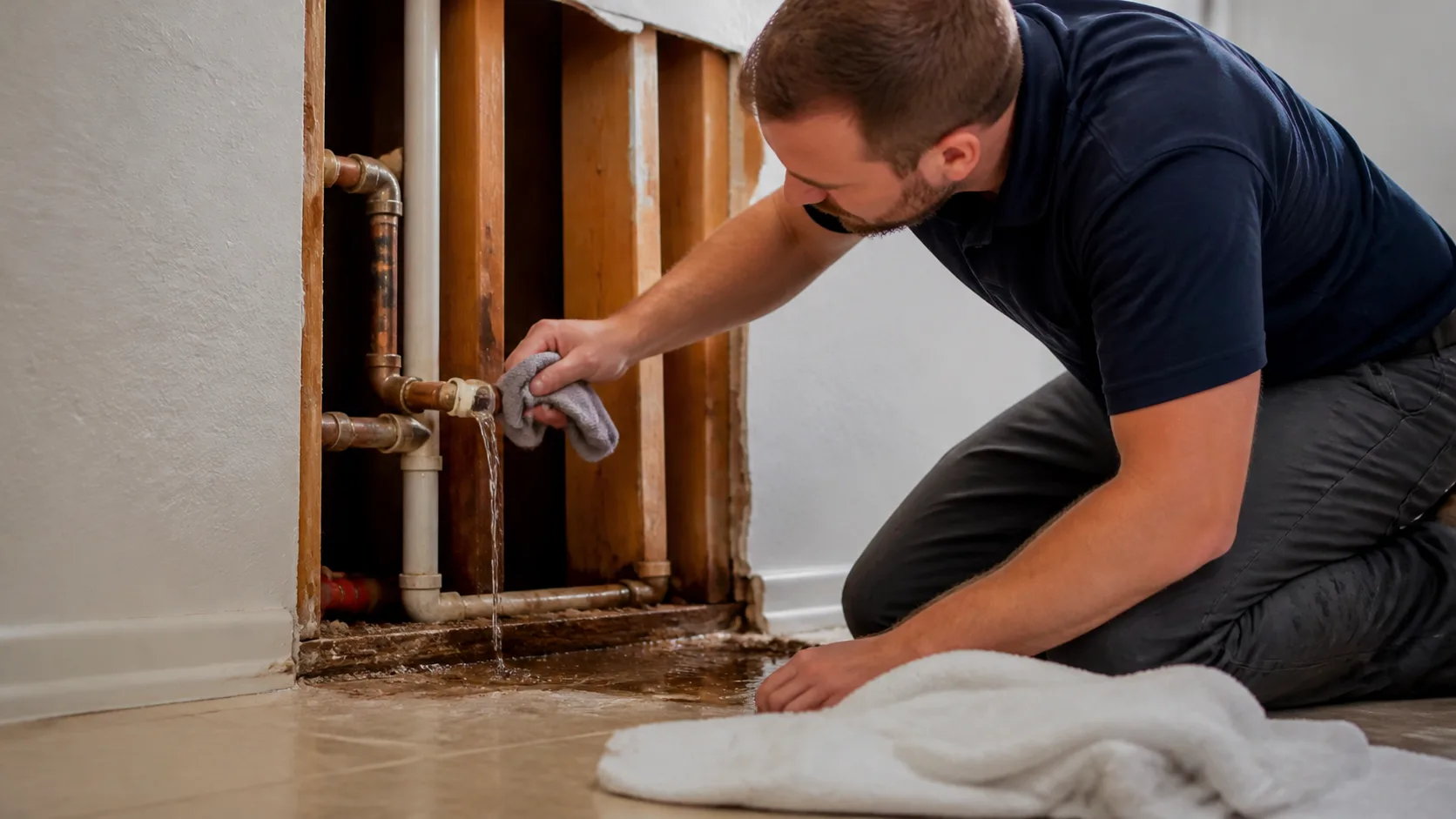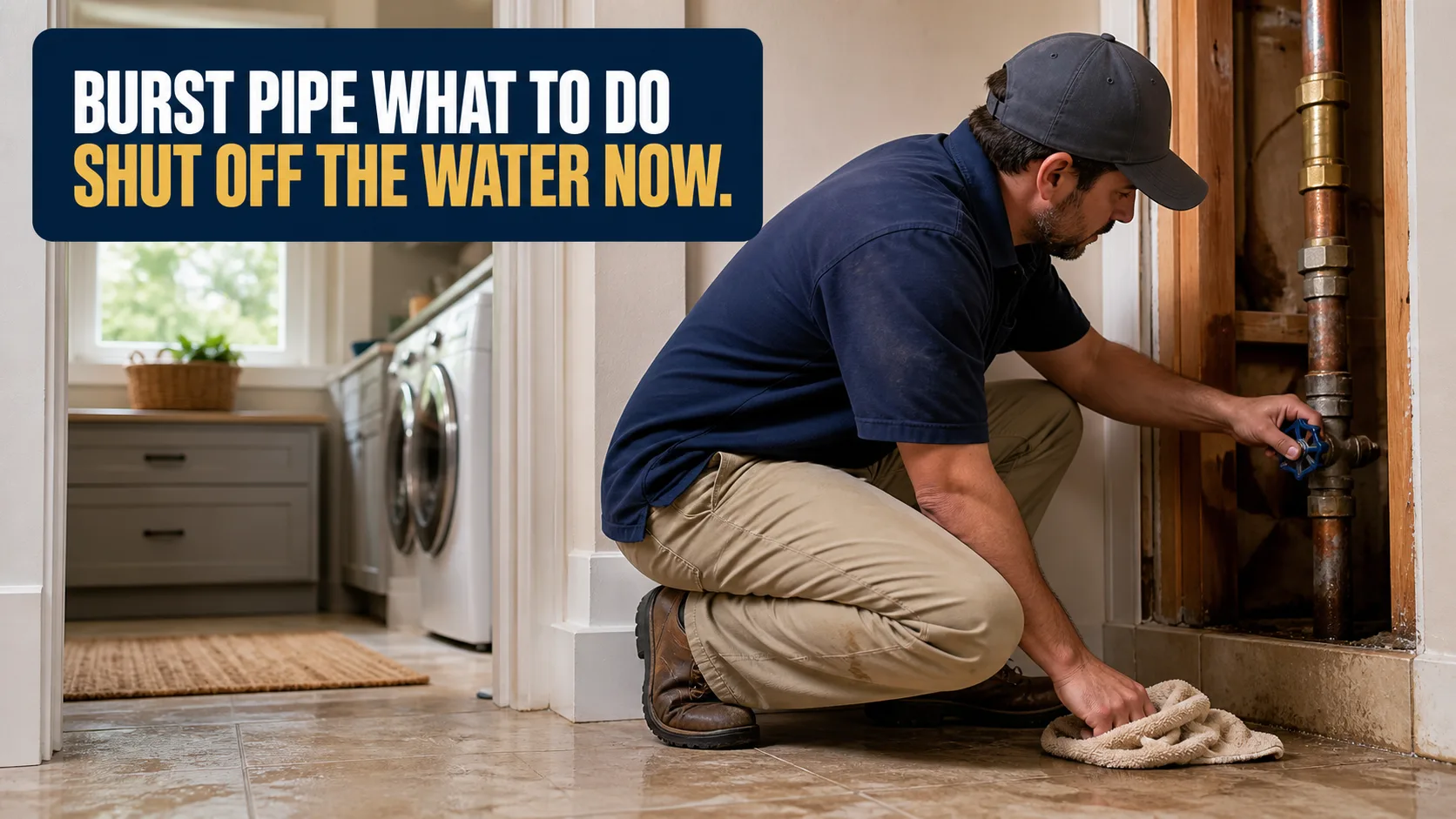
Shut off the water at the **main valve** immediately — that stops the flow regardless of which pipe failed. Then cut power to any area where water is near outlets, open faucets to drain the remaining pressure, and start extracting water and moving belongings up. Photograph everything for your claim. A burst pipe runs at full pressure until someone stops it, so speed decides the damage. Call **(346) 271-7004** for extraction and drying before mold gets its 24–48-hour window.
Do these first, in this order
- Main water off. Don’t hunt for the specific pipe — go straight to the main shut-off and close it. Every minute it’s open is more water in your walls and floors.
- Power off to the affected area at the breaker if water is anywhere near outlets, appliances, or the panel.
- Drain the pressure. Open the lowest faucets in the house and flush toilets to bleed the water still in the lines so less drains out of the break.
- Get belongings up and water out. Lift furniture and electronics, pull rugs, and start extracting with a wet/dry vac and towels.
- Photograph everything — the break, the standing water, its full reach — before you clean up. This is your claim.
- Call for mitigation. (346) 271-7004. Extraction and commercial drying now is what keeps this from becoming a mold job.
Find your main shut-off before you need it
The worst time to learn where your shut-off is, is while water is pouring in. In Houston homes it’s usually one of:
- Near an outside faucet on the front or side of the house
- In the garage where the main line enters
- At the water meter box near the street (the street-side valve often needs a meter key)
Go find yours today and make sure it turns. If your household valves are seized from never being moved, that’s worth fixing now.
Why a burst pipe is different from a drip
Most leaks trickle. A burst pipe pours — full household pressure, 24/7, until it’s shut off. If it lets go while you’re at work or asleep, it can run for hours and reach far beyond the room it started in, traveling under walls and floors. That’s why the response is about speed and shut-off, and why the water hides in places you can’t see even after the floor looks dry.
Warning signs a pipe is about to let go
Supply lines rarely fail without warning. They give a few weeks of hints that almost everyone reads as something else.
The system is under stress:
- Water pressure noticeably higher than it used to be, or a bang in the wall when a faucet or the washer shuts off
- A water heater relief valve that weeps, which is a pressure symptom rather than a heater symptom
- Rust-colored water first thing in the morning, or flakes in an aerator screen
A line is already failing:
- A hissing or running sound in a wall or ceiling with every tap closed
- The water meter counting with the whole house shut down
- A warm patch on a slab floor, which is a hot-side slab leak rather than a mystery
The connectors are the weak point: braided supply hoses under sinks and toilets and behind the washer are the single most common indoor flood in Houston homes, and they fail at the crimp. If yours are original to the house, they are older than their design life.
A freeze is coming: attic and garage runs in Texas houses sit outside the conditioned envelope, and that is where splits happen.
What to check once the main is off
The water is stopped. The next twenty minutes decide how much of this becomes a mold job.
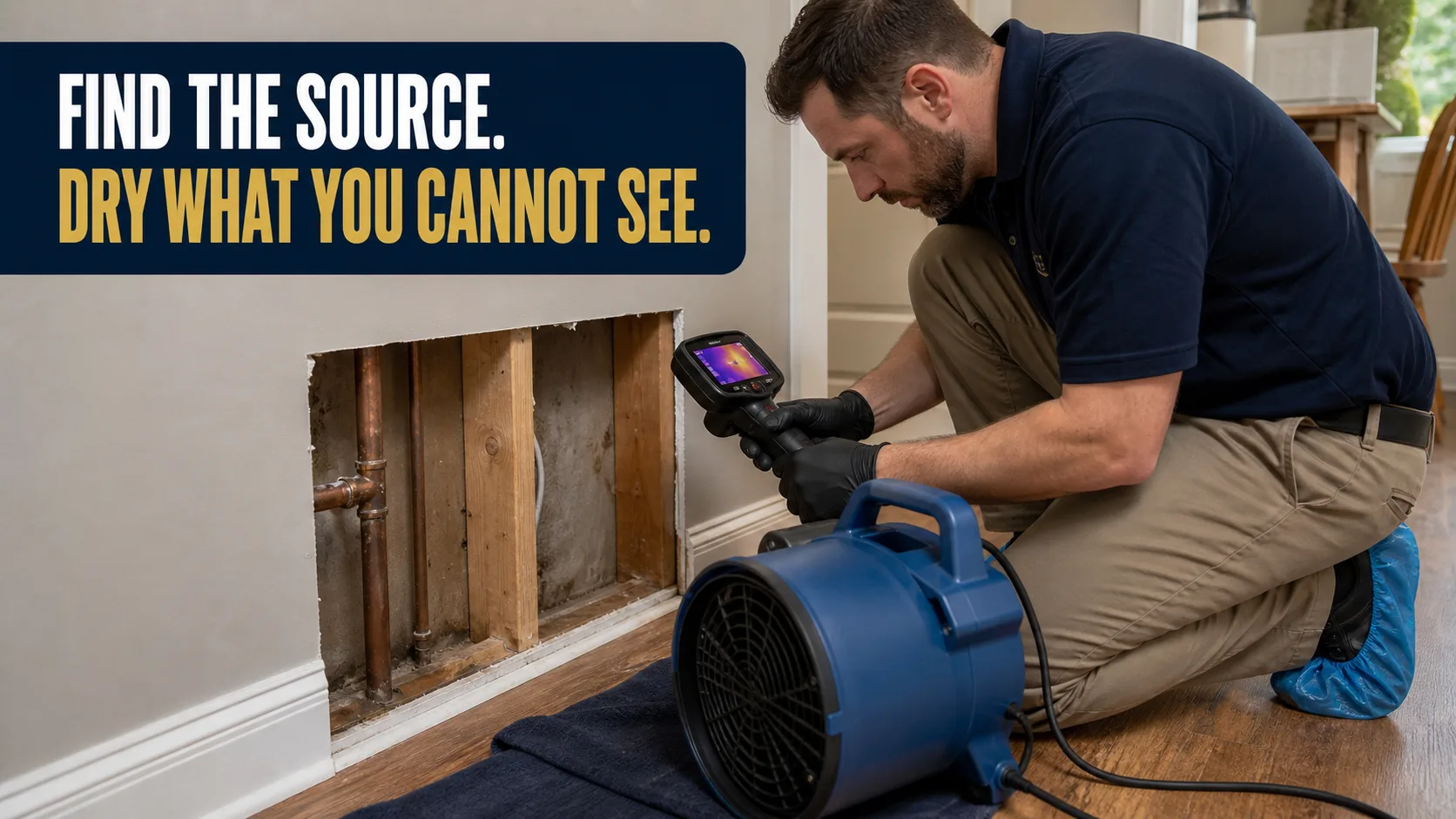
- Follow the water, not the break. Walk outward from the source and press the bottom four inches of drywall as you go. Where the wall stops feeling cool is the real edge of the loss, and it is usually further than the wet floor.
- Check the room on the other side of that wall. Water crosses through the bottom plate, and the far side is often wetter than the side you found first.
- Check the level below, and the ceiling under the break if there is one.
- Feel the carpet at the doorway of the next room. Carpet wicks water sideways under the door without showing it on top.
- Open cabinets and look at the kicks. Cabinet bases sit on the subfloor and hold water for days after the room looks dry.
- Photograph everything with the date stamp on before you clean up — the break itself, the standing water at its full reach, the wet line on the wall, and the contents in the path.
The insurance side
A sudden burst is one of the most clearly covered losses there is. Two things protect your claim: acting fast (your policy expects you to prevent further damage) and documenting (photos, the source, moisture readings). Report the sudden event plainly and let the documentation carry it. For the full sequence, see the first 24 hours after water damage.
What a burst pipe costs to dry out
Volume drives it. A burst runs at full household pressure until somebody closes the main, so the question is not how big the hole was but how many minutes it ran.
- How long it ran. Ten minutes with someone home is a room. Eight hours while you were at work is a floor plan, and the number moves accordingly.
- How far it traveled. Water runs under walls and along the underside of flooring, so the affected area is almost always larger than the wet area you can see.
- What has to come out. Carpet pad, saturated drywall, wet insulation and cabinet kicks are removed rather than dried. Framing and subfloor are dried in place.
- What the water crossed. Hardwood and mortar-bed tile both add days and specialty equipment.
- Equipment days, which Gulf Coast humidity extends on every job.
Your plumber’s repair is a separate invoice and usually the smaller one. The structure of mitigation pricing is in what mitigation costs in Houston.
How long it takes
Three to five days for a contained clean-water loss caught within hours, on hard-surface flooring. Five to ten days once a wall cavity, a subfloor, or hardwood is involved. Longer again if the water sat overnight, because clean water does not stay clean — category degrades with time, and a Category 1 loss left standing becomes a removal job rather than a drying job.
Readings decide, not the calendar. Framing, subfloor and the bottom of the drywall get metered daily until they reach dry standard, and the rebuild starts after that. What actually sets a drying timeline covers it material by material.
What NOT to do
- Don’t look for the broken pipe first. Shut the main, then investigate. Order matters.
- Don’t flip breakers while standing in water. If the panel or outlets are wet and you can’t reach them safely, call an electrician or the utility.
- Don’t assume it’s dry because the floor is. After a high-volume release, the walls and subfloor need a moisture meter, not a guess.
If the cause was cold weather, the prevention and specifics are here: frozen pipes in Houston.
The free things worth doing tonight
- Turn the main shut-off both directions so you know it moves, and put the meter key beside it where everyone in the house can find both.
- Look at the braided supply hoses under every sink and toilet and behind the washer. Corrosion or rust at the crimp means replace them this month.
- Photograph the wet line on the wall again tomorrow, dated. Two dated photos of a line that moved is the clearest proof of an active loss anyone can produce.
- Take the baseboards off the wet run so the cavity can breathe.
- Pull carpet and pad back off the wet edge and get furniture up on blocks or foil.
- Run the AC rather than opening windows. In Houston air, opening up adds moisture to the room instead of taking it away — dew point decides that, not temperature.
- Report the loss in writing today and keep the confirmation.
Where the plumber ends and we begin
TruePoint Restoration is not a plumbing company. We do not locate breaks, cut and solder, re-pipe, replace a water heater, or pull plumbing permits, and we are not a public adjuster. Both calls should be made the same hour rather than one after the other, because the plumber stops the water and the water already in your walls is on its own clock.
Our part is everything that escaped: emergency extraction, removal of material that will not dry, opening and drying wall cavities and subfloor, structural drying with logged daily readings, mold remediation if it sat long enough to start, and a documented file — source, category of loss, affected materials, daily readings, disposal records — that your adjuster works from. That file is the part you cannot go back and create later, which is why the photographs matter before the cleanup rather than after it.
Call (346) 271-7004. We work out of Pearland and serve Manvel, Friendswood, League City, Pasadena, Sugar Land and the Greater Houston area.