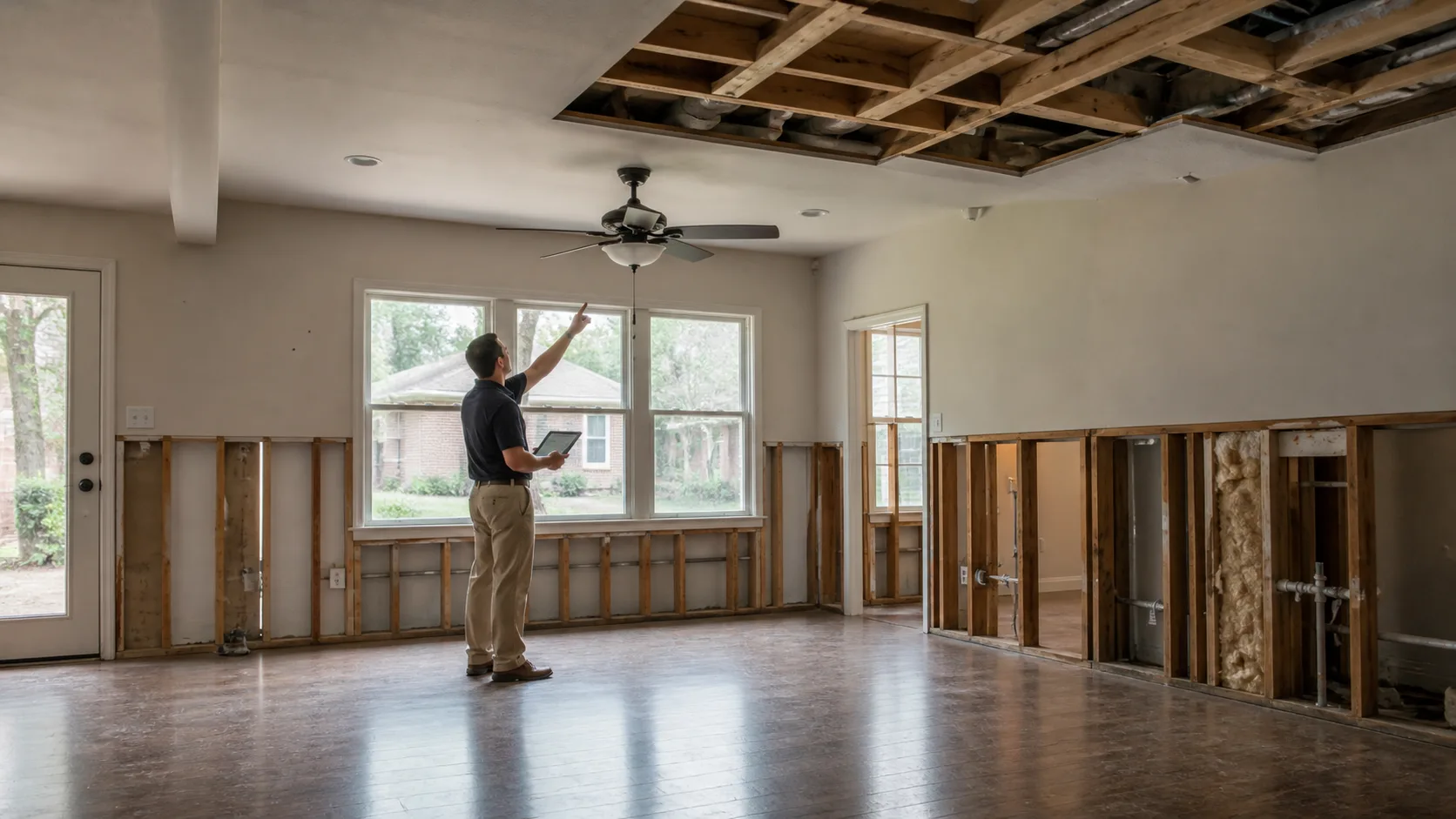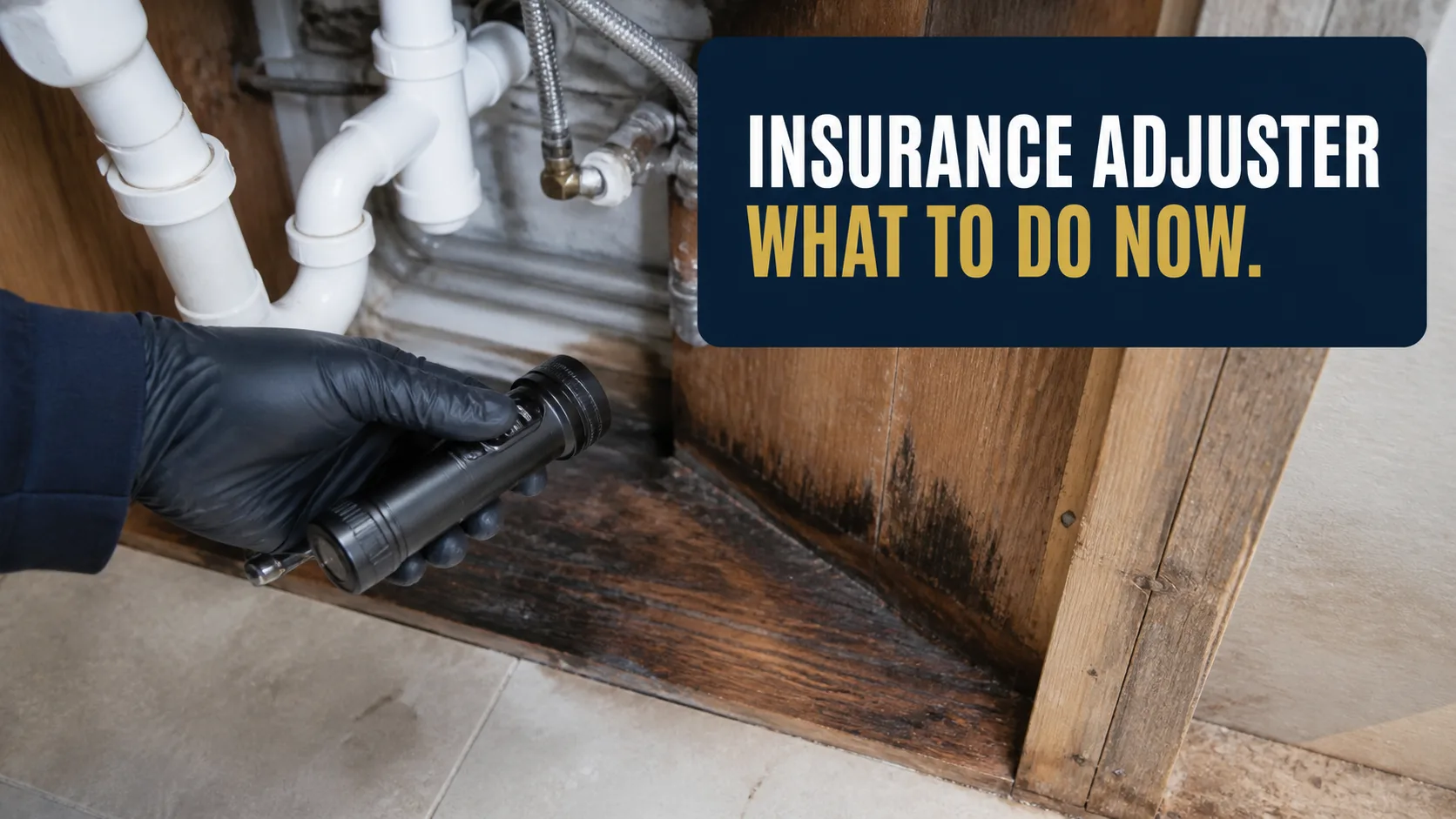
Understand the roles first. Your adjuster evaluates the loss for the carrier and applies the policy; you control the evidence. Document the damage before anything is cleaned or moved, describe only what you know, and hand over a scope written in line items rather than a lump-sum invoice. Read your own declarations page — it, not the conversation, decides what is covered.
If you’ve never filed a major homeowner’s claim before, the process can feel adversarial — like the insurance company is looking for reasons to deny you. The truth is more complicated, and understanding it changes how you approach every conversation.
Your adjuster works for the insurance company. Not you.
This isn’t a criticism, it’s just the structure. The adjuster’s job is to evaluate the loss and recommend a payout that fits the policy. Their incentive is accuracy — not generosity.
What you control:
- The quality of the evidence you provide
- The scope of damage that gets documented
- Whether you have independent professionals speaking on your behalf
That third one is where mitigation companies like ours come in.
What a restoration company is — and is not — in your claim
Be precise about this, because the roles are separate in Texas law and blurring them helps nobody.
A company adjuster is the carrier’s employee. An independent adjuster is contracted by the carrier, common after a storm when volume spikes. A public adjuster is licensed by the Texas Department of Insurance to represent the policyholder for a fee, and is the only one of the three working for you.
A restoration contractor is none of those. Our role is to document the condition of the property and perform the mitigation — readings, logs, photographs, a line-item scope of the work we did. We are not your public adjuster, we do not negotiate your claim, we do not advocate for a settlement number, and we do not tell you what your policy covers. Texas keeps those functions apart, and a licensed public adjuster generally cannot also perform or hold a financial interest in the repair work on the same claim.
What that means practically: if you want someone representing your interests in the negotiation, that is a licensed public adjuster or an attorney, and you hire them separately. What you get from us is the factual record. Whoever reads it — your adjuster, a public adjuster, or you — is reading the same measurements.
The three documents that win claims
Every well-supported water or fire damage claim has three pieces of paperwork your adjuster wants to see:
- Initial damage report with moisture readings or fire damage assessment. Taken within the first 24–48 hours, by a certified professional, with timestamped photos.
- Daily drying logs (for water claims) or air quality test results (for fire/smoke). These prove the work was done correctly and continuously.
- Itemized scope of work matching the insurance industry’s pricing software (most carriers use Xactimate). Random invoices in random formats slow claims down.
When we mitigate a job, we generate all three automatically. That’s not a sales pitch — that’s why working with a certified mitigation company at the start saves you time and money even if your premium goes up a little.
The Texas timelines worth knowing
Claim handling in Texas runs on statutory clocks, and knowing the numbers changes how you read a quiet week.
- The insurer generally has about 15 days after notice to acknowledge the claim, begin investigating, and request the documents it needs.
- After it receives everything it asked for, it generally has 15 business days to accept or reject the claim in writing, with a limited extension if it explains the delay in writing.
- Those windows can shift after a declared catastrophe, and they vary by policy form.
- Texas also sets deadlines running the other way. Most policies require prompt notice, and the statutory limitations period for a claim dispute is shorter than people assume.
Two practical consequences. Report in writing and keep the confirmation, because the clock starts at notice and you want a date you can point to. And respond to document requests quickly, because the second clock does not start until the carrier has what it asked for. Confirm the current requirements with the Texas Department of Insurance rather than with anyone who has a stake in the claim, including us.
Build the file in the first 48 hours
Everything below is free, and all of it expires the moment materials get moved, cut out, or dried.
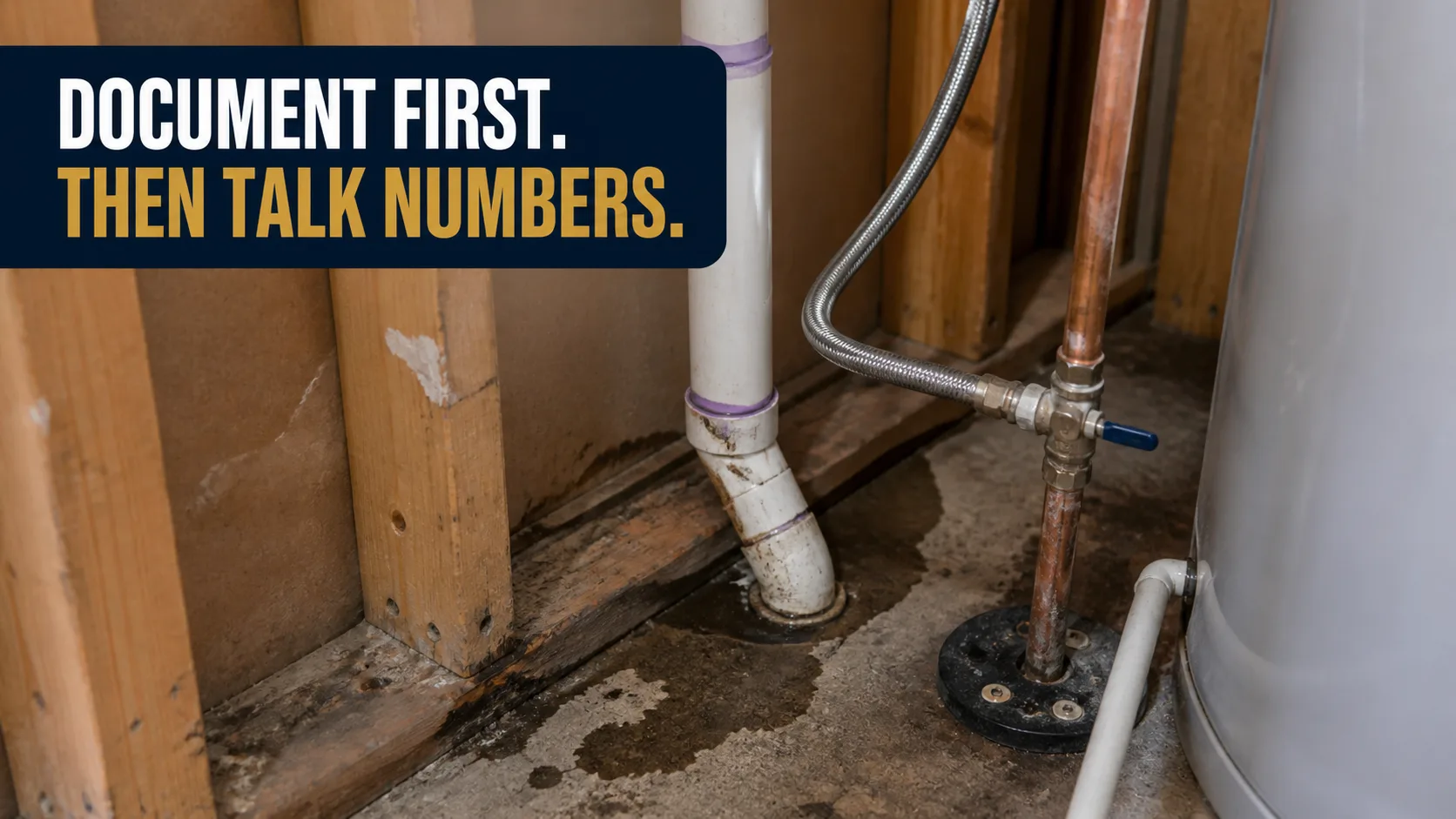
- Photograph before you touch anything. Wide shots of every affected room from the doorway, then the water line on walls and furniture with something in frame for scale.
- Photograph the source and the failed part, then bag the part and label it. A part that failed inside its warranty gives the carrier a subrogation target, and when they recover, your deductible can come back with it.
- Shoot a slow walkthrough video, narrating what you see and the date out loud.
- Find your declarations page and read the deductible, the limits, and any separate windstorm deductible. That document, not the conversation, decides what is covered.
- List damaged contents with approximate purchase dates and prices, while you still remember them.
- Ask your mitigation company for the readings — moisture map, daily drying logs, line-item scope — and keep your own copy.
- Keep every communication in writing. After a phone call, send a short email summarizing it and keep the reply.
- Check the date stamp is on, then back the album up off the phone the same day.
Report only what you know. Speculating about how long something had been leaking puts a guess into the record as a fact — more on that in what not to say to an insurance adjuster.
Common claim disputes — and how to avoid them
“That damage was pre-existing.” The way to win this argument is photos and dates. Phone backups timestamp everything. If you can show a photo of dry, intact drywall taken three weeks before the leak, the dispute ends.
“You should’ve stopped the damage sooner.” Insurance policies require homeowners to “mitigate further loss.” If you waited 48 hours to call anyone, the carrier can argue you contributed to the spread of damage. Calling a mitigation company within hours of discovery shows you took action.
“This work wasn’t necessary.” The fix: have a certified pro write the scope, not just an estimate. A scope says what needs to happen and why. An estimate just says how much. Adjusters trust scopes; they negotiate estimates.
What to do if your claim gets denied
Claim denials happen — sometimes for legitimate reasons (the policy excludes flood damage, for example), sometimes because of incomplete documentation. If your claim is denied:
- Get the denial in writing with specific policy language cited
- Request a re-inspection with your mitigation contractor present
- Consider a public adjuster for claims over $25,000 (they take a percentage but they know how to fight)
We don’t write claim appeals — that’s not our lane — but we’ll provide all our documentation to whoever does, at no charge. Your file, your win.
What the documentation costs, and what the claim math looks like
The documentation itself costs nothing. Photographs, a written notice, a phone log and a contents list are free, and they are the highest-value work available to you in the first two days.
Three numbers do need arithmetic:
- Your deductible, which comes off the top — and which on a Texas coastal policy may be a percentage of the dwelling limit rather than a flat figure on wind and named-storm losses.
- Replacement cost versus actual cash value. A replacement-cost policy typically pays actual cash value first and releases the remainder once the work is done and invoiced; an actual-cash-value settlement is depreciated and final. Many Texas policies have moved roofs specifically to actual cash value. The mechanics are in replacement cost versus actual cash value.
- Claim history, which is reported and generally stays visible for several years whether or not the claim was paid.
For a loss close to your deductible, do that arithmetic before you file. For a significant loss, an undocumented and unmitigated problem is usually the larger risk — a wet cavity that was never dried becomes a mold claim later, and the first question will be why there is no record of the original loss.
Fire claims are a bigger file than water claims
If your loss involved fire, the file grows in ways homeowners rarely expect. A fire claim usually brings a cause-and-origin determination, a detailed contents inventory, smoke and soot damage to items that never burned, and additional living expenses while the house is unlivable. Water used to fight the fire is generally handled inside the fire claim rather than as a separate water loss.
Ask about additional living expenses early rather than late — that coverage reimburses the increase in your normal living costs against receipts, usually up to a limit or a time cap, and an advance is often available. Expect the contents inventory to be the longest part of the job, so start the list the day you are allowed back in. The sequence is in what to do after a house fire, and the claim side is in fire damage insurance claim.
The cheapest fire claim is the one that never opens. Smoke alarms expire ten years from the manufacture date printed on the back — you replace the unit, not the battery — and carbon monoxide alarms run five to seven years. Check both dates the same week you review your declarations page.
The honest bottom line
Most insurance claims in Pearland and the greater Houston area get paid out fairly. Adjusters are professionals, and most of them want to close cases quickly with a fair settlement. The homeowners who struggle are the ones who didn’t document early, didn’t bring in a certified mitigation contractor, or signed an Assignment of Benefits to a contractor without reading the fine print.
Document everything. Bring in certified pros early. Keep copies of every conversation in writing.
The seasonal shape of Houston claims
Claim volume here is not evenly spread, and volume changes how long everything takes.
- December through February. Freeze events. Burst pipes arrive across whole neighborhoods in the same 48 hours, and both plumbers and adjusters are saturated at once — the prevention side is in the freeze checklist.
- March through October. Air conditioning condensate losses, the most common single water claim in Texas homes and the one most often argued as gradual rather than sudden.
- June 1 through November 30. Hurricane season, peaking August and September. After a named storm, carriers bring in independent adjusters, catastrophe timelines can shift, and flood coverage is a separate policy with a 30-day waiting period.
- Year round. Slab movement on expansive clay, and the connector failures that hard water and attic heat produce on their own schedule.
Expect longer timelines when the whole region files in the same week.
Where we fit, and where we don’t
TruePoint Restoration does mitigation. We extract water, dry structures with logged daily moisture readings, remediate mold, and clean smoke and soot. We do not repair plumbing, service HVAC systems, do electrical work, put on roofs, or rebuild — those are separate licensed trades, and you will need them.
We also do not adjust claims. We do not negotiate with your carrier on your behalf, we do not advise you on what your policy covers, and we are not your public adjuster or your advocate. What we produce is a factual record of what was wet, how wet, for how long, and what was done about it — written in line items an adjuster can read without translation. If a dispute goes beyond the facts, a licensed public adjuster or an attorney is the right next step, and the Texas Department of Insurance accepts complaints. More on that in water damage claim denied and does insurance cover water damage.
We work out of Pearland and cover Manvel, Friendswood, League City, Pasadena, Sugar Land and the Greater Houston area. (346) 271-7004, or claims@truepointrestoration.com.
Got a claim coming up and want a free walkthrough of what to expect? Call us at (346) 271-7004. We’ll talk through your specific situation, no commitment.