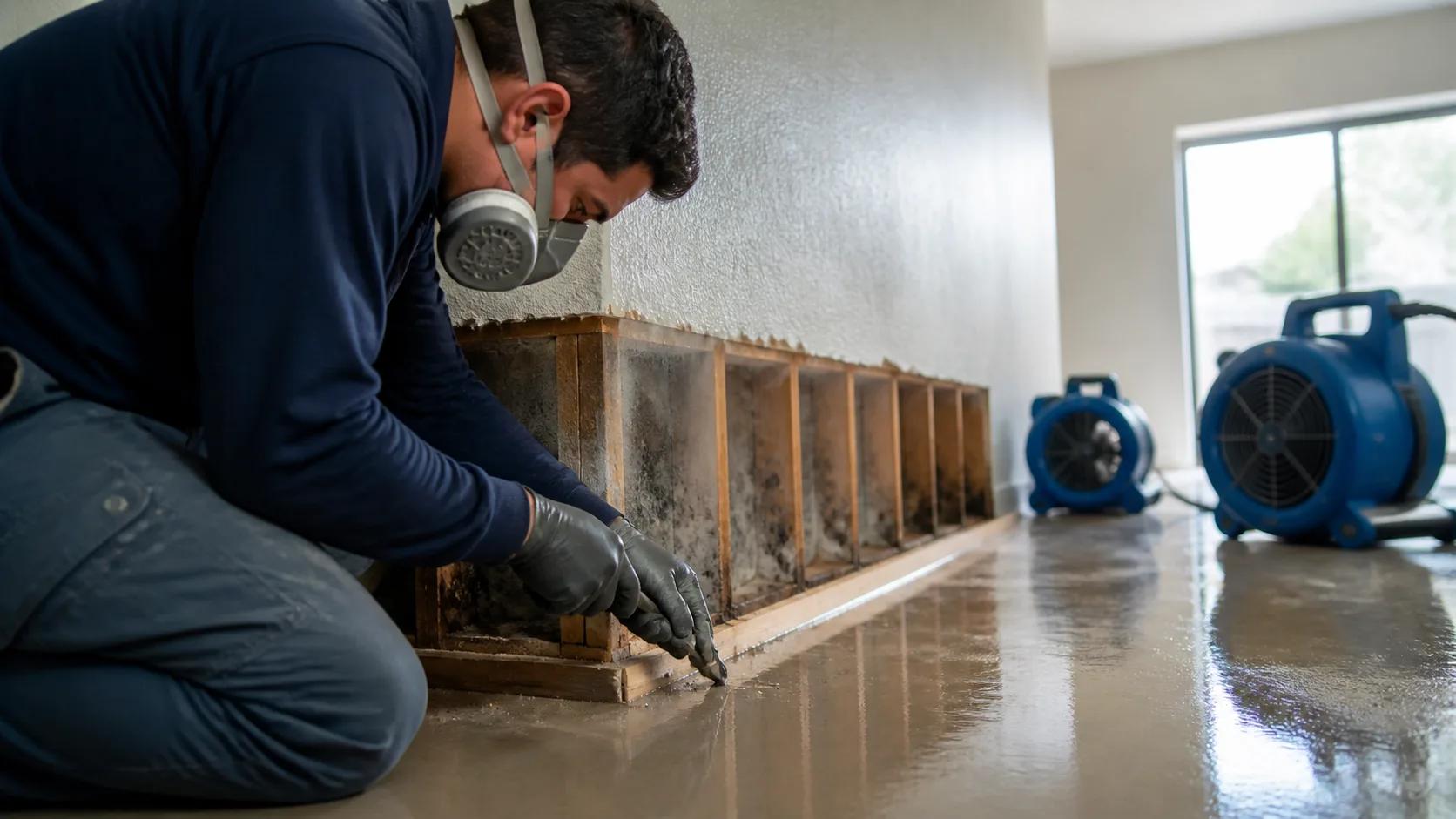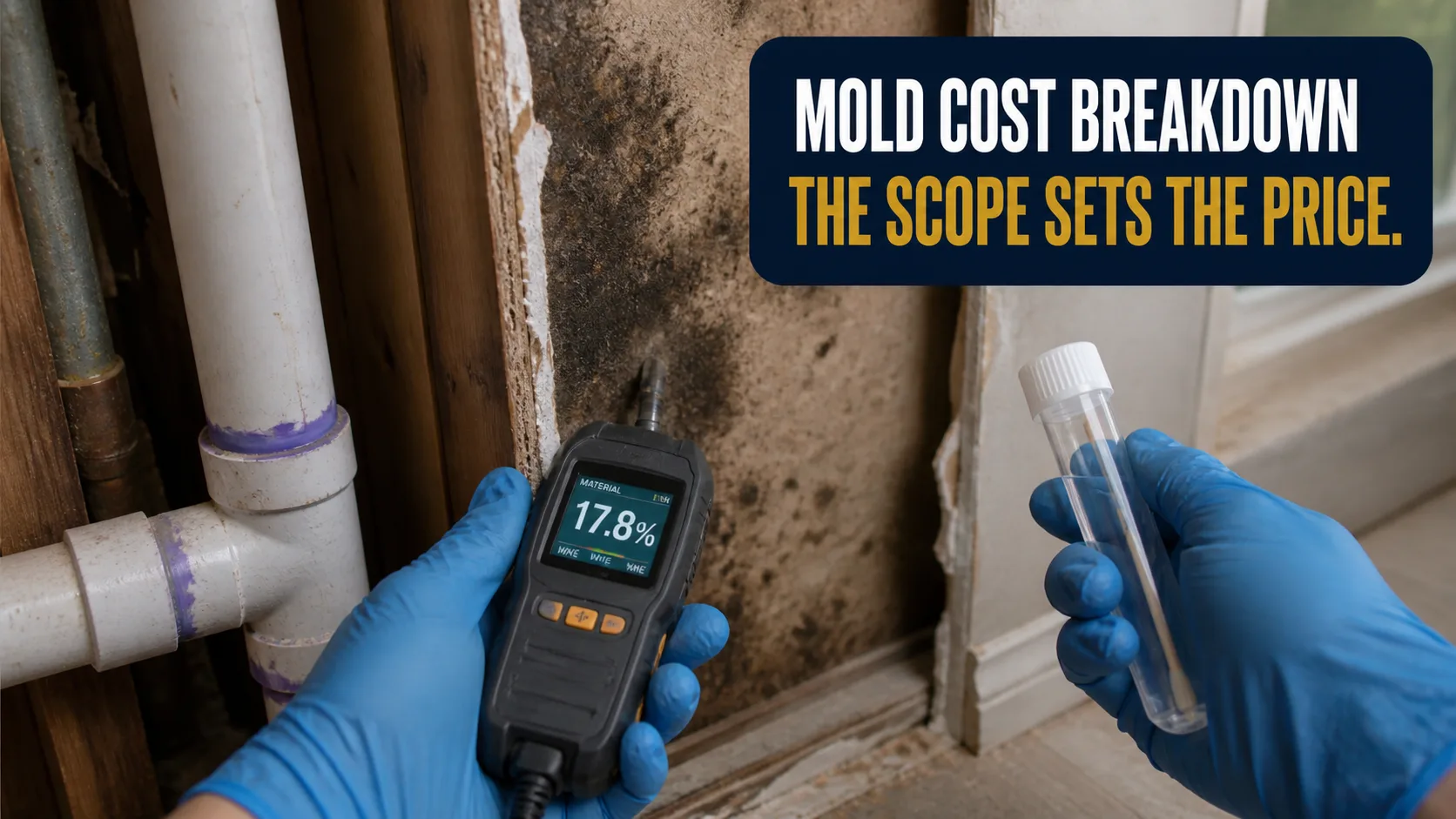
Mold remediation is priced per job, not off a rate card. The number is driven by six things: the area affected, where the mold is growing, whether containment is required, how much porous material must be removed and rebuilt, testing before and after, and how hard the space is to reach. A bathroom corner and a mold-filled crawl space are different projects. For a real figure, call **(346) 271-7004**.
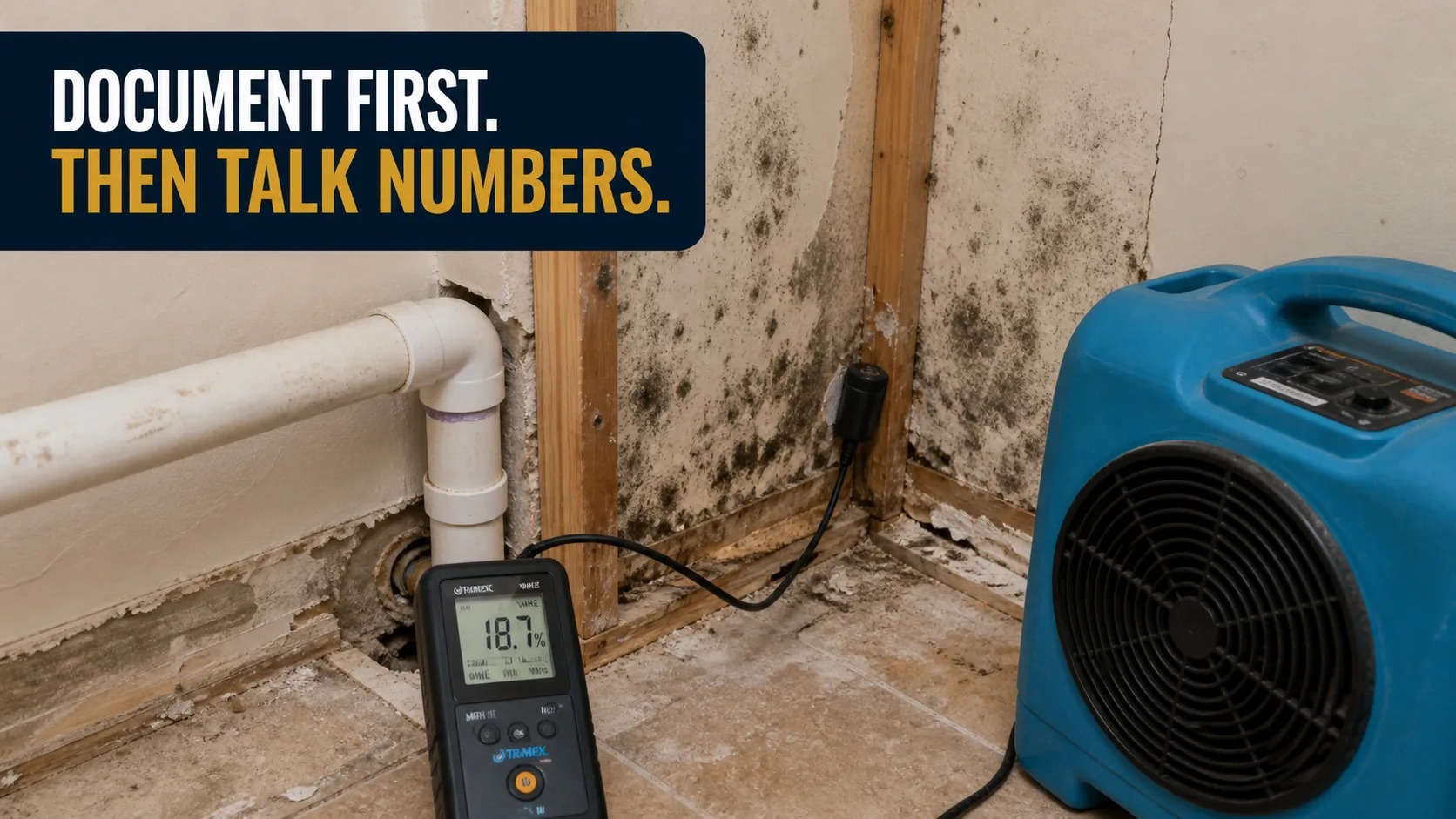
Why is there no single price for mold remediation?
Because you are not buying a product, you are buying a scope of work, and nobody can see the full extent of that scope until something gets opened up. Two homes with an identical patch of visible growth can land an order of magnitude apart, and the difference usually has very little to do with the mold itself. It has to do with what is behind the drywall, how hard that spot is to reach, and how much has to be put back afterward.
That is the honest answer, and it is also the useful one. Once you know what moves the number, you can look at a quote and tell whether it makes sense. For the wider Houston picture — insurance limits, why prevention is cheaper — see mold remediation cost in Houston. This page is the breakdown underneath it.
The six things that actually move the number
1. Area affected. Not the size of the stain — the size of the wet zone around it. Moisture wicks, and mold follows moisture. A hand-sized patch of visible growth on a baseboard frequently means several feet of affected drywall and bottom plate on either side.
2. Location and access. A wall in a bedroom is straightforward. The same square footage in a crawl space, over an attic joist, behind built-in cabinetry, or inside an HVAC plenum takes far longer per square foot, because every hour is spent getting to it and working awkwardly once there.
3. Containment requirements. Cutting into moldy material releases spores. Protecting the rest of the house means poly barriers, zippered entries, negative air machines with HEPA filtration, and a controlled path for hauling debris out. This is largely a fixed setup cost, which is why small jobs feel expensive per square foot.
4. Porous material removal and rebuild. Porous materials — drywall, insulation, carpet pad, particleboard, ceiling tile — hold mold inside their structure and generally cannot be cleaned and kept. Non-porous materials like framing, tile, and metal can usually be cleaned and treated. The more of the first category involved, the more removal, disposal, and reconstruction the job carries.
5. Testing, before and after. Pre-testing to define the scope and post-remediation verification to confirm the work are each their own line item. Neither is always necessary, but both show up on some jobs and neither is free.
6. The moisture source. If the leak, the condensation point, or the ventilation problem feeding the mold is not fixed, the mold returns and you pay twice. Sometimes the fix is a plumber for an hour. Sometimes it is roof work or a drainage system. That single variable can change a project more than everything else on this list.
Does location matter more than square footage?
More often than people expect, yes. Square footage tells you how much material comes out. Location tells you how long each square foot takes and how much containment is needed to do it safely.
Consider two jobs with the same twenty square feet of affected drywall. One is an open bedroom wall with a clear path to the front door. The other is behind a built-in bathroom vanity, over a tiled floor, in a room the family still needs to use every day. Same materials, very different projects. The second needs the cabinetry removed and replaced, a tighter containment because it is in daily use, and careful protection of the tile so it does not become part of the scope too.
This is also why mold found early — while it is still surface growth on a wall you can walk up to — is dramatically cheaper than the same mold discovered six months later inside the cavity. The relationship between drying speed and cost is spelled out in mold after water damage.
What does mold remediation cost room by room?
The table below is a relative scale, not a price list. It is meant to help you see why one quote is three times another. The only honest number for your house comes from someone standing in it with a moisture meter.
| Where the mold is | What the job usually involves | Relative cost | What pushes it higher |
|---|---|---|---|
| Bathroom grout, caulk, tile surface | Clean, treat, reseal, correct the ventilation | Lowest | Water has reached the subfloor or the wall behind the tile |
| Under a sink or inside a vanity | Remove cabinet base, cut out wet drywall, dry, rebuild | Low | Saturated particleboard cabinet that has to be replaced |
| One wall cavity in a single room | Containment, drywall to the studs, insulation out, treat framing, air scrubbing, rebuild | Low to moderate | Mold traveled along the bottom plate into the next room |
| A whole room after a flood or long leak | Full containment, flooring and drywall out, extensive reconstruction | Moderate to high | Hardwood, tile on a mud bed, or built-in cabinetry |
| Attic from a roof leak or poor ventilation | Work above the joists, treat sheathing and rafters, insulation removal and replacement | Moderate | Blown-in insulation, low clearance, decking that has to be replaced |
| Crawl space or under-floor area | Access controls everything: containment, vapor barrier, insulation, subfloor | Moderate to high | Standing water, low clearance, plumbing in the way |
| Basement or below-grade room | Containment, wall finishes and flooring out, plus stopping ongoing intrusion | Moderate to high | Groundwater that needs drainage or waterproofing first |
| HVAC system and ductwork | Specialist cleaning, coil and plenum work, sometimes duct replacement | Variable, often high | Flex duct that cannot be cleaned and must be replaced |
| Multiple rooms or several floors | Phased containment, negative pressure zones, possible relocation, large rebuild | Highest | Occupied home requiring staged work around the family |
Why basements and crawl spaces cost more
Most Houston homes are slab-on-grade, so a true basement is unusual here. The space that plays the same role is the crawl space, and it behaves the same way for pricing: tight access, high humidity, poor air movement, and a water source that is often the ground itself rather than a pipe.
Three things drive the number up in below-grade and under-floor spaces:
- You cannot stand up. Everything takes longer on your knees, and containment has to be built in a space that was not designed for people.
- The humidity never leaves. Even after the visible growth is gone, a crawl space with no vapor barrier and no ventilation will grow it back. Fixing that is part of the honest scope.
- The water source may be structural. A plumbing leak is a plumber. Groundwater against the foundation is drainage, grading, or waterproofing, and it has to be handled before remediation or the money is wasted.
If someone quotes a crawl space job without discussing the vapor barrier and the moisture source, that quote is incomplete.
What does mold remediation cost per square foot?
Per-square-foot pricing exists mostly as a comparison tool after the fact, not as the way jobs are actually built. Here is the problem with it: a large share of the cost is fixed. Setting up containment, running negative air, protective equipment, hauling and disposal, and the trip itself all cost roughly the same whether the affected area is thirty square feet or eighty.
That produces a curve people misread. Small jobs look expensive per square foot and large jobs look cheap, even when the crew did the same quality of work. If you want to use a per-square-foot figure at all, only compare it between jobs of similar size, similar location, and similar containment level. Comparing an attic figure to a bathroom figure tells you nothing.
Can a mold remediation cost calculator give you a real number?
It can give you an order of magnitude, and that has some value. What it cannot give you is a number worth budgeting against, because a calculator only knows what you type into it, and the expensive variables are the ones you cannot see to type.
A calculator does not know how far the moisture traveled inside the cavity, whether the framing is salvageable, whether the insulation is contaminated, whether containment has to be built to protect an occupied home, or whether the rebuild involves painted drywall or custom cabinetry. Those are the variables that decide the price.
Use a calculator the way you would use a rough estimate on a car repair — a check on whether a quote is in a sane range. Then get the actual scope from someone who has looked.
Do national franchises charge more than local companies?
They price differently more than they price higher. National franchises generally estimate from standardized software and national pricing structures. That brings consistency, documentation insurers recognize, and the overhead that comes with a franchise system. Independent local operators generally price the specific job in front of them, carry lower overhead, and vary more from company to company in both price and process.
Neither model is automatically cheaper or better, and the honest advice is the same either way: ignore the totals and compare the scopes. Ask both to write down what is being contained, what is being removed, how far past the visible growth they are cutting, whether testing is included, and whether the rebuild is in or out. When you line up two scopes that way, the price difference almost always explains itself, and sometimes the higher quote turns out to be the cheaper one because it includes the rebuild.
Does black mold cost more to remove?
Color does not set the price. What people call black mold is not a single species, and you cannot identify it, or price it, by looking. The cost drivers are identical to any other mold job: area, location, containment, material removal, and access. More on that in black mold after water damage.
Where a black mold job genuinely does cost more is when the response gets more cautious. Lab sampling to confirm what is there, stricter containment, additional protective equipment, and clearance testing afterward all get added on some jobs — often when someone in the household has asthma or allergies, or when a landlord or buyer is involved. Those additions are real costs. The color of the growth is not.
The line item people forget: the rebuild
Remediation removes contaminated material and cleans the space. It stops at a room with studs showing. Everything after that — drywall, insulation, tape and float, texture, paint, trim, flooring, cabinetry — is reconstruction, and on a substantial job the rebuild can rival the remediation itself.
This is the most common reason a homeowner feels blindsided. The number they were quoted was correct, and it simply did not include putting the house back together. Ask directly, before signing anything: does this quote end at demolition and cleaning, or does it include reconstruction? If reconstruction is separate, ask for a range on it at the same time, so you are budgeting the whole project rather than half of it.
The same distinction applies on the water side of a loss, which is worth understanding before you get a bill — see mitigation vs. restoration vs. remediation and water damage mitigation cost in Houston.
How to read two quotes side by side
Take this list to any two estimates and you will know more than most homeowners do. Answer each one for both quotes:
- What is the affected area they are pricing, and how did they determine it — visual only, or with a moisture meter?
- How far past the visible growth are they removing material? A specific distance is a good sign. Vagueness is not.
- Is containment included, and what kind — poly barrier, negative air, HEPA filtration?
- What happens to the insulation? Removed and replaced, or left in place?
- Is the moisture source identified, and who fixes it? If nobody owns this, the job is incomplete.
- Is testing included, before or after, and who performs it?
- Is reconstruction in scope, and to what finish level?
- What is the disposal plan for contaminated material?
- What is the payment schedule, and what triggers each stage?
- What is not included? The most informative question on the list.
If one quote answers all ten and the other answers four, you are not comparing prices. You are comparing one written scope against one number.
Getting a number you can trust
The only honest mold remediation figure comes from someone who has been in the space, metered the walls, and written down what is coming out and what is going back. Everything above is meant to make that conversation useful to you rather than mysterious, so you can ask better questions and recognize a complete scope when you see one.
If you are in the Greater Houston area and want the affected area properly identified before anyone starts quoting, TruePoint Restoration is based in Pearland and works across the region. Call (346) 271-7004 or email claims@truepointrestoration.com, and bring the ten questions above with you — whoever you end up hiring.
TruePoint Restoration is a mitigation and remediation contractor, not a public adjuster, a claims representative, or a law firm. Texas keeps those roles separate from the company performing the repair work, and a public adjuster generally may not hold a financial interest in the repairs — so we do not negotiate settlements or represent anyone on a claim. Where a dispute is real, that is work for a Texas-licensed public adjuster, an attorney, or the Texas Department of Insurance.