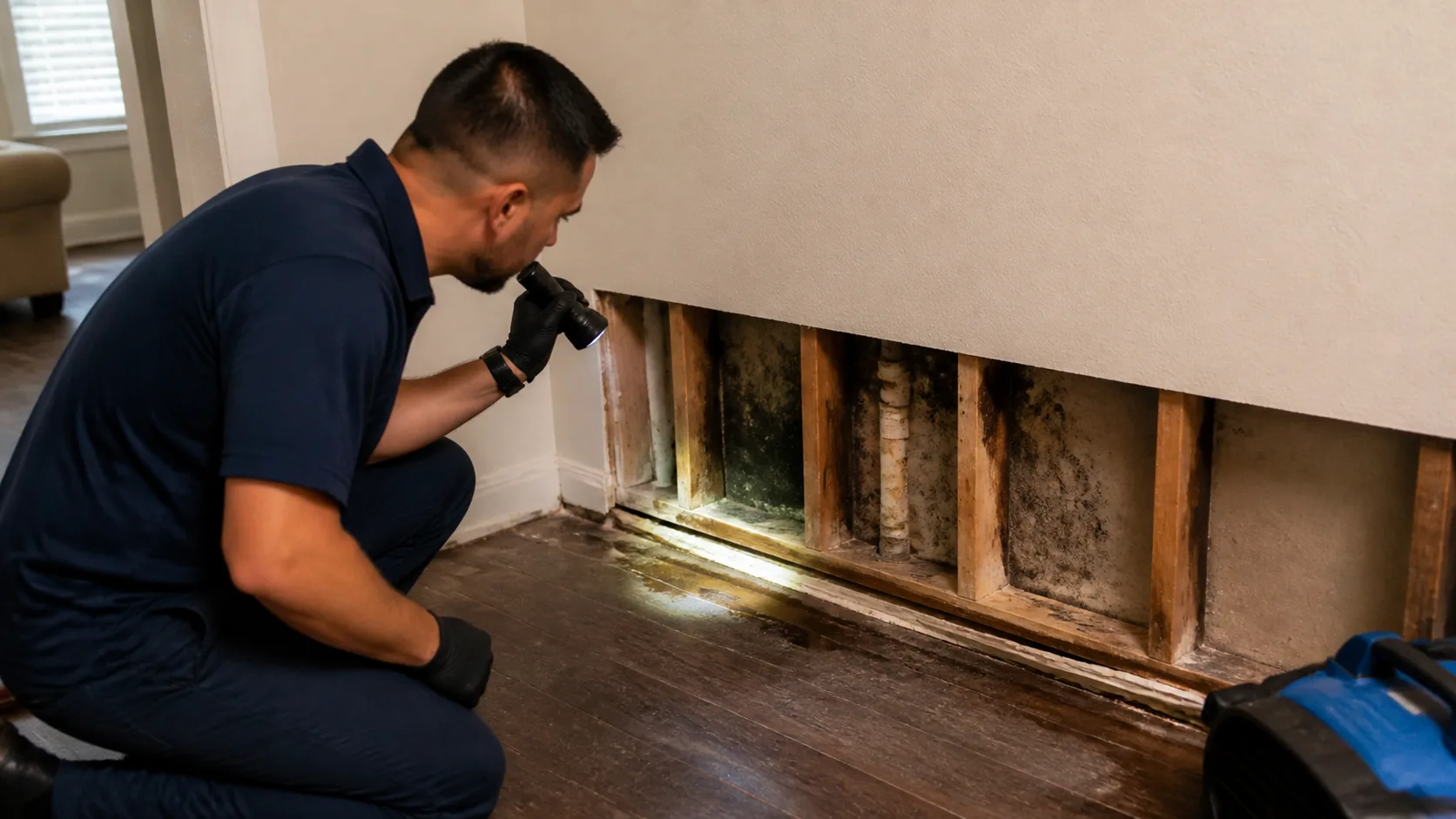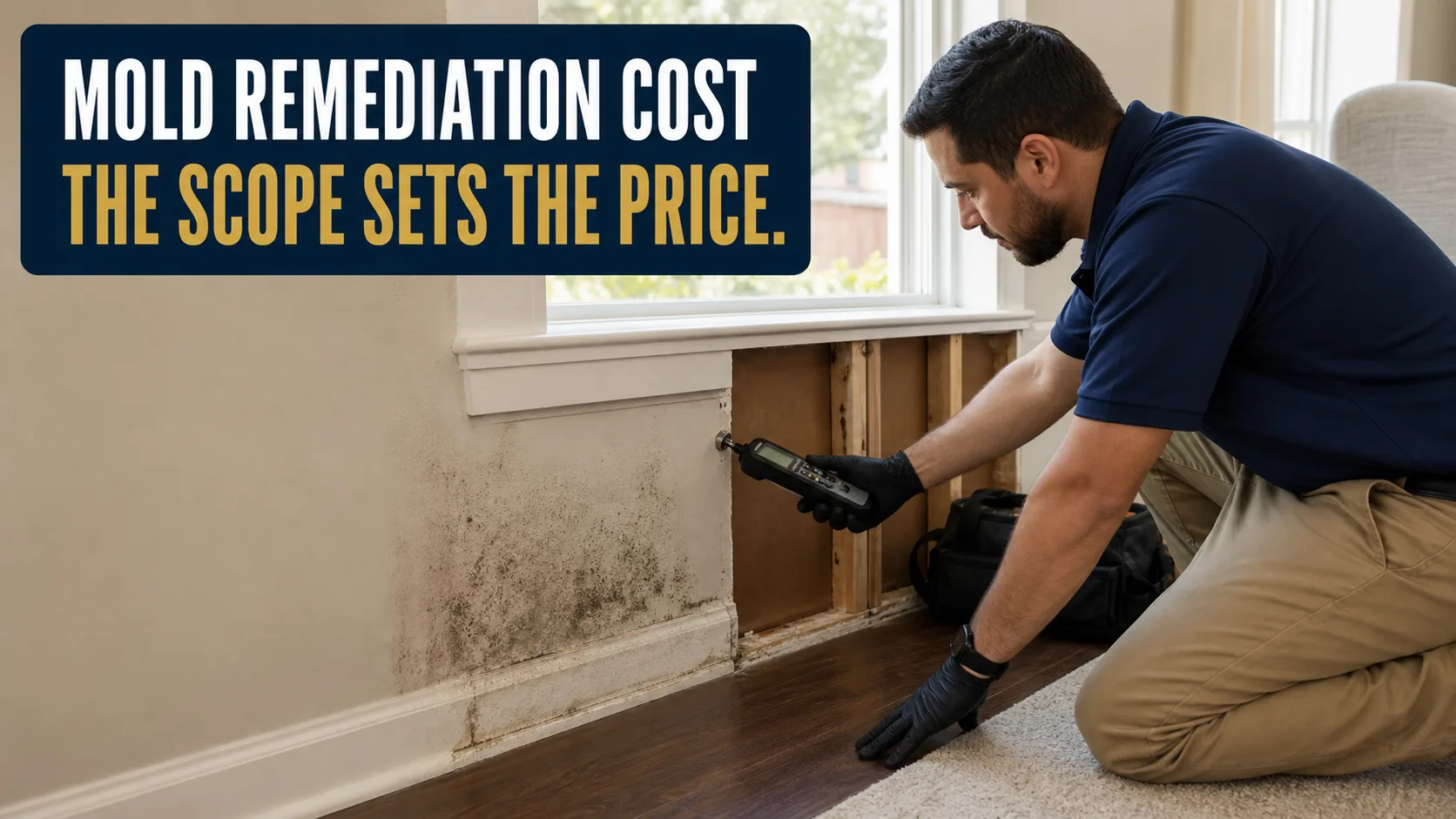
Mold remediation cost swings widely with **how much** mold there is and **where** it's growing — a small contained patch is a modest job; mold inside walls, the HVAC system, or across multiple rooms costs far more. The price is driven by material removal, hard-to-reach cavities, containment, and whether the moisture source is fixed. The cheapest remediation is the one you never need: dry the water fast, before mold's 24-to-48-hour window closes. Not sure what you're dealing with? Call **(346) 271-7004**.
Why there’s no single price
Anyone who quotes a flat mold-remediation price sight-unseen is guessing. The cost depends on real variables:
- Area affected — a bathroom corner versus several rooms.
- Location — surface mold is one thing; mold inside wall cavities or the HVAC system is harder to reach and remove.
- Material removal and rebuild — how much drywall, insulation, and flooring must come out and go back.
- Containment and air handling — protecting the rest of the building from spores during removal.
- The moisture source — if the leak feeding the mold isn’t fixed, it comes back, and you pay twice.
The cheapest remediation is prevention
Here’s the number that matters most: mold needs 24 to 48 hours of moisture to start. Nearly every mold-remediation bill traces back to water that sat too long or dried incompletely. So the single most cost-effective move is fast, complete water mitigation — extract and dry before mold establishes. That’s the difference between a drying bill and a remediation bill. The relationship between the two is spelled out in mitigation vs. restoration vs. remediation.
The 25-square-foot line that changes the job
Texas regulates mold work, and one number decides which rulebook applies. Remediation of mold contamination covering 25 contiguous square feet or more generally has to be performed by a licensed mold remediation contractor working from a written protocol, and that protocol comes from a separately licensed assessor. Below the threshold the work is usually handled as ordinary cleaning.
That number moves the price twice. Above it you pay for a licensed scope — assessment, protocol, containment, documented clearance — and for two independent firms, because the rules keep the company that finds the mold apart from the company that removes it. Below it, a contained patch on a bathroom wall is a couple of hours of careful work.
It also changes what you own afterward. A licensed remediation ends with a Certificate of Mold Damage Remediation, and that certificate follows the property — Texas requires a seller to give it to a buyer. It turns “there was mold here once” into a dated record of what was removed and who verified it.
Measure before you assume which side you are on. Contiguous means one connected patch, not three spots in three rooms added together, and what shows on the surface is routinely smaller than what is behind it — what a mold inspection costs covers who measures it.
The insurance reality in Texas
Many Texas policies cap mold coverage or require an endorsement, and coverage usually applies only when mold results from a covered sudden event that was addressed promptly. Mold from a long-neglected leak is typically excluded as a maintenance issue. This is exactly why documentation and speed matter: fast, documented drying keeps your loss in the “sudden and accidental” category rather than letting it drift into “gradual.”
A worked example: one bathroom wall
Numbers invented to show the mechanic. Nothing below is a quote or a market rate.
A supply line under a vanity fails on a Friday and nobody is home until Sunday. By the time drying starts, growth has established behind roughly 30 contiguous square feet of drywall on one wall — over the licensing line. Assume a $2,500 deductible and a policy with a $10,000 mold sub-limit.
| Line | Amount |
|---|---|
| Water mitigation — extraction, drying, logged readings | $3,200 |
| Mold assessment and written protocol, independent firm | $700 |
| Remediation — containment, removal, cleaning, clearance | $4,100 |
| Reconstruction — drywall, texture, paint, trim | $2,400 |
| Total scope | $10,400 |
The mitigation and the rebuild are ordinary water-claim lines against the dwelling coverage. The assessment and the remediation count against the mold sub-limit — $4,800 of a $10,000 ceiling. Spread the same loss across two rooms and a hallway and the mold lines alone can pass that ceiling, and the excess is yours no matter how the rest of the claim goes.
Then the settlement basis applies. On a replacement cost policy the carrier commonly pays the depreciated figure first and releases the rest once the work is finished and invoiced — the mechanic is in actual cash value vs replacement cost. The deductible comes off once against the claim, not once per contractor.
Two variables moved that total more than any other: the 48 hours the water sat, and whether the mold lines fit under the sub-limit. Only the first was under the homeowner’s control.
What to do in order
- Stop the water. Remediation over an unfixed source is money spent twice, because the growth returns on the same clock.
- Dry the structure and log the readings. Drying inside the first 24 to 48 hours is the only step that can delete the remediation bill entirely.
- Measure the affected area once materials are open, and write the number down. Twenty-five contiguous square feet decides which rules apply.
- Get an assessment if you are over the line, from a licensed assessor who is not performing the removal.
- Report the loss to your carrier, describing the sudden event and the date you found it, and ask what your mold sub-limit is.
- Have the remediation performed against the written protocol, with containment and documented clearance.
- File the Certificate of Mold Damage Remediation with your closing documents.
- Book the rebuild last, after clearance — never before.
What to photograph, and why an adjuster cares
Each item below answers a question the file gets asked later.
- The failed part, before it leaves the house. It establishes a sudden cause, and its warranty history opens a recovery path — see subrogation explained.
- The water at discovery, date stamp on. A sharp wet edge and a clean line read as a sudden discharge. Rust rings and layered tide marks read as months.
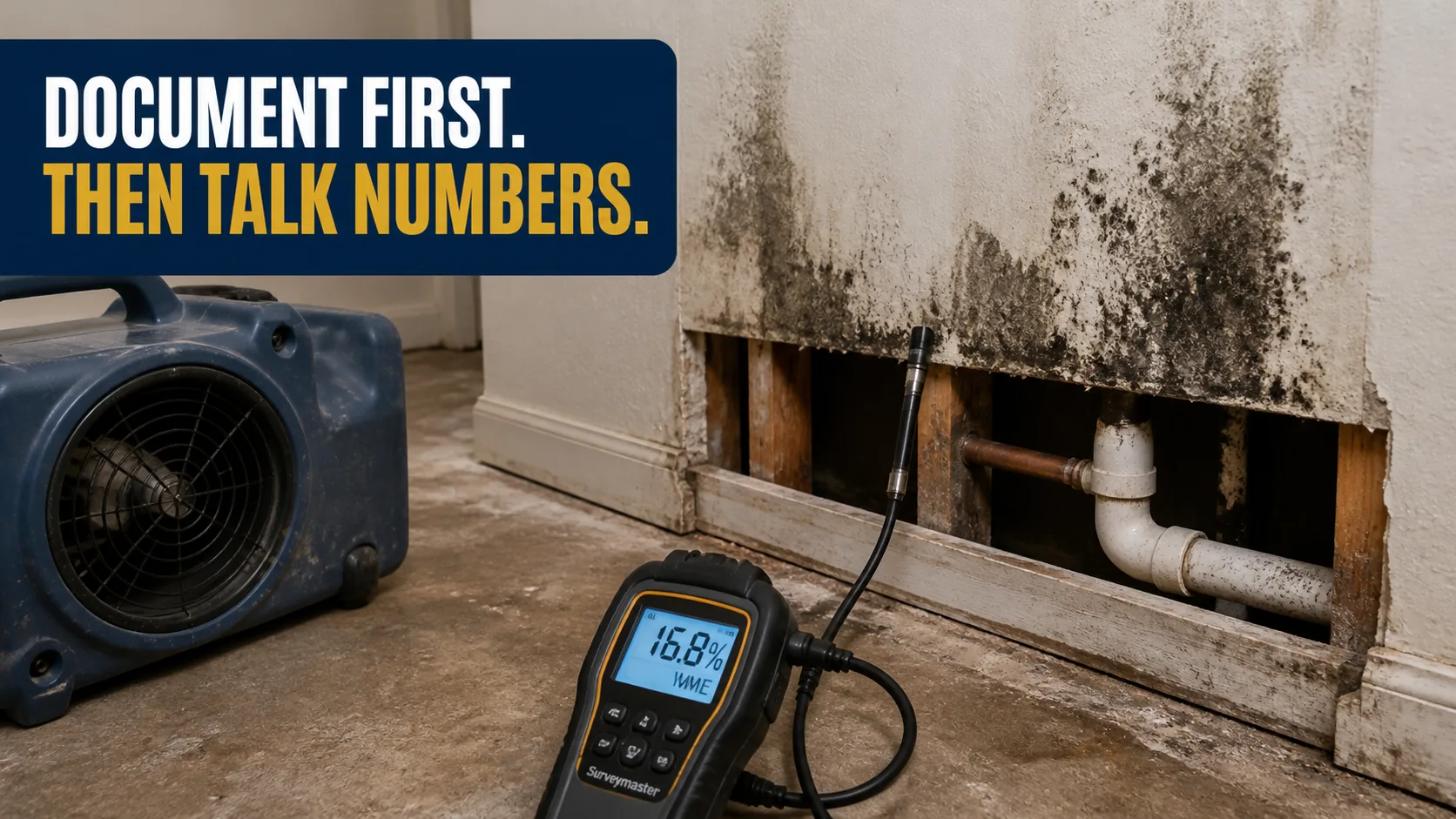
- A tape measure in the frame of the affected area. That square footage sets the regulatory scope, and a photo of it beats a recollection of it.
- The daily moisture readings. They show the water was addressed promptly, which is the condition most Texas mold coverage attaches to.
- The protocol, the clearance report, and the certificate, which show the removal met a standard rather than was described as finished.
- Invoices itemized against the scope. Paperwork that reconciles releases held-back depreciation; paperwork that does not stalls the file.
What the claim timeline looks like
Texas claim-handling rules set general windows, not promises. An insurer normally has about 15 days from notice to acknowledge the claim, start investigating, and ask for what it needs, then about 15 business days after it receives everything it requested to accept or reject the claim in writing, with a limited extension if it explains the delay in writing. Those periods can shift after a declared catastrophe, and your own policy and the current rules govern. The Texas Department of Insurance publishes the requirements and takes complaints.
The work runs on its own clock. Drying is three to five days on a contained loss, assessment and protocol add a day or two, and remediation on one wall is a couple of days inside containment — a multi-room scope runs one to three weeks. Reconstruction follows clearance. The only deadline that never moves is the mold clock, and what sets a drying timeline applies before any mold scope exists.
Bottom line
If you have active water, don’t wait to “see if it dries” — that waiting is what creates the remediation bill. Get it dried fast and documented. For the water-side cost picture, see water damage mitigation cost in Houston.
Do this tonight, free
- Find your declarations page. Write down the deductible, the dwelling settlement basis, and any mold limit or endorsement.
- Run a hand along the wall bases in any room that has ever had a leak. Cool or soft is a reading worth chasing.
- Photograph any staining you can see, date stamp on, before anyone touches it.
- Measure the visible patch and write the square footage down.
- Look under both sinks and behind the washer for the drip that is feeding it.
- Do not spray bleach on porous material. It deodorizes the surface, reaches nothing behind it, and ruins the photograph you needed.
- Do not open the wall to look. Cutting without containment moves spores into rooms that were clean.
Where remediation ends and we begin
TruePoint Restoration is a water mitigation and mold remediation company. We are not your public adjuster, not your claims representative, and not your attorney. Texas keeps those roles apart from the contractor doing the work, and we keep to our side of it — we do not negotiate settlements and we do not tell you what your policy covers.
What we do is the physical work and the record: metering the extent, drying with daily logged readings, containing and removing what cannot be saved, and handing you a file your adjuster can read without translation. Where a scope crosses the licensing threshold, we work to a written protocol from an independent assessor.
If a claim is genuinely in dispute, a Texas-licensed public adjuster, an attorney, or the Texas Department of Insurance is who takes that up. If there is water in your house tonight, call (346) 271-7004. We serve Pearland, Manvel, Friendswood, League City and the Greater Houston area.