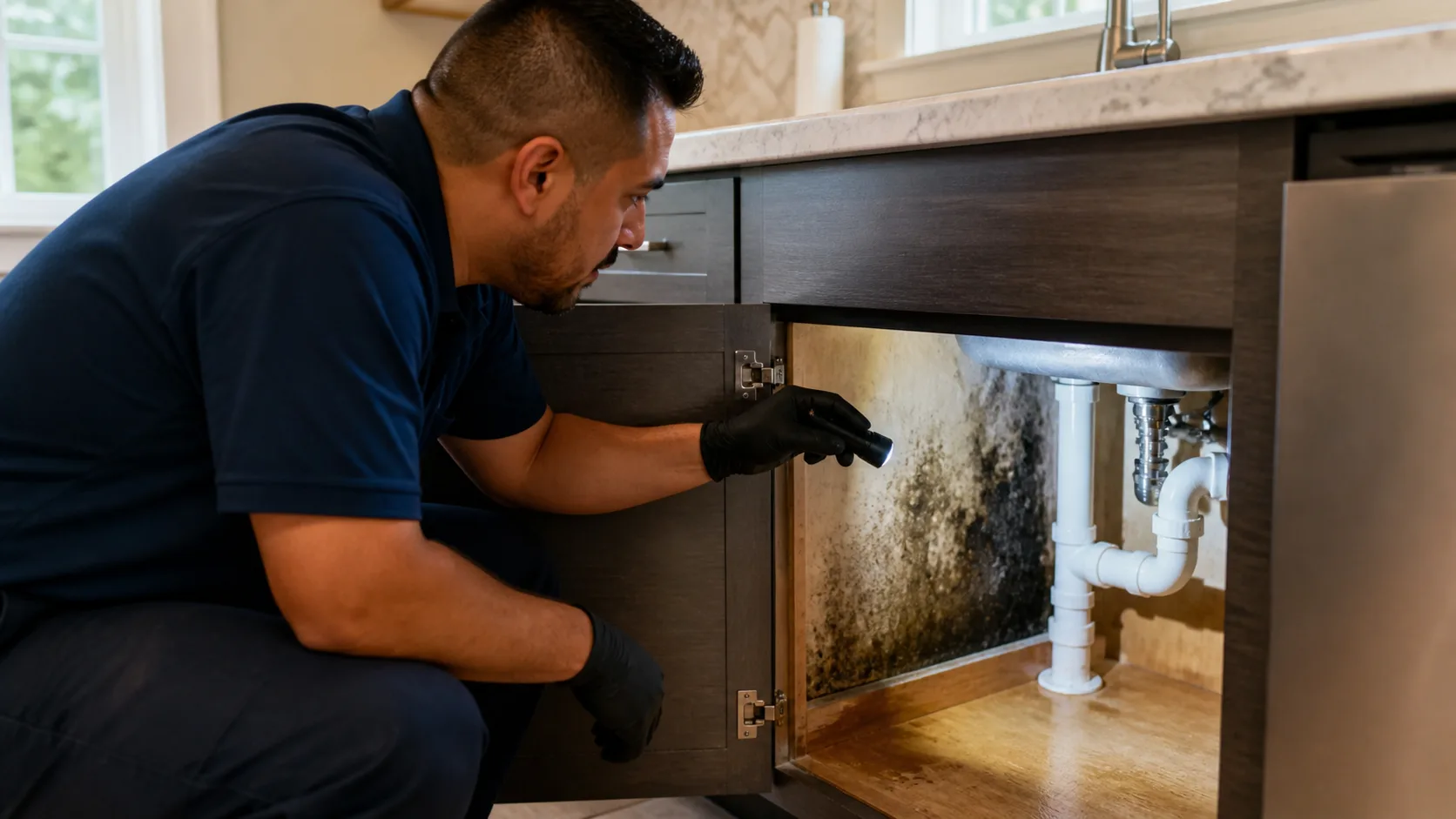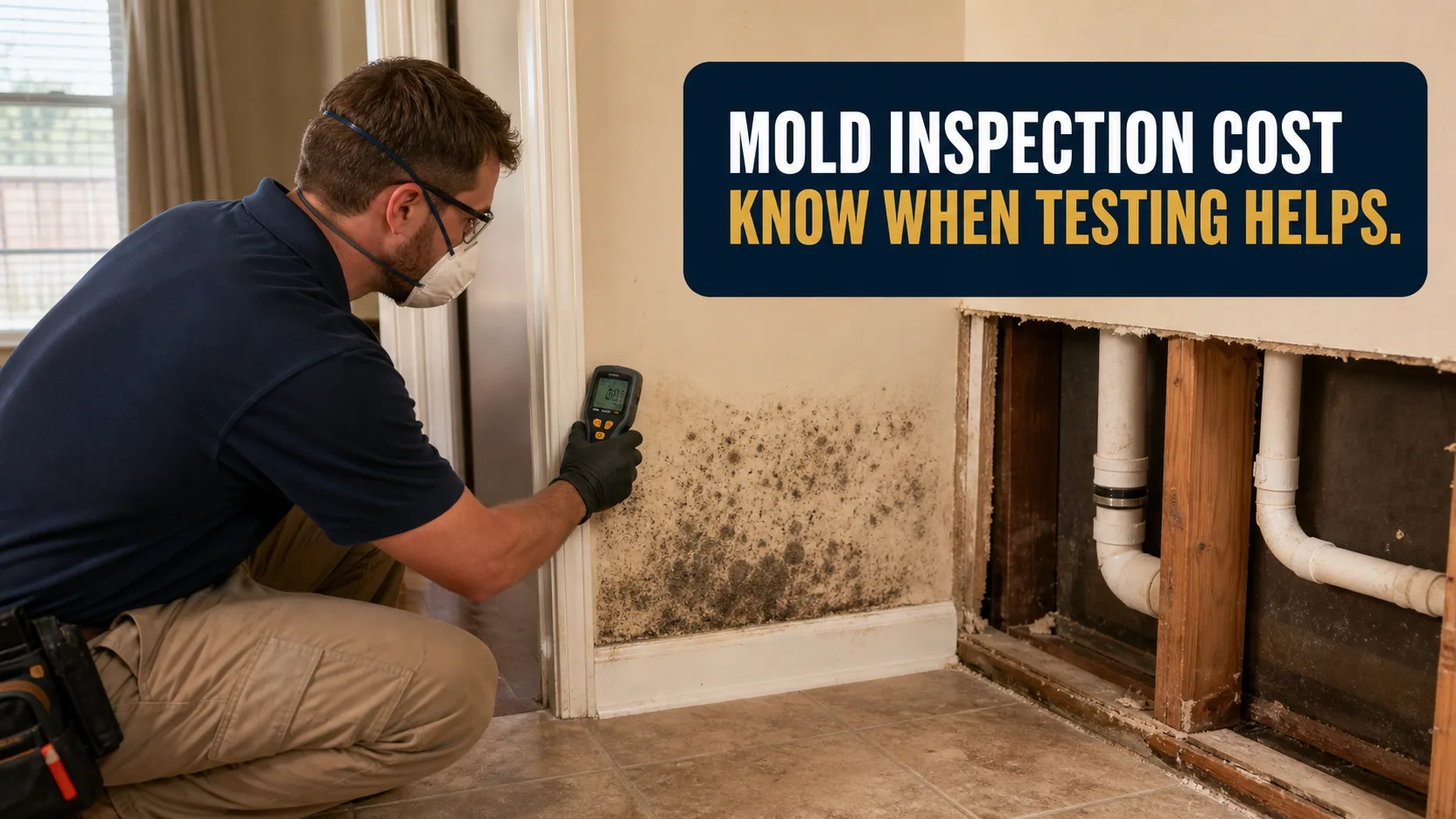
A mold inspection is usually priced as a flat visit fee, and lab testing is charged separately per sample, so the total depends on how many samples get pulled. If you can already see mold, a test rarely changes what happens next — you need the moisture source found and the mold removed. Testing earns its money in disputes, real estate deals, health-driven situations, and clearance after remediation. Call **(346) 271-7004**.
What are you actually paying for in a mold inspection?
You are paying for someone to find water, not to find mold. That distinction is the whole reason this page exists.
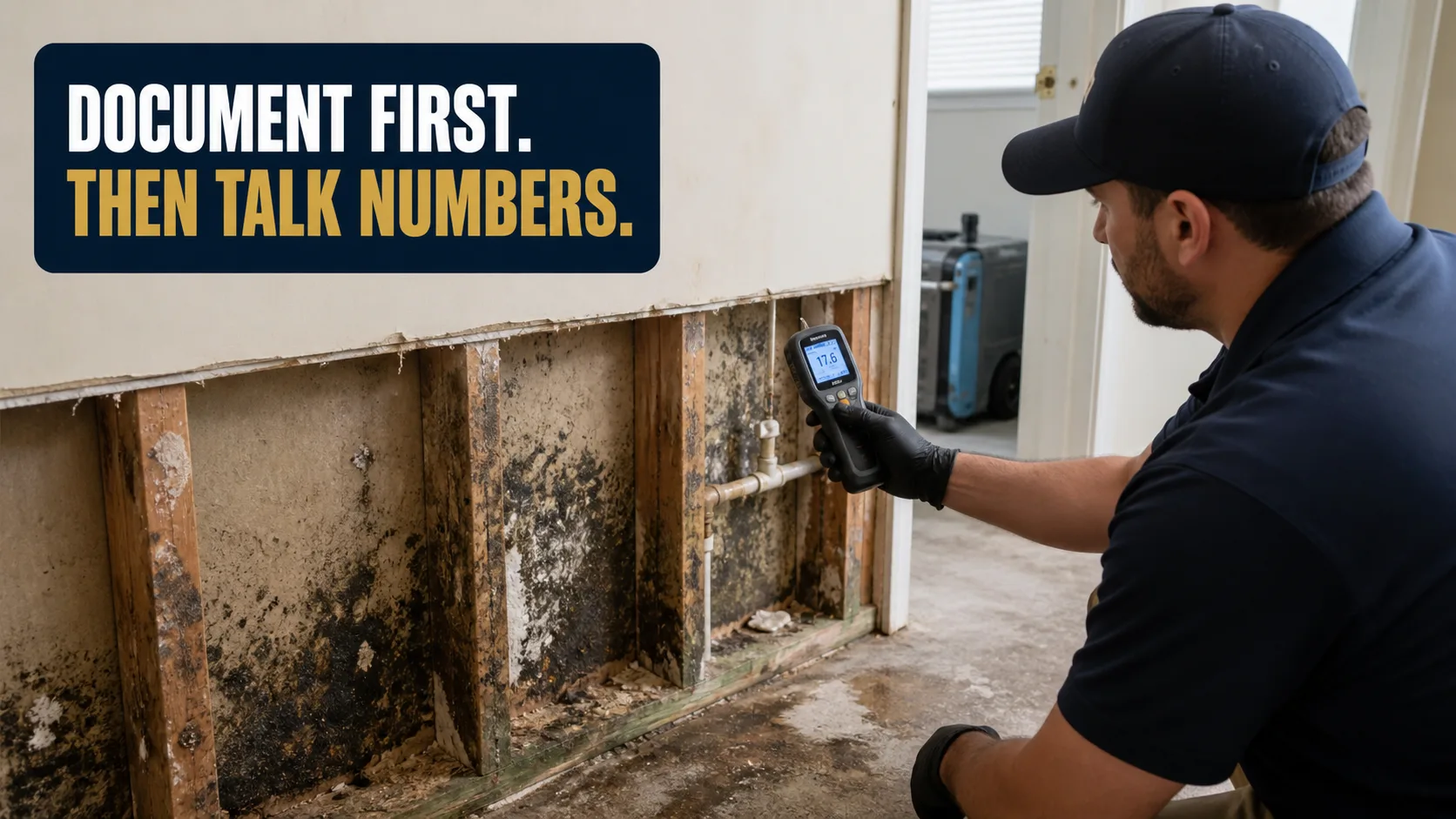
A good inspection is a person walking your property with a moisture meter, often a thermal camera, and a working knowledge of how water moves through a building. They check the obvious suspects — under sinks, around the water heater, at the HVAC drain, along exterior walls, behind the washing machine — and they read the wall bottoms and subfloor for moisture you cannot see. Then they tell you where water is, where it has been, and what it has probably damaged behind the surface.
Lab testing is a separate thing entirely. Testing collects air or surface samples and sends them off to be analyzed. It tells you what kind of spores are present and in what quantity. It does not tell you where the water is coming from, and it cannot find a wet cavity.
That is why the inspection is the part that changes your outcome, and the testing is optional depending on your situation.
What does a mold inspection cost?
Most inspections are quoted as a flat fee for the visit, scaled by property size and how much of the building needs assessing. A single-room complaint — one bathroom, one closet, one ceiling stain — sits at the low end. A whole-home assessment with a written report, moisture mapping across every room, and thermal imaging sits at the high end.
Three things move that number:
- Scope. One suspect area versus the entire building.
- Documentation. A verbal walkthrough and a few photos costs less than a formal written report with a remediation protocol that a contractor can bid from.
- Tools used. Moisture meter only, versus moisture meter plus thermal imaging plus borescope inspection inside cavities.
Lab testing is nearly always billed separately, per sample. This is where quoted inspection fees and final invoices part company, so ask up front how many samples are planned and what each costs.
What does mold testing cost on top of that?
Testing is priced per sample, not per job, which means the sample count decides the bill more than the rate does. A minimum sensible test is one indoor sample plus one outdoor control sample, because indoor spore counts are meaningless without an outdoor baseline to compare them against. A larger home with several suspect areas can easily reach five or more samples, and the cost scales roughly with that count.
Here is the relative picture, from cheapest to most expensive:
| Service | What it is | What you get | Relative cost | When it earns its money |
|---|---|---|---|---|
| Visual inspection only | Walkthrough, photos, verbal findings | An opinion on whether there is a problem | Lowest | You want a second opinion before spending real money |
| Inspection with moisture mapping | Moisture meter and thermal imaging across the property | Where the water is and how far it traveled | Low to moderate | Almost always the right first step |
| Surface sampling (swab or tape lift) | A sample lifted from visible growth | Confirmation of what is growing on that spot | Low, per sample | You need documentation that a specific spot is mold |
| Air sampling with outdoor control | Indoor spore counts compared to an outdoor baseline | Whether indoor counts are elevated relative to outside | Moderate, per sample | Nothing is visible but symptoms or odor persist |
| Full assessment with written protocol | Inspection, sampling, and a scope document a contractor can bid from | An independent, biddable remediation plan | Highest | Disputes, insurance claims, large or complex jobs |
| Post-remediation verification | Independent clearance test after the work | Confirmation the work area is actually clean and dry | Moderate | After any remediation you paid meaningful money for |
When is mold testing worth the money?
In four situations, and they are all situations where the piece of paper does something a pair of eyes cannot.
1. Disputes. A landlord who says there is no problem. A builder denying a defect. An insurer questioning the extent of a loss. In each of these, an independent lab report is documentation with a date on it, and that is worth paying for.
2. Real estate transactions. A buyer needs an independent record before closing, or a seller needs one to head off a renegotiation. Neither side wants the other side’s contractor deciding what is true.
3. Health-driven situations. Someone in the household has asthma, allergies, or a compromised immune system and is reacting to something in the home. If a doctor is asking what is in the air, testing gives them data. To be clear about scope: we handle buildings, not people, and health questions belong with your physician.
4. Post-remediation verification. After the work is done, before anything gets closed back up. This is the test that protects your money.
When testing is money you do not need to spend
If you can see mold growing on a wet material, a lab report saying “this is mold” does not change one thing about what happens next.
The response is the same regardless of what species comes back: find the moisture source, stop it, remove the affected porous material, dry the structure, and verify it is dry before closing it up. Species identification does not alter that sequence. Neither does a spore count. What alters the sequence is finding out how far the water traveled, and that is a moisture meter question, not a lab question.
So if a company’s first move on a visible, obvious mold problem is to sell you a testing package, ask them directly: what will the result change about the work you would do? If the answer is nothing, put that money toward finding the leak instead. The same logic applies to a persistent musty smell with nothing visible — the smell tells you moisture is feeding something, and the next step is locating the water, not cataloguing the spores.
Should the same company test and remediate?
For anything contested, no. This is a real conflict of interest, and it exists whether or not the company is acting in good faith.
Think about the structure of it. A company that profits from remediation is the same company deciding whether remediation is needed, defining how large the affected area is, and later confirming its own work passed. Even an honest operator has a thumb on that scale without meaning to. In some jurisdictions the separation is required for exactly this reason.
Where you genuinely want independence:
- Any dispute with a landlord, insurer, builder, or HOA.
- Real estate transactions, where both parties need to trust the report.
- Post-remediation clearance testing. Never let the company that did the removal be the only party certifying the removal worked.
Where one company handling it is usually fine: a visible, straightforward, single-source leak where you already know what happened, the scope is obvious, and you just want it fixed properly. If your dishwasher supply line let go last Tuesday and the cabinet base is wet, you do not need an independent assessor to establish that.
We say this plainly because it is the kind of thing homeowners find out too late: ask any company whether they perform both, and if they do, decide deliberately whether that is acceptable for your situation.
Is a black mold test worth the extra cost?
Usually not, and the reason is that the question underneath it has a different answer than people expect. What gets called black mold is not one species, and color tells you nothing reliable about what you are dealing with or how it should be handled. More on that in black mold after water damage.
An inspector will not charge you more for a black mold inspection than any other mold inspection, because the inspection is identical. If you want species confirmed, you are buying lab sampling, priced per sample as above. And species identification, once you have it, rarely changes the remediation plan — extent and location drive that, not what grows on the plate.
Where identification does matter is when a physician has asked for it, or when a legal or insurance process specifically requires it. Those are legitimate reasons. Curiosity is an expensive one.
What about a free mold inspection?
Free inspections exist and some are genuinely useful, particularly when a restoration company is assessing an active water loss they may end up handling. That is a sales visit that also produces real information, and there is nothing wrong with it as long as you know which one it is.
What a free inspection generally is not: independent, documented, or suitable for a dispute. If you need a report that will stand up in front of an insurer or a buyer, you are paying for it. If you just want a competent set of eyes on a wet cabinet, free is fine.
The distinction that matters is not free versus paid — it is whether the person inspecting has a stake in the answer. On an active claim, understanding what your policy actually covers before anyone inspects will make the whole conversation shorter.
Do this yourself before you book anything
Half the inspections we hear about could have started from a better place, because the homeowner already had the information and did not know it counted. Before you spend anything, work through this:
- Write down the timeline. When did you first notice it? Was there a leak, a storm, an appliance failure, an AC issue? Dates matter enormously for insurance.
- Photograph everything now, including the wide shot that shows where in the room it is. Photos taken before anyone touches anything are the most valuable documentation you will ever have.
- Follow the smell. Musty odor is strongest closest to the source. Walk the room slowly and note where it intensifies.
- Check the usual suspects yourself. Under every sink, behind the toilet, at the water heater, at the HVAC drain pan and secondary line, behind the washer, and along the bottom of exterior walls.
- Touch the baseboards. Soft, swollen, or separating from the wall means water sat there.
- Buy a cheap moisture meter. A basic pin meter costs less than a restaurant meal and will tell you more about your actual problem than a lab report will.
- Note who else is affected. If one person in the house reacts in one specific room, that is useful information for both an inspector and a doctor.
- Ask any inspector these two questions: do you also perform remediation, and what will a test result change about the recommended work?
That list is free, it is most of what an initial assessment establishes, and it makes any inspection you do buy faster and more accurate.
Getting a straight answer
If the outcome you actually want is a dry house rather than a document, the sequence is: find the water, stop the water, remove what cannot be saved, dry the rest, verify it is dry. Testing supports that process in specific situations and substitutes for it in none. As for what the removal itself will run, the cost breakdown and the Houston mold cost overview cover the drivers, and mold after water damage covers how it started.
TruePoint Restoration is based in Pearland and works across Greater Houston. If you want someone to find where the water is before you spend money on anything else, call (346) 271-7004 or email claims@truepointrestoration.com. And if you would rather have an independent assessor handle the testing side, that is a reasonable choice and we will tell you so.
TruePoint Restoration is a mitigation and remediation contractor, not a public adjuster, a claims representative, or a law firm. Texas keeps those roles separate from the company performing the repair work, and a public adjuster generally may not hold a financial interest in the repairs — so we do not negotiate settlements or represent anyone on a claim. Where a dispute is real, that is work for a Texas-licensed public adjuster, an attorney, or the Texas Department of Insurance.