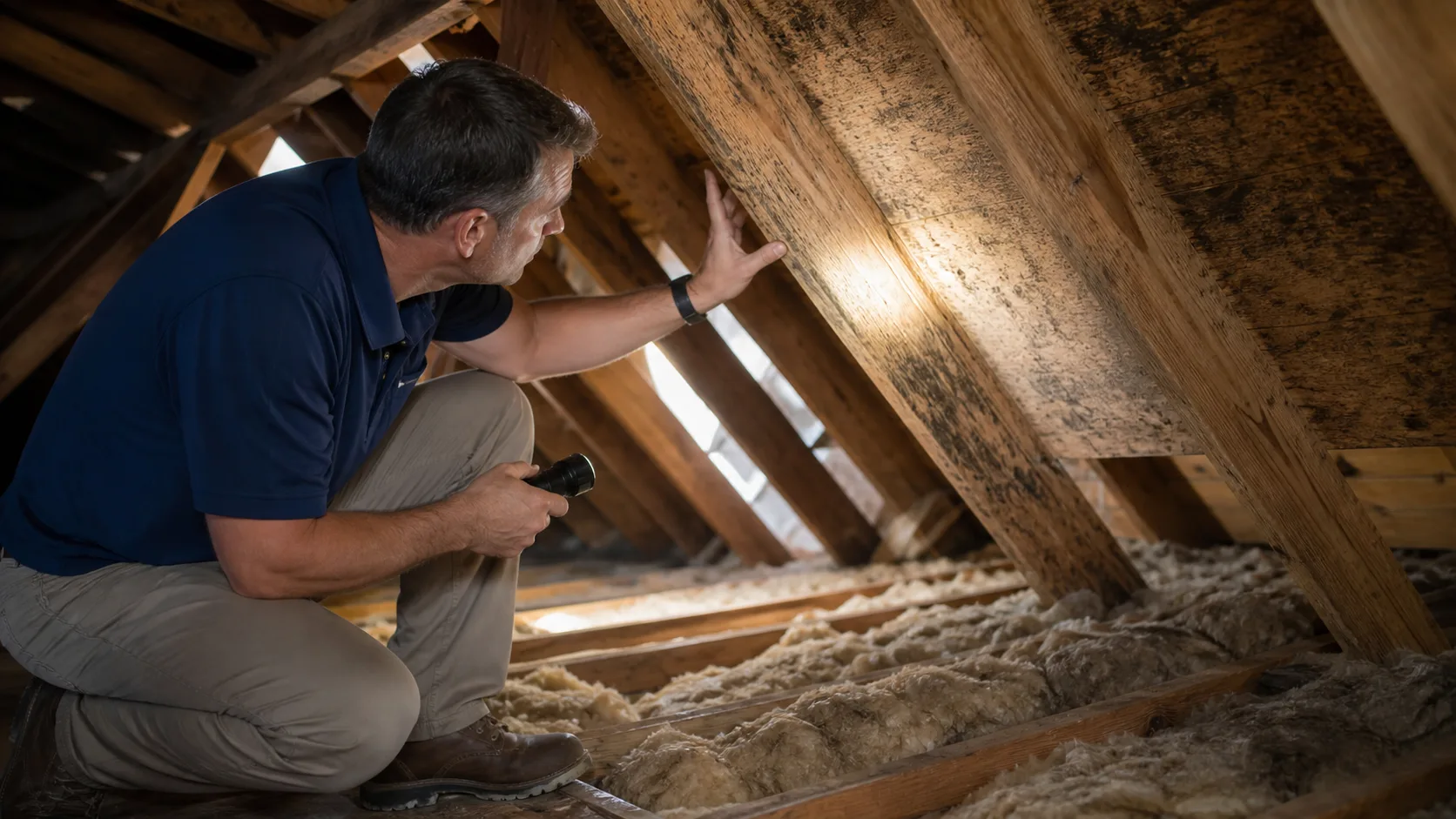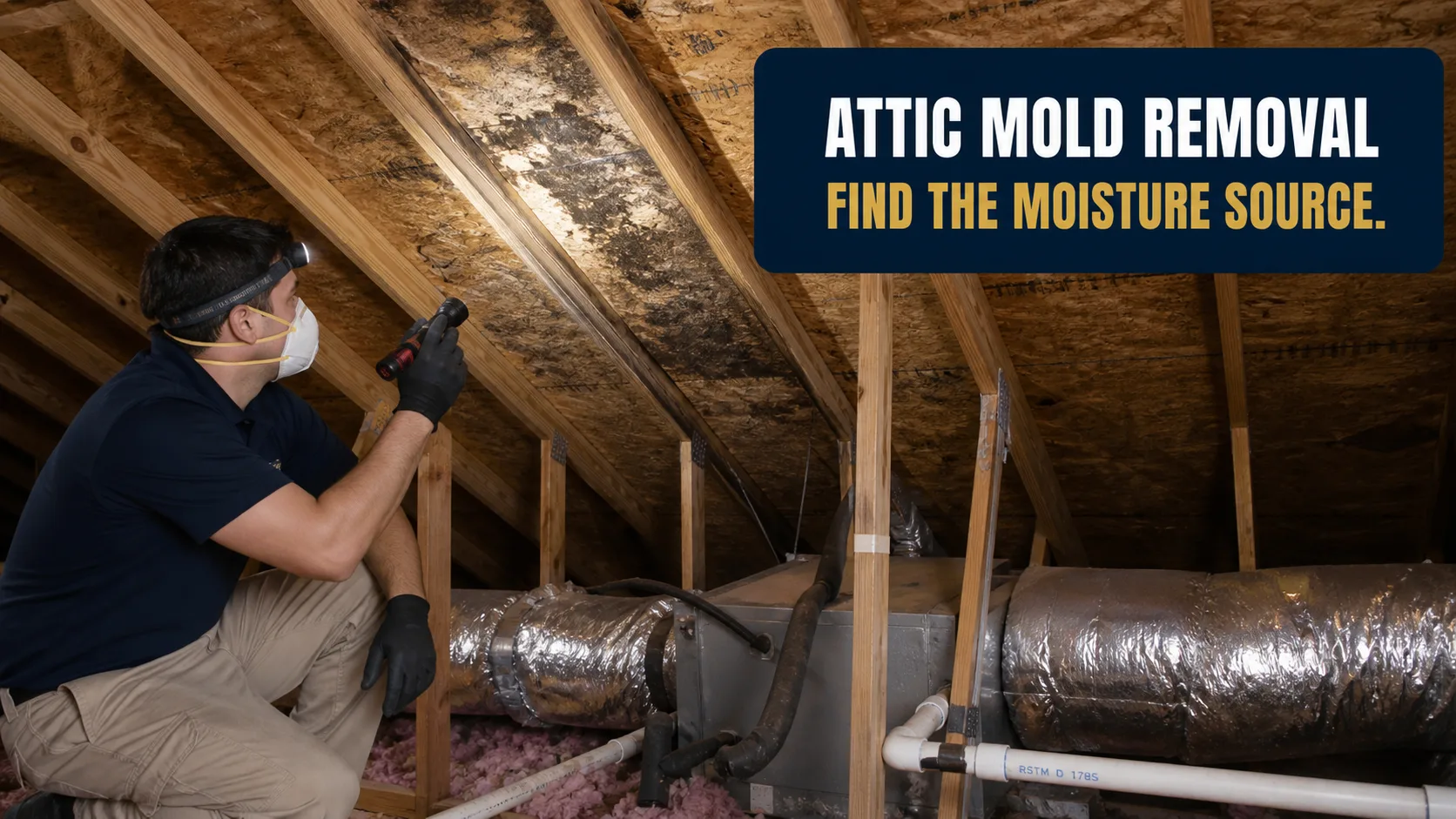
Attic mold removal only holds if you fix the moisture first. In Houston that usually means a roof leak, a bathroom fan venting into the attic, blocked soffit vents, or sweating AC ductwork. Then the work is containment, HEPA cleaning, removing or treating the affected sheathing, and correcting the ventilation. Clean it without the ventilation fix and it returns within a season or two. Call **(346) 271-7004**.
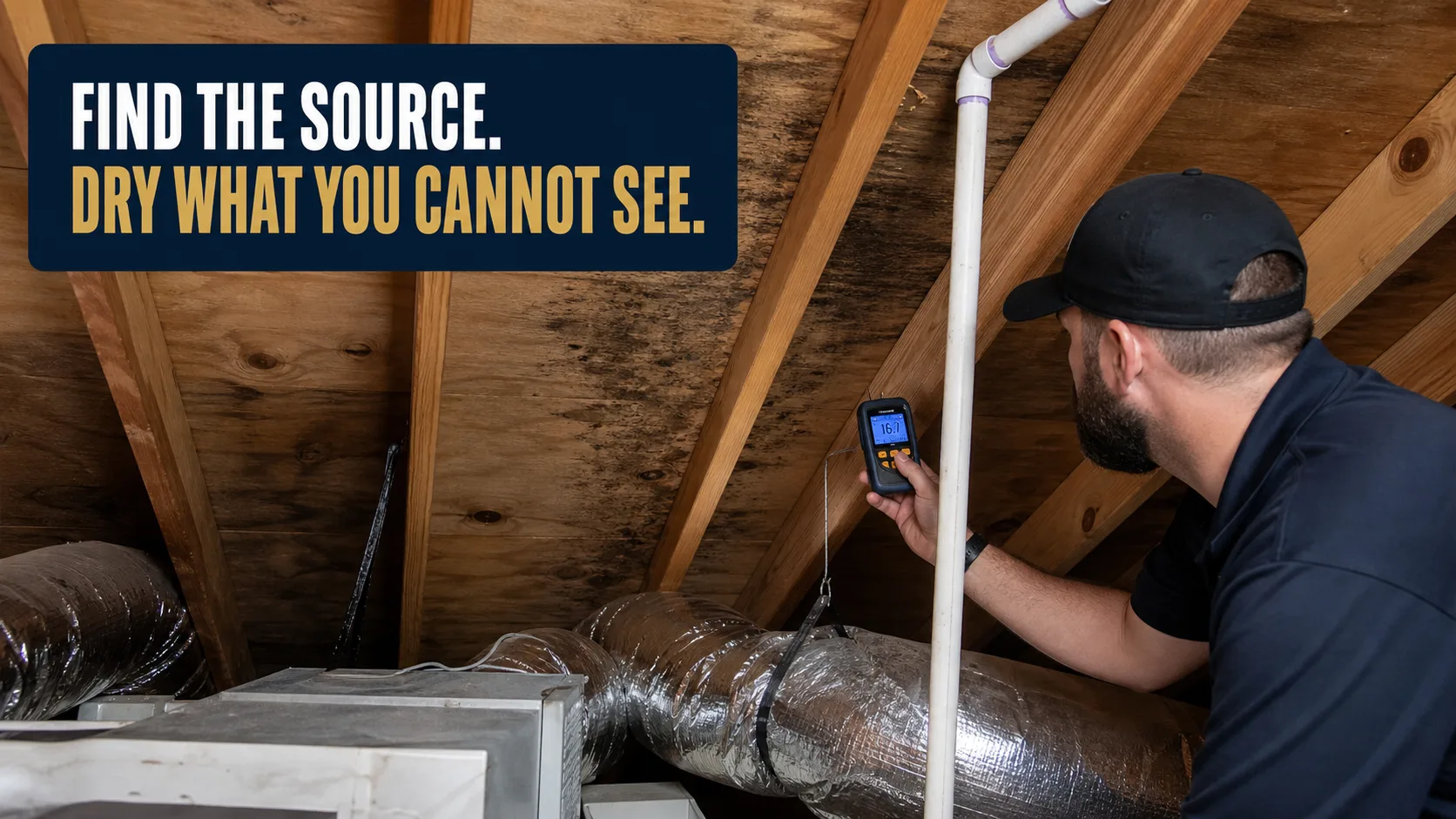
Why do Houston attics grow mold?
Because a Houston attic hands mold everything it needs. Mold needs spores, which are in every home already, a food source, which is the wood deck and paper facing over your head, and moisture. The first two are permanent. The third is the only variable, and on the Gulf Coast it is rarely in short supply.
An attic in Pearland or Katy can sit above 120 degrees in August with outdoor air near saturation. Every time humid air touches something cooler — an uninsulated duct, the underside of the roof deck on a clear winter night — moisture condenses on it. Add any of the following and you have a colony rather than a damp patch:
- A roof leak you have not found yet. Slow leaks around flashing, pipe boots, and nail pops do not drip onto your ceiling for months. They soak the sheathing first. If it has already reached the ceiling, that is water leaking from the ceiling when it rains.
- A bathroom fan venting into the attic instead of outside. This is one of the most common causes we find. The fan runs, the mirror clears, and every shower sends warm wet air straight up into the attic. Sometimes the duct was never connected to the roof jack. Sometimes it fell off years ago and nobody looked.
- Blocked soffit vents. Blown-in insulation drifts into the eaves and plugs the intake. Air stops moving, humidity has nowhere to go, and the sheathing near the eaves is usually the first thing to darken.
- AC ductwork and air handlers sweating. Torn or compressed duct insulation lets 55-degree air chill the outer jacket in 95-degree attic air. It condenses, drips, and wets whatever sits below. A clogged condensate line does the same thing faster and wetter — see HVAC drain line maintenance.
Three of those four have nothing to do with your roof. That is worth remembering when someone looks at attic mold and quotes you a roof.
The moisture sources and what actually fixes each one
| Moisture source | What you tend to see | The fix that holds |
|---|---|---|
| Roof leak at flashing, boot, or nail pop | Dark staining in a defined path down the rafters, worse after rain | Roofer repairs the penetration, then dry and remediate |
| Bath fan venting into the attic | Growth clustered above one bathroom, drips in cool weather | Duct routed to a roof or gable termination, sealed and strapped |
| Blocked soffit vents | Even darkening along the eaves, attic feels stuffy and still | Clear the intakes, install baffles, balance intake against exhaust |
| Sweating AC ducts or air handler | Damp insulation directly under duct runs, rust on the drain pan | Repair duct insulation, seal the jacket, clear the condensate line |
| Dryer or kitchen exhaust in the attic | Lint or grease film near the outlet, damp insulation | Terminate outside the building envelope, never inside it |
| Under-ventilated roof with no real exhaust | Uniform staining across the whole deck, no single source | Add exhaust, verify intake, correct the net free vent area |
Every row has the same shape. The growth is downstream of the moisture. Remediation is the second half of the job; the first half is working out which row you are in.
How do you know if you have attic mold?
Most people find out one of three ways: an inspector’s photo during a sale, a musty smell that seems to follow the AC around the house, or a trip up the ladder for something else entirely.
If you are checking it yourself, go up on a dry day with a good flashlight and look at:
- The underside of the roof deck, especially near the eaves and in the corners. Sound sheathing is a fairly uniform light color. Mold reads as grey, black, green, or white patches with a fuzzy or speckled texture, rather than the flat discoloration of a water stain.
- Directly above every bathroom. Follow each fan duct with your eyes. If one simply ends in open air, you have found your source and most of your answer.
- The insulation under the duct runs. Compressed, darkened, or damp-feeling insulation means something above it has been dripping.
- The soffit line. If you cannot see daylight or feel any air movement at the eaves, the intake is plugged.
- Your nose. A persistent earthy, musty odor upstairs often arrives before anything is visible. More on that in the musty smell that will not go away.
One caution about appearance: color does not identify the species and does not tell you how dangerous something is. Black growth is not automatically worse than white or green growth, and a fair amount of dark staining on sheathing turns out to be old water staining or mineral discoloration rather than mold at all. We go through that in black mold after water damage. What matters is whether something up there is still getting wet.
What does professional attic mold removal involve?
Proper attic mold removal is five steps, and the first one is not cleaning.
- Find and fix the moisture source. Nothing else on this list matters if the deck gets wet again next week. A roof leak means a roofer. A misrouted fan or a torn duct is mechanical work that can often run alongside the remediation.
- Contain the work area. The attic hatch is sealed, negative pressure is established with a HEPA-filtered air scrubber, and the space below is protected. Attics connect to the living area through recessed light cans, wiring penetrations, and leaky return ducts, so disturbing growth without containment simply relocates it.
- Remove what cannot be cleaned. Contaminated insulation is bagged and taken out. Insulation is porous, holds both spores and moisture, and costs less to replace than to attempt to salvage.
- Clean or replace the affected wood. Framing and sheathing are usually cleanable, because wood is dense enough that growth stays largely at the surface. The methods are physical: HEPA vacuuming, controlled abrasive cleaning such as soda or dry ice blasting on larger jobs, wire brushing on small areas, then an antimicrobial and usually an encapsulant. Sheathing gets replaced when the wood is soft, spongy, or delaminating, which is a moisture-damage call more than a mold call.
- Correct the ventilation and verify the result. Baffles at the eaves, intakes cleared, exhaust adequate, every duct terminating outside, insulation reinstalled to the right depth without choking the vents. Then a final HEPA vacuum and a moisture reading on the deck, so what you are closing up is measurably dry.
Does attic mold removal spray work on its own?
No, and this is worth being blunt about, because attic mold removal spray is marketed hard as a shortcut.
A spray does one thing. It kills or bleaches what it lands on. It does not remove the material, and dead growth left in place still has to be cleaned off. It does not reach the far side of the sheathing, the seams between panels, or the underside of the insulation. And it does nothing whatsoever about the bathroom fan that has been humidifying your attic for six years.
There is a narrow case where a spray-and-encapsulate approach is honest: a small patch on sound wood, where the moisture source has already been corrected and the deck reads dry on a meter. If that is what you have, you should be told so rather than sold a full remediation. Bleach specifically is a poor choice on wood — it is mostly water, so it soaks in and adds moisture while the chlorine stays on the surface.
Should the sheathing be cleaned or replaced?
Most attic sheathing gets cleaned rather than replaced. Here is roughly how that call gets made.
| Situation | Typical call |
|---|---|
| Surface growth on sound, dry plywood or OSB | Clean, treat, encapsulate |
| Widespread staining, wood still firm | Abrasive cleaning, then encapsulate |
| Wood soft, spongy, or delaminating | Replace the affected sheathing |
| Growth on rafters or truss members | Clean; structural replacement is uncommon |
| Contaminated batt or blown-in insulation | Remove and replace, essentially always |
| Growth inside the AC ductwork | Flex duct is usually replaced rather than cleaned |
Encapsulation matters more than people expect. Cleaning rarely removes every trace of staining from wood, and sealed, treated sheathing reads as remediated to the next inspector instead of looking like an active problem.
What does attic mold removal cost?
Cost tracks square footage, access, and how much material has to leave the house — not how alarming the growth looks. Some typical Houston-area ranges, as orientation rather than a quote:
| Scope | Typical range |
|---|---|
| Small contained area, moisture already fixed | roughly $500 to $1,500 |
| Average attic, cleaning plus partial insulation removal | roughly $1,500 to $4,000 |
| Full attic, all insulation out, abrasive cleaning, encapsulation | roughly $4,000 to $8,000 |
| Sheathing replacement or significant structural work | $8,000 and up |
The moisture repair sits on top of that. Rerouting a bath fan and terminating it properly is usually a few hundred dollars; soffit baffles and added exhaust are typically modest; a roof repair is its own number entirely.
These ranges move with attic size, roof pitch, access, and how many bags of insulation come out. Two things reliably inflate a price and should not: a scope that assumes replacement where cleaning would do, and an air test sold before anyone has gone looking for the water. There is more on how remediation pricing is built in mold remediation cost in Houston.
How long does attic mold removal take?
One to three days for cleaning and treating a typical single-story attic, once access is set up and containment is in place. Longer when insulation has to come out across the whole footprint, when sheathing is being replaced, or when the ventilation correction happens in the same visit.
If the affected area crosses 25 contiguous square feet, Texas mold rules apply and the schedule stretches to one to three weeks end to end, because an independent consultant writes the protocol and verifies the result before anything is signed off.
Readings decide, not the calendar. Sheathing and framing get metered until they reach dry standard, and new insulation goes back only after the ventilation fix is in — otherwise the same attic is back on the same schedule next summer.
Does homeowners insurance cover attic mold?
Usually not, and the reason is worth understanding before you file. Most Texas policies cover mold only when it results from a covered sudden event that was addressed promptly, and many cap mold coverage or require a separate endorsement. Attic mold is almost always the slow kind — a fan venting wrong since the house was built, a leak weeping since the last hail storm, ventilation undersized from day one. To an adjuster, that reads as maintenance, and maintenance is excluded.
The exception is real. If a storm opened your roof last month and the attic got wet in a documented event, that is a different conversation, and how fast and how thoroughly it was dried is what protects the claim. The same logic runs through mold after water damage anywhere else in the house.
Why cleaning without fixing the ventilation guarantees a repeat
An attic that grew mold once has already proven it holds moisture. Cleaning removes the evidence. It does not change the conditions.
If the intake is still blocked and the exhaust is still undersized, the deck goes back to condensing on cool nights and staying damp through humid mornings. If the bath fan still empties into the attic, every shower keeps feeding it. Growth reappears in the same spots, usually within a season or two, and the second remediation costs the same as the first. That is why a competent scope leads with ventilation. If a quote for attic mold removal says nothing about where the water came from or how the airflow will change, it is a quote for cleaning, not for solving it.
A free attic check you can run this weekend
You do not need a company to do the first pass. On a dry, mild morning, take a flashlight and a phone camera up and work through this list:
- Count your bath fans, then find each duct in the attic. Follow every one to where it terminates. Anything ending in open attic space is your problem and your first repair.
- Look at the eaves from inside. Can you see daylight at the soffit vents, or feel any air? If insulation is packed against the roofline, the intake is blocked and the baffles that should hold it back from the eave are missing or crushed.
- Walk the duct runs with your eyes. Look for torn insulation jacket, crushed sections, and damp or darkened insulation underneath.
- Photograph the roof deck in each corner, along the ridge, and around every penetration — vent stacks, the chimney chase, the attic fan housing. Uneven darkening near the eaves points to ventilation; a defined stain path points to a leak.
Send those photos to a roofer or a remediation company and you will get a far more grounded answer than from a phone description. If anyone in your home has asthma, allergies, or a compromised immune system, they should not be the one going up there, and any health questions belong with your doctor rather than with a restoration company.
Getting a straight answer about your attic
If you have photos and want a read on what you are looking at, we are happy to look. Sometimes the answer is that the staining is old, the wood is dry, and nothing needs doing but a vent correction. Sometimes it is a real remediation. Either way you should hear which one before anyone quotes a number.
We are not a roofing or HVAC contractor. We do not cut in ridge vents, replace soffit baffles, re-route a bath fan, or service the air handler sitting up there — those trades fix the cause, and we say so rather than quietly remediating around it. On a licensed-size project the consultant who writes the protocol and verifies the result also has to be independent of whoever does the removal.
TruePoint Restoration works throughout Greater Houston from Pearland. Call (346) 271-7004 or send your attic photos to claims@truepointrestoration.com, and we will tell you what we see.