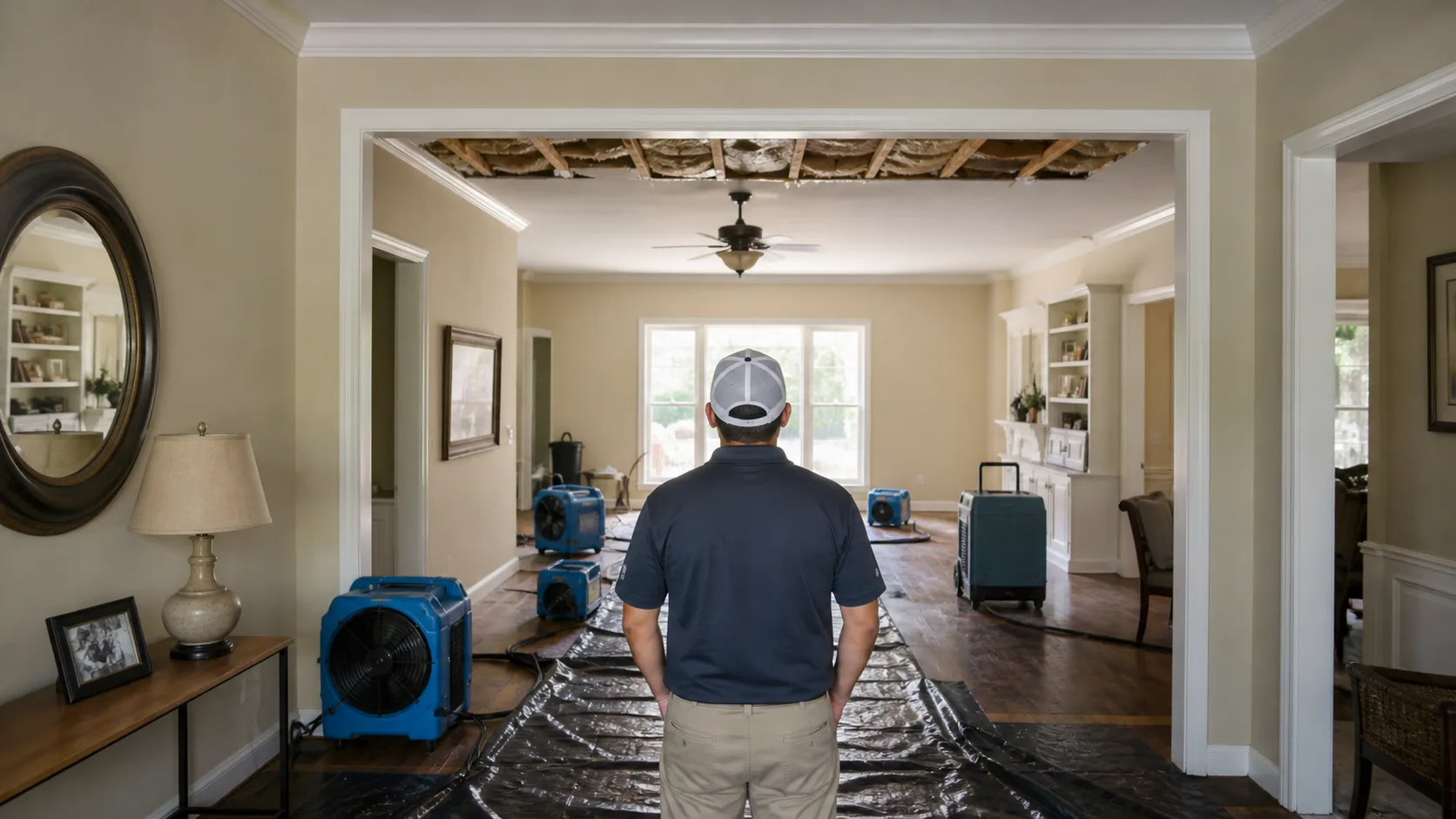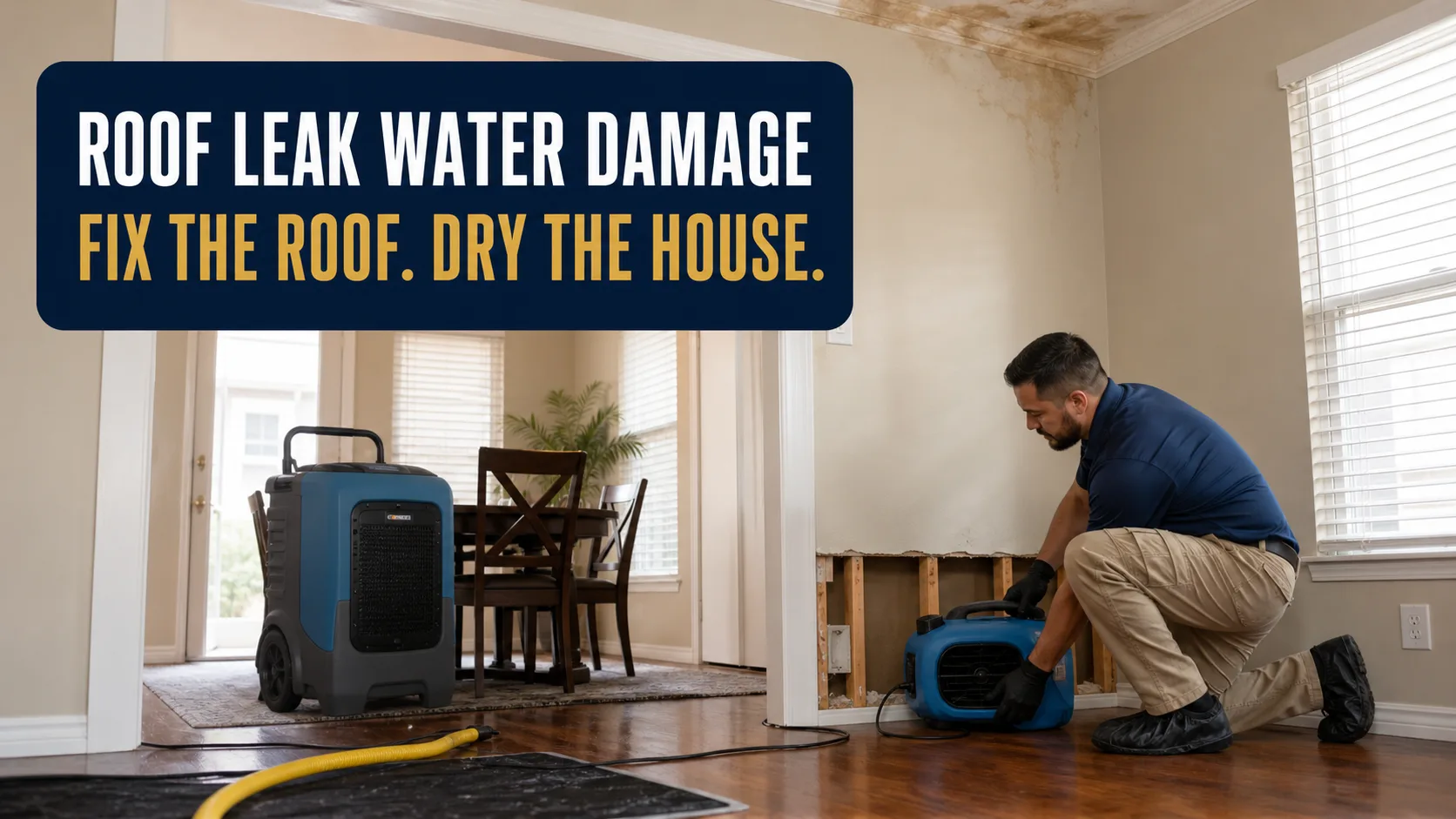
Two different trades fix two different problems. A roofing contractor stops the water at the roof. A water mitigation company dries out the ceiling, insulation, walls, and floors the water already soaked. Tonight, contain the water, photograph everything, and relieve any bulging ceiling from below. Then get a tarp on the roof and drying equipment inside. TruePoint Restoration handles the interior side and works alongside your roofer. Call **(346) 271-7004**.
What Should You Do Right Now, Before Anyone Arrives?
Contain the water and relieve the ceiling. In that order, and both before you start making calls.
- Move what is under the drip. Furniture, electronics, rugs, anything paper. Water finds the low point in a ceiling and lets go all at once.
- Catch and channel. A bucket with a towel in it beats a bare bucket, because it kills the splash.
- If a ceiling is bulging, drain it. A sagging, discolored bulge is a bag of water sitting on drywall. Poke a small hole at the lowest point and let it drain into a bucket. It feels wrong. It is far safer than the panel coming down on someone.
- Kill power to that area if water is anywhere near a light fixture, a fan, or a ceiling can.
- Photograph everything before you touch it. The room, the stain, the bucket, the roof from the ground, and the sky. Timestamped photos are the backbone of every roof claim.
Do not go on the roof in the rain, at night, or on anything steeper than a gentle slope. Almost every serious roof injury happens on a wet roof someone climbed in a hurry.
Who Fixes What: Roofer, Mitigation Company, or Both?
Both, and they do genuinely different jobs. This is the part almost nobody explains, so here it is plainly.
TruePoint Restoration does not do roofing. We do not sell shingles and we do not replace your flashing. We handle everything the water did after it got in: extract it, dry the structure, pull out materials that will not dry, and document it for your claim. A roofer stops the leak. We stop the damage. The two jobs run on different clocks.
| Task | Roofing contractor | Water damage / mitigation company |
|---|---|---|
| Find and stop the leak at the roof | Yes | No |
| Emergency tarp over the failure | Yes | No |
| Replace shingles, membrane, flashing, decking | Yes | No |
| Extract standing water inside | No | Yes |
| Dry wall cavities, ceilings, subfloor | No | Yes |
| Remove saturated attic insulation and drywall | No | Yes |
| Moisture readings and daily drying logs | No | Yes |
| Document interior damage for the claim | No | Yes |
| Rebuild the ceiling and repaint | Sometimes | Sometimes |
The overlap at the bottom row is where confusion starts. Ask each company in writing which part of the rebuild they are covering so nothing falls between them.
Do You Call the Roofer or the Water Damage Company First?
Call the roofer first if water is actively coming in, and the mitigation company within the same hour. There is no reason to wait for one before starting the other, and waiting is what costs money.
Here is the common failure pattern. Homeowner calls a roofer. Roofer arrives in two days, tarps it, returns the following week for the real repair. Meanwhile nobody dried the attic. Ten days later there is a musty smell and the ceiling is stained across half the room. The roof is now perfect and the inside needs demolition.
The drying window is roughly 24 to 48 hours before mold starts in Houston humidity. Your roofer’s schedule does not bend around it, so the interior work has to run in parallel.
What Is Emergency Roof Leak Repair?
Emergency roof leak repair is temporary containment, not a permanent fix. Its only job is to stop water entering the building until proper work can happen in daylight and dry weather.
That usually means a tarp mechanically fastened over the failed section, a temporary patch on an obvious penetration, or clearing a drain or valley that has backed up. A good emergency roofer will say outright that it is temporary and schedule the real repair.
On the inside, emergency response means extraction, air movers, and a dehumidifier the same night, plus opening up anything holding water. If your ceiling drips only during rain and is dry in between, that pattern has its own page: water leaking from the ceiling when it rains.
How Much Does It Cost to Repair a Roof Leak?
Most single-point roof leak repairs land in the few-hundred-dollar range, and the number climbs quickly once decking is soft or a larger area is involved. Roof cost and interior drying cost are two separate line items, and you should get them separately.
| Scope | What it usually involves | Typical range, varies a lot |
|---|---|---|
| Small shingle or flashing repair | Replace a few shingles, reseal a vent boot | Low hundreds |
| Emergency tarp or after-hours call-out | Temporary containment, premium for hours | Several hundred |
| Larger section with rotted decking | Tear off, new sheathing, underlayment, surface | Low thousands |
| Flat roof seam or membrane section | Cut out, patch, reseal, sometimes new drain | Low thousands |
| Full replacement | Whole roof, often driven by a storm claim | Many thousands |
Those ranges move with pitch, height, material, and access. What moves them most is time. A leak caught on day one is a flashing repair. The same leak in month three has rotted decking, soaked insulation, and stained ceiling drywall, and now three trades are involved.
How Do You Repair a Roof Leak Yourself, and When Should You Not?
You can safely tarp a low-slope roof section and you can safely stop water inside. Everything past that belongs to a roofer, mostly because finding the leak is harder than fixing it. Water rarely enters directly above where it drips. It comes in uphill, runs down the underside of the decking or along a rafter, and lets go at the first low point, sometimes ten or fifteen feet away. That is why homeowners patch the wrong spot and it leaks again in the next storm.
If you are going to do anything yourself:
- Tarp from the ridge down so water runs over the tarp, not under it, and fasten it rather than weighting it with bricks.
- Clear the gutters and valleys. A lot of Houston “roof leaks” are overflow from a blocked gutter backing up under the shingle edge.
- Check the attic with a flashlight on a dry day. Stains on the underside of the decking tell the roofer where to look.
- Do not walk a wet, mossy, or steep roof. Nothing up there is worth an ambulance.
Does Roof Leak Repair Sealant Actually Work?
Sealant works for a few dry days on a small, clean, dry, clearly identified hole. It does not work as a repair, and used heavily it makes the real repair harder.
Roof cement and rubberized sealant need a dry, clean surface to bond, and they get applied in the rain, which is why they lift within weeks. Applied thickly, sealant also traps moisture and hides the failure point, so the roofer has to scrape it off before diagnosing anything. Use a little, on one spot, and tell your roofer where you put it.
Flat Roof Leak Repair in Houston
Flat roofs leak at seams, penetrations, and drains, and they leak differently because the water never leaves. A pitched roof gives water seconds to find a weakness. A flat roof gives it days.
The usual culprits are seams that opened as the membrane aged, penetrations where a vent or HVAC curb passes through, and drains blocked with leaves after a storm. Ponding water is not itself a leak, but it is a countdown. And because water travels sideways across the deck before it drops, the stain inside is rarely near the breach, which makes water testing by an experienced flat-roof contractor worth paying for.
Metal Roof Leak Repair
Metal roofs leak at the fasteners and the flashing, almost never through the panel. The panel is the part people look at and the part that is fine.
Exposed-fastener roofs use screws with rubber washers, and under Gulf Coast sun those washers harden, shrink, and stop sealing. A roof can have hundreds of them. Standing-seam roofs fail instead at end laps, penetrations, and wall or chimney flashing. Never fix a metal roof leak by adding more screws. That adds more holes.
Asphalt Shingle Roof Leak Repair
Shingle roofs in Houston usually fail from wind lift, hail bruising, or aged flashing rather than the field wearing out evenly. Wind gets under a tab, breaks the seal strip, and the shingle stops shedding water while still looking fine from the driveway.
The high-risk spots are the same on nearly every house: valleys, the flashing around chimneys and skylights, plumbing vent boots whose rubber has cracked, and the edge where the roof meets a wall. After a named storm, damage is usually spread across the whole roof rather than concentrated in one place, which is a different conversation, covered in hurricane and storm flooding in Houston.
How Do You Pick Roof Leak Repair Contractors?
Pick the contractor who shows you a photograph of the actual failure point before they quote. That one filter removes most of the bad options.
Ask for the Texas license and a certificate of insurance, get the scope in writing with decking marked included or extra, and be wary of a large deposit before work starts. After a big storm, be careful with crews who knock on doors, promise to “cover your deductible” (not legal in Texas), or push you to sign an assignment of benefits on the spot. A legitimate roofer will let you read the contract overnight.
How Long Does the Drying Side Take?
Two to four days for a contained ceiling and attic dry-out where the insulation comes out and the framing is only surface wet. Five to ten days once water ran down inside a wall cavity, reached a subfloor, or soaked a mortar bed. Anything with the roof still open waits on the tarp, because drying a structure that is still taking water is money spent twice.
Readings decide the end date, not the calendar. Sheathing, ceiling joists and the top of the drywall get metered daily until they reach dry standard, and the ceiling gets closed and painted after that rather than before it. The roofer’s schedule and ours run in parallel — the tarp is what lets both of them start.
The Insurance Sequence for a Roof Leak
Run it in this order. The sequence matters more than the wording.
- Document before you clean up. Photos and video of the roof from the ground, the interior stain, the contents, and the weather that day.
- Mitigate immediately. Every policy requires you to prevent further damage. Tarping and drying are not jumping the gun, they are you meeting that obligation.
- Report the sudden event with a date. “Wind and rain on the night of the 14th, water came through the ceiling in the back bedroom.” Not “I think the roof has been going for a while.” What you say early shapes how the file is read, which is why what not to say to your insurance adjuster is worth ten minutes.
- Keep every receipt, including the tarp, the fans you rented, and the hotel if the room is unusable.
- Get the interior scope in writing, with moisture readings and drying logs. Adjusters pay what is documented.
The usual split is that a sudden storm event is covered and a worn-out roof is not, and many Texas policies treat the roof surface differently from the interior damage it caused. The detail is in does insurance cover water damage, and if a claim came back short, water damage claim denied covers what to do next.
What the Water Actually Does Inside
Once water is through the roof deck it stops being a roof problem. It soaks the attic insulation, which then holds that water against the top of your ceiling drywall for weeks because no air moves through it. From there it runs down the top plate of a wall, into the cavity, behind the baseboard, under the flooring. That is why a leak in the attic shows up as a wet wall downstairs.
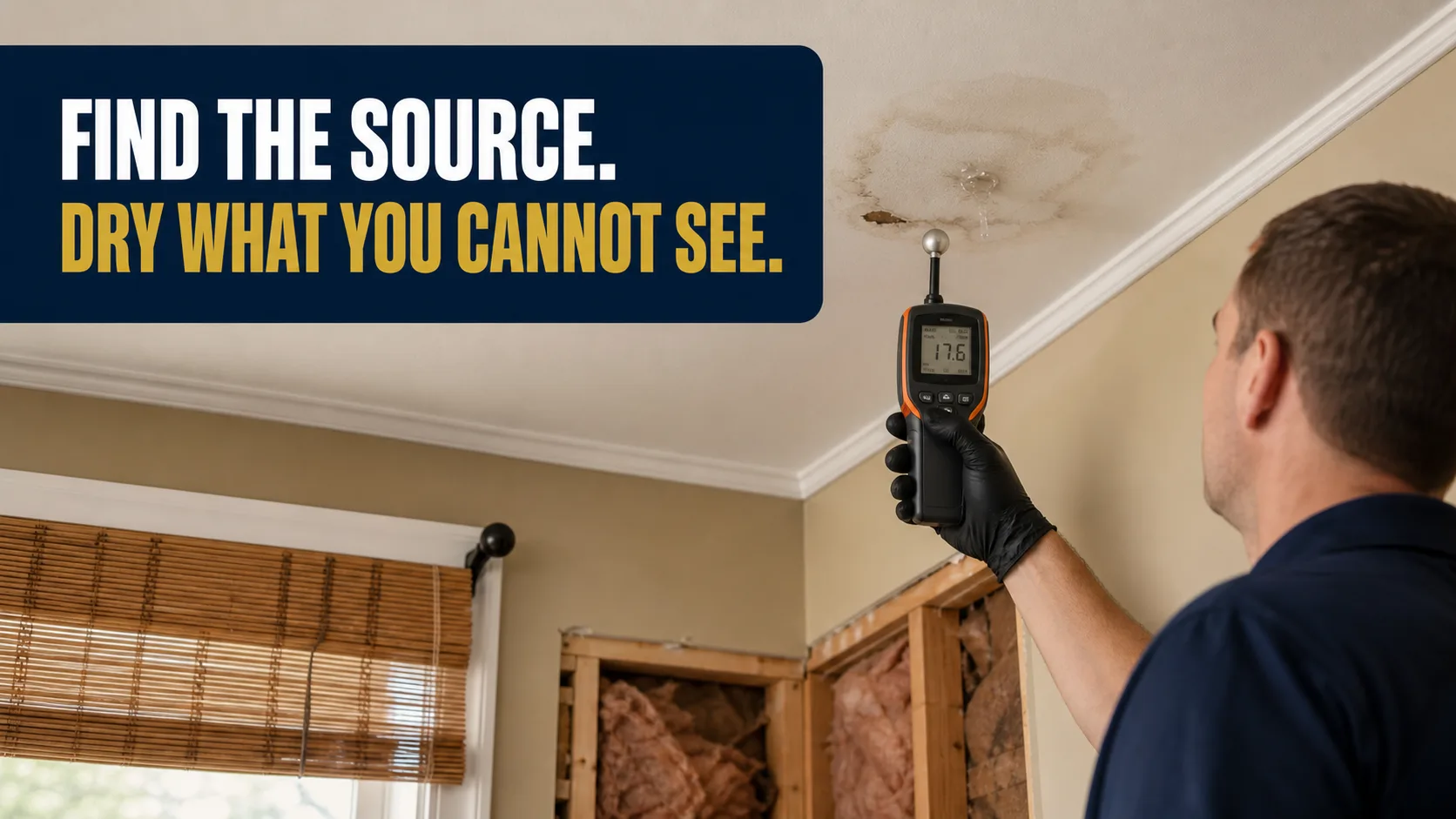
So the interior work means pulling back saturated insulation, opening whatever is holding water, drying until a meter agrees, and deciding whether the drywall stays. That decision comes down to how wet and how long: wet drywall, remove or dry, and for ceilings, ceiling water damage.
Your Roof Leak Documentation Checklist
Copy this into your phone notes. It takes fifteen minutes and it is the difference between a paid claim and an argued one. Use it whether or not you ever call us.
Photos, before anything is moved
- Wide shot of each affected room, with a door or window in frame for scale
- Close-up of every stain, sag, and drip point, plus the water in the bucket
- The roof from the ground on all sides, plus the sky and any debris
- Attic shot of wet insulation or decking, if you can get up safely
- Contents that got wet, individually, before you move them
Notes, the same day
- Date and time you first saw water
- Weather, including wind, and the storm name if there was one
- Everyone you called, when, and what you did to stop further damage
- Every receipt, including tarps, fans, and hotel
Numbers, in writing
- Roof scope and price, itemized, with decking marked included or extra
- Interior drying scope, with moisture readings at the start
- Who rebuilds the ceiling, roofer or mitigation, so it does not fall between them
If the building is commercial, the documentation bar is higher and there are tenant and business-interruption questions on top: commercial roof leak covers that version.
When You Want Someone on It Tonight
If your roof is leaking into the house right now, get a roofer on the roof and drying equipment running inside. TruePoint Restoration handles the inside half. We extract the water, dry the structure, deal with the insulation and drywall, take the moisture readings your adjuster will ask for, and coordinate with whichever roofer you choose. We will also tell you honestly when your interior does not need us, because a one-bucket leak dried in a day usually does not.
We are based in Pearland and cover Greater Houston. Call (346) 271-7004 or email claims@truepointrestoration.com. If you are not sure whether it is bad enough to call, describe it to us and we will tell you.