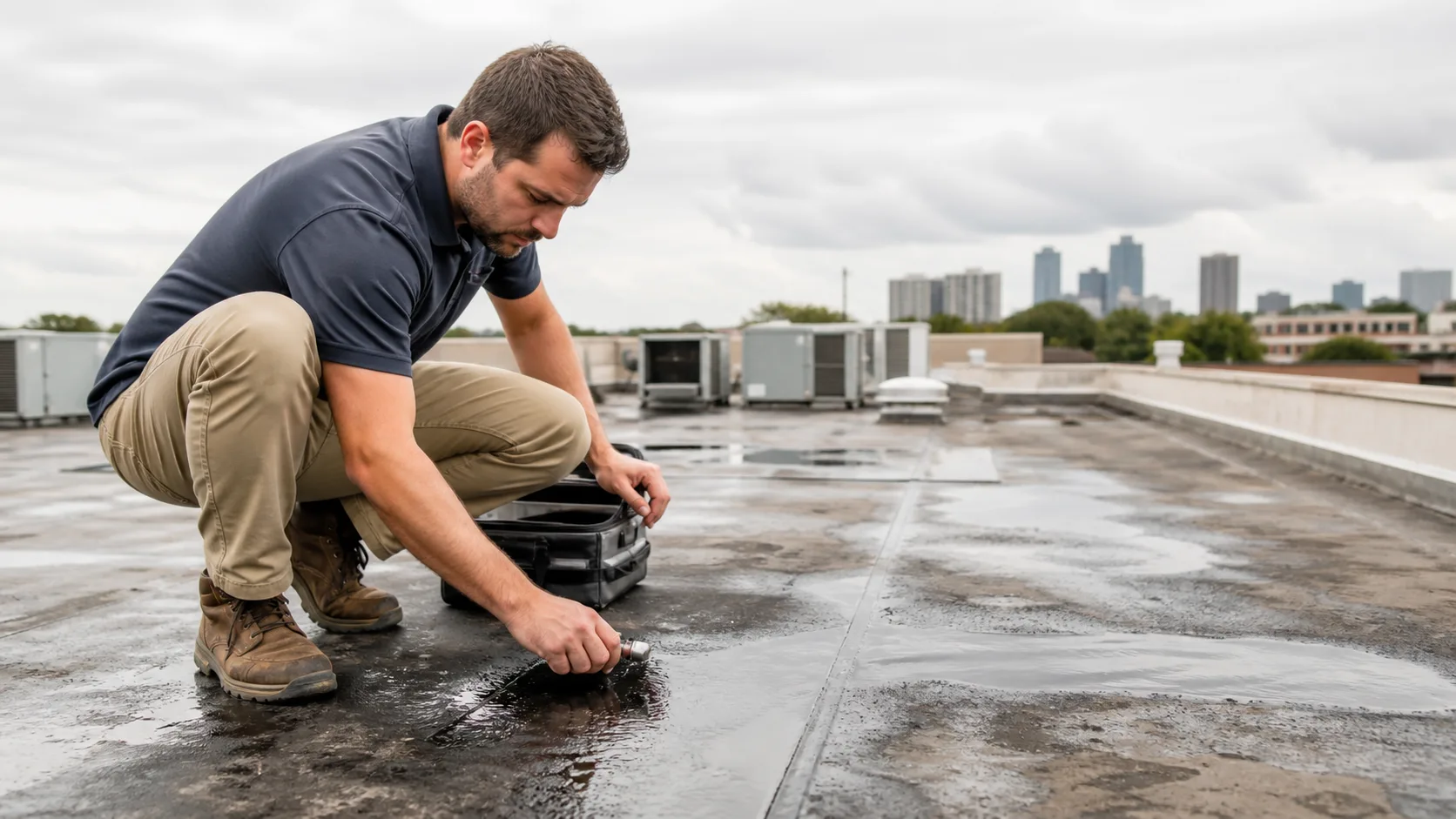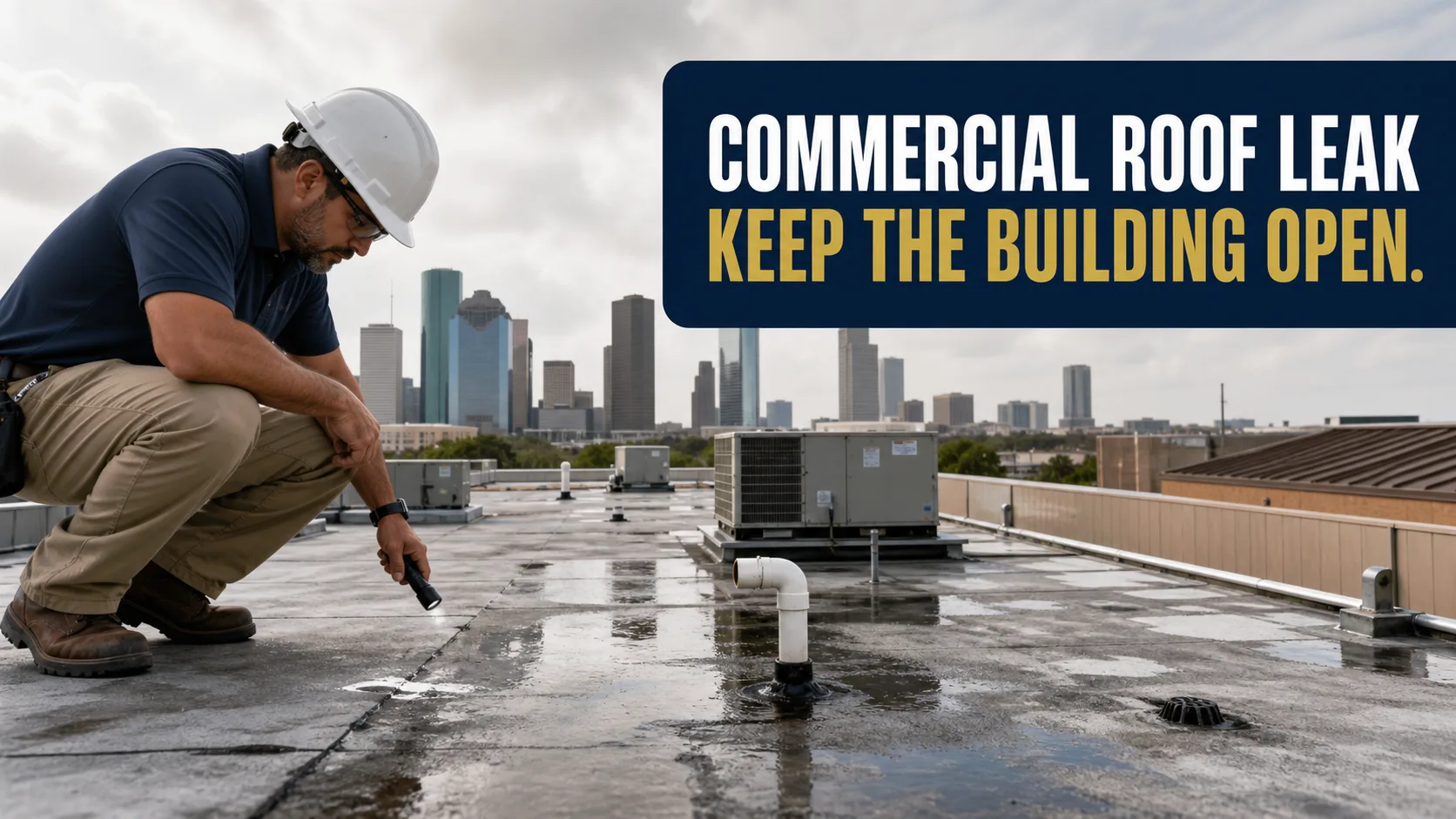
Isolate the area, protect stock and electronics, and start documenting before anyone touches anything. Then run two tracks at once. A commercial roofing contractor stops the water at the roof. A mitigation crew extracts, dries, and records moisture readings inside so the building can keep operating and the claim can be substantiated. TruePoint Restoration handles the interior side, after hours included. Call **(346) 271-7004**.
What Should You Do in the First Hour?
Isolate, protect, document, then call. In that order, and the documenting genuinely comes before the cleanup.
- Isolate the area. Cone it off, close the suite, and keep the public out from under any ceiling that is holding water. A saturated ceiling tile grid is a real drop hazard.
- Kill power to affected circuits if water is anywhere near lighting, panels, or floor outlets. Bring an electrician in before anything is re-energized.
- Protect what has value. Stock, servers, files, POS equipment, product on the bottom shelf. Get it moved and photograph it where it sat before you move it.
- Relieve loaded ceilings from below. A bulging drywall ceiling or a bowing tile is a bucket waiting to fail. Drain it deliberately into a container.
- Start the log now. Time water was discovered, who found it, what the weather was doing, who was notified. Write it as it happens.
- Call two trades. A commercial roofer for the source, a mitigation crew for the interior. Both, tonight, not one after the other.
Who Is Responsible, the Landlord or the Tenant?
Your lease decides, and the two clauses that decide it are maintenance and repair, and casualty. Read those before you agree to pay for anything or accept that anyone else will.
The common structure is that the landlord owns the roof, structure, and building shell, while the tenant owns their improvements, trade fixtures, inventory, and business income. A triple-net or absolute-net lease can push roof maintenance onto the tenant, which surprises tenants regularly. Separately, most commercial leases contain a waiver of subrogation between landlord and tenant, meaning each side looks to its own insurer rather than suing the other.
The practical advice is the same for both sides: notify your own carrier on day one and do not wait until fault is agreed. Delaying notice while two parties argue about a lease clause is how a covered loss becomes a late-notice problem.
Who Does What on a Commercial Roof Leak?
Three different companies do three different jobs, and confusing them costs weeks. TruePoint Restoration does not do roofing. We handle everything the water did after it got inside.
| Task | Commercial roofer | Mitigation company | General contractor |
|---|---|---|---|
| Locate the breach, water testing | Yes | No | No |
| Emergency tarp or temporary seal | Yes | No | No |
| Membrane, seam, flashing, drain repair | Yes | No | No |
| Replace wet roof insulation board | Yes | No | No |
| Extract standing water inside | No | Yes | No |
| Zone containment so the building stays open | No | Yes | No |
| Dry ceiling plenum, walls, subfloor | No | Yes | No |
| Remove saturated tile, drywall, carpet, insulation | No | Yes | No |
| Moisture mapping and daily drying logs | No | Yes | No |
| Rebuild finishes, grid, casework | No | Sometimes | Yes |
| Documentation for the interior claim | No | Yes | Sometimes |
Decide in writing who owns the rebuild before demolition starts. That handoff is where commercial jobs stall.
Why Is a Commercial Claim Heavier on Paperwork Than a Residential One?
Because more parties are attached to the loss and because time itself is a covered item. On a house there is one owner and one policy. On a commercial building there is often an owner, a property manager, one or more tenants, a lender with an interest in the asset, a roof warranty carrier, and separate coverage for building, contents, and business income.
Each of those wants evidence in its own format. A photo set that satisfies a homeowner adjuster gets returned on a commercial file with a request for moisture maps, an equipment log, a scope broken out by suite, and revenue records. On top of that, business interruption puts a dollar value on every day of delay, which means an adjuster reviews not just what was damaged but how fast you responded.
The takeaway is unglamorous: build the file while the event is happening. Reconstructed documentation is always weaker, and it reads as reconstructed.
What Does the Water Actually Damage?
Far more than the ceiling tile you are looking at. On a commercial building the ceiling plenum is the problem, because it is where everything lives.
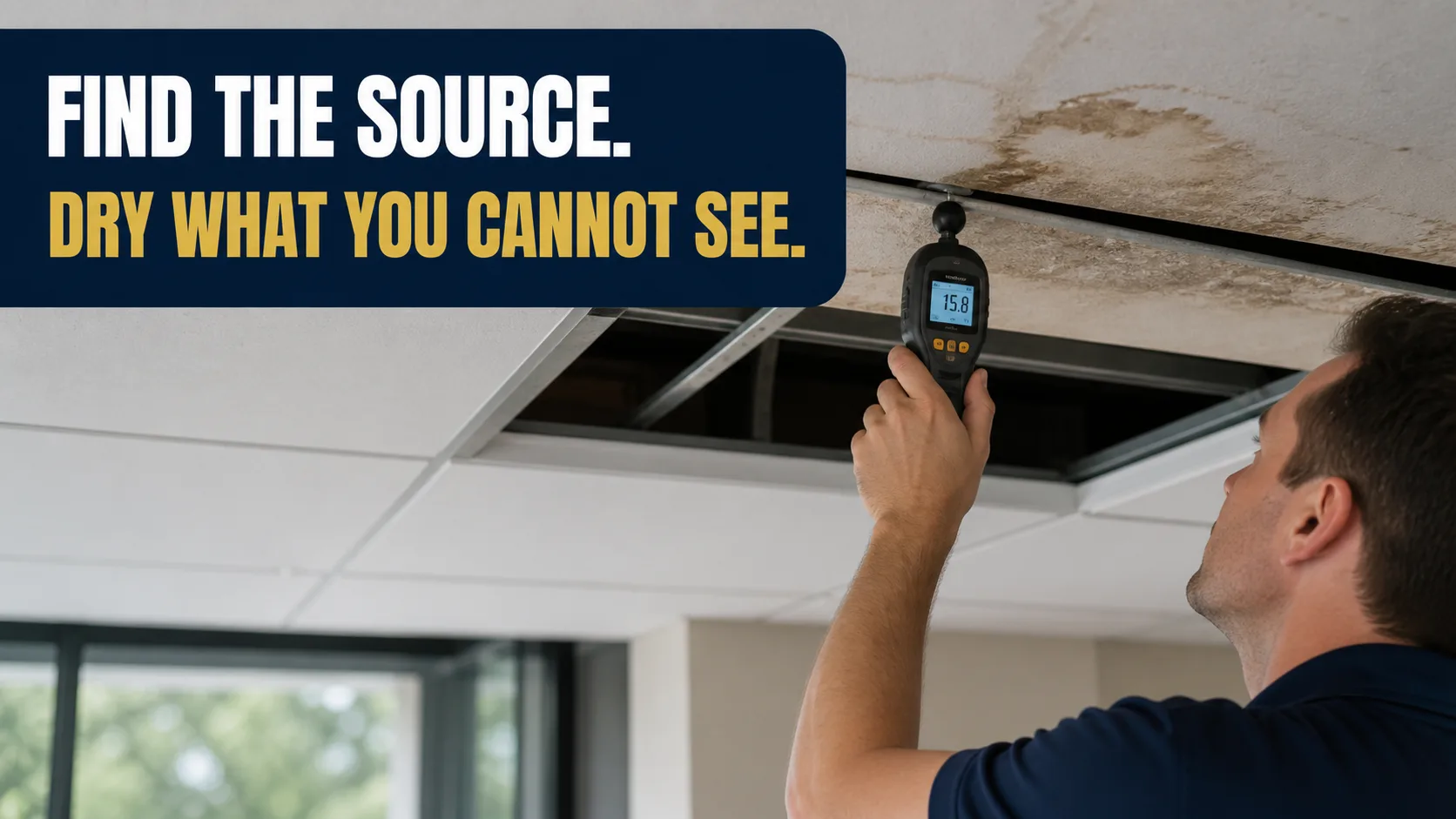
Water comes through the deck, soaks the rigid insulation board above it (which holds water for a very long time and is the reason a “repaired” roof keeps leaking), then drops into the plenum onto ductwork, cabling, and light fixtures. From there it runs along conduit and structural members and can appear in a suite two doors down. It saturates tile and grid, wets the top of partition walls, and lands on carpet, stock, and equipment.
In multi-tenant buildings this is why the tenant reporting the leak is often not the tenant under the breach. It is also why a proper response involves lifting tile across a wide area and metering, rather than replacing the three stained tiles everyone can see. The same physics we describe in ceiling water damage applies here at a much bigger scale.
Can You Keep Operating While the Building Dries?
Usually yes, if the drying is zoned. Most commercial buildings can be split behind poly containment so one suite or section is under negative pressure with equipment running while the rest trades normally.
What forces a closure is narrower than owners fear: standing water over electrical, contaminated or category-three water, a ceiling grid compromised above a public area, or a food-service health requirement. Everything else is a scheduling and containment problem.
Practical ways to stay open:
- Run the loud work overnight. Extraction and demolition after close, quiet dehumidification during trading hours.
- Contain rather than close. Barriers, signage, and a defined walking route beat locking a whole floor.
- Protect the HVAC. Shut down or isolate air handling serving the wet zone so you are not distributing humid air, and spores, through the building.
- Sequence by revenue. Dry the areas that generate income first, storage and back-of-house second.
Why After-Hours Response Matters More Here
Commercial leaks are almost always discovered outside business hours, and the response window closes before the doors open. A cleaner at 11pm, a security round at 3am, or the first employee at 6am finds it, and whether you trade at 9am depends entirely on what happened in between.
There is a claim reason too. Every policy obliges the insured to take reasonable steps to prevent further damage. On a commercial file with business interruption attached, the gap between discovery and response gets measured. A twelve-hour delay while everyone waits for the property manager to call back is a twelve-hour gap an adjuster can point at.
Storm season compounds it, because a single named storm generates hundreds of simultaneous calls across Greater Houston and response queues fill in hours. That dynamic is covered in more detail in hurricane and storm flooding in Houston.
How Do You Document a Commercial Roof Leak Claim?
Photograph before you touch, log as you go, and keep the interior scope separate from the roof scope. Those three habits carry most commercial claims.
Before anything is moved
- Wide shots of every affected area, plus a shot showing suite numbers or signage for location
- Close-ups of each stain, sag, drip, and pooled area
- The ceiling with tiles lifted, showing wet insulation and plenum contents
- Damaged inventory and equipment individually, with model and serial numbers where visible
- Roof photos of the failure point from the roofer, dated
As the event unfolds
- Time water was discovered and by whom
- Weather conditions and storm name if applicable
- Every notification made, with time and recipient
- Every mitigation action taken, with time
- Staff sent home, hours lost, appointments or orders cancelled
- Daily moisture readings and equipment counts from the mitigation crew
For the financial side
- Prior-period revenue for the same weeks last year
- Inventory loss list with cost values, not retail
- Extra expense receipts, including temporary space, generators, and overtime
- Closure notices, cancelled bookings, and customer communications
Two related reads worth handing to whoever is managing the file: does insurance cover water damage for what typically falls in and out of coverage, and what not to say to your insurance adjuster, which matters more on commercial calls because more people are speaking to the carrier.
How Much Does Commercial Roof Leak Repair Cost?
A single-point repair on a commercial flat roof commonly runs from the high hundreds into the low thousands, and it climbs fast once wet insulation board or a section of membrane has to come out. These are typical ranges and they vary widely.
The drivers are specific to commercial work: roof access and whether a lift is needed, how much rooftop equipment is in the way, whether the membrane is TPO, EPDM, modified bitumen, or built-up, and how much saturated insulation board sits under the breach. That last one is the sleeper cost. A membrane patch over wet insulation looks fixed and leaks again the following season.
Interior mitigation is priced separately and driven by affected square footage, number of floors involved, containment requirements, and whether work has to happen after hours. Get both scopes in writing and itemized, because your carrier will review them as separate line items anyway.
How Long Does a Commercial Dry-Out Take?
Three to five days for a contained leak in one suite on hard-surface flooring. One to two weeks once water crossed into carpet, ran under a raised floor, wicked into millwork, or reached a second tenant. Longer again when the roof is still open, because drying a building that is still taking water is money spent twice.
Readings decide, not the calendar. Deck, framing, ceiling grid area and drywall get metered daily until they reach dry standard, and reconstruction starts after that. What actually compresses a commercial schedule is equipment density and access — how many air movers we can power without tripping the panel, and whether we can work the space overnight rather than around your staff.
What Happens If a Commercial Leak Is Ignored
The failure mode is predictable. Three stained tiles get swapped, the leak is declared handled, and the wet insulation above the deck stays wet. Six weeks later there is a musty smell in the return air, corrosion on the grid, and a much larger area of ceiling to replace.
The mold clock on wet commercial materials is the same 24 to 48 hours it is anywhere else, and thick assemblies plus sealed envelopes make commercial buildings slower to dry, not faster. The mechanics are the same as in mold after water damage, with the added complication that a mold finding in an occupied commercial building brings tenant notification and sometimes regulatory questions with it.
There is a coverage consequence too. A leak documented and mitigated immediately reads as a sudden event. The same leak found again six months later reads as gradual damage and deferred maintenance, which is where commercial claims most often get reduced or refused. If that has already happened to you, water damage claim denied covers the routes back.
Your Commercial Roof Leak Incident Log
Copy this into a shared doc the moment a leak is reported and give every manager access. It is free, it takes minutes, and it is the single highest-value thing you can do for the claim. Use it whether or not you ever call us.
Header
Property address, suite or zone, date and time discovered, discovered by, weather conditions, storm name if any, policy numbers for building, contents, and business income.
Running timeline (one row per entry, with timestamp and initials)
Discovery, notifications made, power isolated, area contained, roofer called, roofer on site, temporary repair made, mitigation called, mitigation on site, extraction started, equipment placed, first moisture readings, tenant notified, closure or partial closure, reopening.
Attachments to collect
Pre-cleanup photos, plenum photos with tile lifted, roof failure photos, moisture maps, daily drying logs, equipment placement counts, inventory loss list, staff hours lost, revenue comparison, all invoices.
Sign-off
Who owns the rebuild scope, who is coordinating with the carrier, and the date the building was returned to normal operation.
If your building is residential-scale or you want the homeowner version of the roofer-versus-mitigation split, that is here: roof leak repair and interior water damage. The broader commercial picture beyond roofs is in commercial water damage.
When You Need Someone There Tonight
If water is coming into your building, get a commercial roofer on the roof and get a mitigation crew inside, and do not run them sequentially. TruePoint Restoration handles the interior half. We extract, contain, and dry, we lift ceiling tile and meter properly rather than guessing, we keep the moisture logs and photo record your adjuster and your tenants will ask for, and we work around your trading hours so the building stays open where it safely can.
We are based in Pearland and serve Greater Houston. Call (346) 271-7004 or email claims@truepointrestoration.com, and if you are a property manager who just needs a second opinion on whether a stained ceiling is a real problem, describe it to us and we will tell you straight.