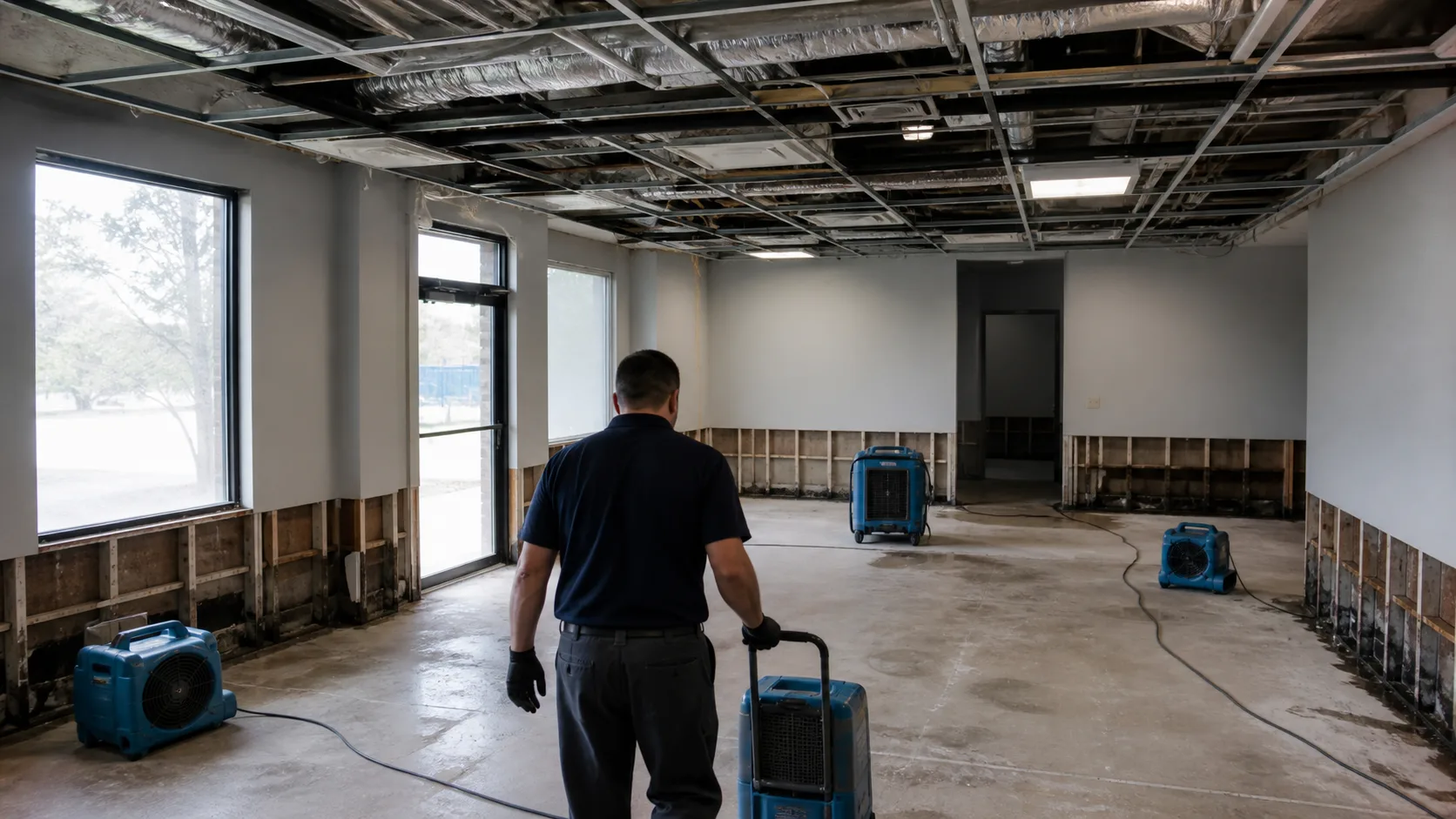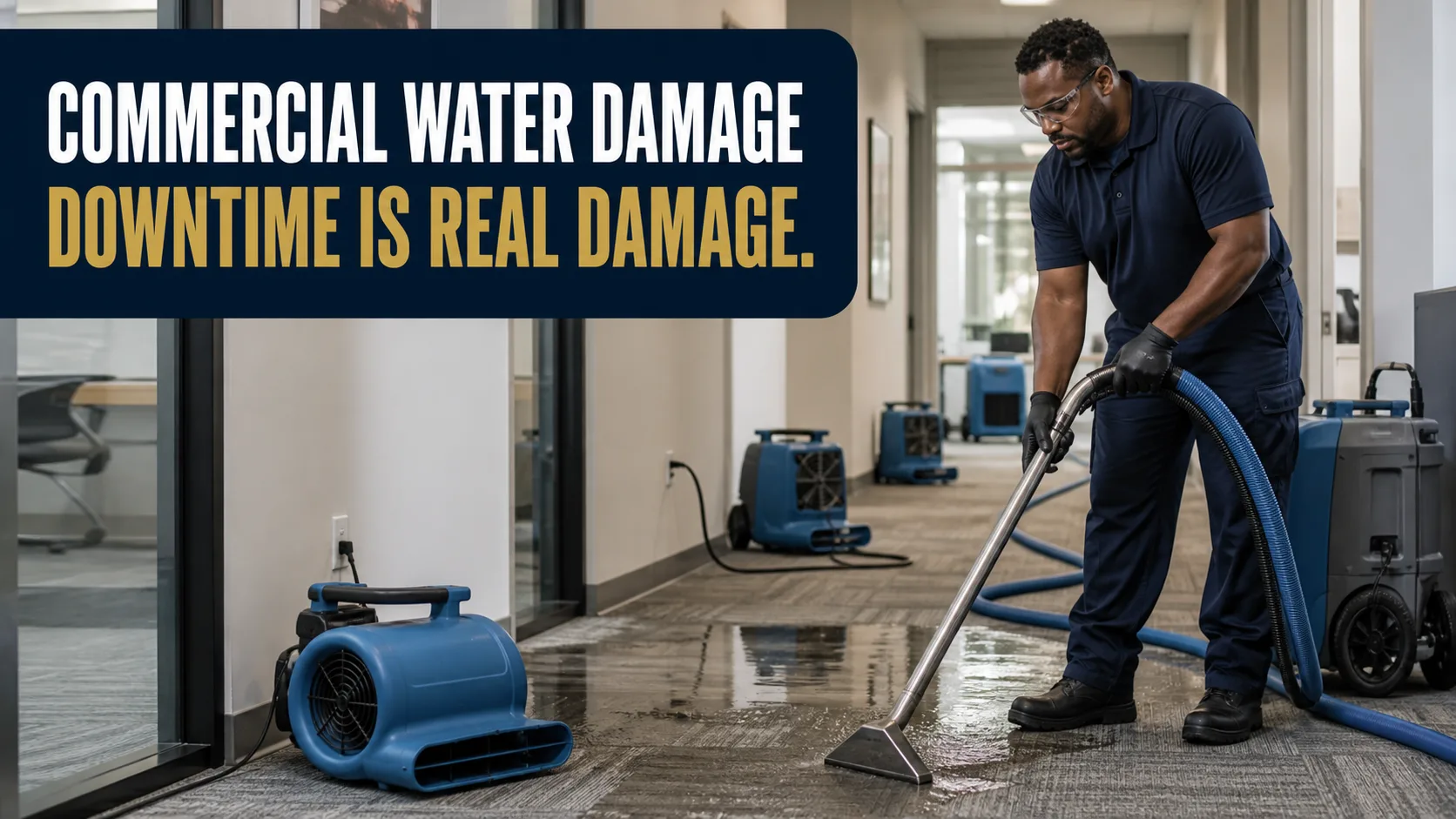
For a business, the water is only half the problem — **downtime is the other half.** Every hour closed is lost revenue, and mold still starts within 24 to 48 hours. So the move is the same but the urgency is higher: make the space safe, stop the source, document everything with photos and video, and get professional extraction and drying started immediately while you notify your commercial insurer. TruePoint Restoration handles Houston offices, restaurants, retail, and multi-unit properties — call **(346) 271-7004**.
Why commercial losses are their own animal
The physics of water damage don’t change between a house and a restaurant, but the stakes do:
- Business interruption is often the biggest cost — and many commercial policies help offset it, but only with documentation.
- Scale — larger footprints need more equipment, more coordination, and a plan to keep as much of the operation running as possible.
- Stakeholders — property managers, tenants, and, for restaurants, health-code requirements all come into play.
- Different claims process — commercial policies aren’t homeowners policies; how the loss is documented affects both the property and business-interruption portions.
Warning signs a commercial building has a water problem you have not found
Commercial losses get found late. Nobody sleeps in the building, and the wet part sits above a ceiling grid or under a slab where no one is looking.
Something is leaking above the ceiling:
- Ceiling tiles sagging, stained, or shedding fibers in a grid that was flat last week
- A rusting grid tee, or a ring of white mineral crust around a sprinkler head
- A stain that grows on Mondays — a weekend leak with nobody in the building to catch it
Something is leaking under the floor:
- A warm spot on the slab, or a water bill that climbed with no change in occupancy
- VCT lifting at the seams, or carpet that stays damp near one wall
- A water meter still counting with every fixture in the suite shut off
The building already smells wrong. A musty return-air odor, or a smell that arrives when the rooftop units start in the morning. Odor on the air side means the wet material is in the airstream, and every tenant downstream of it is breathing the same air.
The fire system is the source. A sprinkler head that weeps, or a dry system that tripped in a freeze. Sprinkler water is stagnant pipe water, not fresh supply — it stains, it smells, and it is handled as contaminated.
What to do first
- Safety. Power off near standing water; close the affected area if needed.
- Stop the source — shut-off valve, breaker, or the responsible trade.
- Document before you touch anything — photos and video of every affected area, plus the source. This is your claim.
- Call for mitigation now. Fast extraction and drying limits both the damage and the downtime. (346) 271-7004.
- Notify your commercial insurer and, for leased space, your property manager.
What you can check yourself before anyone arrives
None of this needs a meter, and all of it shortens the call.
- Find the meter and watch it. Shut every fixture in the suite, then watch the low-flow indicator for two minutes. Movement with everything closed means a supply-side leak, and that is a plumber’s call before it is ours.
- Lift one ceiling tile at the edge of the stain, not the center. The center is the wettest point and it fails when you touch it. Look at which way the water is tracking on the deck above.
- Pull the filter on the unit serving that area. A filter loaded grey since last month means the air side has been moving something through the building.
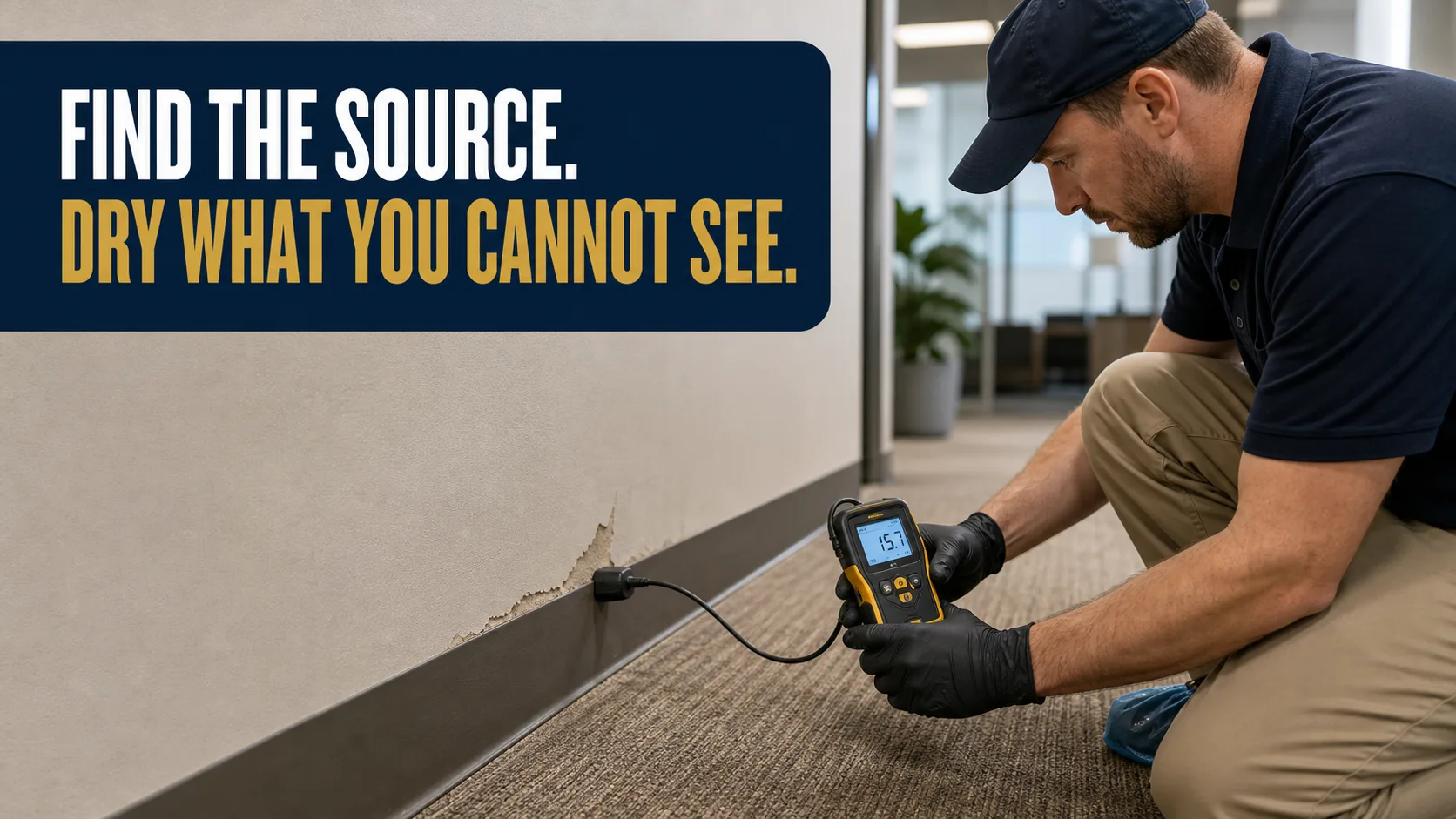
- Press the bottom four inches of drywall around the affected area with a flat palm. Wicking climbs, so where the wet line sits at 8 p.m. tells you more than where it sat at noon.
- Knock on the neighbors. In multi-tenant space water crosses demising walls long before anyone reports it, and that knock settles whether this is one suite or three.
- Photograph all of it with the date stamp on — the source, the water line on the wall, the ceiling grid, and the stock and equipment in the path. Take those photos before anyone moves inventory, because moved inventory is what an adjuster questions later.
Getting back open fast
Our job on a commercial loss is to compress the timeline: extract immediately, set enough commercial drying equipment to hit a verified dry standard as fast as the structure allows (see how long drying takes), and document every step for the claim. Where we can, we work around your operation so you lose as little business as possible.
How long a commercial dry-out takes
Three to five days for a contained clean-water loss in one suite on hard-surface flooring. One to two weeks once the water crossed into carpet, ran under a raised floor, wicked into millwork, or reached a second tenant. Contaminated water or a slab-level source runs longer again, because removal has to finish before drying starts.
Readings decide, not the calendar. We set target moisture values on framing, subfloor and drywall on day one, then log them daily until they hit dry standard. What actually compresses a commercial schedule is equipment density and access — how many air movers we can power without tripping the panel, and whether we can work the suite overnight instead of around your staff.
What commercial water damage mitigation costs
No square-foot price survives contact with a real building. Ask what moves the number instead.
- Affected area and ceiling height. Drying is an air-volume problem, not a floor-area problem, so a warehouse bay under a 24-foot deck costs more per wet square foot than an office suite.
- Water category. Clean supply water gets dried. Contaminated water — sewer, stagnant sprinkler pipe, storm intrusion — means porous material comes out first, and removal is the largest line on the invoice. Category also degrades with time, so clean water left sitting over a weekend is not clean water on Monday.
- What the water sits under. Glue-down carpet, VCT, raised access floor and mortar-bed tile each hold water differently, and each changes the removal decision.
- Equipment days. Every extra day is another day of air movers, dehumidifiers and power, and Gulf Coast humidity adds days a dry climate would not.
- After-hours work and containment. Running overnight so a restaurant opens on time, or building containment so half a floor stays occupied, is labor a vacant building does not need.
A contained single-suite clean-water loss lands in the low thousands. Multi-suite losses with contaminated water, removal and after-hours crews run into five figures. The same pricing logic on the residential side is in what water damage mitigation costs in Houston, and how your policy values the building against the contents is in actual cash value versus replacement cost.
Protect the claim
Commercial claims reward clean documentation and careful framing — the same principles as talking to your adjuster apply, and our mitigation experience means we document the loss the way your insurer needs from the first visit.
Serving commercial properties across Houston and the surrounding metro.
The free things worth doing tonight
- Find and tag the main shut-off for your suite and for the building, and confirm the valve actually turns.
- Get stock and paper off the floor. Four inches of height is the whole difference between damaged and not.
- Shut the air handler serving the wet area so the system stops pushing moisture and odor into dry suites.
- Write the log — time the water was found, who found it, who was called, what was shut off. Commercial adjusters ask for a timeline in a way residential adjusters often do not.
- Pull your declarations page and find the business interruption and extra expense limits, plus the waiting period before that coverage starts.
- Do not run building HVAC to dry the space. It moves humidity around the building instead of removing it.
Where the plumber and the general contractor end and we begin
TruePoint Restoration is a mitigation contractor. We do not locate or repair pipes, service rooftop units, touch the fire sprinkler system, do electrical work, or act as the general contractor who rebuilds your finishes — and we are not a public adjuster, so we do not negotiate your claim for you. Those are separate licensed trades, and we say so on the phone rather than after the estimate. On a commercial loss they run in parallel with us rather than in sequence, because the source has to stop while the drying starts.
What we do is the water: emergency extraction, containment so cleaning does not carry contamination into occupied suites, removal of material that will not dry, structural drying with logged daily readings, and a documented file — category of loss, affected materials, moisture logs, disposal records — that your carrier and your property manager both work from. If the water arrived because the building burned, it is fire-hose water, and the smoke and soot side is scope we carry too.
Call (346) 271-7004. We work out of Pearland and cover Greater Houston — Manvel, Friendswood, League City, Pasadena, Sugar Land and the rest of the metro.