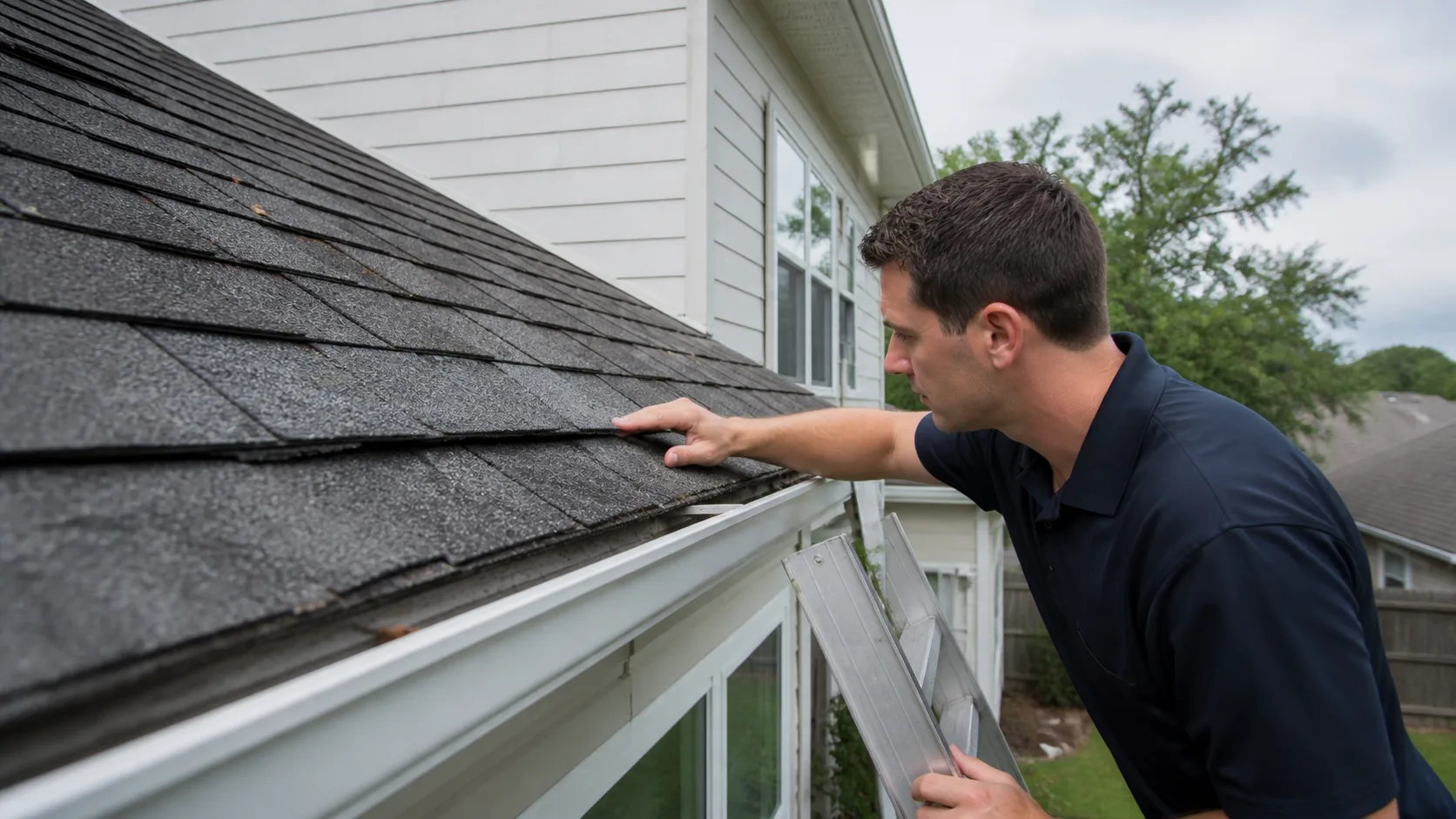
If water comes through your ceiling **only when it rains**, the source is your roof or its flashing — not plumbing. Rain finds a gap (a failed shingle, cracked flashing, a worn vent boot, a clogged valley) and travels along the decking before dripping through, often far from where it got in. Contain it now, keep people from under any bulge, and get **two** people out: a roofer to stop it and a mitigation company to dry the soaked attic and ceiling before mold starts. Call **(346) 271-7004**.
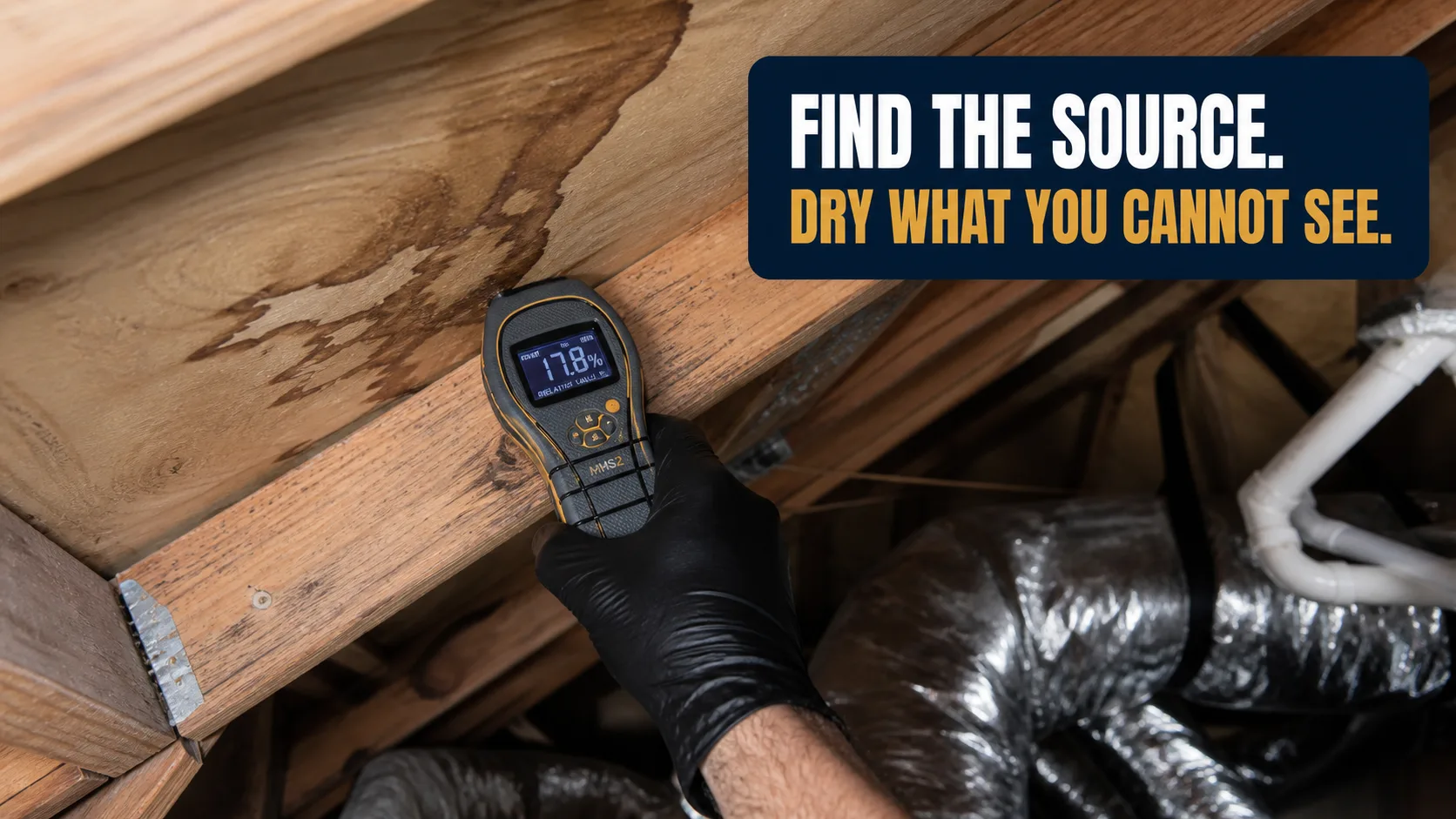
Rain-only = roof, not pipe
The single most useful clue about a ceiling leak is timing. A leak tied to rain is a roof or flashing problem. A leak that happens regardless of weather — especially in summer when the AC runs — is usually the attic HVAC or plumbing. Getting this right tells you who to call first and saves you chasing the wrong source.
Water is sneaky here: it enters at one point on the roof, runs along the decking and rafters, and drips through the ceiling somewhere else entirely. So the stain inside rarely sits directly under the actual roof gap.
Common rain-entry points in Houston homes
- Failed or lifted shingles — often after wind or hail.
- Cracked flashing around chimneys, vents, and skylights.
- Worn rubber vent boots — a top cause; they dry-rot and crack in the sun.
- Clogged roof valleys and gutters — water backs up and finds a way in.
Warning signs the roof has been leaking longer than you think
A rain leak announces itself at the ceiling only after the attic has been wet several times. These are the earlier signals.
The attic has been taking water for a while:
- Dark streaking or a rusty halo on the underside of the roof decking, visible from the attic hatch with a flashlight
- Insulation that is flattened, matted, or discolored in one bay while the rest is fluffy
- Rusted nail shanks poking through the decking, which means the attic is running humid
The ceiling is further along than the stain suggests:
- A stain with a hard brown ring around a lighter center — the ring is a tide line, and more than one ring means more than one storm
- Drywall tape lifting at a ceiling seam, or a hairline crack that opens after rain
- Nail pops or a faint sag along one joist line
It is now urgent: a bulge or a dome in the ceiling, water beading on a light fixture or fan, or a breaker that trips during rain. Water-loaded drywall is heavy and it fails without warning.
It is already growing: a musty smell in the room below after a storm, or an attic that smells earthy on a hot day. Wet fiberglass in a Houston attic is the fastest mold substrate in the house.
What to do right now
- Contain it. Bucket under the drip; move furniture and electronics clear.
- Mind a bulge. A sagging ceiling is holding pooled water — keep people from underneath, cut power to nearby light circuits, and drain it carefully into a bucket if it’s safe and away from fixtures.
- Photograph everything — the storm, the entry area if visible, the interior damage — for your claim.
- Get the roof fixed and the attic/ceiling dried. Wet attic insulation usually comes out. (346) 271-7004.
A diagnosis you can run yourself on the next rain day
Do this from inside. Nobody should be on a wet roof.
- Time it. Note the exact minute the drip starts relative to the rain starting. Immediate means an open path. An hour or more of delay means water is pooling somewhere first — a valley, a clogged gutter, or a low spot on a flat section.
- Test the wind. Leaks that only show up in a driving rain from one direction are usually flashing or siding, not a hole in the field of the roof.
- Go to the attic hatch during the rain with a flashlight. Do not walk the joists in the dark. From the hatch, look for a shine on the decking, drips off a rafter, or a wet path running downhill from a boot or a valley.
- Measure the offset. Note how far the wet spot in the attic sits from the stain on the ceiling below. That distance is what a roofer needs, because entry and exit are rarely in the same place.
- Check the vent boots first. Cracked rubber around a plumbing vent is the single most common Houston entry point, and it is visible from the attic as a ring of daylight or a stained collar.
- Photograph all of it with the date stamp on — the ceiling, the attic decking, the wet insulation, and the sky outside so the weather is in the record.
Don’t just paint the stain
Sealing a rain-fed stain before the roof is fixed and the ceiling is dry does two bad things: the stain comes back with the next storm, and you’ve trapped moisture in the ceiling to grow mold. Fix the roof, dry the cavity and attic to a verified moisture reading, then seal and repaint.
What this costs to put right
Two invoices from two trades, and the roof one is not ours.
- The emergency tarp is a separate small job, priced by size and pitch, and it stops the loss growing while the real repair gets scheduled.
- The roof repair ranges from a vent boot replacement in the low hundreds to flashing, valley, or decking work in the thousands. A roofer prices that, not us.
- The mitigation is priced on how far the water traveled and what it soaked. Wet attic insulation almost always comes out — it loses its R-value and will not dry usefully in Gulf Coast humidity — and that removal is a real line item across a large attic footprint.
- The ceiling. A light stain caught fast is a stain-blocking primer and paint. Soft or sagging drywall is a cut-out, a cavity dry, and new board hung by a rebuild contractor.
- How many storms it took. Repeat wetting is what turns a boot replacement into a decking replacement, and it is also what an adjuster looks for when deciding whether the damage was sudden.
How long the drying side takes
Two to four days for a contained ceiling and attic dry-out where the insulation comes out and the framing is only surface wet. Five to ten days once water ran down inside a wall cavity, reached a subfloor, or soaked a mortar bed. Anything with a roof still open waits on the tarp, because drying a structure that is still taking water is money spent twice.
Readings decide, not the calendar. Attic sheathing, ceiling joists and the top of the drywall all get metered daily until they hit dry standard, and the ceiling gets closed and painted after that — not before. The material-by-material ranges are in how long drying takes.
The insurance angle
Sudden, storm-caused roof damage and the interior water damage it causes are commonly covered; age- or wear-related roof failure usually isn’t — though the resulting interior damage may still be. Document the storm, the entry point, and the interior loss. A mitigation team that documents claims properly will record it the way your insurer needs.
The free things worth doing tonight
- Cut power to the circuit feeding any light or fan near the wet area.
- Save the date and the storm. Write down which storm it was. Carriers check weather records against your reported loss date.
- Clear the gutters and downspouts on that side of the house if you can do it safely from the ground. Backed-up water is a common entry route that has nothing to do with the shingles.
- Call a roofer for a tarp before the next system moves through, and get the tarp photographed too.
- Do not prime or paint the stain. Sealing a wet ceiling traps moisture in a cavity full of insulation.
Where the roofer ends and we begin
TruePoint Restoration does not do roofing. We do not replace boots, flashing, shingles, or decking, we do not sell you a roof, and we are not a public adjuster. If your problem is the roof itself, we will say so on the phone and you should call a roofer — ideally today, because the two jobs run on different clocks and the leak has to stop before drying means anything.
What we do is everything the water did once it got in: extraction, removal of wet attic insulation that will not dry, opening and drying ceiling and wall cavities, structural drying with logged daily readings, mold remediation if growth has already started, and the documented file — source, affected materials, daily readings, disposal records — your adjuster works from. If your ceiling is sagging tonight, that part is urgent whether or not the roofer can get there this week.
Call (346) 271-7004. We work out of Pearland and serve Manvel, Friendswood, League City, Pasadena, Sugar Land and the Greater Houston area.