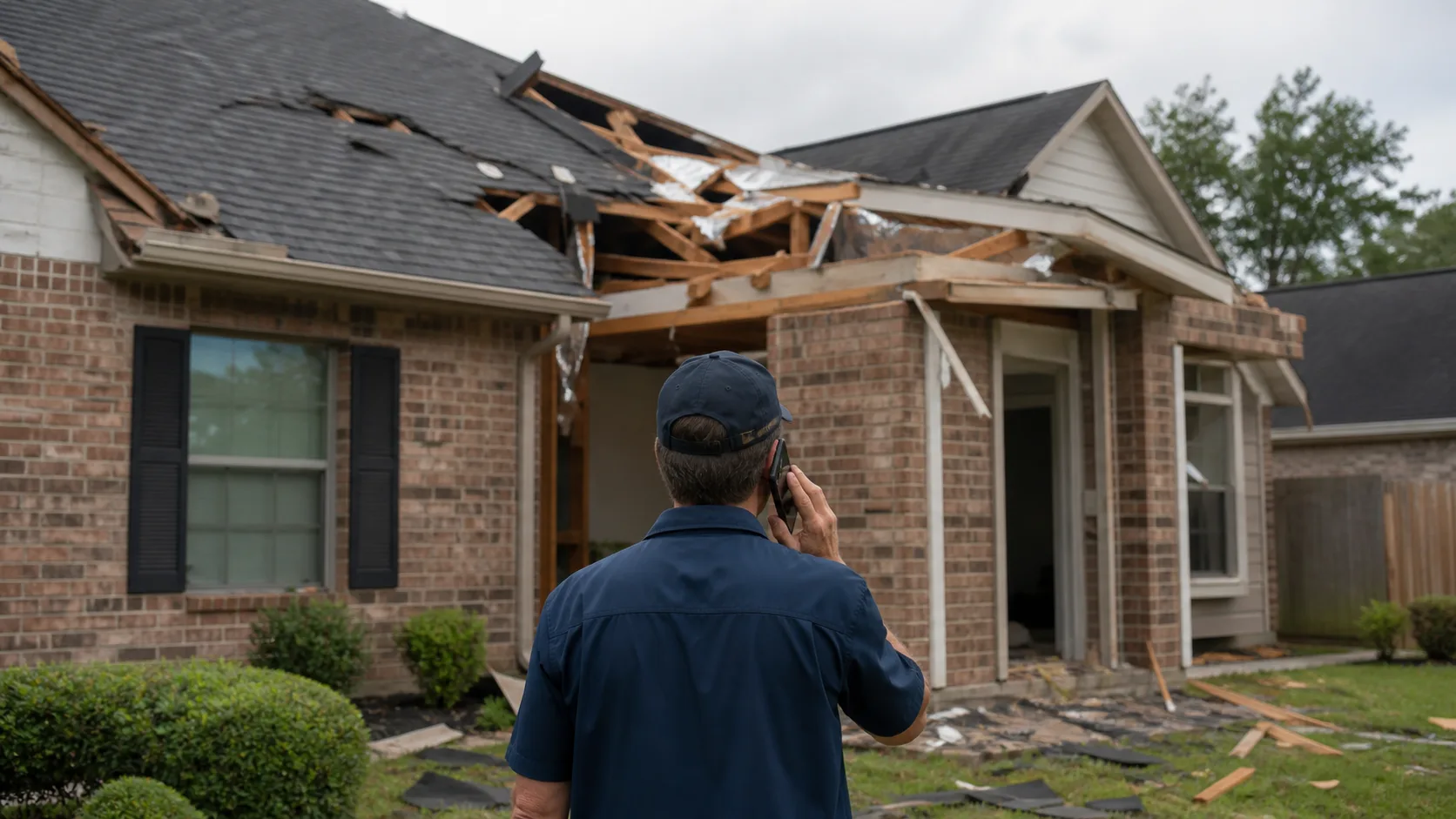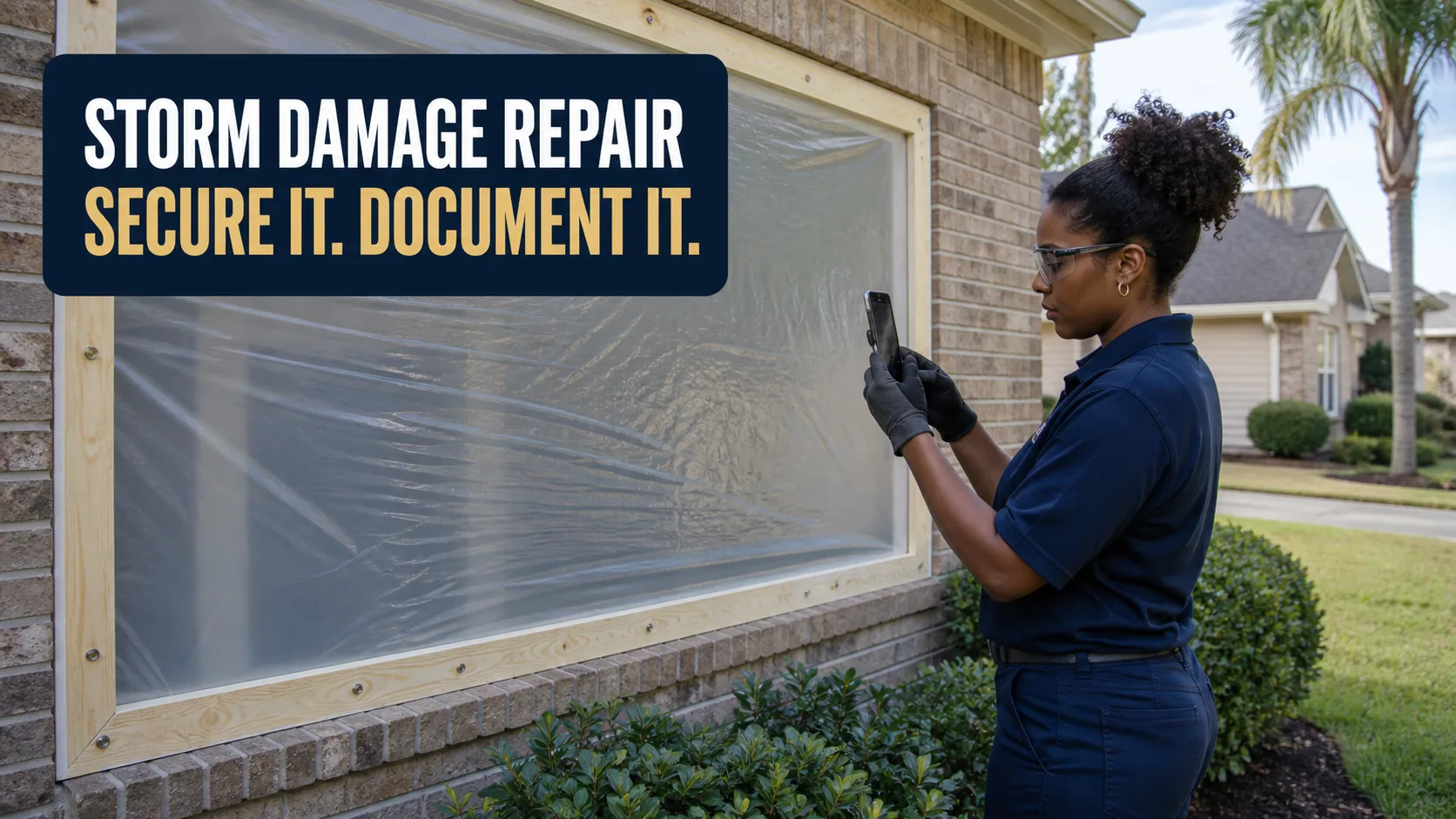
Make the house safe first, then document everything before you move or repair anything. Get the roof tarped and the interior dried so water damage stops spreading, then file the claim. Wind and wind-driven rain through storm-damaged roofing usually fall under homeowners; rising water needs a separate flood policy. For emergency tarping, drying, and repair across Greater Houston, call **(346) 271-7004**.
The first 24 hours, in order
Storm work follows a sequence, and doing it out of order is what costs people money.
- Make it safe. Downed lines, a gas smell, a sagging ceiling, standing water anywhere near outlets or the panel. If any of that is present, get out and call the utility. A bulging ceiling is holding pooled water and can come down all at once.
- Document before you touch anything. Wide shots of all four sides of the house, then close-ups. The debris, the water line, the ceiling stains, the shingles in the yard, the tarp you are about to put up. A slow video walking room to room takes four minutes and is worth more than a hundred words later.
- Stop the damage from spreading. Tarp the roof, board the broken glass, extract standing water, get air moving. This is mitigation, and your policy requires it of you.
- Report the claim. Get a claim number, and write down who you spoke to and when.
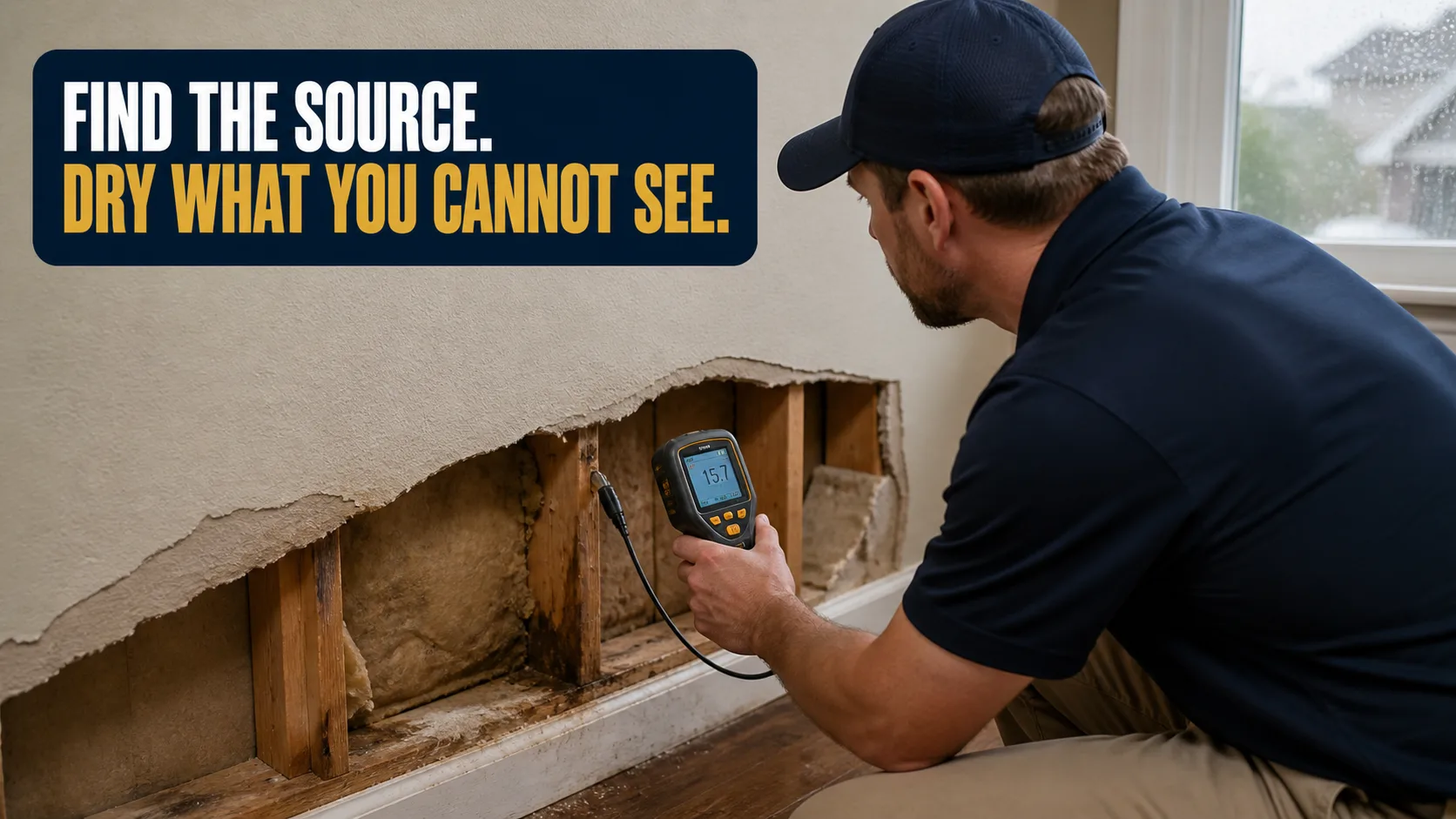
- Dry it out and verify. Moisture meter readings, not “it feels dry.”
- Then repair. Permanent repairs come last, once the loss is recorded well enough that nobody has to take your word for it.
The step people skip is the second one, and it is the step that decides how the rest of the claim goes.
What counts as storm damage?
Storm damage is anything the weather event physically broke, plus the water that came in through the opening it made. On the Gulf Coast it shows up in five places: the roof, the windows and doors, the siding, the fence and detached structures, and the interior that got wet once one of those failed.
That last category is the one that grows. A missing shingle is a small repair. The same missing shingle over three days of rain becomes wet decking, saturated attic insulation, a stained and softened ceiling, and — in Houston humidity — mold inside the wall cavity within 24 to 48 hours. Residential storm damage repair is really two jobs stacked together: fixing what broke, and drying what got wet before the second problem outgrows the first.
Wind-driven rain, roof failure, or flood — which one is it?
This is the most important question you will answer after a Houston storm, because the three are paid by three different sources, and one of them is nobody.
| What happened | Typical example | Usually paid by |
|---|---|---|
| Wind and wind-driven rain | Wind lifts shingles, rain pours into the attic and ceilings | Homeowners policy |
| Hail | Bruised or fractured shingles, dented flashing, vents, and siding | Homeowners policy |
| Falling tree or limb | Punctured decking, crushed fascia, broken window | Homeowners policy |
| Rising water from outside | Street, bayou, or surge water entering at floor level | Separate flood policy only |
| Pre-existing wear the storm exposed | Rotted decking, old cracked flashing, worn vent boots | Usually neither |
The line between the second-to-last row and the rest is the one that surprises people every season: standard homeowners policies exclude flooding from outside. Rising water needs an NFIP or private flood policy, and those often carry a waiting period, so buying one as a storm approaches does not help for that storm. The full picture on flood water is here: hurricane and storm flooding in Houston.
Practically, this means you should photograph where the water entered. Water on the ceiling and running down the inside of an exterior wall tells a wind-and-roof story. Water with a level line at eight inches on every wall in the house tells a flood story. Those two photos lead to two completely different claims.
What do insurers expect you to do?
They expect three things, and they are reasonable ones. First, report promptly — Texas policies set notice requirements, and a long unexplained delay invites questions about whether the damage really came from the storm you named. Second, mitigate, meaning take reasonable steps to stop further damage: tarp, board up, extract, dry. Third, document, both the original damage and everything you did about it, including receipts for tarps, fuel, and emergency work.
What trips people up is that the duty to mitigate does not pause while you wait for an adjuster. If your roof stays open for a week because nobody told you to tarp it, the additional interior damage during that week can be argued as your responsibility, not the storm’s. That argument is one of the more common reasons a claim gets denied or cut back.
One more thing worth checking before you ever need it: your wind and hail deductible. In Texas these are commonly written as a percentage of dwelling coverage rather than a flat amount, and a percentage deductible on a larger home is a very different number than the flat deductible people remember from their auto policy. It is on your declarations page. More on the coverage line generally: does insurance cover water damage.
What does storm damage roof repair actually involve?
Roofing storm damage repair starts with finding every point of entry, not just the obvious one. Water enters at one spot on the roof, travels along decking and rafters, and drips through the ceiling somewhere else entirely — which is why the stain inside almost never sits under the actual hole. If you have ever had water leaking from the ceiling only when it rains, you have met this problem.
A complete sequence looks like this: emergency tarp, then inspection of shingles, flashing, valleys, vent boots, and ridge, then decking assessment from inside the attic, then the interior. Wet attic insulation generally comes out rather than being dried in place. Wet decking has to read dry on a meter before anything is closed back up. Then the roof repair or replacement, then drywall, texture, and paint.
The common shortcut — patch the roof, paint over the ceiling stain, call it done — reliably comes back. The stain returns because the cavity above it never dried, and now you have a mold problem behind fresh paint.
Is tile roof storm damage different?
Yes, in ways that catch out crews who mostly do shingle work. Storm damage tile roof repair has three quirks. Tile cracks and slips instead of blowing off, so damage hides under rows that look fine from the driveway. The waterproofing is the underlayment beneath the tile, not the tile itself, so a roof can look intact and still leak badly. And walking a tile roof without knowing where to step breaks more tile than the hail did. Sourcing replacement tile in a discontinued profile or color is often what sets the timeline, not the labor.
Siding, windows, and the parts people forget
Everyone looks up after a storm. Fewer people walk the perimeter. Hail bruises vinyl siding and dents metal; wind-driven debris cracks and punctures it; and once siding or its flashing is compromised, the next ordinary rainstorm goes into the wall cavity where you cannot see it. Storm damage siding repair is not cosmetic work — it is the difference between one storm’s damage and a slow leak you discover next spring.
Same for windows and doors: broken seals, bent frames, and separated caulk lines let water track down inside the wall. And check the soffit and fascia, which take wind uplift hard and hide a lot.
What storm damage repair costs
Two scopes, two invoices, and only the second one is ours.
- Emergency work first. A tarp and a board-up are priced by area and pitch, and they are a separate small job from the repair. Insurers expect it, and it is usually paid.
- The roof itself. A vent boot or a small flashing repair runs in the hundreds. Sections of decking, valley work, or a full replacement runs into the thousands and up. A roofer prices that.
- The water inside. Priced on how far it traveled and what it soaked — wet attic insulation almost always comes out, and across a single-story Houston attic that removal is a real number on its own.
- Category. Wind-driven rain through a damaged roof is clean water. Water that rose from outside is not, and contaminated water means removal rather than drying.
- Timing. After a named storm every trade in the region is booked the same week, and every day a house sits open adds scope.
The mitigation pricing structure is in what water damage mitigation costs in Houston.
How long storm repair takes
The emergency work happens in a day. Tarping, board-up, and extraction are same-day or next-day jobs, and after a widespread event they are the only jobs that move quickly.
The drying is three to ten days depending on how much water got in, whether attic insulation came out, and whether anything reached a wall cavity or subfloor. The permanent repair is the long pole — after a named storm, roofing and rebuild schedules run weeks to months because the whole region is queued at once.
Readings decide the drying end date, not the calendar. Framing, sheathing and drywall get metered daily until they hit dry standard, and the rebuild starts after that rather than alongside it.
How do I choose a storm damage repair contractor?
Choose the way you would choose any contractor, with two storm-specific cautions. Look for a local address you can actually drive to, current proof of general liability and workers’ compensation, a written scope of work rather than a verbal promise, and willingness to coordinate with your adjuster without asking you to assign your claim rights over to them.
The two cautions: be careful with crews that show up door to door in the days after a storm with out-of-area plates and no local office, and be very careful with anyone who offers to “cover your deductible” or “get you a free roof.” Waiving a deductible is not a favor — in Texas it is illegal, and it puts your claim at risk, not theirs. Storm damage repair contractors worth hiring will put the scope in writing and let you read it before you sign anything.
The photo list an adjuster actually wants
Here is the part worth keeping regardless of who you hire. Take these before you clean up anything. It costs you ten minutes and it is the single highest-leverage thing a homeowner does after a storm.
- All four elevations of the house from far enough back to show the whole wall and roofline.
- The roof from the ground, zoomed, from several angles — plus anything visible from a second-story window.
- Gutters and downspouts, showing granule accumulation.
- The yard: shingles, tile fragments, siding pieces, downed limbs, and the tree they came from.
- Every damaged room, wide first, then close on each stain, crack, and warped board.
- A tape measure or a common object in frame next to hail dents and holes for scale.
- The water line on the walls, if water rose from outside — this is what separates a flood claim from a wind claim.
- Your mitigation work: the tarp going on, the board-up, fans and dehumidifiers running, and every receipt.
- A date-stamped video walking the whole property, narrating what you are looking at.
Store it somewhere off your phone — email it to yourself or upload it — before anything else happens.
If you want the prevention side of this, the pre-season version of the checklist lives in getting ahead of hurricane season in Houston.
When you want a hand
If a storm has opened your roof or put water inside, the useful next step is getting it tarped, extracted, and drying while the damage is still documented and recoverable. TruePoint Restoration works out of Pearland and covers Greater Houston for emergency tarping, water extraction, structural drying, and the repairs that follow — and we will tell you honestly if what you are describing does not need us. Call (346) 271-7004 or email claims@truepointrestoration.com, and bring your photos.
On the roof itself we are not the contractor. We do not replace shingles, flashing, or decking, we do not do electrical work, and we are not a public adjuster. A roofer stops the water and we stop the damage inside — the two jobs run on different clocks, which is why the tarp call and ours should be made the same hour rather than one after the other.