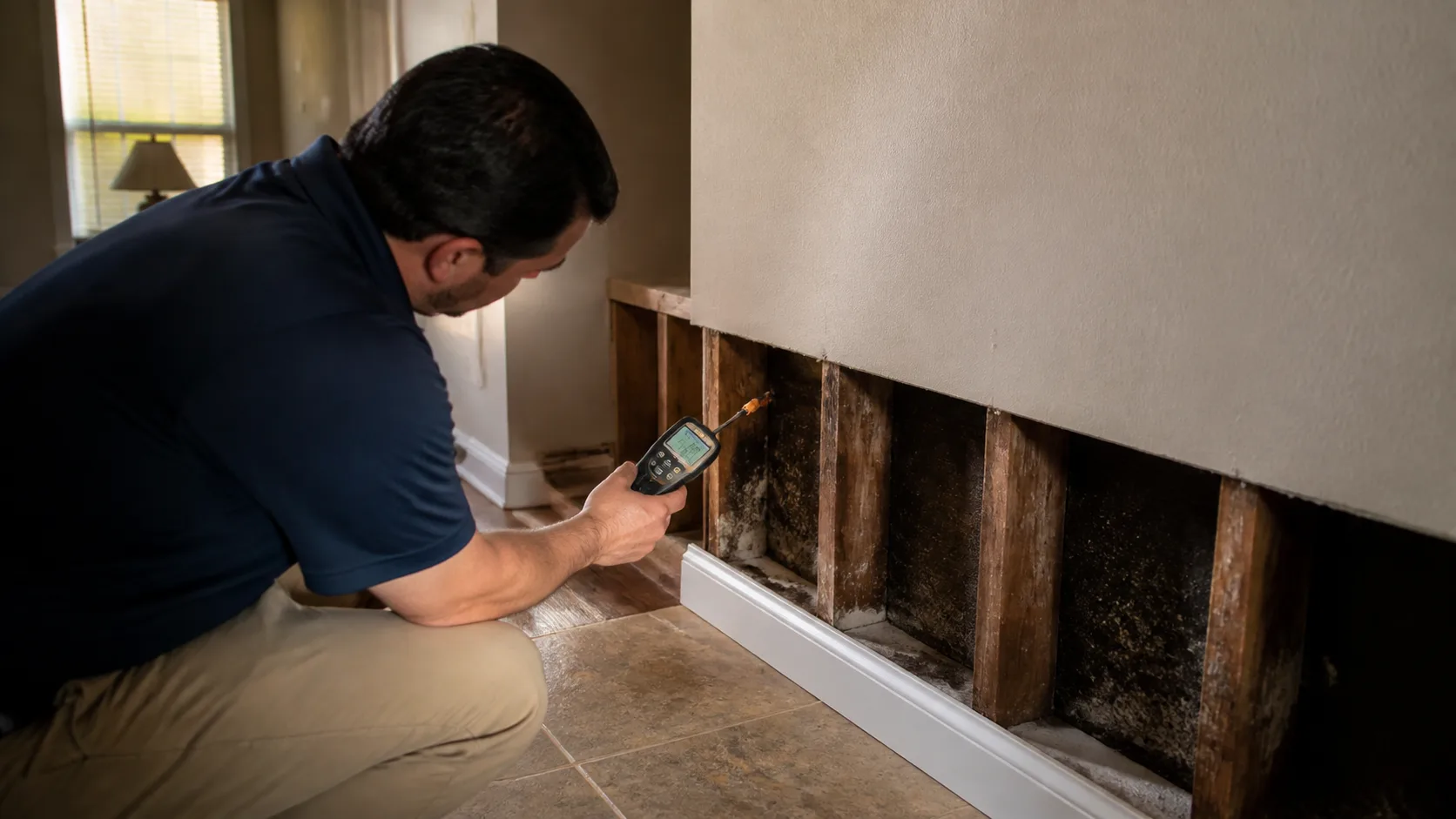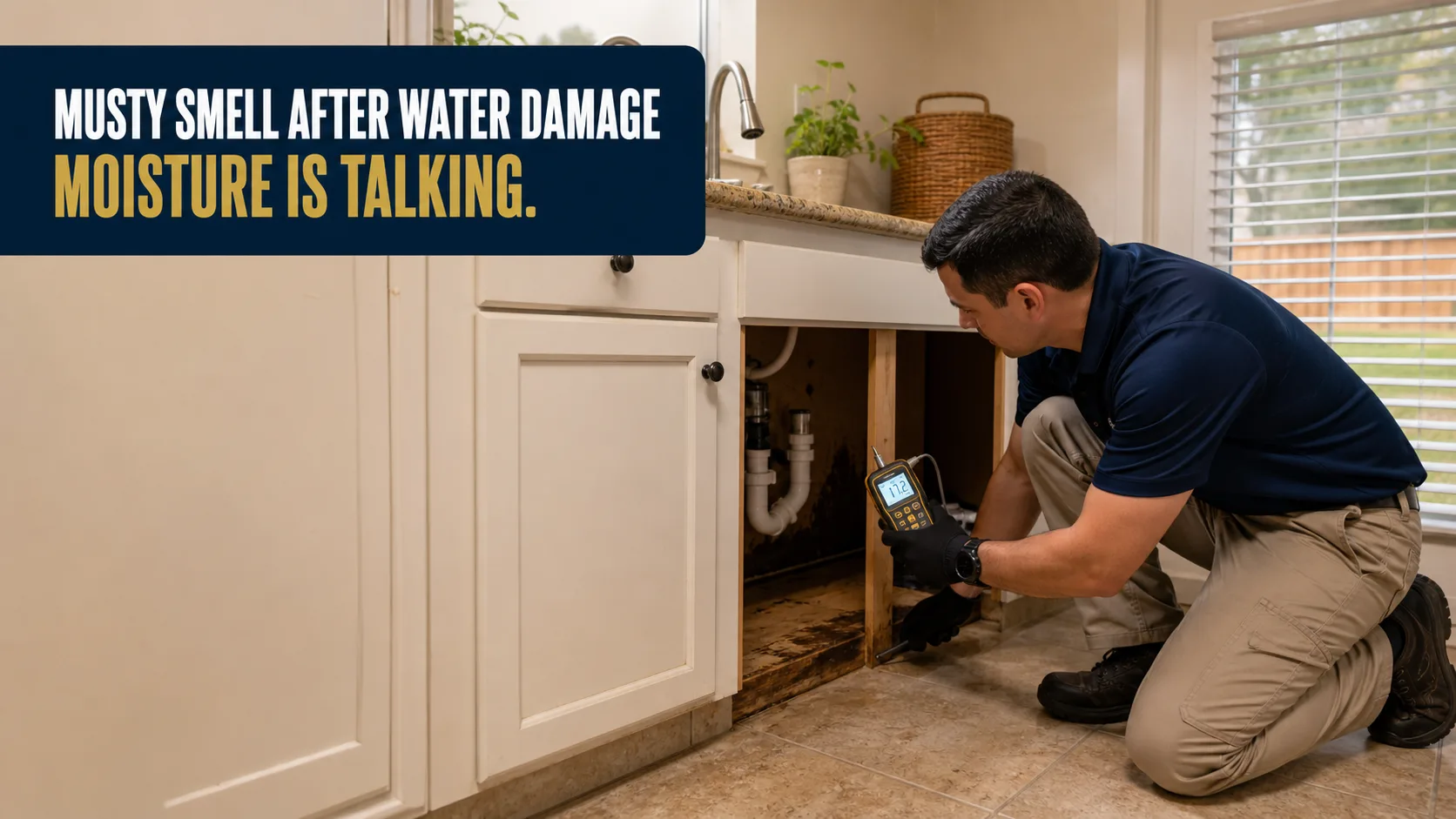
A musty smell after water damage almost always means mold or mildew is growing on something that stayed wet — usually inside a wall, under the floor, or behind a cabinet where you can't see it. The smell is one of the earliest warnings of hidden moisture, often showing up before any stain. You can't deodorize it away: the only fix is finding the wet source, drying it completely, and removing what's contaminated. If your home smells musty after a leak, call **(346) 271-7004** and we'll help you find where it's coming from.
What the smell actually is
That earthy, “old basement” odor is the gas that mold and mildew release as they grow. Your nose is picking up an active biological process — which means two things are true: there is moisture feeding it, and there is material it is eating (drywall paper, wood, dust, carpet backing). In Houston, where humidity keeps things wet longer, that process runs faster and lingers.
The important part: you usually smell it before you see it. The growth is often inside a wall cavity or under flooring, so the odor is your only early clue.
Where the smell is usually coming from
- Inside wall cavities — after a leak, the drywall bottom and framing stay wet and grow mold on the hidden side.
- Under flooring — laminate and wood trap a damp subfloor beneath them; the top looks fine.
- Behind or under cabinets — kitchen and bath cabinets sit against walls and over subfloors that hold water.
- The HVAC system — a clogged condensate drain pan or wet duct insulation will push a musty smell through the whole house every time the AC runs.
- The attic — in Houston the water heater and HVAC live up there; a slow leak grows mold in the insulation.
How to track it down
- Notice when it’s strongest. Right when the AC kicks on points to the HVAC. Worse when it rains points to an intrusion path. Strongest in one room points to that room’s walls or floor.
- Check the obvious wet history. Any room that had a leak, overflow, or ceiling stain is the first suspect.
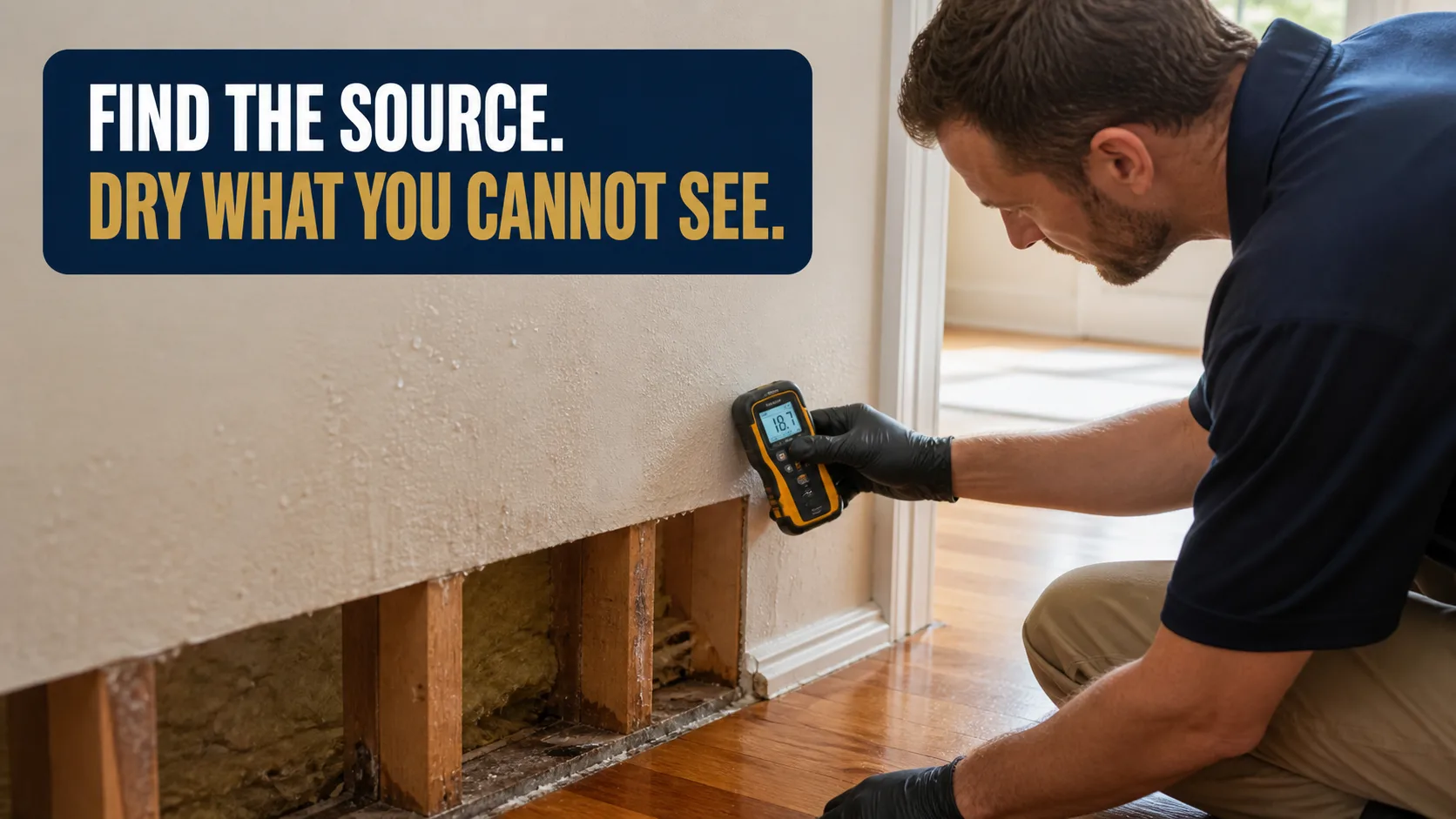
- Meter the walls and floor. A moisture meter along the baseboards and subfloor finds the damp cavity the smell is coming from.
- Look low and behind. Pull a baseboard or look behind the toe-kick of a cabinet — mold shows up at the bottom first.
Warning signs the smell is growth rather than damp
Damp smells go away when a room dries. Growth smells do not, and they come with company.
It is an active colony, not stale air:
- The odor is strongest first thing in the morning, before anyone has opened a door
- It comes back within an hour of airing the room out
- It is worse in humid weather and better after a cold front, which tracks with what growth does
The materials agree with your nose:
- Discoloration at the bottom four inches of drywall, in the corner where two walls meet the floor, or along a grout line
- Baseboard swelling, paint bubbling in a band, or a cabinet kick that is soft to a thumb press
- A cool, slightly giving patch of wall in a room that had water months ago
The air system is spreading it: the smell arrives when the AC starts and fades when it stops, or the filter loads grey faster than it used to. In Houston the air handler is usually in the attic, which puts the source upstream of every room.
It is a different smell entirely: a sharp, acrid, burnt odor is not mold, it is smoke residue, and it comes off surfaces rather than out of cavities. The two are treated completely differently.
How to actually get rid of it
- Remove the moisture. Dry the cavity completely with air movers and a dehumidifier — surface drying is not enough.
- Remove what’s contaminated. Porous materials that grew mold (carpet pad, soaked drywall) come out; they can’t be deodorized clean.
- Treat and verify. Antimicrobial where appropriate, then a moisture reading to confirm the cavity is dry before closing it back up.
- Fix the source. If the smell tracks with rain or the AC, the underlying leak or drainage issue has to be corrected or it comes right back.
When the smell means the job needs a license
Texas regulates mold work by area. Once the affected material passes roughly 25 contiguous square feet, the state’s mold assessment and remediation rules apply, and the work belongs to licensed people.
Three consequences worth knowing before anyone quotes you:
- The assessor and the remediator have to be independent. The licensed consultant who writes the protocol and verifies the result cannot be the firm doing the removal. A company offering to inspect, remediate, and clear its own licensed-size job is describing something the rules do not permit.
- A licensed project ends with a Certificate of Mold Damage Remediation, and that document follows the property. Keep it. A buyer’s agent will ask, and its absence on a house with a known mold history becomes a problem at closing.
- Odor is a poor guide to area. A smell you can barely place can come from a cavity holding several times 25 square feet of affected material, because you are smelling the back of the drywall rather than the front.
What it costs to remove the smell and its source
Nobody prices odor. They price the material producing it.
- How much has to come out. Drywall, insulation, carpet pad, and cabinet kicks are removed rather than deodorized. That removal is the largest line, and it is measured on the material rather than on the size of the stain.
- Access. A wall cavity behind a tiled shower, an attic, or a crawl space costs more to reach than an open bedroom wall.
- Whether the HVAC is in scope. Wet duct insulation and a contaminated air handler add system cleaning or replacement, and they are what put the smell into every room at once.
- Whether the job crosses the licensing threshold, which adds a consultant’s protocol, containment, and post-remediation verification.
- Whether the source is fixed. Remediating around a leak that is still running means doing it twice.
Small contained work runs in the hundreds to low thousands. Licensed multi-room projects run into five figures. The line items are in the mold remediation cost breakdown.
How long until the smell is actually gone
Two to four days for a contained single-wall job — remove, clean, treat, then dry the structure behind it. One to three weeks for a licensed multi-room project, because the protocol, containment build, removal, and clearance sample each take their own time.
Readings decide, not the calendar, and here the smell decides nothing at all. Odor drops off as soon as the bulk material leaves the building, while whatever is absorbed into a bottom plate or a subfloor stays exactly where it is. A finished job ends with the affected materials at dry standard on a meter and a written record of what came out — not with a room that smells better on the day the crew packs up.
What NOT to do
- Don’t mask it. Ozone machines, plug-ins, and candles cover the odor while the source keeps growing and spreading.
- Don’t assume it’s “just old house smell.” A new, persistent musty odor is new moisture.
- Don’t wait it out. In Gulf Coast humidity the smell doesn’t fade on its own — it means the material feeding it is still wet, and the damage is ongoing.
For the full picture on what’s feeding that smell and how fast it develops, read mold after water damage.
Does insurance cover a musty smell?
Not on its own. Carriers pay for damage from a covered event, and odor is a symptom rather than a loss. What decides coverage is what is producing it and how it got there.
A sudden, promptly reported water event with documented drying is the covered version. A slow leak that ran for months is the excluded version, because most Texas policies exclude gradual damage and carry a separate mold sublimit or exclusion on top of it. That is why the useful record is the water event and the date you acted, not the smell. What mold coverage actually looks like in Texas is in does insurance cover mold.
The free things worth doing tonight
- Shut the AC off for twenty minutes and walk the house nose-first. Air movement dilutes odor; still air concentrates it in the room producing it.
- Change the filter and look at the old one in daylight before you bag it.
- Open the cabinet under every sink and check the back corners with a flashlight.
- Photograph anything you find with the date stamp on, close and wide, before it gets cleaned.
- Close the door on the affected room and stop running fans in it, so nothing gets pushed into clean space.
Where the HVAC tech ends and we begin
TruePoint Restoration is a mitigation and remediation contractor. We do not service air conditioners, replace coils or drain pans, repair pipes or roofs, do electrical work, or act as the rebuild contractor who hangs and paints new drywall. On a licensed-size mold project we also do not write our own clearance — an independent consultant does, and that separation exists to protect you.
What we do is find the wet material behind the smell and take it out: metering walls, floors and cavities to locate the source rather than guessing at it, containment so the work does not seed clean rooms, HEPA filtration and negative air, removal and bagging of porous material at the source, treating and drying what stays, and a documented file — affected materials, moisture logs, disposal records — your adjuster works from.
If your house smells wrong and you cannot find why, call (346) 271-7004. We work out of Pearland and serve Manvel, Friendswood, League City, Pasadena, Sugar Land and the Greater Houston area.