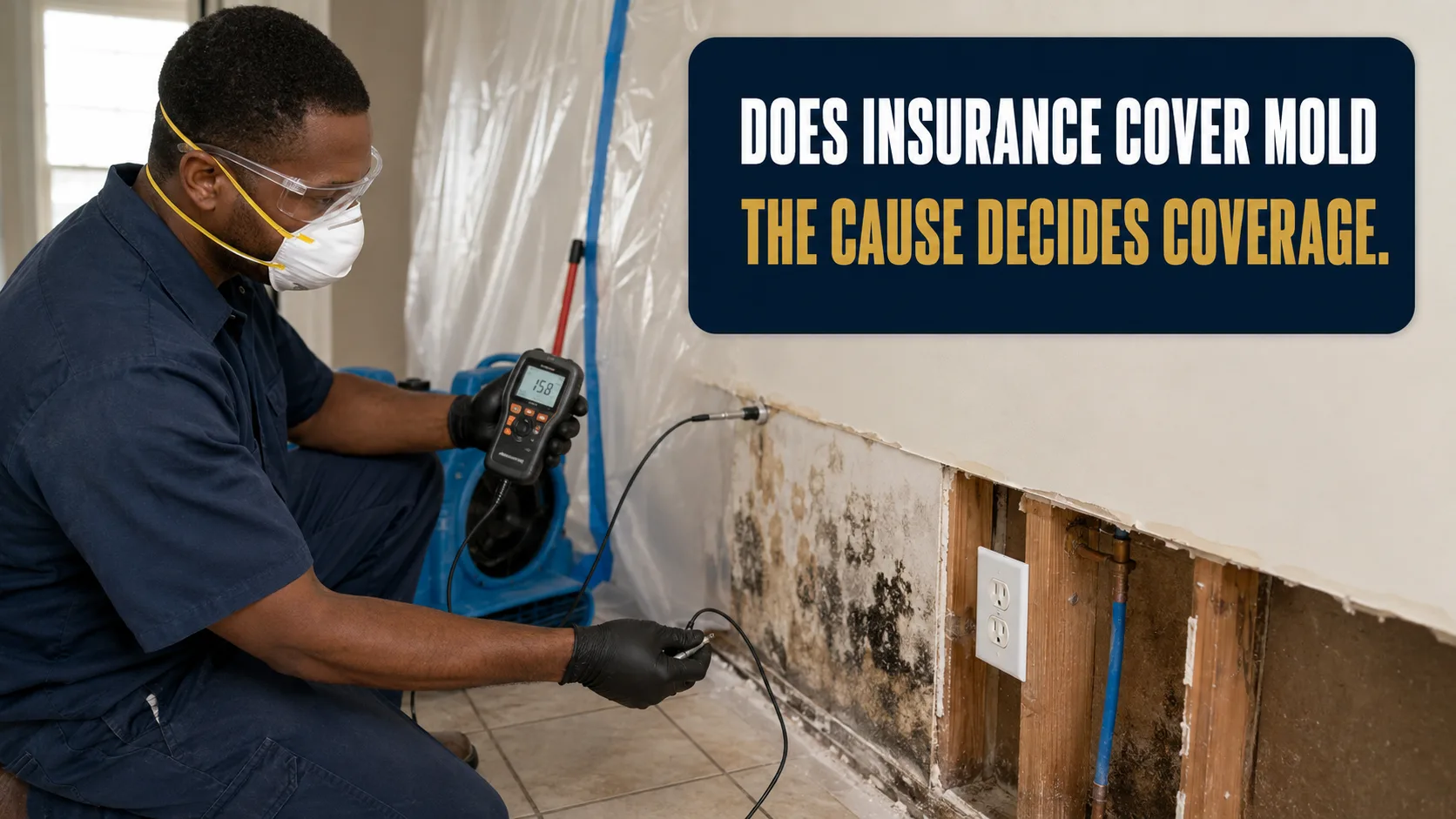
Usually only when the mold results from a covered sudden event that was addressed promptly. Texas policies generally exclude mold from gradual leaks, humidity, and deferred maintenance, and many cap mold at a sub-limit or require an endorsement. In practice the drying timeline decides it, because slow drying turns a sudden loss into a gradual one. Coverage questions, call **(346) 271-7004**.
Why mold sits in its own corner of the policy
Every other kind of water damage gets argued over cause. Mold gets argued over cause and time, because mold is the one thing on a claim that visibly announces how long something has been wet. That makes it the easiest loss for an insurer to reclassify, and the hardest one for a homeowner to argue after the fact.
So most Texas policies handle mold with a separate set of rules: sometimes a sub-limit, sometimes an endorsement you have to buy, sometimes an exclusion with a narrow exception. Three different structures, three completely different outcomes at claim time, all of them printed on your own declarations page.
This page is only about the coverage question. If you want the biology and the timeline, that is mold after water damage. If you want to know what remediation costs before anyone quotes you, that is mold remediation cost in Houston.
Does homeowners insurance cover mold?
Usually only when the mold is a direct result of a covered sudden event that was addressed promptly, and even then only up to whatever mold limit the policy carries. That is the whole answer, and every complication below is a variation on it.
Break it into the three conditions the carrier is checking:
- Was the underlying cause covered? Mold is never covered on its own. It rides on the loss underneath it. A burst supply line is a covered cause. Humidity is not a cause at all, it is a condition.
- Was the water addressed promptly? Policies contain a duty to prevent further damage. A homeowner who called mitigation the same day has met it. A homeowner who let it sit has handed the carrier an argument.
- What does the mold provision say? Coverage that exists in principle can still be capped at a fraction of the remediation cost. The sub-limit is where covered claims quietly turn into partly-paid claims.
What is the sudden-and-accidental test?
It is the language most Texas policies use to separate an accident from a condition, and it decides almost every disputed mold claim. Sudden means it happened at a point in time. Accidental means nobody intended it and nobody neglected it into existence.
What makes this test unusual is that the adjuster does not take your word for it, or theirs. They read the materials. Wet drywall with clean edges and uniform saturation says recent. Rust rings, layered tide marks, delamination, cupped flooring that has already dried once, and established growth say this has been going for a while. The building keeps its own record, and the record generally wins.
Which means most of the verdict is written before anyone arrives, by what happened in the first day. The full sequence is in the first 24 hours after water damage, and the underlying coverage map is in does insurance cover water damage.
What is the gradual damage exclusion?
It is the clause that removes anything occurring continuously or repeatedly over a period of weeks or months, and it is the single most common basis for a denied mold claim. Insurance funds accidents. Deterioration is considered the homeowner’s job to prevent, and mold is treated as the visible proof that deterioration happened.
The practical effect is a default position: mold is presumed gradual until the file shows otherwise. That presumption is not personal and it is not unreasonable, since most mold genuinely is gradual. It just means the burden of showing a sudden origin sits on your side of the table, and the only currency that works is dated evidence.
Some policies contain a narrow carve-out for hidden leaks a homeowner could not reasonably have discovered, such as a supply line inside a wall cavity. Worth reading closely if that describes your loss, and worth not assuming if it does not.
How much mold coverage does a Texas policy actually carry?
Often much less than homeowners expect, because mold is usually handled through a separate limit rather than the dwelling limit. Three structures show up:
- A sub-limit. Mold remediation is covered, but only to a stated dollar amount that is a small fraction of the policy limit. Everything above it is yours.
- An endorsement. Mold coverage exists only if you bought it, at a higher limit, for extra premium. If it is not on the declarations page, it does not exist, and it cannot be added after a loss.
- An exclusion. Some policies exclude mold, fungi, and microbial growth outright, with limited or no exception.
You can find out which one you have without calling anyone. Pull your declarations page, search it for the words mold, fungi, or microbial, and note the number next to it. That is the ceiling on this entire category of loss, and knowing it now is far better than discovering it in the middle of a claim.
Why does the drying timeline decide coverage?
Because slow drying converts a sudden loss into a gradual one, in evidence if not in fact. Mold can begin colonizing within roughly 24 to 48 hours of materials staying wet, and Gulf Coast humidity holds moisture in a wall cavity long after the surface feels dry. Once growth is established, the physical record of your claim starts saying time instead of accident.
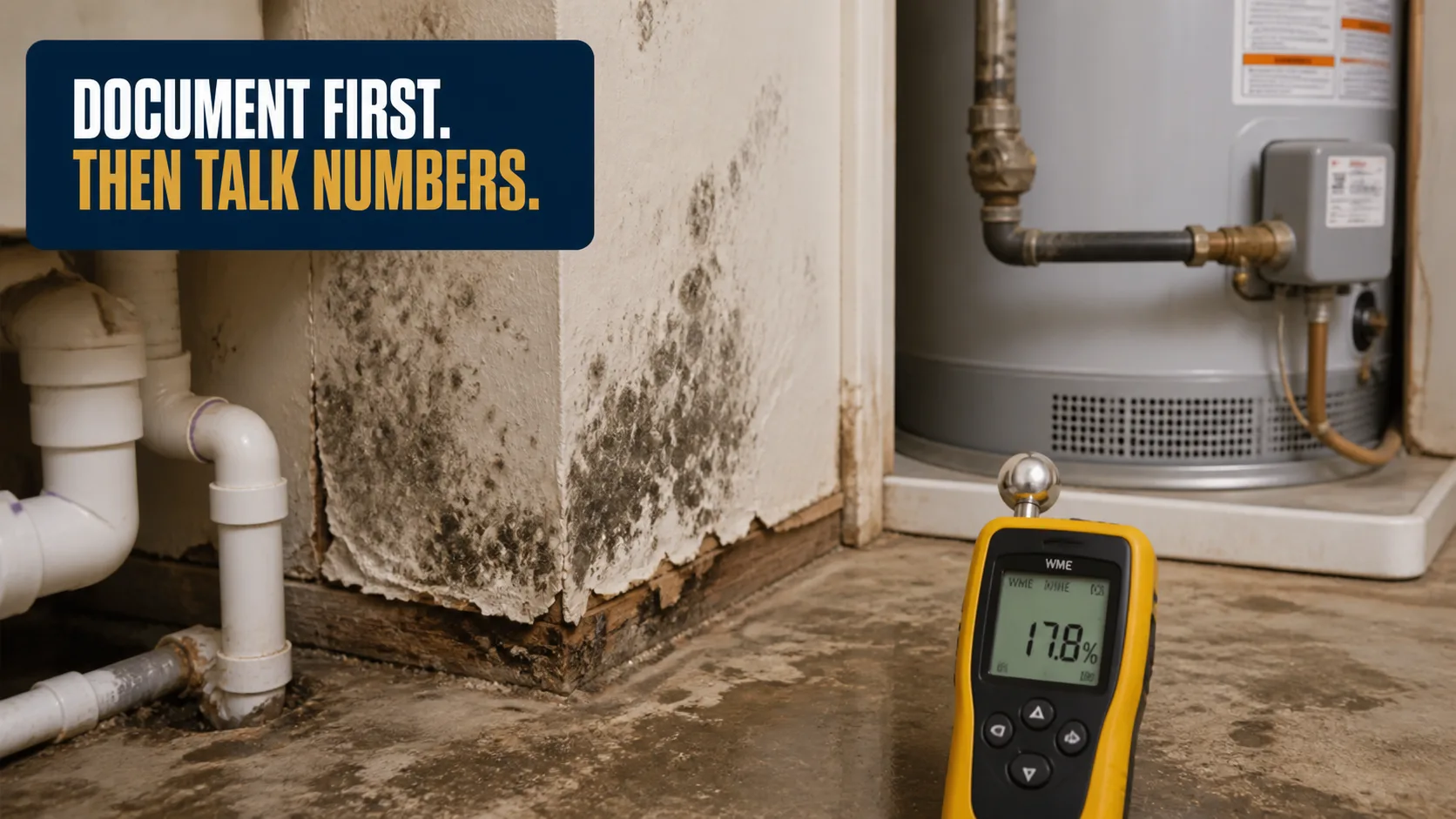
This is the part homeowners find counterintuitive. The mitigation response is not just a repair decision, it is a coverage decision. Fast, metered, documented drying does two things at once: it keeps the damage small, and it produces the daily moisture logs that prove the loss was new when you found it. Slow drying loses both.
It is also why “it looks dry” is not a standard anyone should accept. Dry is a number on a meter compared against a dry-standard reading elsewhere in the house, recorded each day until it lands. If nobody is producing that log, nobody is producing your evidence either.
Does insurance cover mold removal and testing?
Removal is generally treated as part of repairing the covered loss, within the mold limit. Testing is a different story and is frequently treated as an investigative expense rather than physical damage, which means it often is not reimbursed.
A practical note on testing. If an adjuster or carrier asks for air sampling or a lab result to confirm scope, get that request in writing before you pay for it. A test performed at the carrier’s written request is a straightforward reimbursement conversation. A test you commissioned on your own initiative usually is not.
The same logic applies to a post-remediation verification. Useful, sometimes necessary, and much easier to submit when someone in the claim file asked for it.
Covered or not, how four common scenarios usually land
Every policy is different and none of this overrides your own. But these are the patterns that repeat.
| What happened | How it usually lands | What it turns on |
|---|---|---|
| Supply line burst overnight, mitigation same day, mold found in the cavity during teardown | Typically covered, within the mold limit | Documented discovery date, immediate response, drying logs |
| Under-sink leak found after months, cabinet base rotted, growth on the back wall | Typically excluded as gradual | Physical evidence of long-term wetting |
| AC condensate pan overflowed, ceiling stained, growth above the drywall | Depends on why it overflowed | Service records and whether the blockage was recent |
| Storm-driven rain entered through an opening in the roof, ceiling stayed damp | Depends on whether the opening was storm-created | Wind damage documentation and response time |
Notice what the right-hand column has in common. None of it is about the mold. All of it is about the record of what happened before the mold.
If the mold claim comes back denied
Ask for the denial in writing with the specific provision cited, then read the provision against the facts. Most mold denials rest on the gradual-damage exclusion, and the counter-argument is always evidence rather than emotion: the dated discovery, the same-day mitigation invoice, the moisture readings, photographs of the failed component.
A denial is a position, not a verdict. Carriers reconsider when new documentation arrives, and reopening a claim with a moisture log attached is a very different conversation from reopening it with a complaint attached. The full walkthrough is in what to do when a water damage claim is denied, and if the dispute stalls, the Texas Department of Insurance takes complaints and can prompt a formal response.
One thing worth knowing separately: if another party caused the loss, such as an upstairs neighbor or a manufacturer whose part failed, your carrier may pursue them for what it paid, which can also return your deductible. That process is subrogation, and it is a reason to keep the failed part rather than throw it out.
The five-minute policy check, free
You do not need a claim to do this, and doing it now is worth more than reading anything else on this page. Pull up your declarations page and answer four questions.
- Is there a mold, fungi, or microbial line item? Write down the limit if there is one. If there is not, you are looking at an exclusion or a missing endorsement.
- Do you have water backup coverage? Sewer and drain backup is usually a separate endorsement, and mold from a backup will follow whatever that endorsement says.
- What is your deductible, and is it a flat amount or a percentage? Percentage deductibles on wind and hail change the math on storm-related losses considerably.
- Is your dwelling coverage replacement cost or actual cash value? This decides how much of the repair you actually receive, entirely separately from whether mold is covered at all.
Four answers, five minutes, and you will know more about your own exposure than most homeowners find out until they are standing in it. If any answer surprises you, that is a conversation with your agent, not with us.
Where we fit
TruePoint Restoration is a water mitigation and mold remediation company based in Pearland, serving Greater Houston. The part of this we control is the part that decides most coverage arguments: getting materials dry quickly, measuring it rather than guessing, and producing a documented file that shows what the loss looked like on the day it was found.
If you have water now, or a mold question and no idea where your policy stands, call (346) 271-7004 or email claims@truepointrestoration.com. We will walk through what we would document and what we would expect the carrier to ask, at no cost. This page is general information, not insurance advice, and the only document that decides your coverage is your own policy.
TruePoint Restoration is a mitigation and remediation contractor, not a public adjuster, a claims representative, or a law firm. Texas keeps those roles separate from the company performing the repair work, and a public adjuster generally may not hold a financial interest in the repairs — so we do not negotiate settlements or represent anyone on a claim. Where a dispute is real, that is work for a Texas-licensed public adjuster, an attorney, or the Texas Department of Insurance.