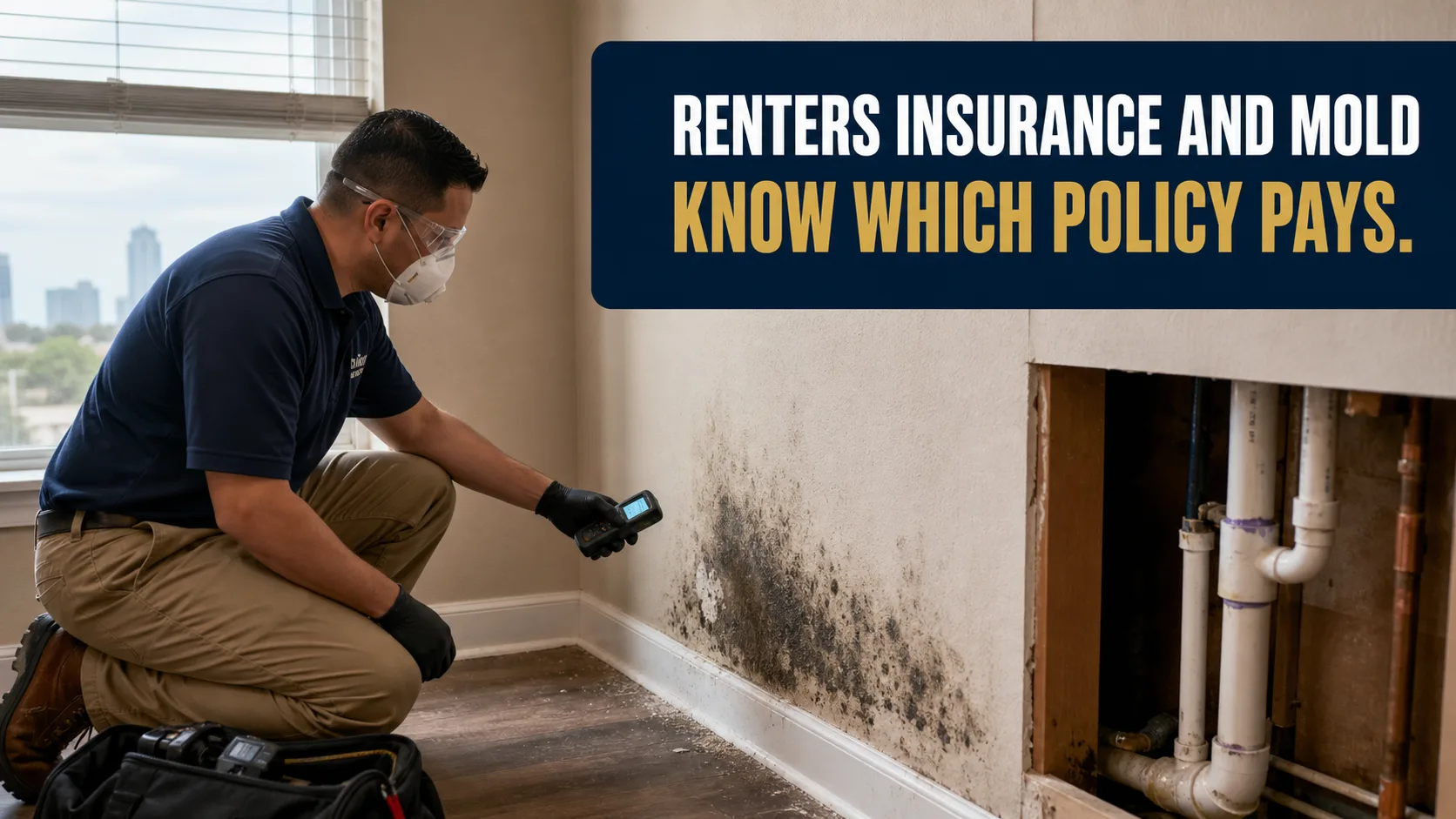
Renters insurance covers your belongings and your living costs, not the building. Mold damage is typically covered only when it grows out of a sudden, covered water event that was dried promptly, and most policies cap or exclude it otherwise. The structure, and remediation inside the walls, fall to your landlord's policy. Questions about a wet rental, call **(346) 271-7004**.
Two policies are in play, and they do different jobs
When water shows up in a rental, there are almost always two insurance policies in the room, and they are not backups for each other. Your renters policy is aimed at your belongings and your displacement. The landlord’s property policy is aimed at the building. Most tenant confusion comes from expecting one of them to do the other’s job.
| What got wet | Whose policy typically responds |
|---|---|
| Your furniture, clothes, electronics, bedding | Your renters policy (personal property) |
| A hotel or short-term rental while the unit dries | Your renters policy (loss of use) |
| Damage you caused to the unit or a neighbor’s unit | Your renters policy (liability) |
| Drywall, subfloor, ceilings, cabinets, the structure | Landlord’s property policy |
| Appliances that came with the unit | Landlord’s property policy |
| Mold remediation inside the walls and floors | Landlord’s policy, within its own mold limits |
| The plumbing repair itself | Usually neither, it is a repair cost, not damage |
The landlord’s deductible is also not your problem, and your deductible is not theirs. Two separate claims, two separate files, two separate sets of documentation. If you only remember one thing from this page, make it that.
Does renters insurance cover mold damage?
Sometimes, and usually only when the mold grew out of a sudden covered water event that was handled promptly. That is the same test homeowners policies apply, and it is a narrower door than most people expect.
Three things generally decide it:
- Was there a sudden, covered cause? A supply line that burst on Tuesday reads very differently from a shower pan that has been weeping since spring. Policies are built to cover accidents, not conditions.
- Was it addressed quickly? Most policies contain a duty to prevent further damage. Water reported and dried the same day is an accident. Water that sat for three weeks starts to look like a choice.
- What does the mold language say? Many Texas policies cap mold at a small sub-limit, some require an endorsement, and some exclude it. There is no universal answer here. The number, if there is one, is printed on your declarations page.
Because the growth timeline is short, the coverage question is really a drying question. We wrote the mechanics of that out in mold after water damage, and it applies to a rental exactly the way it applies to a house.
Does renters insurance cover water damage?
Typically yes, for your personal property, when the water came from a sudden and accidental cause that the policy names. Most renters policies cover contents on a named-perils basis, which means the policy lists the causes it will respond to rather than covering everything and listing exceptions.
Commonly on that list:
- Sudden discharge from plumbing, heating, or air conditioning
- A failed appliance or water heater, including one in the unit above yours
- Accidental overflow from a fixture
- Water that gets in after a covered event opens the building up, such as wind removing part of the roof
Commonly not on that list:
- Rising water from outside, which needs separate flood coverage
- Sewer or drain backup, which usually needs its own endorsement
- Gradual seepage and long-term leaks
- Damage caused by a repair the landlord never made, which is a landlord-liability conversation rather than a covered-peril one
The broader map of what sudden and accidental means, and how adjusters read the evidence, is in does insurance cover water damage. The logic is the same on a renters policy, applied to a smaller pile of property.
What does loss of use actually pay for?
Loss of use pays the extra cost of living somewhere else while your unit is uninhabitable after a covered loss. It is the most underused part of a renters policy and often the most valuable one, because a soaked apartment in Houston humidity can take days to dry properly.
What it typically reimburses is the difference between your normal cost of living and your new one. A hotel you would not otherwise be paying for, restaurant meals because you have no kitchen, extra mileage to work from a temporary address, boarding for a pet the hotel will not take. What it does not do is hand you a lump sum, and it does not usually cover your rent, since you were paying that anyway.
Two practical notes. Keep every receipt, including the small ones. And ask your carrier, in writing, what the limit is and how long it runs, because loss of use is normally capped as a percentage of your contents limit or by a fixed number of months.
What is the landlord’s side of this?
The landlord owns the building, insures the building, and in Texas carries a statutory duty to repair conditions that materially affect health and safety. That duty runs through a notice process, which is why the written request matters more than the phone call.
Their policy covers structure and, if the property was rented out, often their loss of rental income. It does not cover your belongings, and their adjuster is not working your side. That is not hostility, it is just whose file it is.
Where landlord and tenant most often collide is causation. If a landlord believes a tenant created the moisture by blocking vents, running a humidifier, or not reporting a leak, they may argue the cost belongs to the tenant. If the tenant believes the landlord ignored a known leak, that is the reverse argument. Both arguments are won or lost on dated records, which brings us to the part you control.
What do you do when the landlord will not act?
Put it in writing, keep documenting, and start your own claim for your own property rather than waiting for someone else’s decision. Waiting is the expensive option, because wet materials keep getting worse while the argument runs.
A workable sequence:
- Send written notice. Email or a dated letter, describing the condition specifically and asking for repair. Keep the copy. Verbal reports are worth very little later.
- Photograph on a schedule. The day you find it, then every few days. A dated series showing a spreading stain is far more persuasive than a single photo.
- Open your renters claim. Your carrier handles your property under your policy. It is a separate track from the landlord dispute and does not depend on the landlord agreeing to anything.
- Protect what you can without doing structural work. Move belongings out of the wet area, run the AC, get air moving. Do not start cutting into the landlord’s walls.
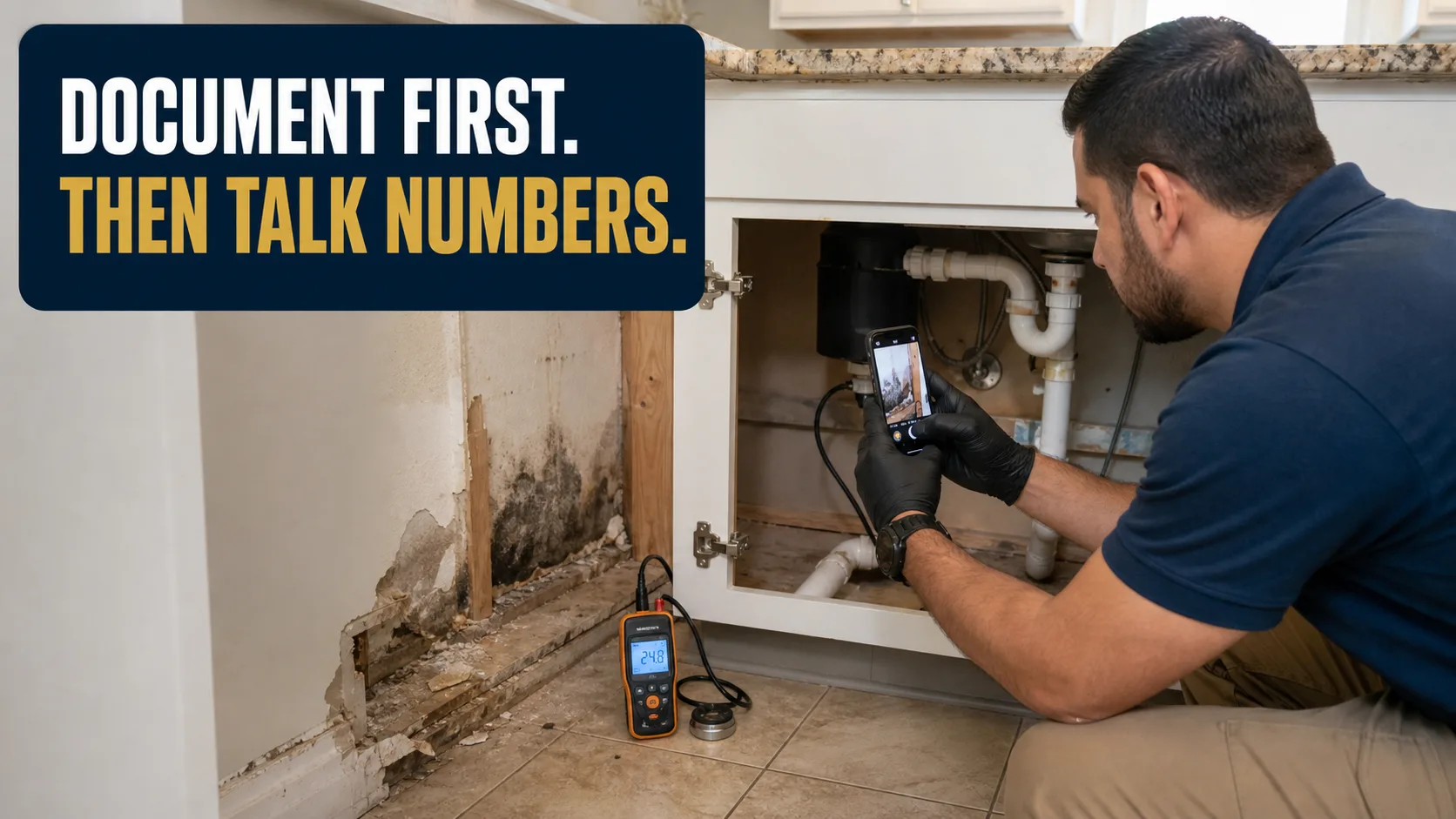
- Get the moisture measured. A written moisture reading from someone with a meter converts your opinion into evidence. It is also the thing that tells you whether the wall is actually drying or just feels dry.
- Know where the escalation paths run. Insurance disputes go to the Texas Department of Insurance. Landlord repair obligations run through your lease and the Texas Property Code, and the deadlines in that process are specific enough to be worth reading before you rely on them.
What should a tenant document, and for how long?
Everything, from the day you find water, until the claim closes and the repairs are done. Documentation is the only leverage a tenant reliably has, and it costs nothing but discipline.
The short list:
- Move-in photos, so nobody can call a new problem pre-existing or an old one yours
- Discovery photos and video, wide and close, on the day you find it
- The source, photographed before anyone repairs it
- Every message to and from the landlord or property manager, in writing
- An inventory of damaged belongings, with what you paid and roughly when, since that determines whether you are paid actual cash value or replacement cost
- Receipts for hotels, meals, laundry, and replacements
- Moisture readings, dated, ideally from a professional rather than a phone app
If you want the checklist version of the first day, the first 24 hours after water damage walks the whole sequence.
Where renters accidentally hurt their own claim
Almost always by speculating out loud. A tenant who says “I think it might have been leaking for a while” has just written the gradual-damage argument for the carrier, even when it is not true and even when they were only being polite.
The other common one is leading with the word mold. Because mold is associated with long-term neglect, it changes how a claim gets read from the first sentence. The accurate framing is to report the event and the date you found it, then let the moisture readings say what they say. That is not evasion, it is precision about what you actually know. More on how that conversation goes in what not to say to your insurance adjuster.
Third: delay. Even when the landlord is the one who should be fixing it, your policy asks you to take reasonable steps to prevent further damage. Moving your things out of a wet room and running the AC is reasonable and it is documented.
The written notice, free to copy
You do not need a lawyer to send a repair request, and the plain version works better than a dramatic one. Adapt this, send it by email so it timestamps itself, and keep the copy.
Subject: Written repair request, [unit number], water damage
On [date] at approximately [time], I discovered [describe what you found and where, plainly]. Photographs taken that day are attached. The affected materials in [room] were still wet as of [date].
I am requesting repair of the source and of the resulting damage. Please confirm in writing when a repair will be scheduled and who will be performing it.
I am documenting the condition on an ongoing basis and will share further photographs as they are taken. I have also notified my own renters insurance carrier regarding my personal property.
[Name, unit, phone, date]
Two things that letter does. It fixes a date, which is the fact everything else gets argued around. And it separates the two tracks cleanly, so the landlord knows your contents claim is already moving.
If you want an estimate of what the remediation side of this actually costs before anyone quotes you, mold remediation cost in Houston lays out how those numbers get built.
Where we fit
TruePoint Restoration is a water mitigation and mold remediation company in Pearland, working across Greater Houston. Tenants call us more often than you would expect, sometimes because the landlord hired us and sometimes because they want an independent read on whether a wall is actually dry.
If you are living with a wet floor and a landlord who has gone quiet, call (346) 271-7004 or email claims@truepointrestoration.com and tell us what happened. We will tell you what we would document and what we would ask for, whether or not there is any work in it for us. Nothing on this page is insurance or legal advice, and the only document that decides your coverage is your own policy, so read it, and take any dispute to the Texas Department of Insurance.
TruePoint Restoration is a mitigation and remediation contractor, not a public adjuster, a claims representative, or a law firm. Texas keeps those roles separate from the company performing the repair work, and a public adjuster generally may not hold a financial interest in the repairs — so we do not negotiate settlements or represent anyone on a claim. Where a dispute is real, that is work for a Texas-licensed public adjuster, an attorney, or the Texas Department of Insurance.