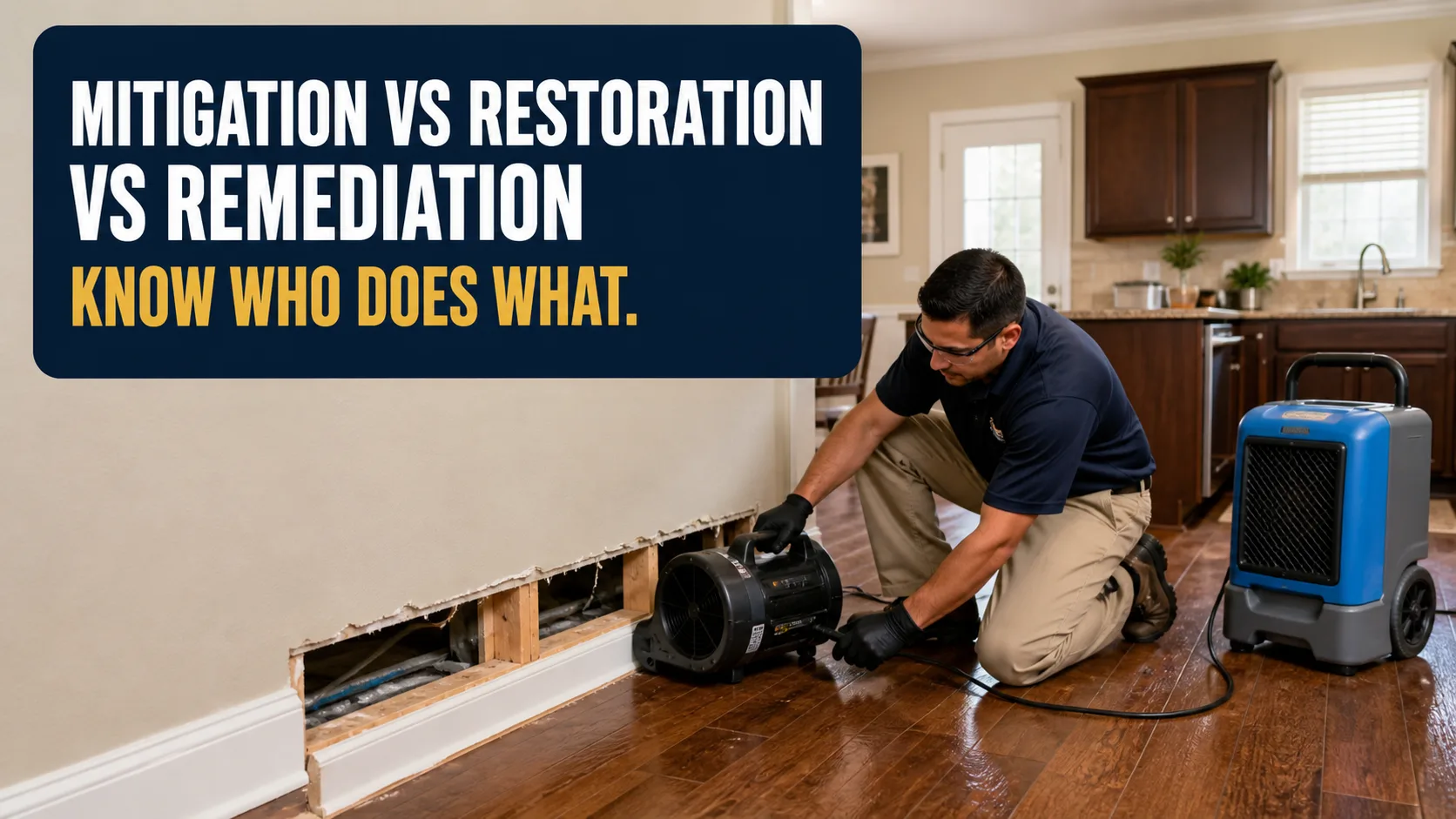
**Mitigation** is the emergency work: stop the water and dry the structure so damage doesn't spread. **Remediation** is removing a hazard that already developed — usually mold — and making the area safe. **Restoration** is the rebuild: replacing the drywall, flooring, and paint that came out. The order after a loss is mitigation first, remediation only if a hazard developed, restoration last. Done fast, good mitigation often means you never need remediation. Not sure what you need? Call **(346) 271-7004**.
Why the words matter
These three terms get used interchangeably in ads, but they describe different stages of work — and confusing them can cost you time and money, and even affect your claim. Here’s the clean way to think about it: mitigation prevents, remediation removes, restoration rebuilds.
Mitigation — stop it and dry it (first)
Mitigation is the emergency stage. The goal is to keep the damage from getting worse: shut off or contain the source, extract standing water, and dry the structure with commercial air movers and dehumidifiers until moisture readings are normal. It’s time-critical — every hour of delay means more spread and a shorter runway before mold. This is what “water mitigation” companies do, and it’s almost always what you need first.
Remediation — remove the hazard (only if needed)
Remediation comes into play when a hazard has already developed — most commonly mold, sometimes sewage contamination. It’s the specialized removal and cleanup that returns the space to a safe condition: containing the area, removing contaminated materials, treating surfaces, and verifying the space is clean. The important point: fast mitigation often prevents ever needing remediation. Mold needs 24 to 48 hours of moisture to start; dry things inside that window and there’s nothing to remediate.
Restoration — rebuild it (last)
Restoration is the rebuild. Once the structure is dry (and any hazard remediated), restoration replaces what was removed — new drywall, flooring, paint, trim, cabinetry — returning your home to how it looked before the loss. “Restoration” is also used loosely as an umbrella for the whole process, which is where a lot of the confusion comes from.
Two more words you will see on the paperwork
Reconstruction is the formal name for the rebuild. Some companies carry both mitigation and reconstruction, some hand off to a general contractor. Either way it is a separate scope with a separate contract, and what matters is that it is written against the same line items as the mitigation file so the claim reconciles without anybody translating.
Abatement is the removal of a regulated hazardous material — asbestos or lead, usually. It shows up in older Houston homes the moment demolition reaches popcorn ceilings, sheet vinyl, or tile mastic. It is neither drying nor mold work; it is a separately licensed trade with its own disposal rules, and it can pause a job until it is finished.
Fire jobs use all the same words. Mitigation on a fire means board-up, tarping, soot removal, and extracting and drying the firefighting water that went in through the ceiling. Deodorization is its own line. The rebuild is reconstruction again — the cost structure is in what fire damage restoration costs.
The order, and why it matters for your claim
- Mitigation — immediate, broadly covered as part of a sudden loss.
- Remediation — only if mold/contamination developed; may be capped or excluded by your policy.
- Restoration — the rebuild, once dry and safe.
Because insurers treat these differently, how the work is documented affects what’s paid. Covered mitigation of a sudden event should be recorded as exactly that. A team that understands both the technical stages and how adjusters read them keeps the paperwork clean — more on the money side in water damage mitigation cost in Houston.
A worked example: one washer hose, three invoices
Numbers invented to show how the stages divide. Nothing below is a quote.
A braided washer hose lets go on a Thursday morning and runs for two hours before anyone gets home. Water crosses the laundry room, the hallway, and into one bedroom. Assume a $1,500 deductible on a replacement cost policy.
| Stage | Scope | Amount |
|---|---|---|
| Mitigation | Extraction, wet baseboard and pad removal, four days of equipment, daily logged readings | $4,300 |
| Remediation | Not needed — dry standard reached on day four, no growth | $0 |
| Reconstruction | Carpet pad, baseboard, paint, one drywall patch | $2,900 |
| Total | $7,200 |
The carrier prices that scope at $7,200, withholds depreciation on the materials that had age on them, and subtracts the deductible once — against the claim, not against each contractor. The first payment is therefore smaller than the total, and the held-back portion is released after the reconstruction is finished and invoiced. That two-payment structure is the single most misread part of a claim, and it is explained line by line in actual cash value vs replacement cost.
Now change one thing. Nobody comes home for three days. Growth establishes on the drywall bottoms, remediation appears as a real line, and it lands against the mold sub-limit rather than the dwelling coverage — a different ceiling with less room under it. Same hose, same house, a different claim entirely.
What to do in order
- Stop the source. Its own valve first, the house main if the valve will not turn.
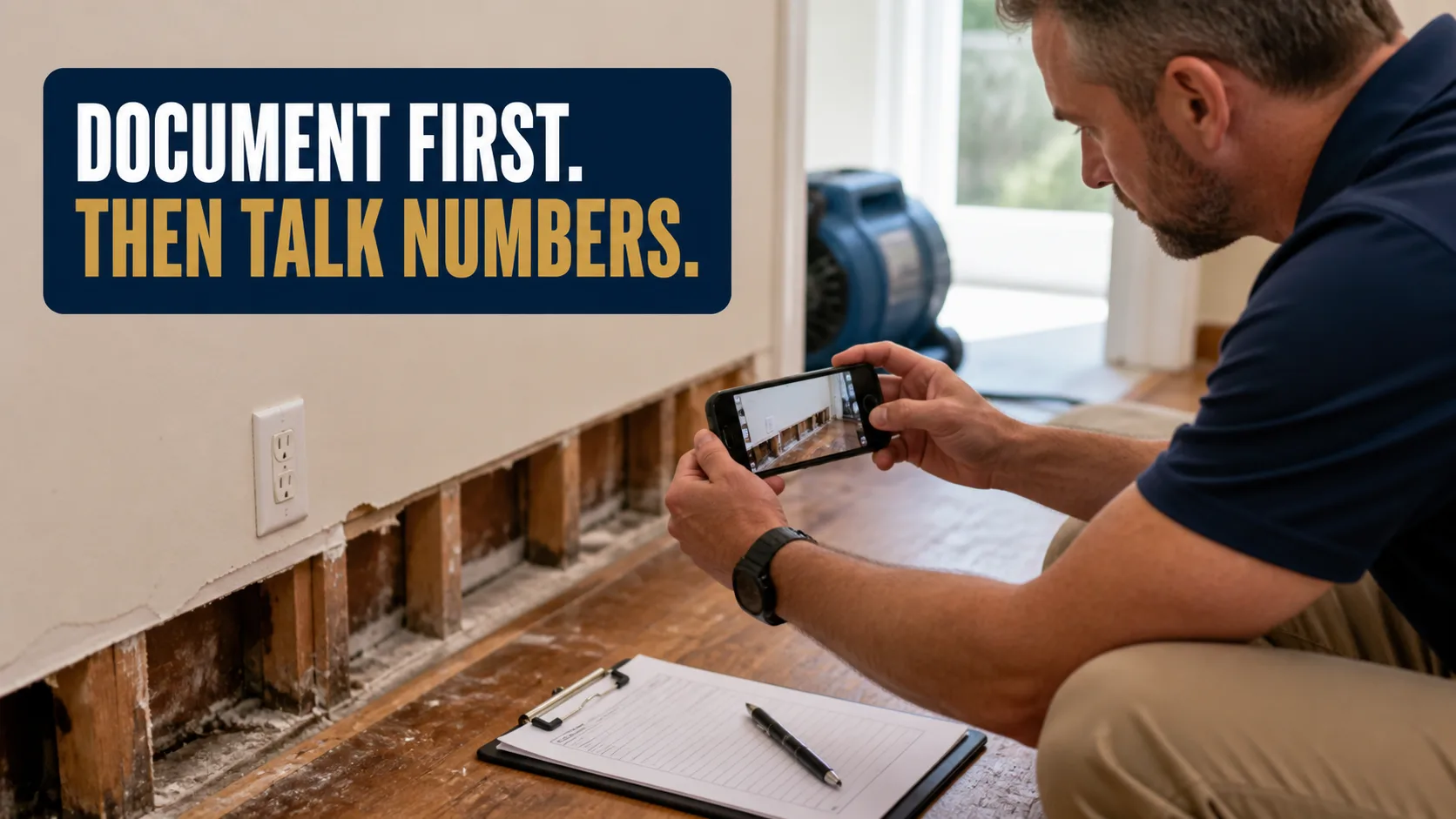
- Photograph before you clean, with the date stamp on. The record of what it looked like at discovery cannot be recreated later.
- Call for mitigation the same day. Policies require you to prevent further damage, and the mold clock starts at 24 to 48 hours.
- Report the loss to your carrier with the discovery time, the source, and what you have done.
- Let the drying finish on readings, not on the calendar — how long that actually takes depends on the materials.
- Add remediation only if a hazard developed, and only with containment and documented clearance.
- Book reconstruction last, once the structure meters dry.
What to document at each stage
The stages produce different evidence, and a claim file needs all three.
- From the source: the failed part itself, its data plate, and the wide shot showing where it sits. This is what establishes a sudden discharge rather than a slow seep.
- From mitigation: the moisture map at discovery, the daily readings, the equipment count and days, and photographs of anything removed and why. Equipment bills per unit per day, so the log is also the invoice’s justification.
- From remediation, if it happens: the written protocol, containment photos, disposal records, and the clearance result.
- From reconstruction: invoices itemized against the approved scope, proof of payment, and finished-work photos from the same angles as the loss photos. That set is what releases held-back depreciation.
The common failure is not a missing photograph. It is a mitigation file written in one vocabulary and a rebuild invoice written in another, so nobody can line them up.
Two clocks run at once
The work clock is physical. Extraction is hours. Structural drying is three to five days on a contained loss and longer where hardwood, plaster, or a slab is involved — whether wet drywall gets dried or removed is decided by readings, not preference. Remediation adds days inside containment. Reconstruction runs on trade availability.
The claim clock is procedural, and it moves independently. Texas claim-handling rules generally give an insurer about 15 days from notice to acknowledge the claim, begin investigating, and request what it needs, then about 15 business days after receiving everything requested to accept or reject in writing, with a limited extension if the delay is explained in writing. Those windows can shift after a declared catastrophe, and your policy and the current rules govern. The Texas Department of Insurance publishes them.
Nothing in the second clock is a reason to slow the first. Waiting for an adjuster before drying costs you materially and reads as neglect in the file.
The bottom line
If you have water right now, you need mitigation — fast. Get that right and you may skip remediation entirely and go straight to restoration. Start at the restoration overview for what the whole process looks like, or call (346) 271-7004.
Do this tonight, free
- Find your declarations page and read the deductible, the settlement basis, and whether a water backup endorsement is on it.
- Write down the mold sub-limit if there is one. It is a separate ceiling from the dwelling coverage.
- Learn where your main shut-off is, and turn it once to confirm it actually turns.
- Photograph the laundry connections and both water heater fittings now, while they are dry. A before picture is worth having.
- Put the number of whoever you would call at 2 a.m. in your phone, and know who to call for water damage before you need it.
Where our scope starts and stops
TruePoint Restoration performs mitigation and mold remediation. We are not a plumbing company, not a rebuild contractor, and not a public adjuster or claims representative — Texas keeps that last role separate from the firm doing the repair work, and we do not negotiate settlements or interpret your policy for you.
What we produce is the middle stage and its record: metered extent, extraction, drying to dry standard with daily logged readings, containment and removal where a hazard developed, and a documented file written in line items an adjuster can read directly. The rebuild contractor picks up from there.
If a claim is genuinely disputed, that is work for a Texas-licensed public adjuster, an attorney, or the Texas Department of Insurance. If you have water right now, call (346) 271-7004. We serve Pearland, Manvel, Friendswood, League City and the Greater Houston area.