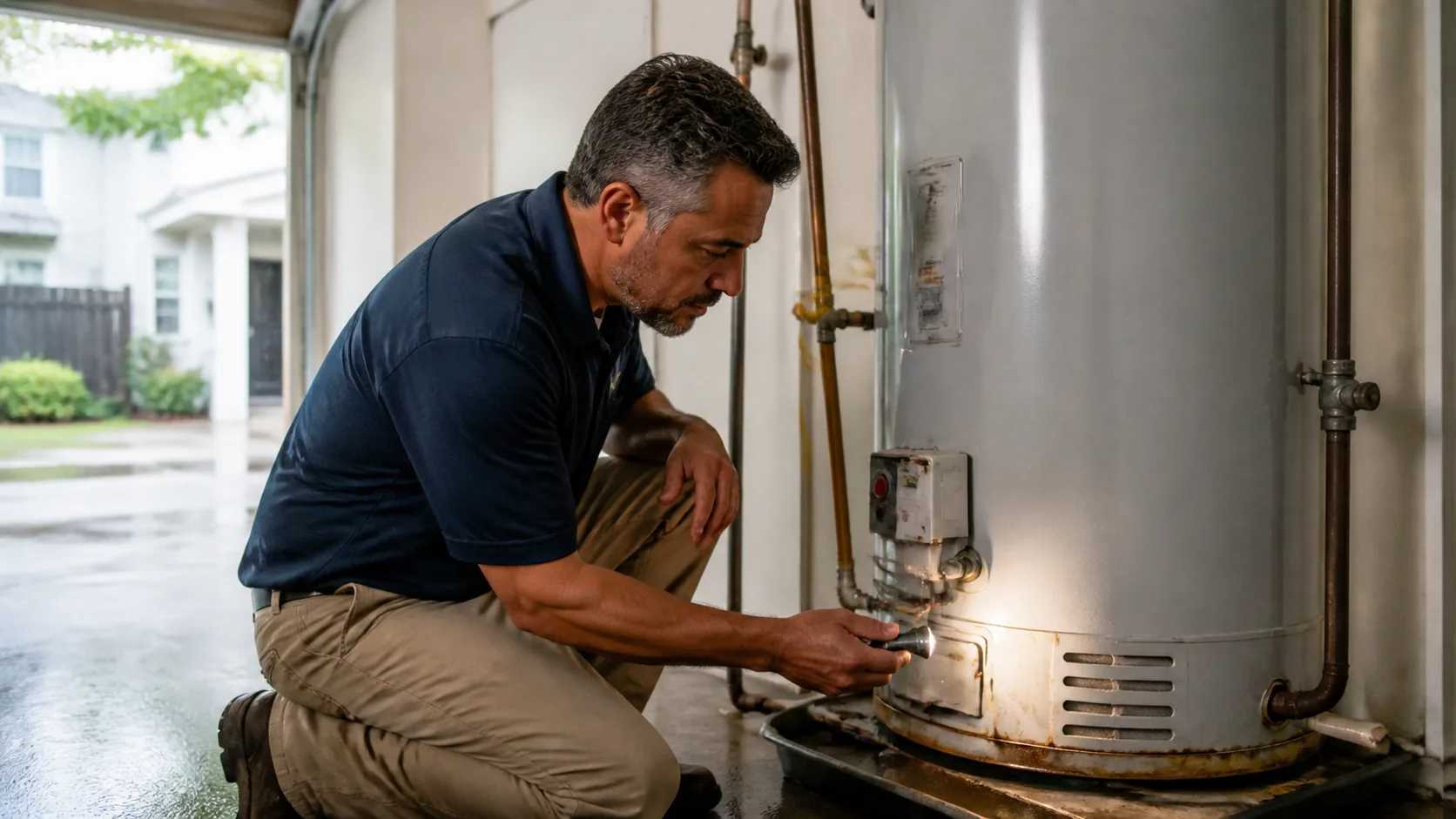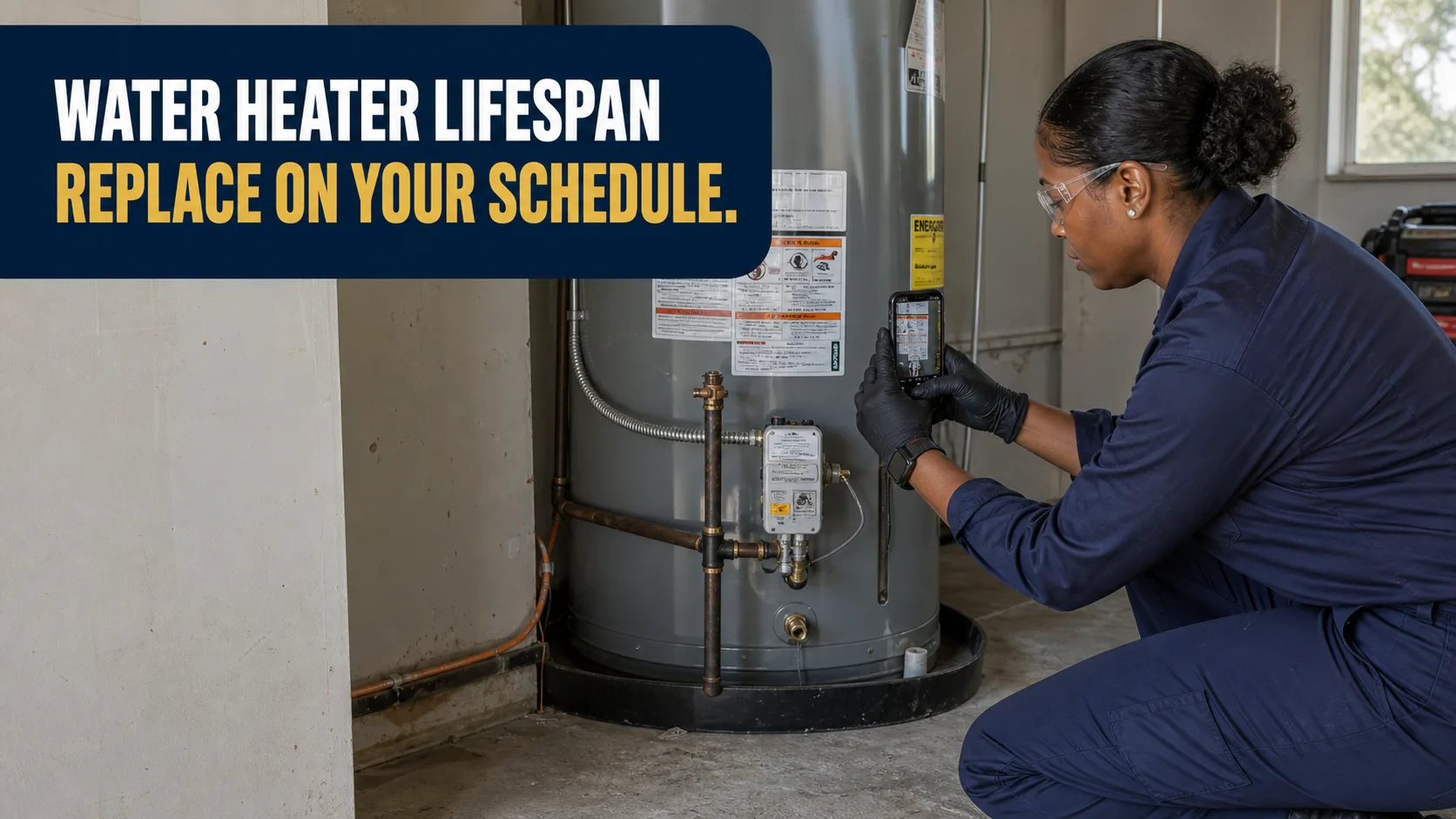
Tank water heaters last 8–12 years — often less in Houston's hard water. Find your tank's manufacture date on its data plate today; past 10 years, plan the replacement proactively, and past 12, stop planning and book it. The math is lopsided: a scheduled swap is a routine plumbing job, while a failed tank — especially the attic installations common here — is a ceiling, a mitigation job, and a deductible on top of the same new water heater.
The clock inside the tank
A tank water heater dies of internal corrosion, and its lifespan is the story of one part: the anode rod — a sacrificial metal rod that corrodes instead of the tank’s steel. Houston’s mineral-heavy water eats anode rods in 3–5 years. When the rod is gone, the water starts on the glass lining’s flaws, then the steel itself, always from the inside, always invisibly.
That is why tanks fail “without warning” from the bottom — the rust-through has been years in the making, on the side of the steel you cannot inspect.
Step one, today: read the data plate
The sticker on the tank’s side carries brand, model, serial, and capacity. The manufacture date is printed directly or encoded in the serial number (most brands: the first characters map to month/year — search your brand + “serial number date” to decode). Then:
- Photograph the plate. That photo establishes the tank’s age and warranty status — the two facts that decide both your replacement timing and, if it ever fails, whether your deductible comes back through subrogation.
- Note the warranty term — 6, 9, or 12 years, usually reflected in the model tier. As with every water-carrying part, the warranty is the manufacturer’s own life estimate.
The replacement decision table
| Tank age | Location | Call |
|---|---|---|
| Under 8 years | Anywhere | Maintain: annual look, anode check at ~4 years |
| 8–10 years | Garage / slab | Watch closely: signs below = replace |
| 8–10 years | Attic / above living space | Start planning the replacement now |
| 10–12 years | Garage / slab | Replace proactively this year |
| 10–12 years | Attic / above living space | Replace now — the location removes the grace period |
| 12+ years | Anywhere | You are past the actuarial tables; book it |
What replacing it early costs against what a rupture costs
A standard 40- or 50-gallon gas tank installed by a licensed plumber generally runs $1,500 to $3,000 in the Houston market, depending on capacity, venting, code upgrades and where the unit lives. Attic installations sit at the top of that range because getting the old tank down and the new one up is genuinely harder. An anode rod swap, the one maintenance item that actually extends life, is usually a couple of hundred dollars including the part.
Now the failure. A tank that ruptures releases its full 40 to 50 gallons and then keeps running, because the supply line above it is still open. On a garage slab that is a mess and a bad afternoon. In an attic it is 40 gallons plus a live supply line through your insulation and ceilings, and the mitigation alone — extraction, containment, structural drying with daily readings — commonly lands in the four to five figure range before drywall, texture, paint and insulation go back in.
Replacing a twelve-year-old attic tank on your schedule costs a known number on a Tuesday. Replacing it on its schedule costs that number plus a claim.
Why attic units change the math
A garage tank that fails makes a mess on a slab. An attic tank that fails puts 40–50 gallons plus a live supply line through your insulation and ceilings — a mitigation event by definition. Many Houston homes have exactly this configuration, which is why the table above shortens every interval for attic units. If yours is in the attic and you have never been up there: this weekend. Pan condition, fitting crust, rust streaks, plate photo. Fifteen minutes.
The signs of a tank near the end
- Rust-tinted or metallic-tasting hot water (cold runs clear — that isolates it to the tank)
- Popping, rumbling, kettling — sediment on the element flash-boiling; the tank is cooking itself
- Moisture, rust, or crust at the bottom seam or in the pan
- Crusted fittings up top (a connector story — cheaper, but same neighborhood)
- Hot water that runs out noticeably faster — sediment displacing capacity
Any of these on a 10-year tank is not a repair conversation. It is a replacement date negotiation, and the tank has opening position.
The gas side: what a water heater does besides flood
A gas water heater is an open flame in a closet, a garage or an attic, and the fire risks are separate from the water ones. They are worth two minutes on the same visit.
- Nothing flammable near it. Gasoline cans, paint, solvents, propane cylinders and stacks of cardboard do not belong in the same space as a burner. Gasoline vapor is heavier than air, travels along the floor, and finds a pilot light — which is exactly why modern garage units are built flammable-vapor-ignition-resistant and why the old rule of raising a garage heater 18 inches off the slab existed.
- Clear combustion air. Louvers and vents around the unit stay unblocked. Boxes stacked against a water heater closet door starve the burner.
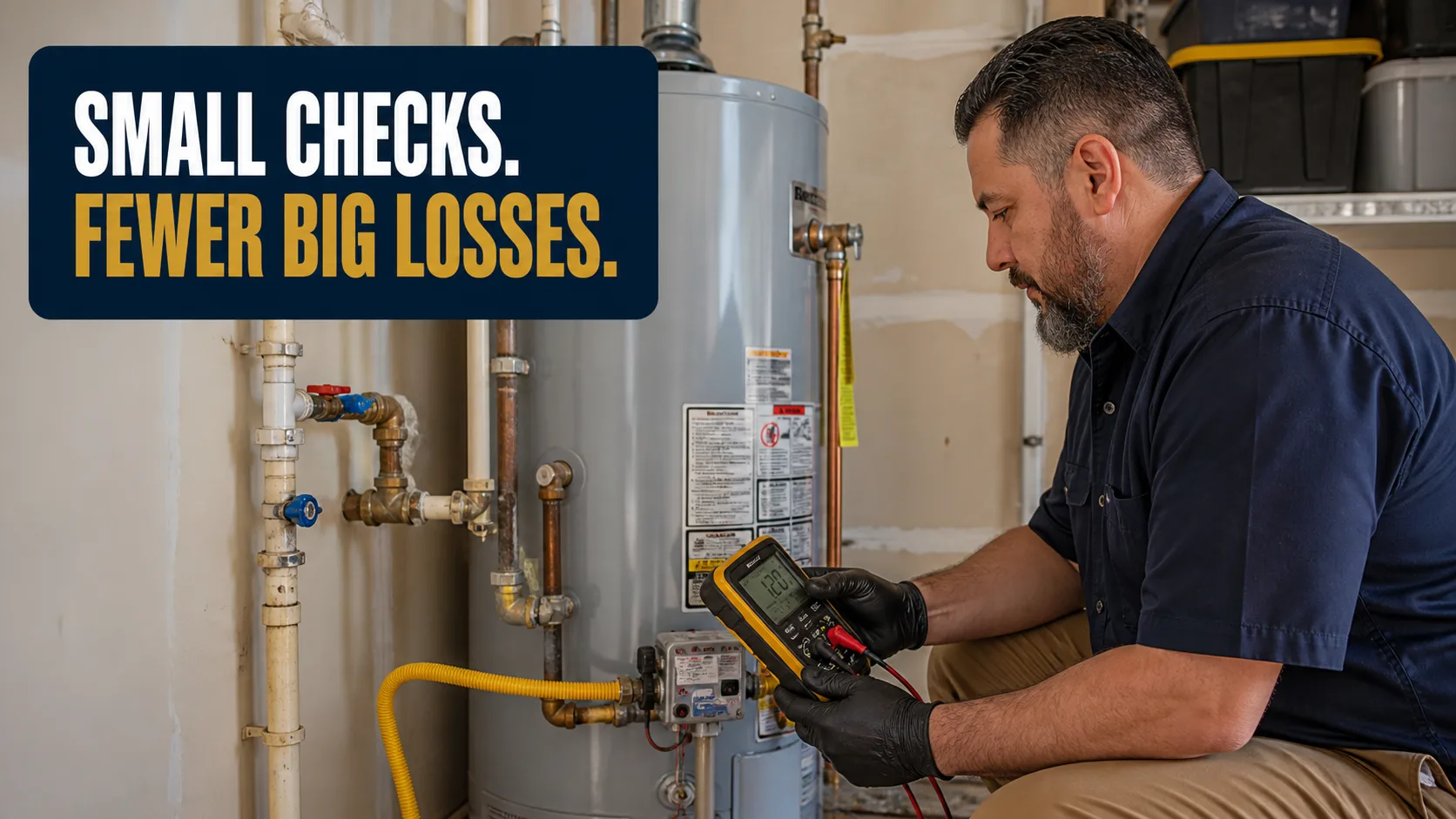
- Look at the flue. It should rise continuously, sit tight at every joint, and show no rust holes or separation at the draft hood. Soot or scorch marks above the hood mean it is spilling combustion gases into the house. Stop there and call a licensed plumber.
- Smell for gas at the connection. Any gas odor means leave, then call CenterPoint or a licensed plumber from outside. Do not test a gas line yourself and do not tighten anything.
- A carbon monoxide alarm on every level, replaced every five to seven years, is not optional in a house with any gas appliance.
None of this is homeowner repair work. Look, photograph, and hand it to a licensed plumber. If it has already burned, what to do after a house fire is the next page.
What your carrier does with a tank failure
A tank that ruptures is a sudden and accidental discharge, and that is generally covered — the water damage, not the tank itself. Almost every policy pays to dry and repair what the water ruined and leaves you to buy the appliance.
A tank that wept from the bottom seam for months, staining the pan and the drywall behind it, reads as gradual damage, which is excluded on nearly every homeowners form in Texas. Same appliance, different section of the policy, and the only thing separating them is how long it ran.
Three things protect you, and all three are free. Photograph the data plate so the age and warranty status are on record. Photograph the pan each year with the date stamp on. Keep the receipts for the anode rod and any service. If the tank fails inside its warranty, that documentation also gives your carrier a subrogation target, and when they recover from the manufacturer your deductible can come back — the mechanism is in subrogation, explained. The wider coverage picture is in does insurance cover water damage.
Extending life (if the tank is young enough to bother)
- Anode rod replacement every 3–5 years — the single genuine life-extender; a plumber swaps it in under an hour
- Annual flush of a few gallons from the drain valve to move sediment out (skip this on an old, never-flushed tank — disturbed sediment can unmask leaks the crust was plugging)
- T&P valve test annually — lift the lever, confirm it discharges and reseats
- Keep the connectors on their own schedule — they fail years before the tank
When you replace: the fifteen-minute upgrades
The day the new tank goes in is the cheapest day for every one of these; insist on them in the quote: a drain pan plumbed to a real drain (non-negotiable in attics), braided stainless connectors with the install date markered on, a functioning shut-off valve you have personally operated, an expansion tank where code or pressure calls for it, and a water alarm in the pan. Then photograph the new data plate and set a calendar reminder for year eight.
The Houston calendar for a water heater
Hard water is the local variable that shortens everything on this page. Much of the Greater Houston supply is mineral-heavy, so anode rods here are eaten in three to five years rather than five to seven, and sediment builds faster on the tank floor. Work off the short end of every interval.
- March or November, at the time change: fifteen minutes at the tank. Pan dry? Fittings clean? Bottom seam clean? Photograph it with the date stamp on.
- April, before the heat: if the unit is in the attic, do the inspection now rather than in August, when the space runs 130°F.
- Year four, then every three to five years: anode rod check.
- Year eight: start planning, and shorten that to now if the tank sits above living space.
- December, before a freeze: check the connectors and the pan, since a hard freeze finds the weakest fitting first — the freeze checklist covers the rest.
- Before any trip longer than a weekend: set the tank to its vacation setting and close the washing machine valves while you are at it.
Where we fit, and where we don’t
TruePoint Restoration does not install, service or replace water heaters. We do not swap anode rods, flush tanks, touch gas connections, or repair plumbing of any kind — that is a licensed plumber, and anything involving the gas line or the flue is a licensed plumber’s call rather than a handyman’s. We also do not rebuild the ceilings the water came through.
What we handle is what came out of the tank: extraction, containment, structural drying with logged daily moisture readings, mold remediation when the water sat, and smoke and soot cleanup on the fire side. If a tank has already let go, close the cold supply valve on top of it and the gas or breaker, then call (346) 271-7004. We work out of Pearland and cover Manvel, Friendswood, League City, Pasadena and the Greater Houston area. What happens next is on water heater tank leak.