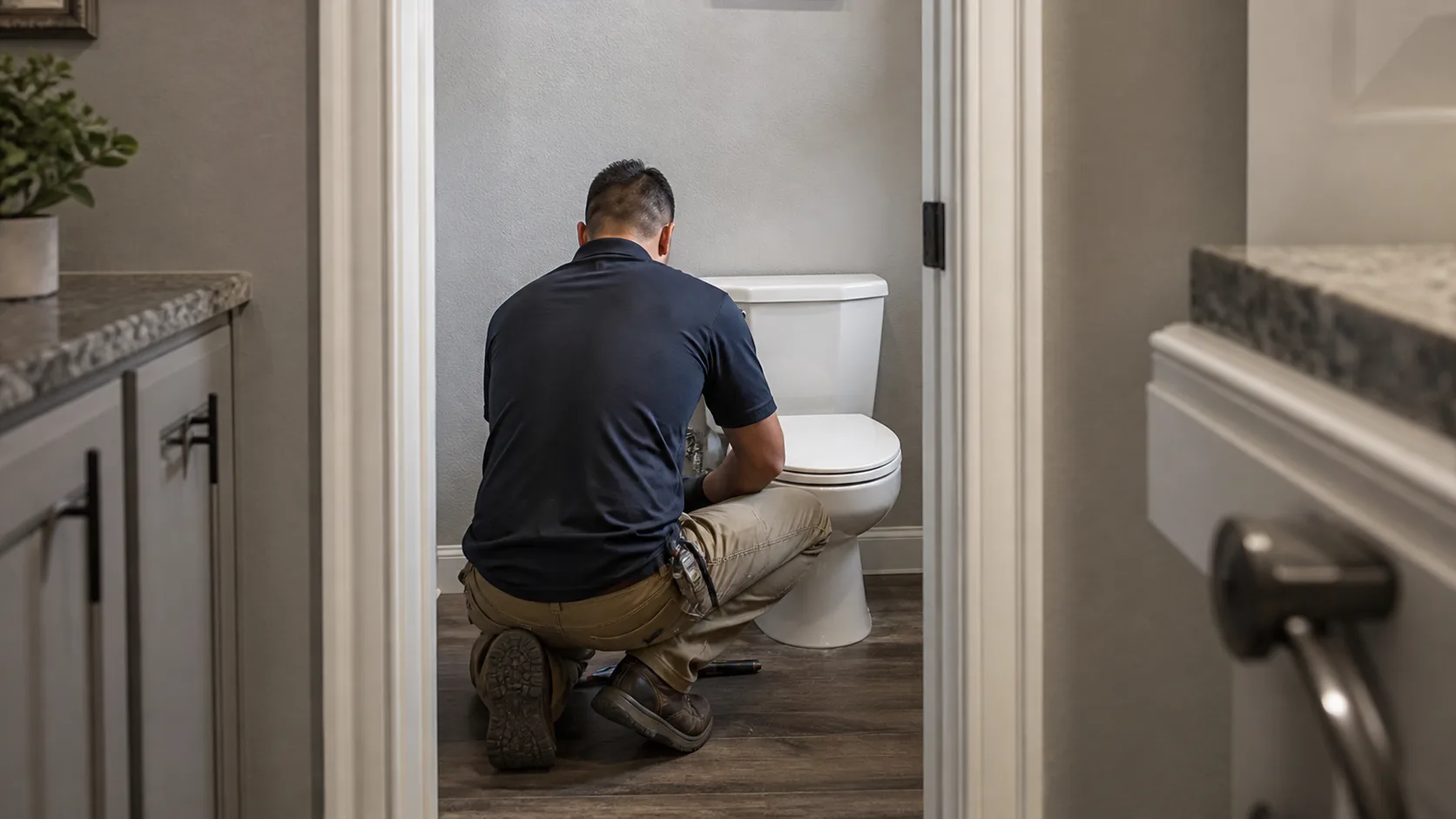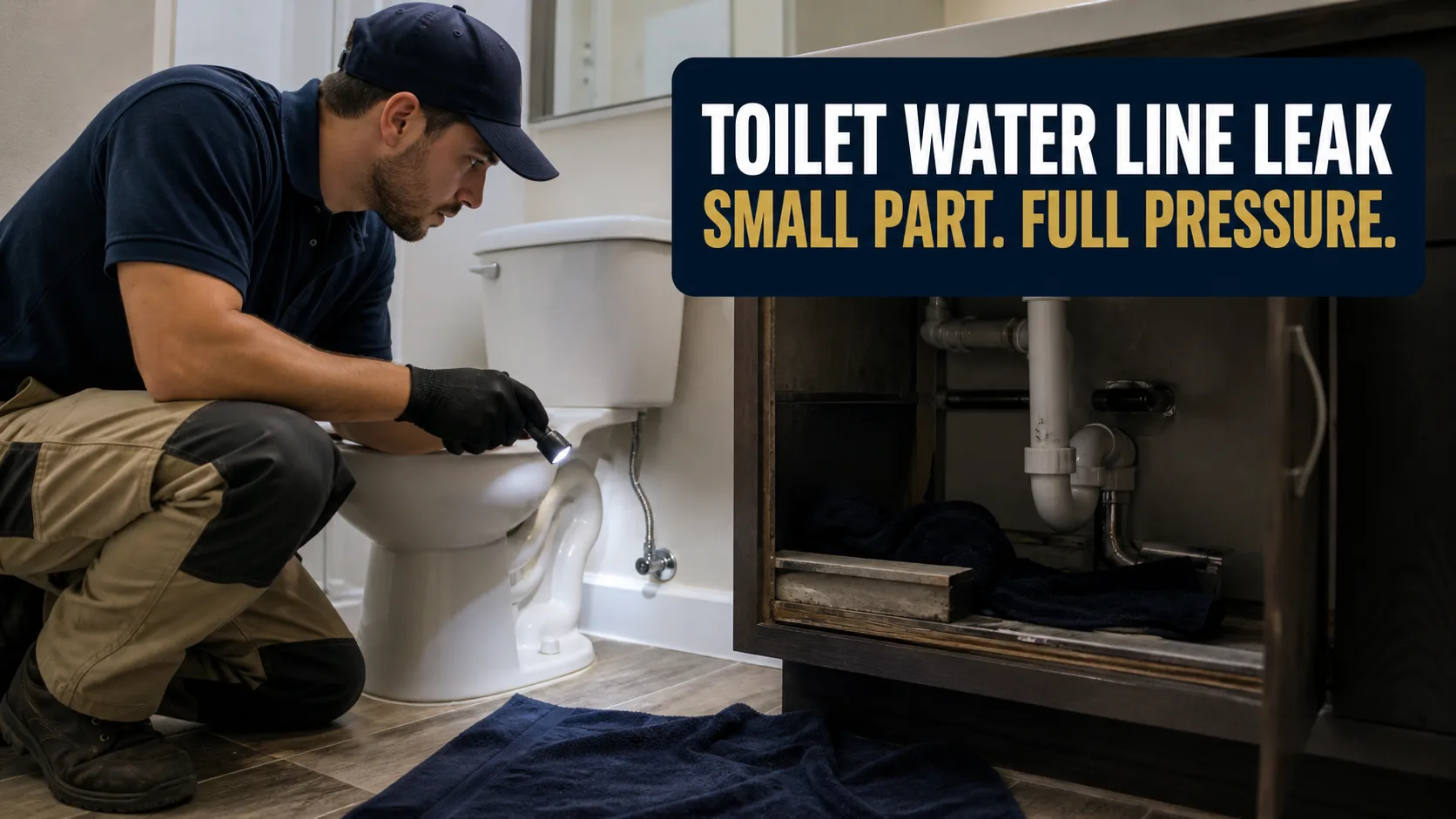
Close the shut-off valve behind the toilet; if it is seized, shut the house main — never wrestle a stuck valve mid-flood. A weeping connection is a this-week part replacement; a burst line is a washer-hose-class flood, hundreds of gallons an hour until stopped. Either way the fix costs less than ten dollars, which is exactly why this loss is so common: nobody replaces a part that cheap until it fails.
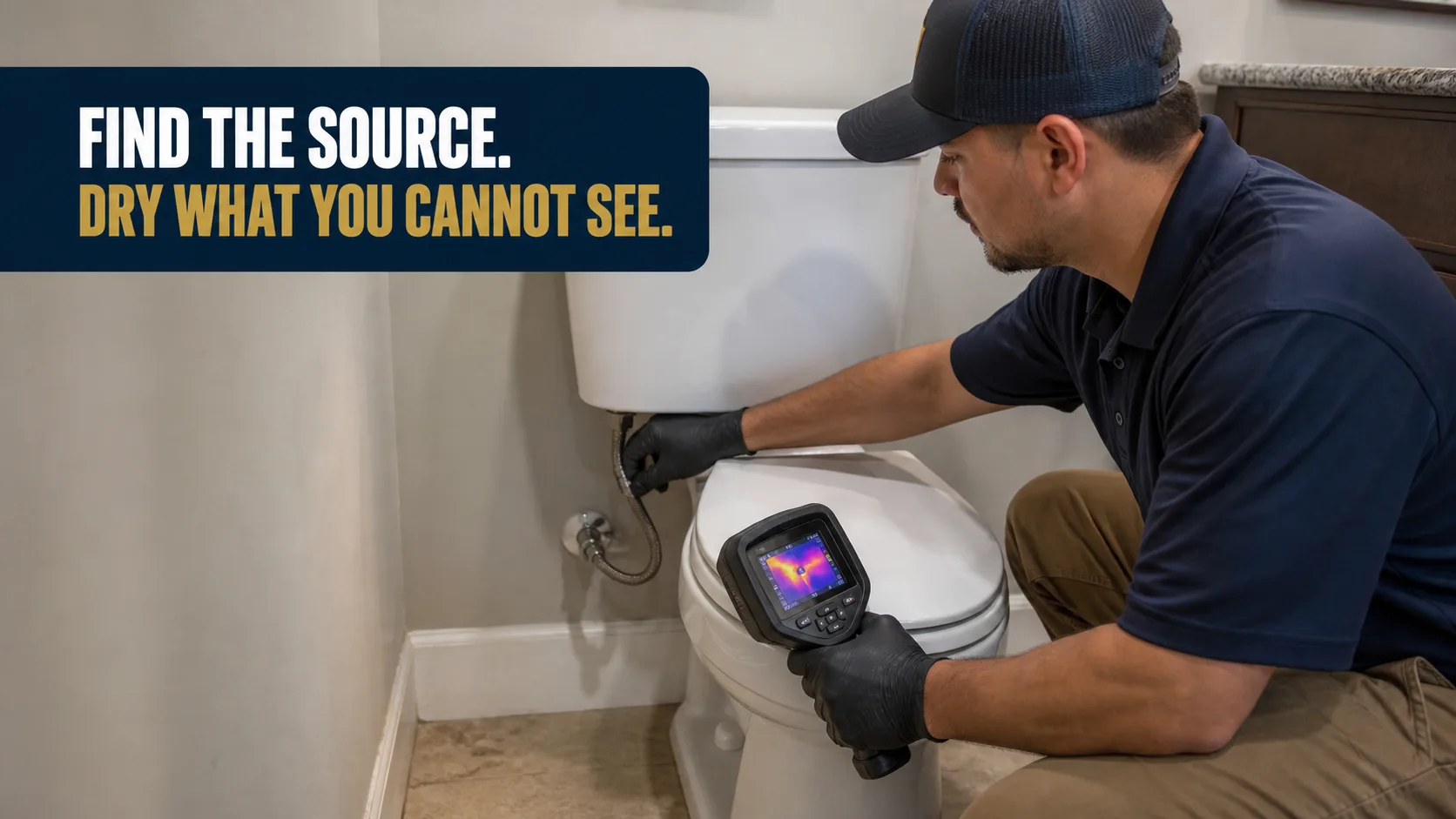
The forgotten pressurized line
Every toilet has one: a short flexible line from the wall valve to the tank, carrying full household pressure every minute of every day. It is the cheapest water-carrying part in your bathroom, installed once and never thought about again — often for fifteen or twenty years, which is a decade past what its own manufacturer would warranty.
The failure modes:
- The coupling nut at the tank — usually plastic, cracks from over-tightening or age
- The valve connection — compression fitting weeps as washers age
- The line body — old chrome-flex kinks and cracks; plastic lines embrittle; cheap braided lines let go at the crimp
Weep or burst: two different events
The weep announces itself quietly: mineral crust on a fitting, a drip you can feel with a dry finger, dampness on the floor behind the toilet that keeps coming back. It is telling you the part has started failing. Replace it this week — the part is $5–10 and the job is fifteen minutes.
The burst skips the pleasantries. An open pressurized line in a room with a door that was probably closed. If it happens overnight, the water finds the hallway, the bedrooms, and — upstairs — the ceilings below, before anyone wakes up.
What to do right now (burst version)
- Valve off behind the toilet. Seized? House main. Do not snap a corroded valve with channel-locks — that upgrade from “leak” to “open pipe” happens weekly somewhere in Houston.
- Power off to affected areas at the breaker if water spread beyond the bathroom.
- Extract fast — every gallon out now is drying time saved.
- Photograph the failed line in place, then the water’s full reach.
- Keep the line. Warranty-period failures are subrogation candidates — your deductible may come back.
- Meter the perimeter. Bathroom water exits at every edge — baseboards, threshold, the ceiling below. High-volume releases need a moisture map, not a mop-and-hope: (346) 271-7004.
What to do right now (weep version)
- Valve off, tank drained (flush once with the valve closed).
- Replace the line — braided stainless, metal coupling nut if available, longest warranty on the shelf.
- Dry and inspect the floor behind and beside the toilet. Weeps run for weeks before discovery; the flooring edge and baseboards behind a toilet are prime slow-soak territory.
- Write the install date on the new line with a marker.
The warning signs, in the order they appear
Supply lines almost always give notice. The notice is small and it is behind a toilet, which is why it gets missed.
At the fitting: white or green mineral crust at the coupling nut or the valve connection — dried minerals left by water that escaped and evaporated. Crust means the joint is already leaking.
On the line: a bulge or soft spot in a braided line, a kink or green tinge on old chrome-flex, a plastic line gone chalky and stiff.
On the floor: a patch behind the bowl that keeps coming back damp, a darkening flooring seam, or baseboard paint blistering along the bottom inch of the wall behind the toilet.
At the valve: a handle that will not turn. A shut-off that does not shut off is why a small leak becomes a flooded hallway.
Tell a leak from condensation in one hour
Gulf Coast humidity makes cold supply lines and porcelain tanks sweat, and that fools people both directions — a real leak gets dismissed as condensation, and condensation gets chased as a leak. This test settles it and costs nothing.
- Dry everything — the line, both fittings, the valve body, and the floor under them.
- Wrap a dry paper towel around each connection and lay one flat beneath.
- Do not use the toilet for an hour.
- Read the towels. Uniform dampness along the whole line is condensation. A wet ring at one fitting with a dry line either side is a leak, and it is that fitting.
- Photograph the result with the date stamp on before you touch anything else. If this turns into a claim, that dated photo is your discovery date.
What NOT to do
- Don’t over-tighten the new coupling nut. Hand-tight plus a gentle quarter turn; cracked plastic nuts from over-torquing are a top cause of the next leak.
- Don’t reuse a line “because it looks fine.” Lines fail from the inside, and you are already standing there with the valve off.
- Don’t ignore a seized valve. The day you need it is not the day to discover it.
What does this cost, before and after?
Before it fails, the entire prevention program is a $5 to $15 braided line and fifteen minutes. After it fails, the number is set by where the water went, not by the part.
- Run time. A line that let go at 2 a.m. put hundreds of gallons through the house. The same line caught in ten minutes did not.
- What the flooring is. Tile over a slab dries. A floating laminate floor traps water underneath and usually has to come up.
- How many rooms. Bathroom water leaves at every edge — threshold, baseboards, vanity toe kick — so the hallway and the room next door are commonly in scope whether or not they look wet.
- Whether it went down. An upstairs bathroom adds a ceiling cavity and wet insulation that is bagged rather than dried.
Working range: a same-day clean-water loss held to a bathroom and a stretch of hallway commonly runs $2,000 to $5,000. Add multiple rooms and a ceiling below and it moves into five figures. Typical Texas deductibles sit at $1,000 to $2,500, which is why this loss is nearly always worth filing.
How long does the drying take?
Three to five days for a clean-water loss caught the same day with equipment on site quickly. Longer when water got under a floating floor or into wall cavities, because those spaces have to be opened or drilled before air reaches anything inside them.
Readings decide the end date, not the calendar. Each wet material is metered against unaffected material of the same type and logged daily — what actually sets the timeline is depth and material, not floor area.
Does insurance cover a burst supply line?
A burst line is the textbook sudden and accidental loss, and damage to flooring, walls, and the ceiling below is what the coverage is for. A connection that visibly wept and crusted for months invites the gradual argument instead — the reasoning behind most denied water damage claims.
Three things protect the claim. Report it the day it happens. Photograph the failed line in place before anybody removes it. And keep the failed part — a warranty-period failure lets your carrier pursue the manufacturer, and that is how deductibles come back.
Prevention: the five-dollar policy
The entire prevention program for this failure costs less than lunch:
- Braided stainless line, best warranty available, on every toilet
- Replace at the warranty date — the manufacturer’s own service-life estimate (the warranty-window principle)
- Exercise every shut-off valve at the twice-yearly walkthrough so they turn when it counts
- Leaving town? Closing the toilet valves takes ten seconds and removes this failure from the list of things that can happen while you’re gone
Where the plumber ends and we begin
TruePoint Restoration is not a plumbing company. We do not replace supply lines, swap seized shut-off valves, or reset toilets, and we do not lay the flooring back afterwards. Call a plumber for the part — it is a fifteen-minute job and it costs less than the drive out.
What we do is everything the water reached: metering the bathroom perimeter, the hallway, and the ceiling below, pulling out material that cannot be brought back, drying the structure and wall cavities with logged daily readings, and handing you a documented file your adjuster can work from.
Text photos to (346) 271-7004 and we will tell you honestly whether it needs a visit. Sometimes the answer is a fan and an open door. We serve Pearland, Manvel, Friendswood, League City and the Greater Houston area.