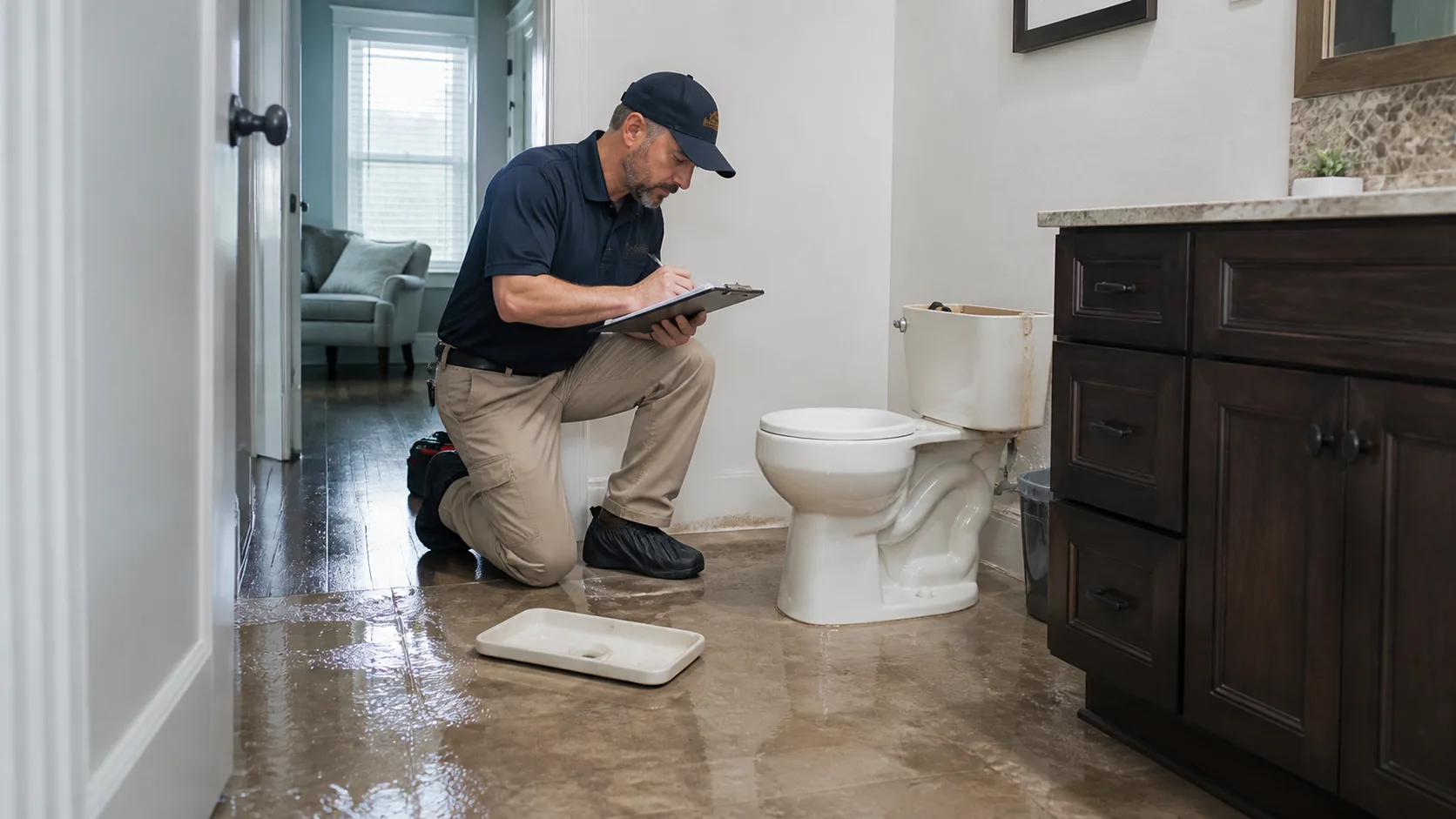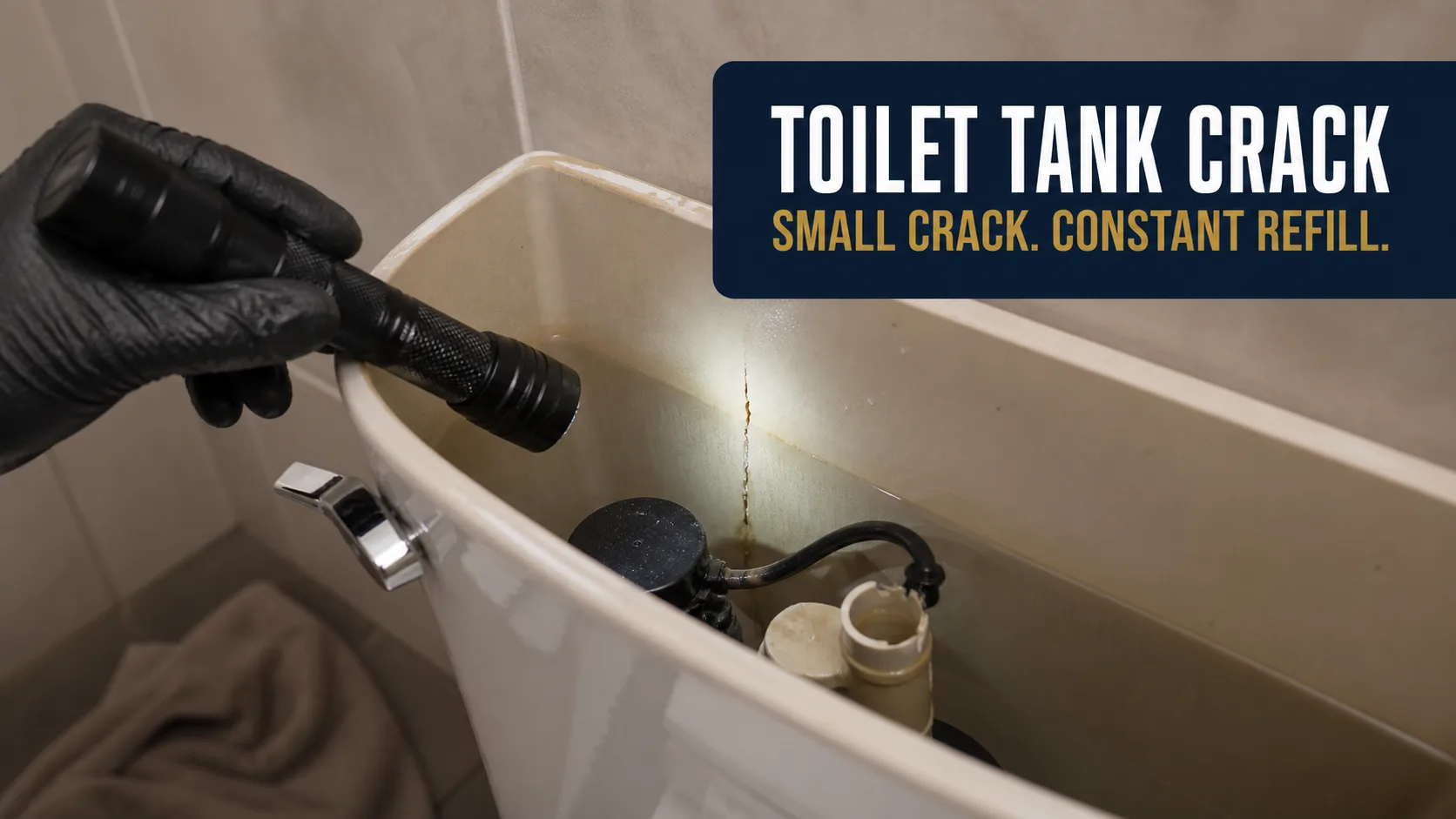
Close the supply valve behind the toilet and flush once to empty the tank — that stops both the weep and the automatic refills feeding it. Find the crack with the paper-towel drag test (hairlines snag fibers and show wet lines). Below the waterline, the tank gets replaced, not repaired; above it, you can monitor. Then look at what months of weeping did to the floor behind the toilet — the least-inspected square foot in the house.
Why a “tiny” crack is a real leak
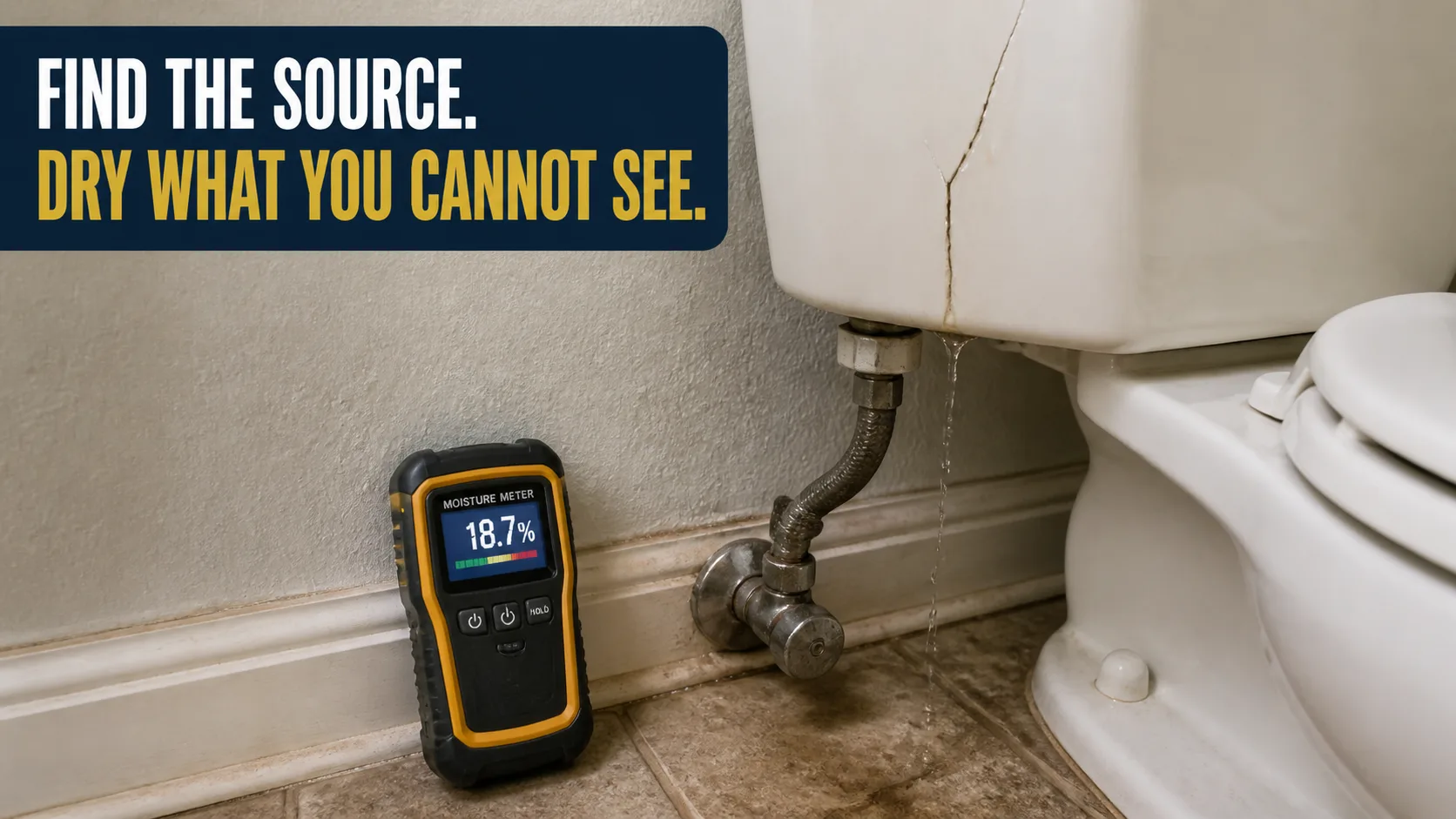
A hairline in porcelain weeps drops, not streams — which sounds harmless until you add the toilet’s defining feature: it refills itself. The fill valve replaces every drop the crack loses, around the clock, indefinitely. The result is a slow, perfectly sustained irrigation system for the flooring behind and beneath the toilet, running for however many months pass before someone kneels back there.
Clean water, yes. But in Gulf Coast humidity, chronically damp flooring and baseboard do not care about water category — they swell, delaminate, and grow mold on the same schedule either way.
How tanks crack
- Over-tightened bolts. The tank-to-bowl bolts and the supply coupling both press against porcelain. Over-torquing creates stress that can crack instantly — or months later, which is why “nobody touched it” cracks usually trace back to the last repair.
- Impact. The porcelain tank lid, dropped from six inches, is the classic.
- Freeze. Rarely used bathrooms during Texas cold snaps — the tank holds water; ice does the rest.
- Age. Decades-old porcelain with manufacturing stresses lets go on its own timetable.
Warning signs, before you ever find the crack
A hairline in porcelain hides well. What it does to the room does not.
The fixture is behaving strangely: the toilet refills on its own every few hours with nobody flushing it, the tank never quite holds its fill line, or there is a faint hiss from the fill valve at night.
The floor behind it is reporting water: a flooring seam behind the bowl that stays dark, baseboard paint blistering along the bottom inch of the wall behind the tank, grout or caulk at the base that never dries out, or a soft spot you can feel through a shoe.
The bill and the meter already know: a water bill that stepped up rather than spiked, and a low-flow dial on the meter that keeps turning with every fixture in the house shut off.
The air tells you last: a musty note in the corner behind the toilet, strongest low down and worst on a humid morning. That is the smell a slow leak makes once material has been damp long enough to support growth.
Finding a hairline
- Dry the tank completely, inside surfaces above the water too if you can reach.
- Drag a dry paper towel slowly over the exterior — hairlines snag fibers, and a weeping crack prints a wet line on the towel within minutes.
- Overnight mapping: several drops of food coloring in the tank, paper towels laid behind and beneath the toilet. By morning the towels show exactly where tinted water exits — tank crack, tank bolts, or supply connection.
- Check the flapper too: a toilet that “runs” periodically without flushing is losing water somewhere, and the flapper is the innocent explanation. The floor behind it will tell you which story you’re in.
Repair or replace
- Crack below the waterline: replace. Porcelain epoxies exist; trusting one against constant pressure on a material that flexes with every fill is how this page gets read twice. Tanks are commonly available separately — match the model number inside the tank lid or wall — so a cracked tank does not always mean a whole new toilet.
- Crack above the waterline: monitorable — it only sees splash and condensation — but porcelain cracks grow, so it earns a spot on the twice-yearly walkthrough and a plan.
- Crack in the bowl: replace the toilet. Bowl cracks and structural loads do not negotiate.
The floor behind the toilet
However the tank verdict goes, the floor gets its inspection. Months of weeping land in the same hidden strip: the flooring seam behind the bowl, the baseboard on the wall behind, the subfloor below the flange area. Feel for softness, look for darkened edges and lifting material, and smell — that back corner musty note is data.
Anything soft, dark, or damp back there deserves a moisture reading before you install the new tank and forget the spot for another decade: (346) 271-7004, photo first, honest answer back.
What does a cracked tank actually cost?
Two numbers, and the second one is the one that moves.
The fixture is predictable: a replacement tank matched to your bowl runs roughly $150 to $300 in parts, a whole new toilet $200 to $500 installed. Match the model number inside the tank lid before you buy anything — most tanks are sold separately, and a sound bowl does not need replacing.
The floor is where the range opens up, and what opens it is time:
- Weeks. Dry the flooring and the wall base. A few days of equipment.
- Months. Flooring comes up in that corner, the baseboard comes off, and the wall cavity behind the tank is opened and dried.
- A year or more. Add subfloor replacement and, commonly, remediation on material that stayed damp.
That is why nobody honest quotes this from a photo of the tank. The tank is the cheap half.
How long does the floor behind a toilet take to dry?
Three to five days once the toilet is pulled and the wet flooring is off, and longer when water reached the wall base and the bottom plate. Months of weeping travels along flooring seams well past the visible stain, so the wet zone is always wider than it looks.
Readings decide the end, not the calendar. The framing and the bottom plate get metered, not just the floor surface, and equipment leaves when those numbers match dry material of the same type elsewhere in the house. What sets a drying timeline is depth, not area.
Does insurance cover a cracked toilet tank?
The tank is a maintenance item and it is on you. Resulting damage splits along the usual line: a tank that split suddenly — a freeze, a dropped lid, an impact — and got same-week attention argues sudden and accidental. A hairline that wept into the floor for a year reads as gradual, and gradual is the most common reason a water claim gets pushed back.
The file decides it, not the argument. Photograph the crack, the floor behind the bowl, and the date you found it, keep the plumber’s invoice describing what failed, and get dated moisture readings the same week. How carriers approach water damage is worth reading before you call one.
Prevention
- Snug, never crank: tank bolts and supply couplings on porcelain get hand-tight plus a cautious quarter turn — over-tightening today is a crack at Thanksgiving
- Two hands for the tank lid, always; it is the number-one impact source
- Hard freeze forecast + rarely used bathroom: let the fixture see a little use, or close its valve and empty the tank
- A periodic 10-second kneel behind each toilet — dry finger on the floor seam — catches this whole page early
Where the plumber ends and we begin
TruePoint Restoration is not a plumbing company. We do not replace tanks, reset toilets, or swap fill valves, and we are not the contractor who lays the new flooring afterwards. Call a plumber for the fixture, and get it done first — drying a floor under a tank that is still weeping accomplishes nothing.
What we do is what the weeping left behind: metering the flooring, the baseboard, the wall cavity, and the framing behind the toilet, removing material that cannot be brought back, drying the structure with commercial equipment and logged daily readings, remediating mold if the leak ran long enough to start some, and handing you a documented file your adjuster can use.
Send a photo of the floor behind the bowl to (346) 271-7004 before the new tank goes on. Sometimes the honest answer is that it reads dry and you should carry on. We serve Pearland, Manvel, Friendswood, League City and the Greater Houston area.